



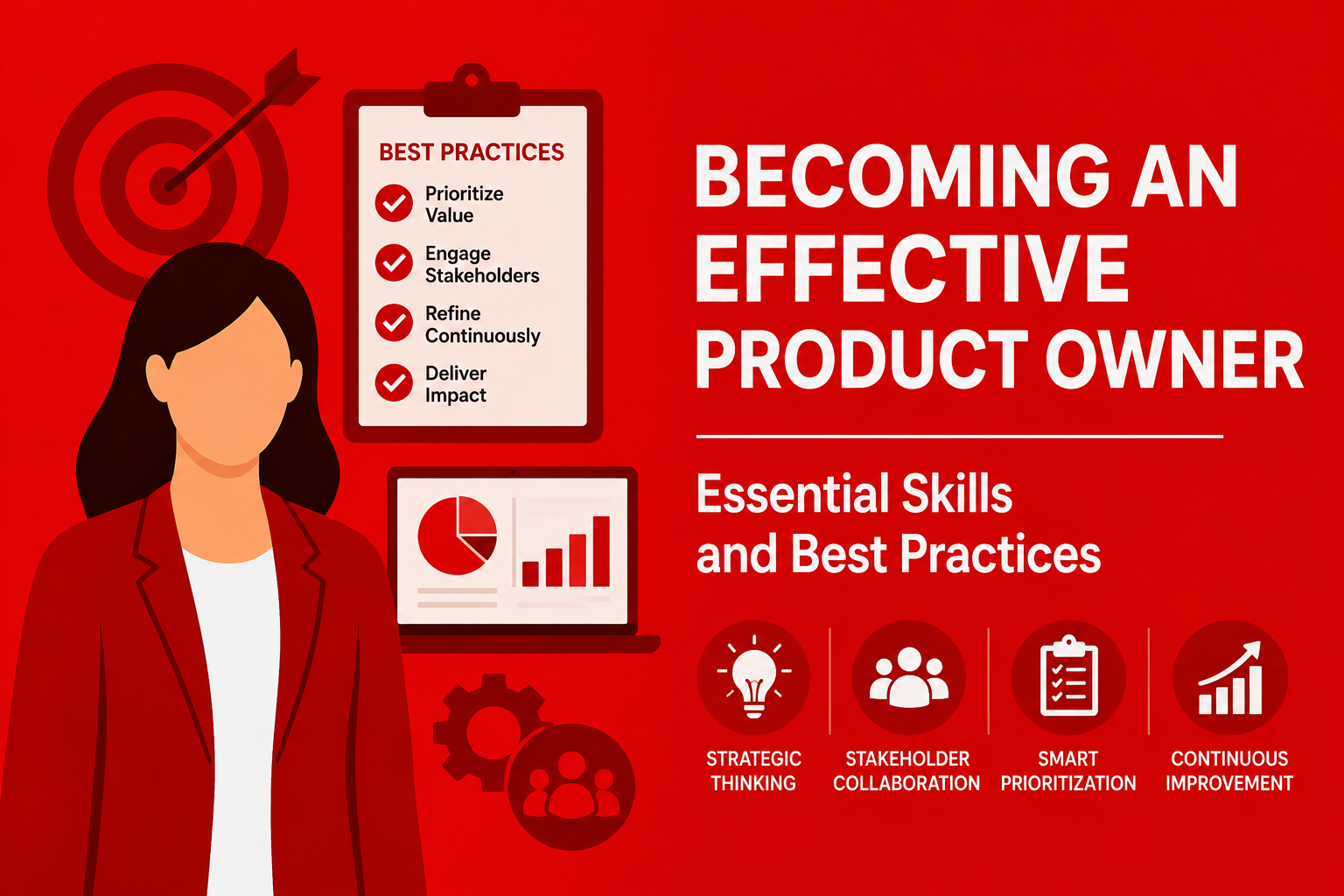
Now that you understand the core responsibilities of a Product Owner, let’s explore how to become truly effective in this role. Being a Product Owner is not just about managing a backlog or writing user stories. It is about making smart product decisions, maximizing value, and helping the Scrum Team deliver outcomes that matter.
Whether you are starting your Product Owner journey or looking to improve your effectiveness, this article outlines the essential skills and best practices that can help you succeed.
Foundational Skills
Success as a Product Owner starts with the right combination of product mindset, communication, and decision-making skills.
Product Thinking
An effective Product Owner thinks beyond individual features. They focus on customer problems, business outcomes, and long-term product value.
Instead of asking, “What feature should we build next?” they ask:
- What problem are we solving?
- Who benefits from this solution?
- How will we measure success?
- Is this the most valuable thing to build now?
Backlog Management
The Product Backlog should not become a simple list of requests. It should be a strategic tool that reflects the product vision, goals, and priorities.
A good Product Owner keeps the backlog organized, transparent, and focused. They regularly remove outdated items, refine unclear work, and ensure that high-priority items are ready for upcoming Sprints.
Prioritization
Prioritization is one of the most important Product Owner skills. Since time, budget, and team capacity are limited, the Product Owner must make careful choices.
Effective prioritization considers:
- Customer value
- Business impact
- Effort
- Risk
- Dependencies
- Strategic alignment
Good Product Owners know that saying no to low-value work is just as important as saying yes to important opportunities.
Stakeholder Management
Product Owners work with many stakeholders, including customers, business leaders, sales teams, marketing teams, support teams, and developers.
The challenge is not only collecting requests but also aligning expectations. An effective Product Owner listens carefully, communicates trade-offs, and explains why certain priorities come before others.
Clear Communication
The Product Owner must make complex ideas understandable. They need to explain product goals to the team, clarify requirements, and communicate progress to stakeholders.
Clear communication reduces confusion and helps everyone stay aligned.
Data-Informed Decision-Making
Effective Product Owners use data to guide decisions. This may include customer feedback, analytics, market research, conversion rates, usage metrics, support tickets, or business KPIs.
The goal is not to follow data blindly, but to combine data with customer understanding and product judgment.
Best Practices to Adopt
Beyond skills, great Product Owners develop practical habits that improve product delivery and team collaboration.
Maintain a Clear Product Vision
The product vision should guide every major decision. When priorities are unclear, the Product Owner should return to the vision and ask whether a backlog item supports the desired direction.
A clear vision helps the team stay focused and motivated.
Keep the Backlog Healthy
A healthy backlog is not too vague, too large, or too outdated. It should help the team understand upcoming work without becoming a dumping ground for every idea.
Best practices include:
- Regular backlog refinement
- Clear acceptance criteria
- Removing obsolete items
- Prioritizing based on value
- Keeping upcoming Sprint items ready
Work Closely with the Scrum Master
The Product Owner and Scrum Master have different responsibilities, but they should collaborate closely.
The Scrum Master helps improve the process and team dynamics, while the Product Owner focuses on product value and priorities. Together, they help the Scrum Team work effectively.
Collaborate with Developers Early
An effective Product Owner does not wait until Sprint Planning to discuss backlog items. They involve developers early to understand technical constraints, risks, dependencies, and possible alternatives.
This collaboration leads to better decisions and fewer surprises.
Define Clear Acceptance Criteria
Acceptance criteria help the team understand when a backlog item is complete and acceptable. They reduce ambiguity and make expectations easier to validate.
Good acceptance criteria are clear, testable, and focused on user or business value.
Use Feedback Loops
Product Owners should actively collect feedback from customers, users, stakeholders, and the Scrum Team.
Sprint Reviews, user interviews, surveys, analytics, and support feedback can all help the Product Owner improve product decisions.
Measure Outcomes, Not Just Output
An ineffective Product Owner may focus only on how many features are delivered. An effective Product Owner focuses on whether those features create value.
Instead of only tracking output, measure outcomes such as:
- User adoption
- Customer satisfaction
- Conversion rate
- Retention
- Revenue impact
- Time saved
- Error reduction
Overcoming Common Challenges
Even experienced Product Owners face difficult situations. Here are some common challenges and how to handle them.
Too Many Stakeholder Requests
Stakeholders often have competing priorities. The Product Owner must listen, evaluate, and prioritize based on value rather than pressure.
A clear prioritization framework can help make decisions more transparent.
Unclear Product Vision
Without a clear vision, backlog decisions become reactive. The Product Owner should work with leadership, customers, and stakeholders to define a stronger product direction.
A clear vision helps the team understand why their work matters.
Overloaded Backlog
A backlog with too many items can become confusing and difficult to manage. The Product Owner should regularly clean the backlog and remove items that are no longer relevant.
A smaller, focused backlog is often more useful than a large, unstructured one.
Limited Customer Feedback
Product Owners sometimes rely too much on internal opinions. To avoid this, they should create regular opportunities to hear from real users.
Customer feedback helps validate assumptions and improve product value.
Pressure to Deliver More Features
More features do not always mean more value. The Product Owner must protect the product from unnecessary complexity and focus on meaningful outcomes.
Sometimes, improving an existing feature is more valuable than adding a new one.
Continuous Growth
Great Product Owners continuously improve their knowledge and practice.
Learn Product Management Principles
Product Ownership is closely connected to product management. Learning about product strategy, discovery, UX, analytics, and market research can strengthen the role.
Join Agile and Product Communities
Communities, webinars, meetups, and professional groups are excellent ways to learn from other Product Owners and product professionals.
Seek Feedback Regularly
Product Owners should ask for feedback from developers, Scrum Masters, stakeholders, and customers. This helps identify blind spots and improve collaboration.
Develop Business and Technical Awareness
A Product Owner does not need to be a developer, but understanding technical constraints helps improve decision-making. Business awareness also helps connect product priorities to company goals.
Consider Product Owner Certifications
Certifications such as Scrum Product Owner, Agile Product Owner, or advanced Scrum certifications can help structure learning and demonstrate professional credibility.
Conclusion
Becoming an effective Product Owner requires more than understanding Scrum. It requires product thinking, strong communication, prioritization, stakeholder management, and a constant focus on value.
A great Product Owner helps the team build the right product, not just build the product right. They guide priorities, clarify expectations, and ensure that every Sprint contributes to meaningful business and customer outcomes.
The journey to becoming a strong Product Owner is continuous. Stay curious, listen to your users, collaborate with your team, and always focus on delivering value.
Agile certification: what it means and how to get one – GetVoucher
[…] study support before committing, GetVoucher’s guides on becoming an effective Scrum Master and becoming an effective Product Owner break down the practical skills behind each exam. Certifications for frameworks like SAFe or […]
Combine PRINCE2 and Agile Without Confusion, Plus Role Certifications
[…] or deployments. If your project needs someone owning the backlog and prioritisation trade-offs, Becoming an Effective Product Owner builds exactly that skillset. For organisations building hybrid capability across a whole team, the […]
2026: AI Is Narrowing the Gap Between Scrum Master and Project Manager
[…] the certification body SCRUMstudy’s core Scrum Master credential, alongside related Agile and Product Owner […]
Voucher Backed Product Owner Certification for Busy Professionals
[…] leaves you able to name these techniques in an interview but not apply them on day one. Read what an effective product owner does day to day to see how these techniques show up once you are actually in the […]
5 Certification Families for Product Managers That Fit Your Career Stage
[…] Becoming an Effective Product Owner: Essential Skills and Best Practices […]
Agile vs Waterfall: 6 Governance Decision Axes for Project Managers
[…] Becoming an Effective Product Owner: Essential Skills and Best Practices […]
5 Steps to Choose an OKR Certification Leaders Can Use at Work
[…] Becoming an Effective Product Owner: Essential Skills and Best Practices […]
Project management certification by career stage: which skill to add
[…] Becoming an Effective Product Owner: Essential Skills and Best Practices […]
Without Project History? Process Improvement Certifications for IT Pros
[…] Becoming an Effective Product Owner: Essential Skills and Best Practices […]