



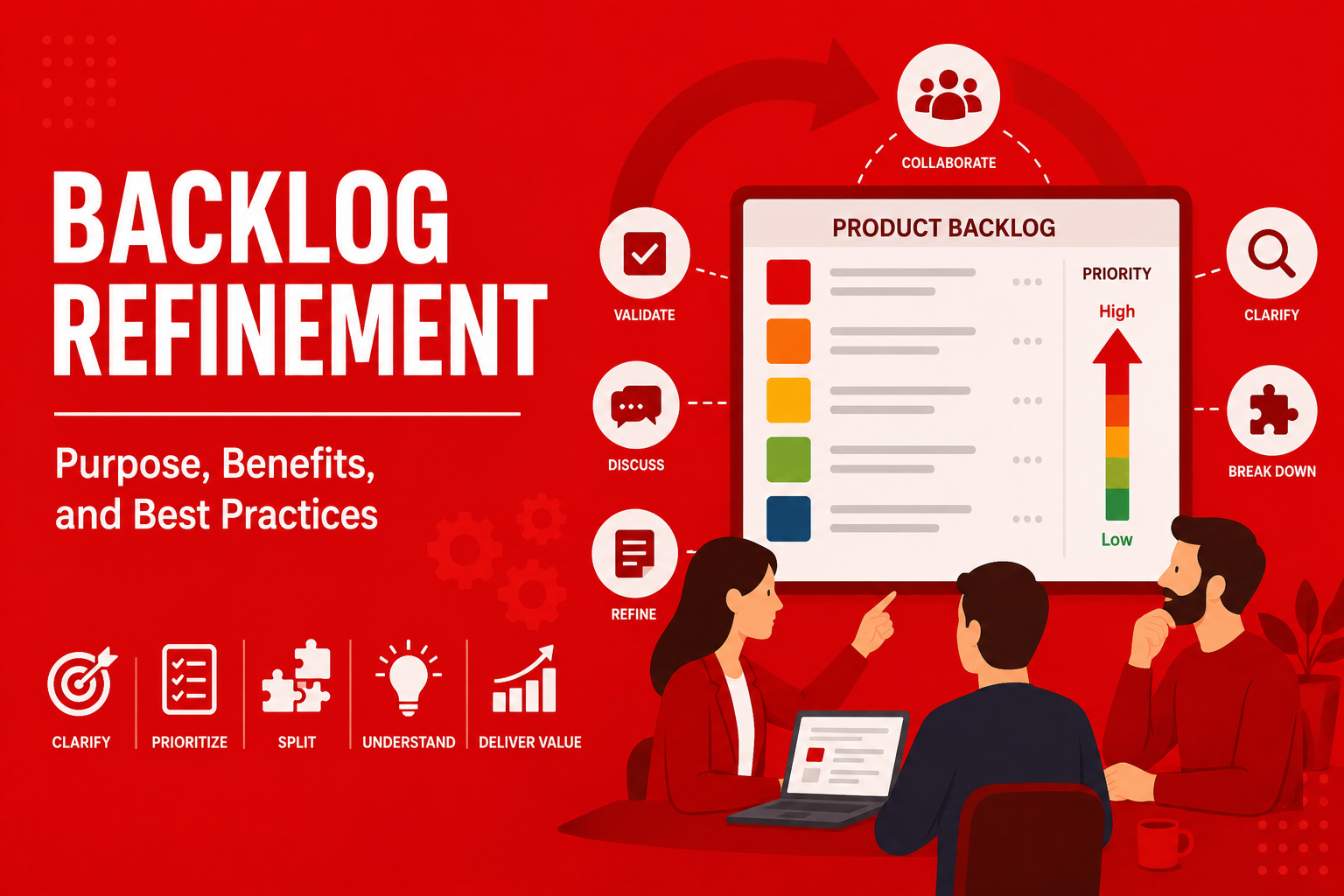
In Scrum, successful delivery does not happen only during the Sprint. A large part of product success depends on how well the team prepares, understands, and prioritizes the work before it enters a Sprint.
This is where Backlog Refinement becomes essential.
Backlog Refinement is the ongoing activity of reviewing, clarifying, and improving Product Backlog items so the Scrum Team can better understand what needs to be built and why it matters. When done properly, it helps teams reduce uncertainty, improve collaboration, and make Sprint Planning more efficient.
Although Backlog Refinement is sometimes underestimated, it plays a key role in helping Agile teams deliver valuable, high-quality outcomes.
What Is Backlog Refinement?
Backlog Refinement is the process of continuously improving the Product Backlog. It helps ensure that backlog items are clear, prioritized, estimated when needed, and ready for future Sprints.
During refinement, the Scrum Team may discuss:
- What a backlog item means
- Why it is important
- Who it benefits
- What acceptance criteria should be included
- Whether the item is too large and needs to be split
- What dependencies, risks, or assumptions exist
- Whether the item still brings value
Backlog Refinement is not a one-time meeting. It is an ongoing activity that supports better product decisions and smoother Sprint execution.
Why Isn’t Backlog Refinement an Official Scrum Ceremony?
Backlog Refinement is not excluded from Scrum because it is unimportant. On the contrary, it is one of the most useful activities for preparing future work. However, Scrum keeps it flexible because refinement does not need to happen in the same way for every team, product, or Sprint.
Here are the main reasons why Backlog Refinement is not considered an official Scrum ceremony.
1. It Is an Ongoing Activity, Not a Fixed Event
Official Scrum events have a clear place in the Scrum cycle and a specific purpose. For example, Sprint Planning happens at the beginning of the Sprint, the Daily Scrum happens every working day, and the Sprint Review happens near the end of the Sprint.
Backlog Refinement is different. It can happen at different moments during the Sprint. A team may refine backlog items during a dedicated session, in a short conversation between the Product Owner and developers, during technical analysis, or continuously as new information appears.
The goal is not to attend a fixed meeting. The goal is to improve Product Backlog items until they are clearer, smaller, and better understood.
2. It Is Not Formally Time-Boxed
Scrum events are time-boxed. They have a maximum duration depending on the length of the Sprint.
Backlog Refinement does not have an official fixed timebox. Scrum does not say that refinement must last one hour, two hours, or any specific duration.
In practice, many Scrum Teams reserve regular time for refinement, but this is a team decision rather than a Scrum rule. For example, some teams may schedule one refinement session per week, while others may refine continuously in shorter discussions.
This flexibility helps teams adapt the amount of refinement to their real needs.
3. It Depends Heavily on Product Context
Not every product requires the same level of refinement.
A new product with high uncertainty, complex features, or many stakeholder inputs may require more frequent refinement. A mature product with a stable backlog and clear priorities may need less.
The amount of refinement also depends on factors such as:
- Product complexity
- Technical uncertainty
- Stakeholder alignment
- Team experience
- Quality of existing backlog items
- Market or customer feedback
Because every product context is different, a strict official format would not always make sense.
4. Scrum Avoids Unnecessary Mandatory Meetings
Scrum is designed to provide a lightweight framework, not a heavy process full of mandatory meetings.
If Backlog Refinement were defined as an official ceremony, some teams might treat it as a ritual instead of a useful activity. They might hold refinement meetings simply because Scrum says so, even when there is nothing valuable to refine.
By keeping refinement flexible, Scrum allows teams to decide when and how it should happen. It can be a scheduled meeting, a short discussion, or a continuous collaborative activity.
In other words, Backlog Refinement is not unofficial because it is less important. It is unofficial because Scrum keeps it adaptable.
Backlog Refinement is not an official Scrum event, but it is still essential for effective Scrum delivery.
Why Backlog Refinement Matters
A poorly refined backlog can create confusion, delays, and frustration. Teams may enter Sprint Planning without enough clarity, leading to long discussions, rushed decisions, or misunderstood requirements.
Effective Backlog Refinement helps avoid these problems.
Key Benefits of Backlog Refinement
1. Clearer Sprint Planning
When backlog items are already discussed and understood, Sprint Planning becomes faster and more focused. The team can spend less time asking basic clarification questions and more time selecting meaningful work for the Sprint.
2. Better Product Understanding
Refinement helps developers understand the product context behind each item. Instead of simply receiving tasks, the team gains insight into customer needs, business goals, and expected outcomes.
3. Improved Prioritization
The Product Owner can use refinement discussions to validate whether certain items still matter, whether priorities should change, and whether the backlog reflects the current product strategy.
4. Reduced Risk and Uncertainty
Backlog items often contain hidden complexity. Refinement allows the team to identify technical risks, dependencies, unclear requirements, and assumptions before the Sprint begins.
5. Better Collaboration Between Product Owner and Developers
Backlog Refinement encourages regular collaboration between the Product Owner and developers. This helps create shared understanding and avoids the “handoff” mindset where requirements are simply passed from one person to another.
6. Higher Quality Delivery
Clear acceptance criteria and better understanding lead to fewer misunderstandings during development. This improves quality and reduces rework.
Who Participates in Backlog Refinement?
Backlog Refinement is usually led by the Product Owner, but it is not the Product Owner’s responsibility alone.
The main participants are:
Product Owner
The Product Owner explains the purpose, value, and priority of backlog items. They clarify expectations, answer questions, and make decisions about what should remain in the backlog.
Developers
Developers bring technical insight, ask clarifying questions, identify risks, estimate effort when useful, and suggest better ways to split or approach work.
Scrum Master
The Scrum Master helps facilitate the refinement process when needed. They ensure the discussion remains productive, collaborative, and aligned with Scrum principles.
Stakeholders
Stakeholders are not always present, but they may be involved when their input is needed to clarify business needs, user expectations, or strategic priorities.
What Happens During Backlog Refinement?
A good refinement session is practical and focused. The goal is not to solve every detail, but to make upcoming work clearer and more manageable.
Common refinement activities include:
Reviewing Product Backlog Items
The team reviews upcoming items and discusses their purpose, priority, and expected value.
Clarifying Requirements
The Product Owner explains the desired outcome, while developers ask questions to remove ambiguity.
Adding Acceptance Criteria
Acceptance criteria help define when a backlog item is complete and acceptable. They make expectations clearer and easier to validate.
Splitting Large Items
If a backlog item is too large or complex, the team may split it into smaller, more manageable pieces.
Estimating Effort
Some teams estimate backlog items during refinement using story points, t-shirt sizing, or another estimation method. The goal is not perfect prediction but better shared understanding.
Identifying Risks and Dependencies
The team discusses possible blockers, technical constraints, external dependencies, or unknowns that could affect delivery.
Removing Outdated Items
A healthy backlog should not become a storage space for old ideas. Refinement is also a good opportunity to remove items that are no longer relevant.
What Makes a Backlog Item Ready?
Many Scrum teams use a shared understanding of what makes a backlog item “ready” for Sprint Planning. This is sometimes called a Definition of Ready, although it should not become a rigid gate that slows down delivery.
A refined backlog item is usually:
- Clearly described
- Valuable to users or the business
- Small enough to be completed within a Sprint
- Prioritized by the Product Owner
- Understood by the team
- Supported by clear acceptance criteria
- Free from major unresolved dependencies
- Estimated when estimation is useful
The goal is not perfection. The goal is enough clarity to allow the team to make confident Sprint decisions.
Common Mistakes in Backlog Refinement
Refining Too Late
If backlog items are discussed for the first time during Sprint Planning, the team may lose time and struggle to make good decisions.
Turning Refinement Into a Long Meeting
Refinement should be focused and useful. Long, unfocused sessions can reduce engagement and productivity.
Writing Too Much Detail Too Early
Over-documenting items too far in advance can create waste, especially if priorities change later.
Ignoring Developers’ Input
Developers should be actively involved. Their technical perspective helps reveal risks, complexity, and better implementation options.
Treating the Backlog as a Fixed Plan
The Product Backlog should remain flexible. Refinement should help the team adapt to new information, not lock the team into outdated decisions.
Confusing Output With Value
A backlog full of features does not guarantee value. Refinement should always connect items to user needs and business outcomes.
Best Practices for Effective Backlog Refinement
1. Refine Regularly
Backlog Refinement works best when done continuously. Many teams schedule regular refinement sessions during the Sprint, while also refining items informally when needed.
2. Focus on Upcoming Work
Do not try to refine the entire backlog. Focus on the items that are likely to be considered in the next one or two Sprints.
3. Keep Items Small and Valuable
Large backlog items are harder to understand, estimate, and deliver. Splitting work into smaller valuable increments improves flow and reduces risk.
4. Use Clear Acceptance Criteria
Acceptance criteria help align the Product Owner and developers on expected outcomes. They should be specific, testable, and easy to understand.
5. Encourage Questions
Good refinement is not a presentation from the Product Owner. It is a collaborative discussion. Developers should feel comfortable asking questions and challenging assumptions.
6. Prioritize Based on Value
The Product Owner should ensure that high-value items are refined first. This keeps the team focused on work that matters most.
7. Remove What No Longer Matters
A clean backlog is easier to manage. Delete or deprioritize outdated items that no longer support the product vision.
8. Balance Detail and Flexibility
Backlog items should contain enough information to guide development, but not so much detail that the team loses flexibility.
Backlog Refinement vs Sprint Planning
Backlog Refinement and Sprint Planning are closely related, but they are not the same thing.
|
Activity |
Official Scrum Event? |
Purpose |
|---|---|---|
|
Backlog Refinement |
No |
Clarify, prioritize, split, and prepare backlog items before Sprint Planning |
|
Sprint Planning |
Yes |
Select work for the Sprint and define how the Sprint Goal will be achieved |
Refinement prepares the conversation. Sprint Planning makes the commitment.
When refinement is effective, Sprint Planning becomes smoother, faster, and more strategic.
Real-World Impact of Good Backlog Refinement
Effective Backlog Refinement can transform how a Scrum Team works.
It helps teams:
- Start Sprints with more clarity
- Reduce rework and misunderstandings
- Improve collaboration between business and technical roles
- Make better product decisions
- Deliver value more consistently
- Adapt quickly when priorities change
In real-world Agile environments, refinement often makes the difference between a team that simply completes tasks and a team that delivers meaningful product outcomes.
Conclusion
Backlog Refinement is one of the most important activities in Scrum, even though it is sometimes less visible than Sprint Planning, Daily Scrum, Sprint Review, or Retrospective.
A well-refined backlog helps the Scrum Team understand priorities, reduce uncertainty, and focus on delivering value. It also strengthens collaboration between the Product Owner, developers, Scrum Master, and stakeholders.
Backlog Refinement is not about creating perfect requirements. It is about creating enough shared understanding to support better decisions and better delivery.
For teams that want to improve their Agile performance, building strong Backlog Refinement habits is a powerful place to start.