




Standard Scrum works when one cross-functional team owns a single product backlog. Once you have several teams building against the same product, dependencies pile up, and you need Scaled Scrum, delivered through frameworks like LeSS, SAFe, Scrum@Scale, or Nexus. The right choice depends on team count and how much coordination overhead you’re willing to accept.
TL;DR:
- Scaling Scrum is justified only after two or three teams have proven their ability to deliver an integrated increment reliably.
- Frameworks like LeSS, Scrum@Scale, SAFe, and Nexus vary significantly in complexity, roles added, and suitability for organizational size and maturity.
- Effective scaling relies on shared backlogs, synchronized sprints, and coordination mechanisms like Scrum of Scrums, rather than the frameworks’ formal structures alone.
- Adopting a scaled Scrum framework prematurely can cause integration issues, organizational restructuring challenges, and amplify existing dysfunctions.
- Focus on reducing dependencies and improving product architecture first through informal practices before committing to a formal scaled framework.
Table of Contents
- Scaled Scrum vs Scrum: what standard Scrum actually covers
- What Scaled Scrum means and why organisations use it
- How do LeSS, SAFe, Scrum@Scale and Nexus compare?
- When should you actually consider scaling?
- How do you choose between Scrum and a scaled framework?
- Training, certification and next steps
- How scaling changes your Scrum events
- What commonly goes wrong when scaling Scrum
- What does successful (and unsuccessful) scaling actually look like?
- How do roles change at scale?
- How do you keep multiple teams aligned?
- What tools support scaled Scrum in practice?
- Author perspective: start smaller than you think you need to
- How GetVoucher helps you build toward scaled Scrum
- Sources
Scaled Scrum vs Scrum: what standard Scrum actually covers
Scrum was built for one team, not a programme of teams. The Scrum Guide sets out three roles (Product Owner, Scrum Master, Developers), a rhythm of events (Sprint Planning, Daily Scrum, Sprint Review, Sprint Retrospective), and three artefacts: the Product Backlog, Sprint Backlog, and Increment.
It also gives a practical size guideline: a Scrum team typically runs at 3–9 people, small enough to coordinate without formal process.
That size limit is not arbitrary. Below it, a team can hold its entire plan in its head and settle disagreements in a five-minute conversation. Push a single product backlog beyond that headcount and you get the exact problems scaled frameworks exist to solve:
- Duplicated work when two sub-groups solve the same problem independently
- Integration conflicts discovered late, often at release time rather than daily
- A Product Owner who can no longer maintain one coherent backlog vision
- Growing coordination overhead that eats into actual delivery time
Scrum itself has no built in answer to any of that. It assumes the coordination problem doesn’t exist because the team is small enough that it never arises.
What Scaled Scrum means and why organisations use it
Scaled Scrum extends Scrum’s principles across multiple teams working on one product or one large initiative. It typically means a shared product backlog, synchronised sprint cadences, and some form of Scrum of Scrums, a regular cross-team sync where representatives surface dependencies and blockers before they derail a release.
Not every scaling approach solves this the same way. Three broad philosophies dominate:
- Minimalist: LeSS and Nexus add as little new process as possible, keeping standard Scrum roles and events largely intact
- Prescriptive: SAFe introduces additional roles, planning cadences, and portfolio-level structures designed for large enterprises
- Modular: Scrum@Scale lets you adopt only the coordination components you need rather than a fixed package
That third point matters more than it looks. Scrum@Scale’s modular design is deliberately built so organisations can pick individual pieces, a Scrum of Scrums here, an Executive MetaScrum there, rather than swallowing a whole methodology at once, according to the Scrum@Scale guide. The framework itself recommends starting with a reference model and a “minimum viable bureaucracy”: add only the coordination structure you can prove you need, and no more. Scaling too early, before a single team has demonstrated it can reliably deliver, tends to bake bureaucracy into an organisation that hasn’t yet earned it.
How do LeSS, SAFe, Scrum@Scale and Nexus compare?
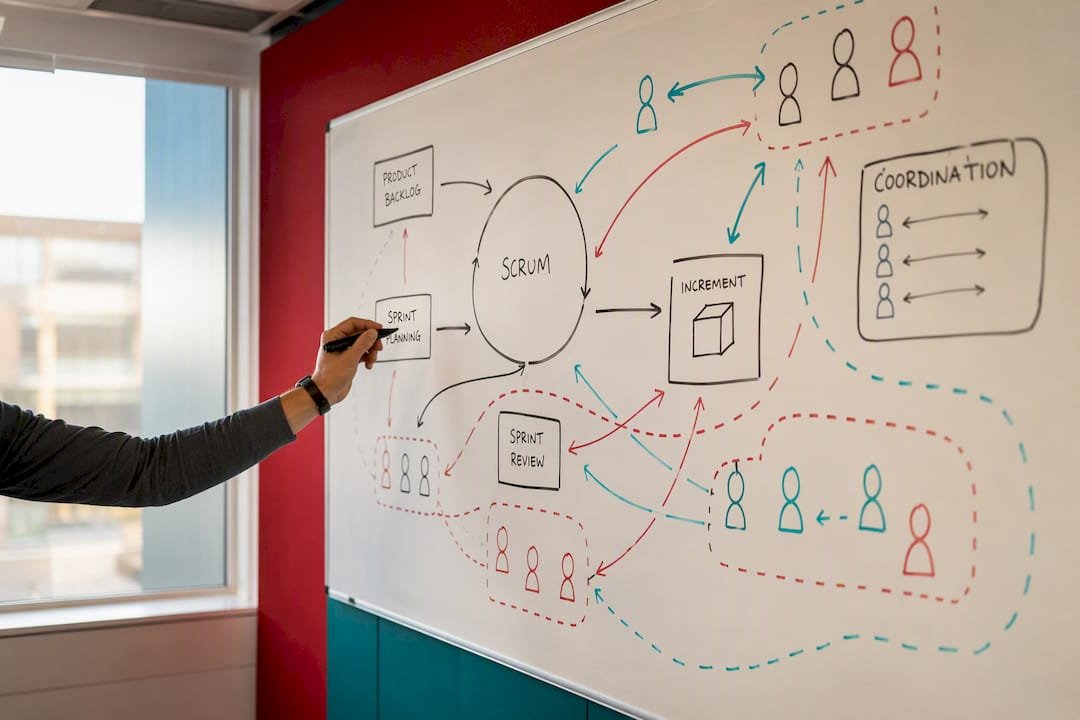
Each framework answers the same coordination problem differently, and the differences show up fastest in how much new structure they ask you to adopt.
LeSS (Large-Scale Scrum) keeps the footprint small. It runs on a single product backlog and synchronised sprints across all teams, with almost no new roles. LeSS offers two configurations: LeSS Basic for 2–8 teams (roughly 10–50 people), and LeSS Huge for 8 or more teams, scaling into the thousands. If your teams already run Scrum well, LeSS is often the simplest next step, since it keeps existing Scrum conventions intact rather than replacing them.
SAFe (Scaled Agile Framework) takes the opposite route. It adds dedicated roles such as Release Train Engineers and Solution Train Engineers, plus Program Increment planning cycles that coordinate dozens of teams at once. It suits large enterprises with limited Agile maturity that need governance and portfolio alignment fast, though that comes with more process to maintain.
Scrum@Scale stays modular. Its two-cycle model, a Scrum Master cycle and a Product Owner cycle, lets you scale coordination and product decisions separately, adding structures like a Scrum of Scrums Master or Chief Product Owner only where needed.
Nexus targets a narrower band: 3–9 Scrum teams. It adds a Nexus Integration Team responsible for managing cross-team dependencies and producing one integrated increment, with minimal change to how individual teams already work.
| Framework | Typical team-size supported | Added roles/artefacts | Complexity/overhead | Best used for |
|---|---|---|---|---|
| LeSS | 2–8 teams (Basic); 8+ (Huge) | Minimal; single backlog | Low | Teams with strong existing Scrum discipline |
| SAFe | Dozens of teams | RTE, STE, Program Increments | High | Large enterprises needing governance fast |
| Scrum@Scale | Modular, scales incrementally | Scrum of Scrums Master, Chief Product Owner (as needed) | Low to moderate, tailored | Organisations wanting to add only what’s necessary |
| Nexus | 3–9 teams | Nexus Integration Team | Moderate | Mid-size product groups needing tight integration |
The dimension that matters most for most leaders is complexity/overhead, not team-size ceiling. A framework that technically supports 50 teams is useless if your organisation only has four and can’t absorb the governance it demands.
When should you actually consider scaling?
Scaling too early is more common, and more damaging, than scaling too late. Watch for these signals before reaching for a scaled framework:
- Integration failures recur every sprint rather than occasionally, and they’re discovered late
- Throughput per team drops as headcount grows, a classic sign of coordination cost outpacing capacity
- One Product Owner is stretched across a backlog no single person can realistically prioritise
- More than roughly nine people, or more than one team, are regularly touching the same product area and stepping on each other’s work
The quantitative anchors from the frameworks themselves are worth keeping in mind: Nexus is built for 3–9 teams, LeSS Basic covers 2–8 teams, and LeSS Huge starts once you’re past 8 teams. If you’re below those thresholds, scaling is very likely premature.
Before adopting a framework, try the cheaper fixes first: refactor the product into genuinely separable components, invest in backlog refinement so the Product Owner isn’t the bottleneck, or introduce an informal Scrum of Scrums practice without adopting a full framework around it.
Pro Tip: Run an informal Scrum of Scrums for a month before committing to any named framework. If a 15-minute weekly sync between team representatives solves your dependency problems, you may not need LeSS, SAFe, or anything else with a name and a certification attached to it.
How do you choose between Scrum and a scaled framework?
Run through this checklist before committing to any framework:
- Does your product genuinely require multiple teams, or could better backlog architecture keep it within one team?
- Do you have compliance, audit, or portfolio-reporting requirements that favour a more structured approach like SAFe?
- Are your teams co-located, distributed across time zones, or a mix, and does that change how much synchronous coordination is realistic?
- Does leadership have the bandwidth to sponsor a genuine reference model, or will scaling become an unsupported side project?
- Is there real appetite to change organisational structure, not just team ceremonies?
A practical adoption pattern that reduces risk: prove a reference model with two to four teams delivering one integrated increment, measure integration friction and lead time, then expand by adding another synchronised group only once that model is stable. Track cycle time, release frequency, and cross-team defect rates as your success measures. If those numbers don’t improve after scaling, the framework isn’t the problem you think it is.
Training, certification and next steps
Scaling only works if the people running it already understand single-team Scrum properly. GetVoucher’s Scrum Master Certified (SMC) and Scrum Product Owner Certified (SPOC) certifications, delivered through VMEdu with SCRUMstudy as the certification body, build that team-level foundation: backlog ownership, sprint facilitation, and stakeholder management.
GetVoucher expects to add two progression certifications in the coming months:
- Scaled Scrum Master Certified (SSMC), which requires SMC certification and builds on it with scaled Scrum and cross-team coordination skills.
- Scaled Scrum Product Owner Certified (SSPOC), building on SPOC with backlog architecture across multiple teams
Until those go live, learners can contact GetVoucher directly to request current pricing, certification details, and availability. In the meantime, the Dual Agile Pack covers both foundational roles together, a sensible starting point if you’re heading toward a scaled environment eventually.
How scaling changes your Scrum events

Every Scrum event stretches once multiple teams share a backlog, and pretending otherwise is where a lot of scaling attempts quietly fail.
Sprint Planning stops being a single-team conversation. In LeSS, teams typically run a joint planning session first to pick items off the shared backlog, then break out into team-level planning. SAFe compresses this further into Program Increment planning, a multi-day event covering several sprints across all participating teams at once.
The Daily Scrum cannot simply expand to include every team member, it would collapse under its own size. Most scaled frameworks solve this with a Scrum of Scrums: a small daily or near-daily sync where one representative per team surfaces blockers and dependencies, kept separate from each team’s own Daily Scrum.
Sprint Review becomes a joint demonstration of one integrated increment rather than several disconnected ones. This is often where scaling problems surface first, if teams can’t produce a single working increment together, the coordination model isn’t functioning yet, regardless of what the sprint board says.
Retrospectives need both a team-level version and an overarching one. Nexus, for instance, adds a Nexus Sprint Retrospective specifically to examine cross-team issues that individual team retrospectives won’t catch because no single team owns the problem.
The pattern across all four events is the same: nothing disappears, but each one gains a coordination layer on top of what already existed.
What commonly goes wrong when scaling Scrum
The most frequent failure isn’t choosing the wrong framework, it’s adopting a framework whose philosophy clashes with the organisation’s actual culture. Experts note that LeSS pushes toward flatter structures and fewer management layers, while SAFe supports and often reinforces existing hierarchy; picking one that fights your culture rather than fitting it is a recognised cause of failed scaling attempts.
A second pitfall is treating the framework as the fix rather than the symptom. Teams adopt SAFe or LeSS because throughput has stalled, then discover the real issue was a poorly architected product with tightly coupled components that no coordination structure can fully untangle. Restructuring the product itself, splitting it into genuinely independent pieces, often matters more than which framework sits on top.
A third is underestimating the organisational redesign that heavier scaling demands. Adopting LeSS properly, for example, frequently requires reducing middle management layers and rebuilding around shared backlog practices, a structural shift that’s usually a bigger obstacle than learning the framework’s mechanics.
Finally, many organisations scale before a single team has proven it can deliver reliably. A struggling team looks the same whether it has one team or ten; scaling multiplies the dysfunction rather than curing it.
What does successful (and unsuccessful) scaling actually look like?
Successful scaling attempts share a common trait: they start small and prove the model before expanding it. An organisation running a reference implementation with two or three teams, delivering one genuinely integrated increment on a shared cadence, and only then adding a fourth or fifth team once that pattern holds, tends to avoid the worst rollout risk. This mirrors the adoption pattern Scrum@Scale itself recommends: prove the reference model, measure it, then expand.
Unsuccessful attempts usually share the opposite pattern: a big-bang rollout across a dozen teams simultaneously, with a new framework, new roles, and new ceremonies introduced all at once before anyone has validated that the underlying coordination model works at all. When integration problems appear (and they will), there’s no smaller working version to fall back on, and no baseline to compare against.
A large comparative study of scaling approaches found only small practical differences in team effectiveness between the major frameworks once you control for organisational experience and size. That’s a useful corrective: the framework brand matters far less than execution discipline, sequencing, and whether leadership actually sponsors the change rather than mandating it and stepping back.
How do roles change at scale?
The Product Owner role fractures once a single backlog spans multiple teams, and this is one of the more disorienting shifts for practitioners moving from standard Scrum into a scaled environment.
In SAFe and Scrum@Scale, a Chief Product Owner (or equivalent) typically sits above individual team Product Owners, owning overall prioritisation and coordinating with them rather than writing every backlog item personally. Individual Product Owners retain day-to-day ownership of their team’s slice of the backlog but now operate inside a shared prioritisation structure they don’t fully control alone.
The Scrum Master role splits similarly. Scrum@Scale’s Scrum of Scrums Master coordinates process across teams, resolving cross-team impediments that no single team’s Scrum Master has the authority or visibility to fix. SAFe’s Release Train Engineer plays a comparable coordinating function at a larger scale, facilitating Program Increment planning and tracking dependencies across the entire train.
This isn’t simply adding a manager on top. A Chief Product Owner who tries to micromanage every team backlog recreates the exact bottleneck scaling was meant to relieve. The role works only when it focuses on cross-team prioritisation and leaves execution detail to the people closest to the work.
How do you keep multiple teams aligned?
Alignment across teams rests on a handful of concrete mechanisms rather than goodwill and good intentions.
A shared product backlog is the foundation: every scaled framework insists on one backlog visible to all teams, preventing the duplicated effort that splintered backlogs almost guarantee. Synchronised sprint cadences reinforce this, when every team starts and ends sprints on the same day, cross-team dependencies surface at predictable points rather than randomly.
The Scrum of Scrums remains the most widely used coordination mechanism across LeSS, Nexus, and Scrum@Scale alike: a short, focused sync where representatives flag blockers before they become release-blocking surprises. Nexus formalises this further with a dedicated Nexus Integration Team responsible for actively managing dependencies, not just discussing them.
Beyond ceremonies, technical alignment matters just as much. Continuous integration practices that merge code across teams frequently, rather than at the end of a sprint, catch integration conflicts while they’re still cheap to fix. Shared definitions of done across teams prevent one team’s “complete” from being another team’s blocker.
What tools support scaled Scrum in practice?
Most organisations already run a work-tracking platform capable of handling multiple team backlogs against one shared product backlog, the practical requirement LeSS, Nexus, and Scrum@Scale all assume. What changes at scale isn’t the category of tool, it’s how it’s configured: shared boards, cross-team dependency tracking, and reporting rolled up to a programme level rather than siloed per team.
Continuous integration and deployment pipelines matter more at scale than in single-team Scrum, since they’re what actually surfaces integration problems daily rather than at sprint boundaries. A team that only integrates its code at the end of a two-week sprint will discover conflicts far too late to fix them cheaply.
None of this replaces the coordination events themselves. Tooling can display dependencies; it can’t resolve them. The Scrum of Scrums, Nexus Integration Team, or equivalent mechanism still has to do the actual work of pulling separate streams into one coherent increment.
Author perspective: start smaller than you think you need to
Most scaling failures trace back to one mistake: adopting a framework before proving a reference model works. Get two or three teams genuinely delivering one integrated increment first. Remove dependencies before adding process. Scaling asks more of leadership than of teams, it needs real authorisation to restructure and invest in architecture, not just a new set of ceremonies bolted onto old habits.
— Rayan
How GetVoucher helps you build toward scaled Scrum
GetVoucher is the voucher platform that gets you the training foundation before you need the scaled version. VMEdu is the main course provider behind these certifications, with SCRUMstudy as the certification body, and it means you can start with team-level Scrum competence now rather than waiting for a scaling initiative to force the issue.

If you’re building toward a multi-team environment, start with SMC and SPOC certification to establish solid single-team practice first. Once SSMC and SSPOC land in the GetVoucher catalogue, they’ll extend those same foundations into cross-team facilitation and backlog architecture at scale. Until then, contact GetVoucher directly to check current pricing, certification details, and availability for the scaled pathways, or browse the Scrum course catalogue to see what’s ready to start today.
Sources
- Scrum@Scale guide
- The Scrum Guide
- The Large-Scale Scrum (LeSS) framework — Atlassian
- Comparative study of scaling approaches (2024)