




SPOC from SCRUMstudy suits learners who want a structured, exam-based credential with a clear voucher route. CSPO from Scrum Alliance suits those who prefer live, instructor-led training and networking over exam pressure. PSPO from Scrum.org suits self-directed learners who want an objective, exam-validated proof of Scrum knowledge. GetVoucher provides the voucher and preparation route into SPOC specifically.
TL;DR:
- SPOC offers a flexible, self-paced exam route with minimal scheduling constraints, making it suitable for those on a tight schedule or budget.
The SPOC exam is an online, unproctored multiple-choice assessment with 140 questions and a 180-minute time limit, allowing candidates to prepare at their own pace before taking the exam online.
- Recertification for SPOC requires either a renewal exam every three years or earning an additional SCRUMstudy credential, influencing long-term planning.
- Compared to CSPO’s attendance model or PSPO’s exam, SPOC stands out by combining a structured exam process with independent study options.
- Choosing the right certification depends on your learning style, employer recognition, and the time or budget you can commit, not just brand reputation.
Table of Contents
- SPOC vs CSPO vs PSPO at a glance
- What does SPOC cover and how do you sit the exam?
- Is CSPO’s course-only model right for you?
- Why do professionals choose PSPO’s exam-based route?
- How do you decide between SPOC, CSPO and PSPO?
- How does the SPOC voucher process actually work on GetVoucher?
- Which certification should you actually trust your career to?
- Where can you buy a SPOC voucher and start preparing?
- Sources
SPOC vs CSPO vs PSPO at a glance
Each certification asks something different of you before it hands over the credential, and that difference should drive your decision more than brand recognition alone.
- SPOC (SCRUMstudy): exam-based, delivered via authorised training and vouchers, typically completed in a few weeks depending on your study pace.
- CSPO (Scrum Alliance): course-based, awarded after a 16-hour instructor-led programme with a Certified Scrum Trainer, no test required.
- PSPO (Scrum.org): exam-based, self-study friendly, assessed through a timed online test rather than classroom attendance.
The practical contrast is this: CSPO rewards you for showing up and doing the work in the room, PSPO rewards you for what you can prove on a timed test, and SPOC sits in between, giving you a structured exam path you can prepare for largely on your own schedule using a voucher rather than booking a live seat. If you value flexibility and a lower-friction route into a recognised credential, SPOC via a voucher is worth comparing against the other two before you commit to a course date or exam slot.
What does SPOC cover and how do you sit the exam?
SPOC stands for Scrum Product Owner Certified, and SCRUMstudy is the certification body behind it, operating under the VMEdu family of accredited training brands. The certification focuses on the practical responsibilities of a Product Owner: managing the product backlog, writing and prioritising user stories, defining acceptance criteria, liaising with stakeholders, and maintaining what SCRUMstudy calls a “dual view” between business needs and delivery reality.
Unlike CSPO, SPOC is assessed rather than attended. SCRUMstudy’s exam is delivered online and unproctored, consisting of a multiple-choice exam of substantial length and duration, with results generated immediately after submission.
That format gives you a defined target to prepare against rather than an open-ended course outcome, which some candidates find easier to plan around when balancing a full-time job.
Training pathways for SPOC typically run through authorised training partners offering self-paced video content, practice questions, and study guides aligned to the exam syllabus. This is where the voucher model becomes relevant: rather than booking a fixed-date classroom session, you purchase access, study on your own timeline, and take the unproctored online exam when you feel ready.
SCRUMstudy also outlines the certification’s target audience and recertification requirements on its official certification page, which is worth reading before you commit.
SPOC tends to suit you if:
- You want a vendor-aligned Product Owner credential with a clearly defined exam rather than an ambiguous “pass by attendance” outcome.
- You prefer studying at your own pace using structured online materials instead of blocking out consecutive days for live training.
- You are budget-conscious and want to avoid the cost of instructor-led sessions where a self-paced exam path achieves a comparable outcome.
- You already have some Agile exposure and want to validate and formalise that knowledge rather than start from a classroom introduction.
Pro Tip: Book your SPOC exam slot only after you have completed at least one full practice run through the syllabus topics, since the 180-minute exam format rewards pacing as much as knowledge, and running out of time on the final third of the paper is a common, avoidable mistake.
Recertification is not indefinite. SCRUMstudy asks SPOC holders to either sit a recertification exam every three years or earn an additional SCRUMstudy certification to keep their credential current, so factor that into your longer-term career planning rather than treating the exam as a one-off event.
If SPOC looks like the right fit, the next step is straightforward: review the SPOC certification course page on GetVoucher, purchase your voucher, and follow the access instructions to begin your preparation and schedule your proctored exam.
Is CSPO’s course-only model right for you?
CSPO stands for Certified Scrum Product Owner, and Scrum Alliance is the organisation behind it. The defining feature of this certification is that it has no exam. You earn CSPO by attending a course delivered by a Certified Scrum Trainer over multiple sessions, and successful completion of that course, rather than a test score, results in certification.
That structure shapes what the course actually teaches you. Rather than drilling exam-style questions, CSPO sessions typically walk through product vision exercises, backlog prioritisation techniques, stakeholder collaboration scenarios, and hands-on simulations of real sprint planning conversations. Scrum Alliance’s own guidance confirms that there is currently no test requirement for CSPO certification; the value sits in the guided practice itself, not in a pass mark at the end.
This makes CSPO fundamentally different from SPOC and PSPO in how it demonstrates competence. You are not proving knowledge retention under exam conditions. You are demonstrating that you sat through structured, expert-led practice and engaged with the exercises, which is a meaningfully different signal to an employer, and one that suits different working styles.
CSPO tends to fit you if:
- You learn better through live discussion, group exercises, and immediate feedback from a trainer than through self-paced reading and practice tests.
- Your employer is willing to fund or schedule time for instructor-led training, since CSPO requires attending a fixed-format session rather than fitting study around spare evenings.
- You want the networking side benefit of sitting in a cohort with other Product Owners and Scrum practitioners, which self-study routes cannot replicate.
- You are earlier in your Product Owner journey and want guided exposure to core concepts before working independently.
There is no formal prerequisite to enrol in a CSPO course, though most trainers recommend reading the Scrum Guide beforehand so classroom time focuses on application rather than definitions. After completing the course, Scrum Alliance creates your account, issues your certification, and gives you access to a digital badge along with a period of complimentary membership, details of which are confirmed directly by Scrum Alliance rather than by the training provider. From there, maintaining the credential involves the membership and renewal terms Scrum Alliance sets out for CSPO holders, which is worth checking directly before you assume it is a lifetime credential.
Why do professionals choose PSPO’s exam-based route?
PSPO stands for Professional Scrum Product Owner, and Scrum.org is the organisation issuing it. Unlike CSPO, PSPO is validated through a timed online assessment rather than course attendance, which puts it structurally closer to SPOC than to the Scrum Alliance model, even though the two exam-based certifications differ in question style, syllabus emphasis, and provider ecosystem.
The entry-level version, PSPO I, focuses on foundational Product Owner knowledge: backlog management, value maximisation, stakeholder engagement, and the mechanics of working within a Scrum team. Scrum.org offers progressively harder levels beyond that for candidates who want to keep validating deeper expertise, but most professionals comparing certifications for the first time are weighing PSPO I specifically against SPOC and CSPO.
PSPO appeals strongly to self-study candidates. Because there is no mandatory course attached, you can prepare entirely through the Scrum Guide, open assessments, and independent study, then sit the exam whenever you feel ready. That flexibility is exactly why training providers such as KnowledgeHut often position PSPO as the stronger fit for candidates who want rigorous knowledge validation without committing to a fixed classroom schedule, while framing CSPO as the better option when guided practice and networking matter more than exam flexibility.
PSPO tends to suit you if:
- You want objective, exam-based proof of Scrum knowledge that does not depend on attendance records.
- You are comfortable studying independently and prefer setting your own exam date rather than working around a fixed course schedule.
- You already have solid Agile grounding and want a credential that validates depth rather than introduces basics.
- You are comparing certifications partly on employer recognition and want an exam-backed result to point to.
Relative difficulty is hard to state as an absolute, since a well-prepared self-study candidate may find PSPO straightforward while someone without a study routine might struggle more than they would in a guided CSPO course. What is fair to say is that PSPO’s timed format rewards focused revision of the Scrum Guide’s terminology and scenarios, in the same way SPOC’s unproctored exam rewards pacing across 140 questions. If exam-taking under time pressure is not your strength, budget extra practice-test time before booking either.
How do you decide between SPOC, CSPO and PSPO?
Matching a certification to your situation comes down to five practical factors rather than brand prestige alone.
- Employer recognition. If your organisation already trains Product Owners through a specific provider, that existing relationship may narrow your choice before you even weigh the syllabus.
- Learning style. Choose CSPO if you retain information best through live discussion and hands-on exercises; choose SPOC or PSPO if you prefer self-paced study and a defined exam target.
- Need for formal exam proof. If you specifically want a tested credential rather than an attendance-based one, that rules out CSPO and points you towards SPOC or PSPO.
- Time and budget. Instructor-led CSPO sessions require blocking out fixed days; voucher-based SPOC and self-study PSPO let you spread preparation across weeks around a job.
- Renewal preferences. SPOC asks for recertification or an additional credential every three years; check Scrum Alliance’s and Scrum.org’s own renewal terms directly before assuming either behaves the same way.
A few concrete scenarios make this easier to apply:
An early-career project coordinator moving into product work often benefits most from CSPO, since guided practice and a trainer’s feedback help build confidence before facing exam-style scrutiny.
A technical Product Owner already comfortable with Agile terminology, who wants a credential to prove depth to a hiring panel, tends to lean towards PSPO or SPOC, since both validate knowledge through assessment rather than attendance.
A hiring manager building out a Product Owner team may value a mix, using CSPO for junior hires who need structured onboarding and SPOC or PSPO for senior hires expected to demonstrate proven competence.
A career switcher moving from a different discipline entirely, with limited existing Agile exposure and a tight budget, often finds SPOC’s voucher route the most accessible entry point, since it avoids the cost of instructor-led training while still delivering a recognised exam-based outcome. Understanding the Product Owner role’s day-to-day responsibilities before choosing a certification can also sharpen this decision, since some paths emphasise stakeholder work more heavily than others.

Pro Tip: If you’re torn between two certifications, write down which one you’d still choose if it cost the same as the other. Removing price from the mental equation usually reveals which credential you actually respect more, and that instinct is often a better guide than a feature comparison table.
Use this short checklist before you commit:
- Confirm whether your employer already recognises or funds a specific certification.
- Decide whether you want an exam outcome or a course-attendance outcome.
- Check the time you can realistically commit over the next four to eight weeks.
- Compare renewal and recertification terms for your shortlisted option.
- Purchase or book your chosen route only once the first four steps point clearly in one direction.
How does the SPOC voucher process actually work on GetVoucher?
GetVoucher operates as the voucher platform connecting you to certification providers, working with VMEdu as the main provider and SCRUMstudy as the certification body behind SPOC specifically. That structure means you are not buying a generic online course; you are purchasing access to an accredited path towards an officially recognised credential.
The process itself is straightforward. You start on the SPOC certification course page, review the syllabus and format, and complete your purchase. After checkout, you receive access instructions covering the self-paced study materials, and from there you can take your unproctored online exam when your preparation feels solid, rather than waiting on a fixed course calendar.
For busy professionals, a few habits make the preparation phase more efficient:
- Block short, regular study sessions rather than infrequent long ones, since spaced practice suits the 140-question, 180-minute exam format better than cramming.
- Work through practice questions early to identify weak syllabus areas before your final revision pass.
- Treat the voucher materials as your primary source rather than supplementing heavily elsewhere, since they are built around the exact syllabus you will be tested on.
If you are researching certifications beyond SPOC, GetVoucher’s broader Scrum and Agile certification guide maps out how different credentials fit into a longer career roadmap.
Which certification should you actually trust your career to?
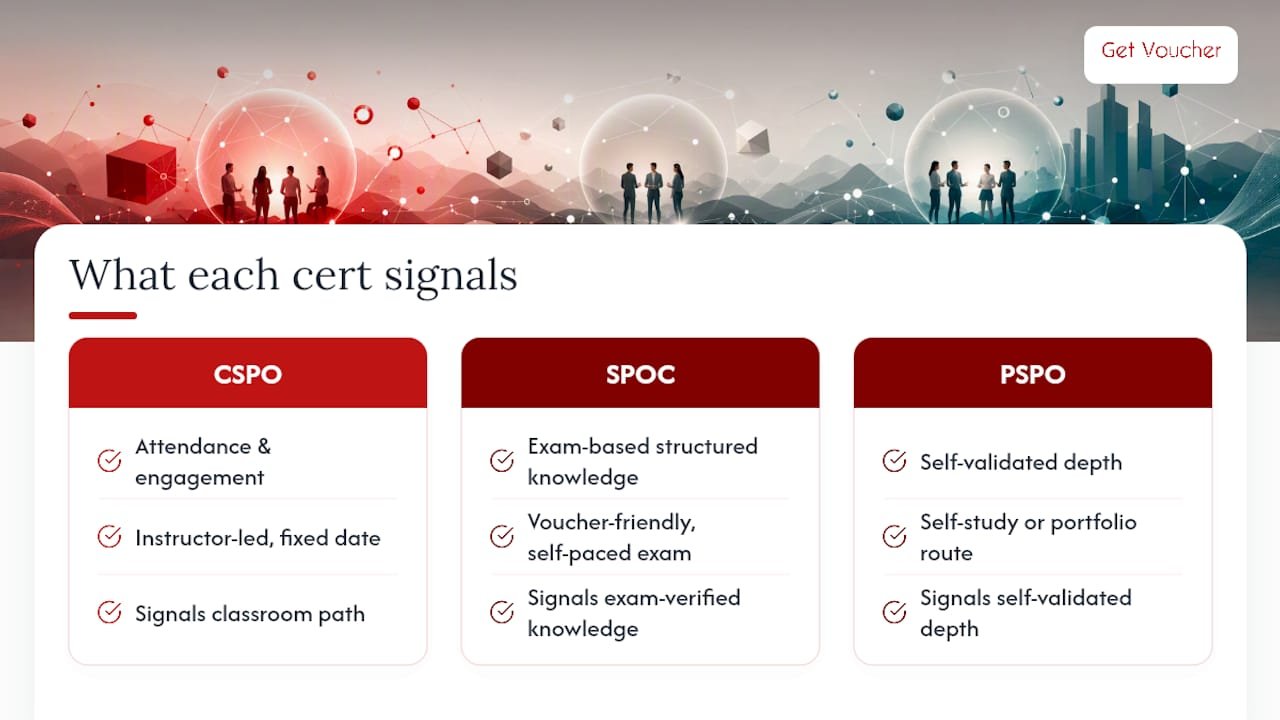
Most comparisons of these three certifications quietly assume one must be objectively better, and that framing does you a disservice. The honest answer is that CSPO, SPOC and PSPO measure different things: attendance and engagement, exam-based structured knowledge, and self-validated depth, respectively. None of them tells an employer you will be a good Product Owner. They tell an employer you took a specific, verifiable path to prove baseline competence, and which path you took says something about how you like to learn.
What gets underestimated is how much the voucher-based model changes the calculus for working professionals. A fixed-date, instructor-led course is a real commitment against a busy job, and that friction alone pushes many capable candidates towards self-paced, exam-based routes purely for logistical reasons rather than any judgment on course quality. That is not a knock against CSPO. It is simply a practical reality GetVoucher’s model exists to address for SPOC specifically. If your working life does not bend easily around a fixed training calendar, that constraint deserves as much weight in your decision as the syllabus itself. For certifications GetVoucher does not yet list, including some VMEdu family credentials, they are planned for coming months, and you are welcome to contact GetVoucher directly for current pricing and availability.
— Rayan
Where can you buy a SPOC voucher and start preparing?
GetVoucher gives you a lower-friction route into a recognised Product Owner credential than booking a fixed-date classroom course. Rather than blocking out consecutive training days, you purchase voucher access once, study at your own pace against SCRUMstudy’s unproctored exam format, and schedule the test when you are ready rather than when a course calendar allows.
You will find the full syllabus breakdown and pricing on the SPOC certification course page, and if you are still comparing multiple Agile credentials before deciding, the main certifications landing page lets you browse other VMEdu-backed options, including SCRUMstudy, SMstudy, and 6sigmastudy pathways, alongside SPOC. Once you have purchased your voucher, GetVoucher provides access instructions for the study materials and guidance on booking your proctored exam slot, so you know exactly what happens between checkout and certification. If you are already holding a SPOC credential and want to understand what recertification involves, GetVoucher’s guide to maintaining your SCRUMstudy certification is worth reading before your three-year window approaches. Start by reviewing the SPOC course page and purchasing your voucher when you are ready to commit to a preparation timeline.
Sources
- Is there a test requirement for CSPO® certification? – Scrum Alliance Help Center
- Instructor-led Scrum Product Owner Certified Certification – SCRUMstudy
Recommended
- Scrum Product Owner Certified (SPOC®) – GetVoucher
- Scrum Master vs Product Owner: Which Agile Role and Certification Is Right for You? – GetVoucher
- Product Owner: Roles, Responsibilities, and Real-World Impact – GetVoucher
- Becoming an Effective Product Owner: Essential Skills and Best Practices – GetVoucher