




If you run daily stand-ups, own a sprint backlog, or answer to a PMO that wants both agility and governance, start with a Scrum foundation such as the Scrum Master Certified (SMC®) credential, then layer on PMI‑ACP for cross-framework breadth or AgilePM for governance-heavy delivery. Pick one achievable certification now, prepare with a voucher-backed self-study route through GetVoucher, and build outward from there.
TL;DR:
- The most practical certifications for project managers are Scrum Master (SMC), PMI‑ACP, and AgilePM, depending on role and governance needs.
- Scrum certifications focus on facilitation and prioritisation, with SMC for ceremonies and SPOC for backlog management, while SAMC suits those scaling Scrum practices.
- PMI‑ACP offers broad, framework-agnostic knowledge for managers working across Scrum, Kanban, and Lean, but requires experience hours to qualify.
- AgilePM is ideal for environments demanding traditional governance alongside agility, as it aligns with fixed budgets and sign-off processes.
- Sequencing certifications logically—starting with team-level facilitation then progressing to scaling or governance credentials—is essential to build a coherent agile career.
Table of Contents
- What does an agile certification for project managers actually prove?
- Which Agile certifications should project managers compare?
- How should you sequence certifications as your career grows?
- How to choose the right agile certification for your role
- What should you expect from exam formats and study time?
- How GetVoucher supports your certification roadmap
- What actually derails a project manager’s certification plan
- Sources
What does an agile certification for project managers actually prove?
Agile certifications for project managers fall into four rough categories, and confusing them is the single most common reason people pick the wrong one. Framework-specific credentials (Scrum, Kanban) prove you can run a particular method’s ceremonies and artefacts correctly. Framework-agnostic credentials, like PMI’s Agile Certified Practitioner, prove breadth across Scrum, Kanban, and Lean without tying you to one. Scaling credentials address how agility works across multiple teams and a portfolio. Governance-blended credentials, AgilePM being the clearest example, exist because most organisations still need fixed budgets, sign-off gates, and audit trails even while teams work in sprints.
For a working project manager, the practical value shows up in three places:
- A shared vocabulary that cuts down misunderstandings when a Scrum team, a PMO, and a client-facing account manager all use the word “done” differently.
- A credential that clears applicant-tracking software before a human ever reads your CV, since many hiring filters still screen for named certifications.
- Demonstrable proof that you can facilitate, not just administer, an agile delivery process.
Certification tends to pay off best when it sits alongside real delivery experience rather than replacing it. One analysis of agile certification outcomes found that certified professionals often see an earnings premium and a hiring edge, but the same source is clear that the credential’s value depends on pairing it with work you can actually point to in an interview. A certificate with no delivery story behind it convinces nobody.
Pro Tip: Before you enrol in anything, write down the three agile-related tasks that currently cause you the most friction at work. That list, not a certification’s marketing page, should decide which credential you sit first.
Which Agile certifications should project managers compare?
Six credential families come up again and again when project managers research this decision. Here is what each one actually covers, and who it genuinely suits.
Scrum path: SMC, SPOC, and SAMC
GetVoucher’s core Scrum pathway runs through three VMEdu-backed, SCRUMstudy-issued credentials, and they are designed to be taken in sequence rather than as isolated choices.
Scrum Master Certified (SMC®) is the entry point for anyone who runs or supports Scrum ceremonies: sprint planning, daily stand-ups, reviews, and retrospectives. If your day job involves removing blockers for a development team and keeping a sprint backlog honest, this is where you start. It sits alongside Scrum Fundamentals Certified as an even lighter entry option if you want to test the waters before committing to a full exam.
SCRUM Product Owner Certified (SPOC™) shifts the focus from facilitation to prioritisation. Where SMC is about protecting the team’s process, SPOC is about owning the product backlog, writing user stories that actually reflect business value, and making the trade-off calls between scope and deadline. Plenty of project managers who inherit product-owner responsibilities alongside their PM title find this the more relevant of the two.
SCRUM Agile Master Certified (SAMC™) is the advanced tier, built for practitioners who already understand Scrum mechanics and now need to coach other Scrum Masters, resolve cross-team dependencies, and handle the organisational politics that come with scaling agile beyond a single team. It is available now through GetVoucher’s SAMC course page.
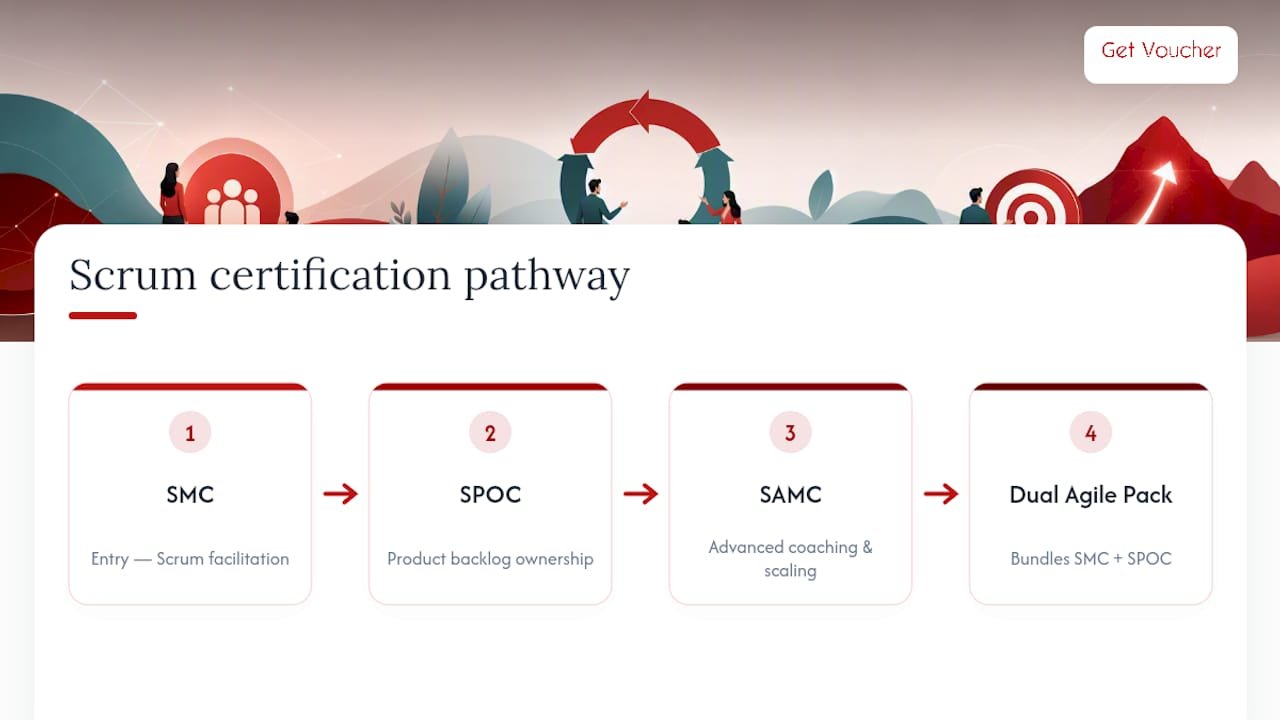
If you want both the facilitation and prioritisation sides covered in one purchase, the Dual Agile Pack combining Scrum Master and Product Owner certification bundles SMC and SPOC together, which suits a PM who expects to wear both hats.
Scrum.org offers a comparable but separately governed route through its Professional Scrum Master (PSM) line. Worth noting: Scrum.org documents PSM I as a standalone exam that self-directed learners can sit without mandatory coursework, which contrasts with course-based routes like Scrum Alliance’s CSM that typically require instructor-led training before you can even book the exam. Knowing which model a credential uses matters when you are weighing study time against cost.
PMI‑ACP: breadth over depth
The PMI Agile Certified Practitioner credential does not tie you to one framework. Instead, PMI’s own certification page confirms that PMI‑ACP requires both formal agile training and a documented number of experience hours, and the exam draws on Scrum, Kanban, Lean, and other agile approaches rather than testing one methodology in isolation.
This makes PMI‑ACP the natural pick for project managers who move between teams using different methods, or who sit at PMO level and need to speak credibly about agile practice without being pigeonholed as “the Scrum person.” It is also the heavier lift: the experience-hour requirement means it is not an entry credential, and industry analysis specifically recommends PMI credentials for PMs whose daily friction points involve governance, budgeting, and PMO reporting rather than pure team facilitation.
AgilePM (DSDM): governance meets agility
AgilePM, governed by the Agile Business Consortium, occupies a different niche entirely. The Agile Business Consortium describes AgilePM as a framework built to balance agility with governance, which is precisely why it resonates with project managers working in regulated industries, fixed-price contracts, or environments where a steering committee still expects a business case and a defined scope.
What sets AgilePM apart operationally is that it was designed to integrate with established approaches like PRINCE2, so organisations already running traditional project governance can adopt agile delivery without ripping out their existing controls. If your organisation still needs a business case, a steering board, and a defined change-control process, AgilePM speaks that language natively in a way that a pure Scrum certification does not.
SAFe and scaling credentials
Once agility needs to operate across multiple teams, a programme, or a portfolio, single-team frameworks stop being enough. Scaling credentials address release trains, programme-level backlogs, and the coordination overhead that appears the moment you have more than a handful of teams working toward the same product. These suit senior project managers and programme managers who need to translate team-level agile fluency into portfolio decision-making. GetVoucher does not currently list a SAFe-specific voucher, and readers interested in this tier should contact GetVoucher directly for guidance on pricing and availability as the catalogue expands.
Specialist add-ons: Kanban, business analysis, and quality management
A handful of specialist certifications round out a project manager’s toolkit without competing directly with the Scrum or PMI routes:
- Kanban certification, issued under the KANBANstudy brand, focuses on flow-based delivery, work-in-progress limits, and visual management, useful for PMs running support or maintenance streams alongside sprint-based product work.
- Business analysis credentials under the BAlearning brand sharpen requirements-gathering and stakeholder analysis, skills that sit naturally underneath product ownership.
- Quality management credentials, including those under the 6sigmastudy brand such as the Dual 6Sigma Pack combining Six Sigma Green Belt and Lean Six Sigma Green Belt, complement agile delivery by giving PMs process-improvement tools that agile ceremonies alone do not cover.
- Risk management credentials under the RMstudy brand address the structured risk analysis that agile retrospectives tend to surface but rarely formalise.
Kanban, business analysis, and several of these specialist pathways are planned for GetVoucher’s catalogue in the coming months. If you want early access or a firm date, get in touch with GetVoucher for current pricing and availability.
How should you sequence certifications as your career grows?
Stacking credentials without a plan is how people end up with a CV full of acronyms and no clear story to tell an interviewer. A sensible roadmap moves in three stages.
- Entry level. Start with Scrum Fundamentals or SMC to prove you can run agile ceremonies competently. This is the stage where you learn the vocabulary and the mechanics before anything else matters.
- Mid level. Add SPOC if your role touches backlog ownership, or move to PMI‑ACP if your organisation spans multiple frameworks and you need PMO-level credibility. If your environment is governance-heavy, AgilePM Practitioner slots in here instead.
- Senior/programme level. Layer on SAMC for cross-team coaching authority, or a scaling credential once you are coordinating multiple teams or a full programme. This is also where portfolio- and PMO-level modules become relevant.
The deep-dive on agile certification for technical project managers makes a useful point here: stacking a team-level Scrum credential with a broader PMI‑ACP or scaling qualification is an efficient way to convert facilitation skills into programme-level governance capability, rather than starting from PMI‑ACP cold with no team-level grounding underneath it.
Renewal timing matters just as much as sequencing. Renewal cycles vary significantly by certification body: some Scrum credentials require renewal roughly every two years, PMI‑ACP typically runs on a three-year cycle, while some foundation-level credentials, including AgilePM Foundation, do not expire at all. Check GetVoucher’s guidance on maintaining SCRUMstudy certification before you schedule your next credential, so you are not paying for two renewal cycles in the same year by accident.
| Career stage | Recommended focus | Typical overlap risk |
|---|---|---|
| Entry level | Scrum Fundamentals, SMC | Low, foundational only |
| Mid level | SPOC or PMI‑ACP, or AgilePM Practitioner | Moderate if both Scrum and PMI routes chosen without a clear reason |
| Senior/programme | SAMC, scaling credentials, PMO modules | Low if sequenced from mid-level credentials rather than started fresh |
How to choose the right agile certification for your role
Four factors should drive the decision more than any marketing page: what you do daily, how your team is structured, how much governance your organisation demands, and what keywords actually appear in job postings you want to apply for. A project manager screening applicants for a client-facing delivery role searches for different terms than a PMO screening for a portfolio analyst.
Run through this checklist before you commit to a voucher or a course:
- Does the certification match the framework your current or target employer actually uses, rather than the one that is trending?
- Are the prerequisites (experience hours, mandatory training) something you can realistically meet in the next six months?
- Is the exam format compatible with your schedule, proctored online versus requiring in-person attendance?
- Does the certifying body publish a clear renewal policy, or is it vague about continuing education requirements?
- Is the credential recognised beyond the vendor that issues it, or does it only carry weight within one training ecosystem?
Watch for a few red flags specifically. Vague renewal rules that only surface after you have paid are a common complaint. So is vendor-only recognition, where a certification carries weight solely within one company’s own hiring pipeline and nowhere else. Unclear exam conditions, no published pass criteria, no sample questions, no stated time limit, should make you hesitate before paying for a voucher.
What should you expect from exam formats and study time?
Prerequisites vary a lot between credentials, and that variation is often the deciding factor for busy project managers. Entry-level Scrum credentials generally require no prior experience hours, just an exam. PMI‑ACP sits at the other end: PMI requires both formal agile training and documented experience hours before you are even eligible to sit the exam, which means it is not a credential you can decide to take next week.
Exam logistics also differ. Most modern agile certifications, including GetVoucher’s SMC, SPOC, and SAMC pathways, run as online proctored exams you can schedule around a working week rather than a fixed classroom date. Some credentials, notably certain Scrum Alliance routes, mandate instructor-led training before the exam is even available, while others, like Scrum.org’s PSM line, let self-directed learners sit the assessment without a mandatory course.
Study-hour expectations tend to fall into rough bands rather than fixed numbers: entry-level Scrum certifications often need a focused week or two of preparation, while PMI‑ACP’s breadth typically demands a longer, multi-month study period given the experience-hour prerequisite alongside the exam content itself. Cost bands follow a similar pattern, entry credentials sit lower, multi-framework and scaling credentials sit higher, though ROI analysis consistently notes that the certification pays off best when paired with delivery experience rather than treated as a standalone CV line.
A few tactics help working professionals fit preparation around a full-time job:
- Break study into microlearning sessions rather than blocking out full weekends, since sprint work rarely leaves you a clear weekend anyway.
- Use voucher-backed self-paced video training so you are not locked into a fixed course start date.
- Run practice assessments under timed conditions before booking the real exam.
- Ask your employer about funding, many organisations will cover a certification voucher if you can show it maps to your current delivery responsibilities.
How GetVoucher supports your certification roadmap
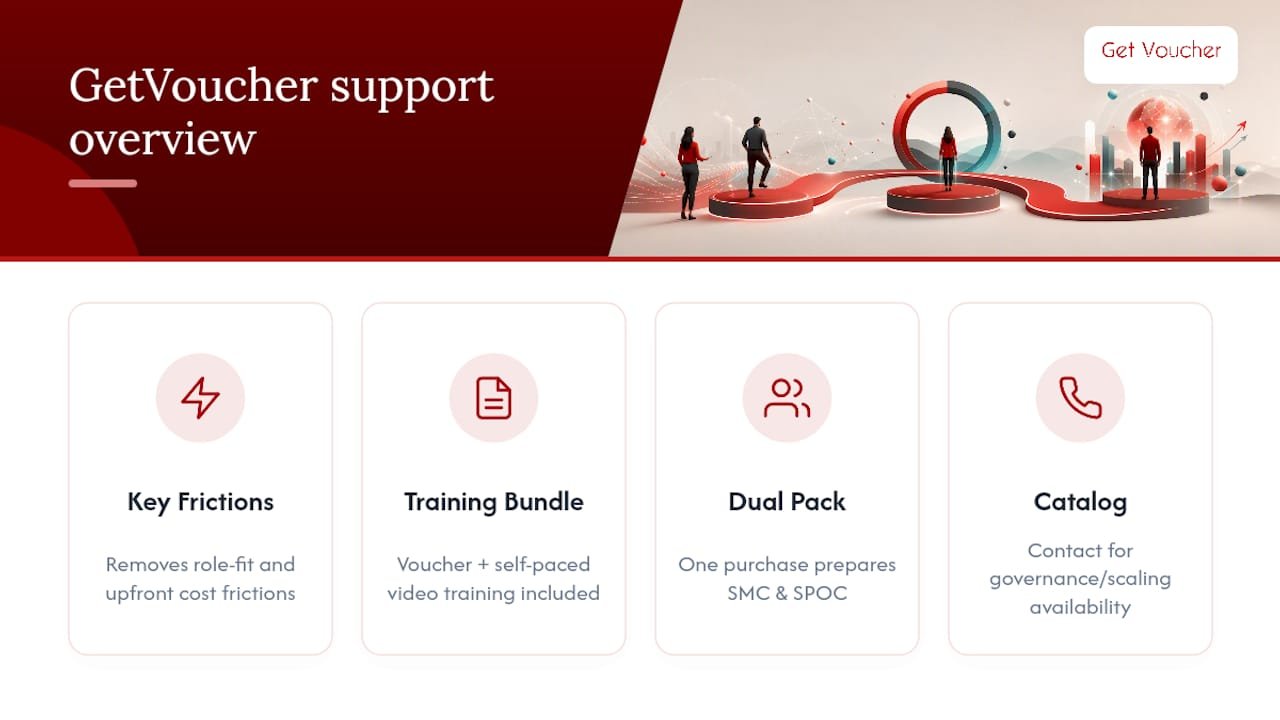
GetVoucher exists to remove the two biggest friction points in this whole process: working out which certification actually fits your role, and paying full price upfront for something you might not finish. As the voucher platform working with VMEdu as the main training provider, GetVoucher gives you direct access to SCRUMstudy-issued credentials, SMC, SPOC, and SAMC, at the point in your roadmap where each one makes sense.
Rather than hunting across multiple training providers, documents, and video libraries to piece together a study plan, you get self-paced video training bundled with the voucher itself, which cuts down the time you would otherwise spend assembling your own materials from scratch. If your role covers both facilitation and backlog ownership, the Dual Agile Pack: Scrum Master & Product Owner certification is built precisely for that overlap, one purchase covering both SMC and SPOC preparation rather than two separate transactions. For readers whose organisation needs governance-blended or scaling credentials that are not yet listed, get in touch with GetVoucher for current pricing and availability as the catalogue expands. Browse the full certifications page to see which voucher matches your next career step, and book your exam slot once you are ready.
What actually derails a project manager’s certification plan
The most common mistake is not picking the wrong certification, it is picking three certifications in the same year without a clear reason for each one. Acronym collecting looks impressive on paper until an interviewer asks you what SAMC actually changed about how you run a team, and you cannot answer because you sat the exam six weeks after the last one and never applied either.
Sequence matters more than volume. Get one credential embedded into how you actually work, SMC or SPOC first for most practising project managers, before adding PMI‑ACP or AgilePM on top. The community discussions on The Freelance PM Club are worth a browse if you are weighing certification against building an independent consulting practice, since the trade-offs there differ from staying inside a single employer’s PMO.
If there is one immediate next step worth taking after reading this, it is this: identify the single daily friction point costing you the most time right now, and match one certification to it. Not three. One.
— Rayan
Sources
For exam blueprints and eligibility rules, always check the certifying body directly rather than a third-party summary. PMI’s Agile Certified Practitioner page and its wider Agile resources hub cover PMI‑ACP prerequisites and role-based learning paths. The Agile Business Consortium’s AgilePM page explains governance-focused positioning, and Scrum.org’s PSM I assessment page details the standalone exam route. For voucher access and current course listings, visit GetVoucher’s certifications page.
- PMI Agile Certified Practitioner (PMI-ACP) — PMI
- Agile Project Management (AgilePM®) — Agile Business Consortium
- Monday