




If you are early-career or targeting UK public-sector roles, PRINCE2 Foundation followed by Practitioner is usually the faster, more accessible route. If you already hold documented project experience and want a globally portable senior credential, PMP is the stronger long-term investment. Prerequisites, not preference, decide which door opens first, and many senior professionals eventually hold both.
TL;DR:
- PRINCE2 Foundation is suitable for early-career professionals entering public-sector or PRINCE2-focused environments without prerequisites, while PMP requires proven leadership experience.
- PRINCE2 carries more weight in the UK, Europe, Australia, and New Zealand, whereas PMP is preferred in North America and multinational companies.
- The PRINCE2 exam is shorter and simpler, focusing on applying a specific method, whereas PMP demands extensive experience and covers broader leadership and management knowledge.
- Employers’ preferences vary by sector and geography, with UK public agencies favoring PRINCE2 and North American or global firms leaning toward PMP.
- Combining both credentials is common for professionals seeking internationally portable project management expertise and diverse sector recognition.
Table of Contents
- PRINCE2 vs PMP: the quick comparison
- PRINCE2 vs PMP: how do the certifications compare?
- What do the PMP and PRINCE2 exams actually involve?
- Where do employers prefer PRINCE2 or PMP?
- How do you choose between PRINCE2 and PMP?
- Where does GetVoucher fit into this comparison?
- Is GetVoucher worth using alongside PRINCE2 or PMP?
- Should you combine PRINCE2 governance with PMP’s leadership breadth?
- Sources
PRINCE2 vs PMP: the quick comparison
PRINCE2 (Projects IN Controlled Environments) is a structured project management method, owned and administered through PeopleCert, built around defined processes, themes, and governance roles. PMP (Project Management Professional) is a competency-based credential from the Project Management Institute (PMI) that validates broad applied knowledge across leadership, delivery, and business acumen, rather than a single method.
The core contrasts worth scanning before you commit study time:
- Approach: PRINCE2 teaches a repeatable method with defined roles and stage gates; PMP tests judgement across a body of knowledge spanning multiple approaches, including agile and hybrid delivery.
- Entry point: PRINCE2 Foundation has no prerequisites; PMP requires documented project leadership experience and formal project management education.
- Geography: PRINCE2 carries more weight in the UK, Europe, Australia, and New Zealand; PMP dominates in North America and multinational corporate environments.
- Depth: PRINCE2 Practitioner tests how you tailor governance to a live project; PMP tests how you lead a project end to end.
The sections below break each of these down properly, including a side-by-side table and the exam mechanics that actually determine your study timeline.
PRINCE2 vs PMP: how do the certifications compare?
The table below sets PRINCE2 Foundation, PRINCE2 Practitioner, and PMP against the dimensions that matter most when choosing a path: who can sit the exam, what it costs in time, and who the credential tends to suit.
| Dimension | PRINCE2 Foundation | PRINCE2 Practitioner | PMP |
|---|---|---|---|
| Recognition / geography | UK, Europe, Australia, New Zealand | UK, Europe, Australia, New Zealand | North America, multinational corporates, global |
| Prerequisites | None | Pass Foundation, or hold an accepted equivalent credential | Documented project leadership experience plus 35 hours of formal project management education |
| Exam format | Multiple choice, closed-book | Objective testing, tailoring-focused | 180 questions, timed, closed-book |
| Maintenance / recertification | Feeds into Practitioner | Periodic renewal via PeopleCert | Continuing certification requirement units over a renewal cycle |
| Typical study commitment | Short, self-paced | Moderate, builds on Foundation | Longer, given the exam’s breadth |
| Best-for | Early-career professionals entering PRINCE2 environments | Practitioners governing projects inside PRINCE2 frameworks | Experienced managers targeting senior roles and international mobility |
The pattern is clear once you see it laid out: PRINCE2’s two tiers form a single accessible ladder, while PMP asks you to arrive with experience already banked. Neither is objectively “harder”. They are testing different things: PRINCE2 checks whether you can apply a method correctly, PMP checks whether you can lead a project regardless of method.
What do the PMP and PRINCE2 exams actually involve?
The eligibility rules are where most people get their first real surprise, so it is worth working through each credential in order.
- PRINCE2 Foundation: no formal prerequisites. You sit a closed-book, multiple-choice exam covering terminology, principles, and the seven themes. Most candidates prepare in a few days of focused study.
- PRINCE2 Practitioner: you need to have passed Foundation, or hold an accepted equivalent credential such as PMP, CAPM, or an IPMA-recognised qualification in some pathways. The exam is objective testing built around applying PRINCE2 to a scenario, not just recalling definitions.
- PMP: eligibility varies by education level, but candidates typically need several years of documented project leadership experience alongside 35 hours of formal project management training. The exam itself runs to 180 questions and is widely regarded as demanding, given how much ground it covers.
Pro Tip: Don’t underestimate the paperwork stage of PMP. Gathering and documenting your project experience for PMI’s application often takes longer than people expect, so start compiling it before you book any training.
PMI notes that the PMP has been earned by over 1.7 million professionals worldwide, which underlines how established the credential is as a global benchmark rather than a niche qualification.
Where do employers prefer PRINCE2 or PMP?
Geography and sector shape this decision more than almost anything else. A credential that opens doors in London may barely register in Toronto, and vice versa.
- UK government departments and public-sector procurement frameworks have historically favoured PRINCE2, partly because it originated as a UK government methodology.
- Multinational consultancies and North American employers tend to favour PMP, reflecting PMI’s stronger footprint in those markets.
- Early-career professionals, particularly those entering PRINCE2-governed environments, often find Foundation the more accessible starting point.
- Senior practitioners aiming at international mobility or multinational roles frequently find PMP’s global recognition more useful once they have the experience to qualify.
- Professionals working across both public-sector and multinational contracts often end up holding both credentials, since each opens a different set of doors.
If your career plan involves moving between sectors or countries, that last point matters more than either single certification.
How do you choose between PRINCE2 and PMP?
Work through this checklist before you book anything:
- Map your experience against eligibility. If you cannot yet document the project leadership hours PMP requires, PRINCE2 Foundation gives you a credential to work towards while you accumulate that experience.
- Identify your target sector. UK public sector and government-adjacent work leans PRINCE2; multinational corporate and North American roles lean PMP.
- Check what your employer or target employer actually asks for. Job postings and internal competency frameworks are the most reliable signal you have.
- Weigh study time against your current workload. PRINCE2 Foundation is a lighter lift than PMP’s exam preparation.
- Factor in recertification. Both credentials require ongoing maintenance, so budget for that beyond the initial exam.
Questions worth asking HR or a hiring manager directly: which credential does the role actually require, does the organisation reimburse exam costs, is there an internal preference between PRINCE2 and PMP, and does the role involve international project delivery where PMP’s recognition carries more weight.
Pro Tip: Watch for training providers promising guaranteed pass rates or claiming official partnership status with PMI or PeopleCert without evidence. Neither body works that way, and unverified accreditation claims are a genuine red flag.
Where does GetVoucher fit into this comparison?
To be clear: GetVoucher does not currently sell PRINCE2 or PMP certification vouchers. This article is provided for general knowledge and comparison purposes, not as a route to purchase either credential through GetVoucher.
What GetVoucher does offer sits alongside both paths rather than competing with them. For project managers building a broader skillset, that includes:
- Agile and Scrum certifications through SCRUMstudy, useful for hybrid delivery environments
- Business Analysis credentials via BAlearning, relevant to requirements-heavy projects
- Quality Management pathways through 6sigmastudy for process-improvement work
- Risk Management certifications via RMstudy for governance-focused roles
Some VMEdu brands, including NGstudy and KANBANstudy, are planned for GetVoucher’s catalogue. the coming months. Contact GetVoucher directly for current pricing and availability on any of these pathways.
Is GetVoucher worth using alongside PRINCE2 or PMP?
Plenty of project managers do not treat certification as a single decision. They build outwards from whichever credential they already hold, adding Agile, Scrum, or Business Analysis skills to round out how they actually work day to day.
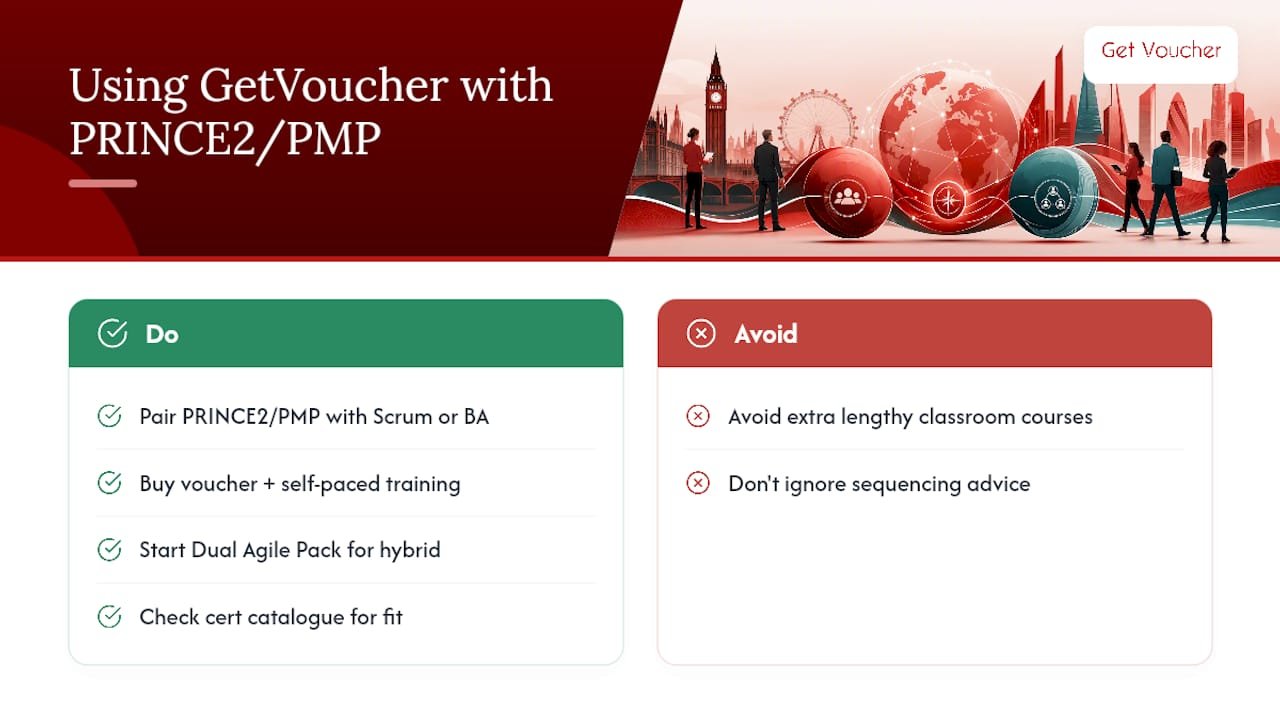
That is where GetVoucher earns its place. GetVoucher sells vouchers for certification courses and exams from established VMEdu brands, including SCRUMstudy and 6sigmastudy, with self-paced online training included. If you already hold PRINCE2 or are studying for PMP, pairing that with a Scrum or Business Analysis credential through GetVoucher builds a broader, more employable skillset without committing to another lengthy classroom course. The Dual Agile Pack covering both Scrum Master and Product Owner routes is a practical starting point for anyone moving towards hybrid delivery, and it slots in well either before or alongside your PRINCE2 or PMP study.
Browse the full certifications catalogue to see which complementary credential fits your current role, and get in touch with GetVoucher if you want guidance on sequencing your learning.
Should you combine PRINCE2 governance with PMP’s leadership breadth?
My honest reading of the evidence is that framing this as an either/or choice undersells both credentials. PRINCE2 teaches you to govern a project properly; PMP teaches you to lead one through ambiguity that no single method fully covers. The strongest practitioners I’d point anyone towards build a staged path: start with what your prerequisites allow, add the other once experience permits, and treat combining both as the actual career strategy rather than a fallback.
— Rayan