




Scrum for Operations and DevOps Expert Certified (SODEC) is a SCRUMstudy credential that teaches how Scrum concepts apply to operations and DevOps delivery environments. It suits DevOps engineers, IT operations staff, Scrum Masters and delivery managers who want structured knowledge of this intersection rather than ad hoc exposure. If the scope fits your role, the sensible next step is to review the official course page or check the SODEC voucher listing on GetVoucher before enrolling.
Table of Contents
- Course overview: purpose, basis and what the credential covers
- Key skills and syllabus topics you will learn
- Who should take this certification and what prerequisites to expect
- Exam format, timing and practical logistics
- Benefits and realistic career value
- How Scrum concepts map to operations and DevOps (with DORA metrics)
- Practical examples: short scenarios showing day-one application
- Certification maintenance and renewal requirements
- Comparison with similar certifications
- Detailed certification path and levels
- How to use SODEC in your learning path
- How GetVoucher can help with your SODEC voucher and preparation
- FAQ
- Sources
Course overview: purpose, basis and what the credential covers
SODEC is built around SCRUMstudy’s white paper on applying Scrum to operations and DevOps contexts, alongside the broader Scrum Body of Knowledge (SBOK®) that underpins SCRUMstudy’s certification family. The course aims to give candidates a working understanding of how Scrum roles, events and artefacts can be adapted when delivery work includes live-service operations rather than pure product development.
Providers typically make several learning formats available to candidates working through the material:
- An e-copy of the relevant guide or white paper for self-paced reading
- Instructional videos that walk through key concepts
- A mobile app for revision on the move
The certification validates knowledge of applying Scrum concepts to operations and DevOps environments. It is a knowledge credential, not a practical skills test, so it demonstrates familiarity with the framework rather than hands-on delivery capability.
Key skills and syllabus topics you will learn
SODEC study material focuses on bringing Scrum’s iterative structure into environments where uptime, incident response and release stability matter as much as feature delivery. Expect the syllabus to touch on:
- Mapping value flow through operations work so bottlenecks between development and live support become visible.
- Running retrospectives and feedback loops that specifically target operational issues, not just sprint output.
- Connecting continuous integration and continuous delivery (CI/CD) activity, including release automation and quality checks, to Scrum artefacts such as the sprint backlog.
- Introducing outcome measurement for delivery performance, including an overview of how metrics like DORA’s can sit alongside Scrum ceremonies as a way to judge whether changes are improving flow.
That last point deserves a separate explanation, which the DORA section below provides. The syllabus treats measurement as a complement to Scrum events rather than a replacement for them, reflecting how UK occupational standards for DevOps engineers describe the role: combining development and live environment support through automated CI/CD, infrastructure-as-code and evidence gathered from production.
Who should take this certification and what prerequisites to expect
SODEC is aimed at professionals whose roles sit near the boundary between delivery and operations, including DevOps engineers, IT operations staff, Scrum Masters and Agile coaches who want to extend their remit, and delivery managers overseeing teams that own both build and run responsibilities. The certification does not require that candidates already work at this intersection: it is designed for professionals moving into or around these roles, not only those already embedded in them.
SCRUMstudy lists no mandatory formal prerequisite for SODEC. Holding the Scrum Fundamentals Certified (SFC) or Scrum for Operations & DevOps Fundamentals Certified (SODFC) credential is preferred but not compulsory.
Helpful preparation, even without a formal requirement, includes:
- Some exposure to CI/CD pipelines or release automation tooling
- Familiarity with backlog or sprint mechanics from any Agile context
- Basic awareness of incident management or runbook processes
Exam format, timing and practical logistics
SCRUMstudy’s own materials describe the SODEC assessment as a computer-based test that can be taken online under proctored conditions. Candidates should check the current candidate handbook or course page directly before booking, as SCRUMstudy’s published information on exam duration varies between sources. Rather than guessing which applies, confirm the details before booking.
Practical steps for candidates:
- Confirm the exact exam duration, question count and pass score on the official SCRUMstudy page for your chosen sitting.
- A voucher purchased through a platform such as GetVoucher’s SODEC course page typically covers access to study materials and an exam attempt, though candidates should verify what is included before paying.
- Register well ahead of your target date, since online proctored exams often require identity verification steps on the day.
Benefits and realistic career value
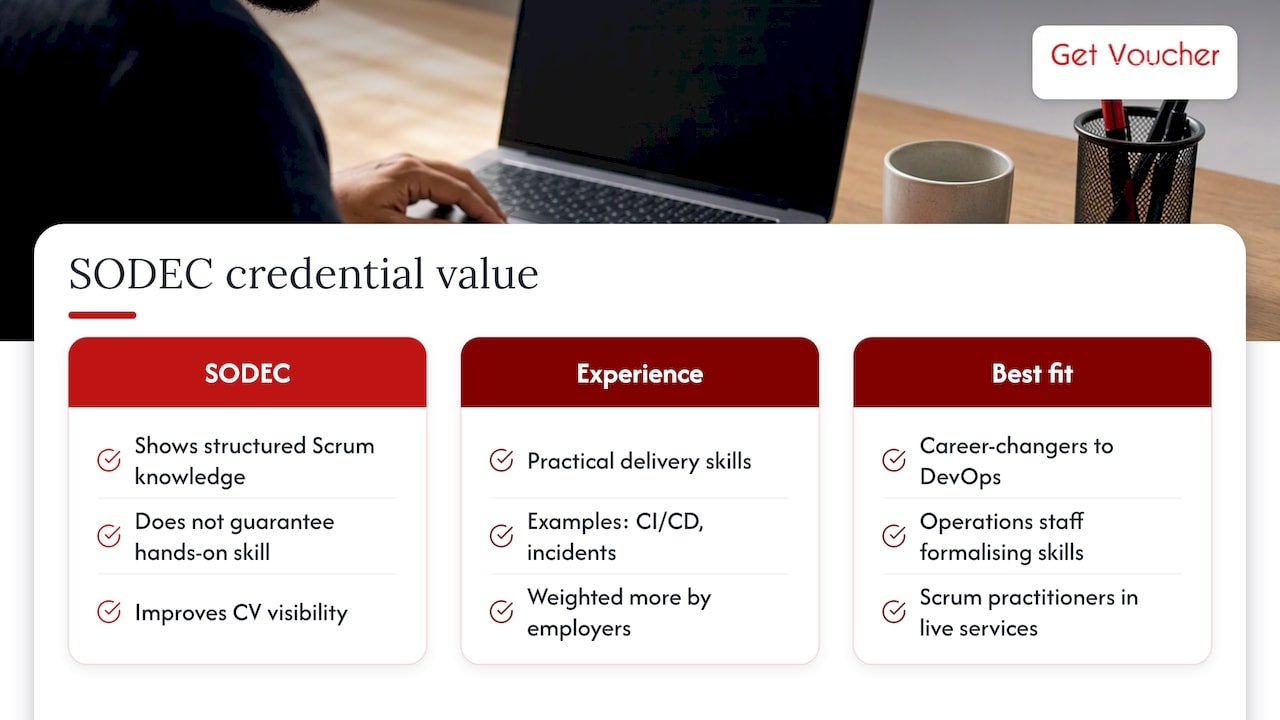
A SODEC credential demonstrates structured knowledge of applying Scrum to operations and DevOps work. It does not, on its own, guarantee hands-on delivery skill, and employers generally weigh practical experience, such as managing a CI/CD pipeline or running a production incident, more heavily than a certificate alone.
Professional certification is associated with stronger CV visibility and career progression. BCS survey data shows that service management and DevOps professionals are among the roles most likely to hold professional certifications, with career advancement and improved CV visibility cited as the leading motivators.
That context matters for how you use SODEC. It fits naturally for career-changers moving towards DevOps roles, operations staff who want to formalise knowledge they have picked up informally, and Scrum practitioners extending their remit into delivery environments with live-service responsibilities. UK career guidance for DevOps engineers frames certifications as structured learning that works best alongside demonstrable projects, not as a replacement for them.
How Scrum concepts map to operations and DevOps (with DORA metrics)
Scrum, DevOps and DORA are related but distinct. Scrum is an iterative framework built around sprints, defined roles and regular inspection points. DevOps, as UK occupational standards describe it, is a delivery philosophy that combines development and live-service support through automation and evidence from production. DORA is neither a framework for running teams nor a project methodology: it defines five specific metrics, grouped into Software Delivery Throughput and Software Delivery Instability, that measure delivery performance.
Those five DORA metrics are:
- Deployment frequency
- Change lead time
- Failed deployment recovery time
- Change fail rate
- Deployment rework rate
What follows is editorial guidance on applying these ideas together, not part of either specification. Teams can feed CI/CD status, observability alerts and deployment outcomes into sprint review and backlog prioritisation discussions, using DORA’s metrics as a lens on whether recent changes have improved or worsened flow. Government guidance on evidence-led assurance supports treating delivery as a connected system where continuous evidence from pipelines and monitoring informs decisions, which is the spirit SODEC study material tries to instil.
Pro Tip: Review DORA metrics in your sprint review rather than a separate reporting cycle, so delivery stability becomes part of the same conversation as sprint progress.
Practical examples: short scenarios showing day-one application
- A team shortens change lead time by tightening its pipeline and then discusses deployment status openly in sprint review, rather than treating releases as a separate workstream from sprint planning.
- After a production incident, a retrospective produces concrete runbook changes, turning a one-off fix into a documented improvement that reduces repeat incidents.
- A Scrum Master uses rising change fail rate as a signal to reprioritise the backlog towards stability work before adding new features, using the trend as evidence rather than instinct.
Observability content on CI/CD monitoring illustrates how teams build the kind of pipeline visibility these scenarios depend on.
Certification maintenance and renewal requirements
SCRUMstudy certifications, including SODEC, typically carry ongoing requirements to keep the credential current rather than being awarded indefinitely on a one-time basis. Candidates should check the specific renewal period, continuing education expectations and any associated fee directly on SCRUMstudy’s official certification page, since these details can change and vary by credential tier.
Treat renewal as part of the overall cost and time commitment when deciding whether SODEC fits your plans, not as a detail to confirm after enrolling. GetVoucher’s page on maintaining your SCRUMstudy certification is a useful starting point for understanding what ongoing steps are generally involved, alongside the certifying body’s own documentation.
Comparison with similar certifications
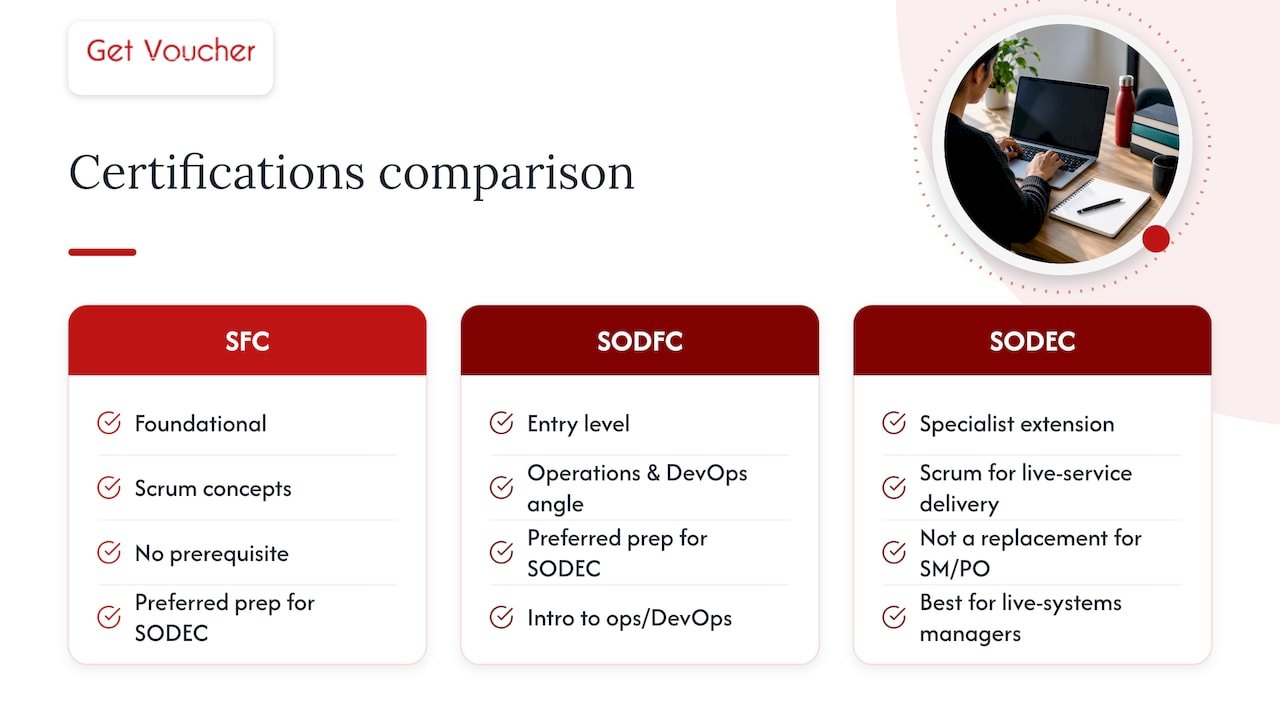
SODEC sits within a family of SCRUMstudy credentials rather than standing alone. Scrum Fundamentals Certified (SFC) covers foundational Scrum concepts with no prerequisite, making it a common starting point for readers new to the framework. Scrum for Operations & DevOps Fundamentals Certified (SODFC) introduces the operations and DevOps angle at an entry level, and is one of the two credentials SCRUMstudy lists as preferred (though not required) preparation for SODEC, alongside SFC itself.
Compared with these, SODEC goes deeper into applying Scrum specifically within delivery environments that include live-service responsibility. It is a specialist extension rather than a replacement for general Scrum Master or Product Owner credentials, which focus on product and team facilitation rather than operations-specific concerns. Readers deciding between these options should weigh their current role: those managing live systems and release pipelines gain more from SODEC’s focus, while those newer to Agile delivery generally benefit from starting with SFC.
Detailed certification path and levels
A typical path towards SODEC starts with Scrum Fundamentals Certified (SFC) for readers new to Scrum, or Scrum for Operations & DevOps Fundamentals Certified (SODFC) for those who want an entry-level introduction to the operations angle specifically. From there, candidates may progress to SODEC itself once they are ready for the deeper material, since SCRUMstudy preferred, but did not make compulsory, prior completion of one of these fundamentals credentials.
Beyond SODEC, professionals often continue building complementary Scrum credentials relevant to their broader role, such as Scrum Master Certified (SMC®) or Scrum Product Owner Certified (SPOC®), depending on whether their career direction leans towards facilitation or product ownership. This is a possible progression rather than a mandatory sequence defined by SCRUMstudy, and candidates should treat each step as a decision based on their own role and goals.
How to use SODEC in your learning path
I would position SODEC on a CV as evidence of structured knowledge in Scrum-and-operations overlap, paired explicitly with a concrete example of applying it, such as a pipeline improvement or an incident retrospective you led. After certification, the next useful step is usually a hands-on project, not another exam immediately.
— Rayan
How GetVoucher can help with your SODEC voucher and preparation
You can buy a SODEC voucher and access associated study materials through an online platform, without needing to compare prices and booking pages across multiple provider sites.
The SODEC course includes voucher access and accompanying study resources made available through the platform. Related options worth comparing before you commit:
- Scrum for Operations and DevOps Expert Certified, the direct voucher page for this credential
- Scrum for Operations & DevOps Fundamentals Certified, a staged option for readers who want the entry-level course first
- Scrum Fundamentals Certified, useful if you are new to Scrum altogether
| Course | Suggested use | Price |
|---|---|---|
| Scrum Fundamentals Certified | New to Scrum | £0 |
| Scrum for Operations & DevOps Fundamentals Certified | Entry-level operations angle | Price on request |
| Scrum for Operations and DevOps Expert Certified | Deeper operations and DevOps focus | Price on request |
Before you book an exam slot, confirm the current exam rules, duration and pass score directly on SCRUMstudy’s official page, since The voucher platform sells access to the certification, while SCRUMstudy remains the certifying body. When you are ready, browse the full certifications catalogue or go straight to the SODEC listing to check current availability.
FAQ
Is Scrum still relevant in 2026?
Scrum remains widely used across software and product teams as an iterative framework for managing work, and it continues to appear in operations and DevOps contexts through adaptations like those SODEC teaches. Its relevance depends on fit: teams managing complex, evolving work tend to find value in sprints and regular inspection points, while highly linear operational tasks may suit other approaches better.
Is a CSM certificate worth it?
A Certified ScrumMaster credential can strengthen a CV and demonstrate structured knowledge of Scrum roles and events, but career guidance consistently notes that certifications work best alongside demonstrable experience rather than in place of it. Treat it as one part of a broader skills portfolio rather than a guarantee of a role.
What is the salary of a 7 year Scrum Master?
Salary for an experienced Scrum Master varies by region, sector, employer size and local demand, and no single figure applies universally. Readers should consult current UK salary surveys or recruitment sources for their specific location and industry rather than relying on a generic number.
How much does PSM 1 cost?
PSM I is a Scrum.org credential, separate from the SCRUMstudy certifications covered in this article, including SODEC. Readers should check Scrum.org’s own site for current pricing, since GetVoucher does not sell or price that specific certification.
Sources
- DORA metrics guide
- Evidence-led assurance for the software development lifecycle (Cabinet Office)
- How to become a DevOps engineer in 2026 — Platform Recruitment