




For most people, the best route runs from free foundational training straight into one recognised, exam-based credential: start with Semrush Academy’s free SEO courses, then progress to the SMstudy Certified SEO Professional through a certification voucher. This combination suits early-career and mid-level marketers because it balances cost, exam rigour and relevance to AI and Generative Engine Optimisation. You can browse the SEO Expert course to see how the pathway fits together.
Table of Contents
- Side-by-side comparison of common SEO certification types
- How to choose an SEO certification for your experience, goals and budget
- GetVoucher recommended pathway: from free course to SMstudy professional credential
- Practical preparation checklist: study hours, tools and minimal portfolio evidence
- Author perspective: certification as a career signal in 2026
- GetVoucher offering and where to buy vouchers and bundles
- FAQ
- Sources
Side-by-side comparison of common SEO certification types
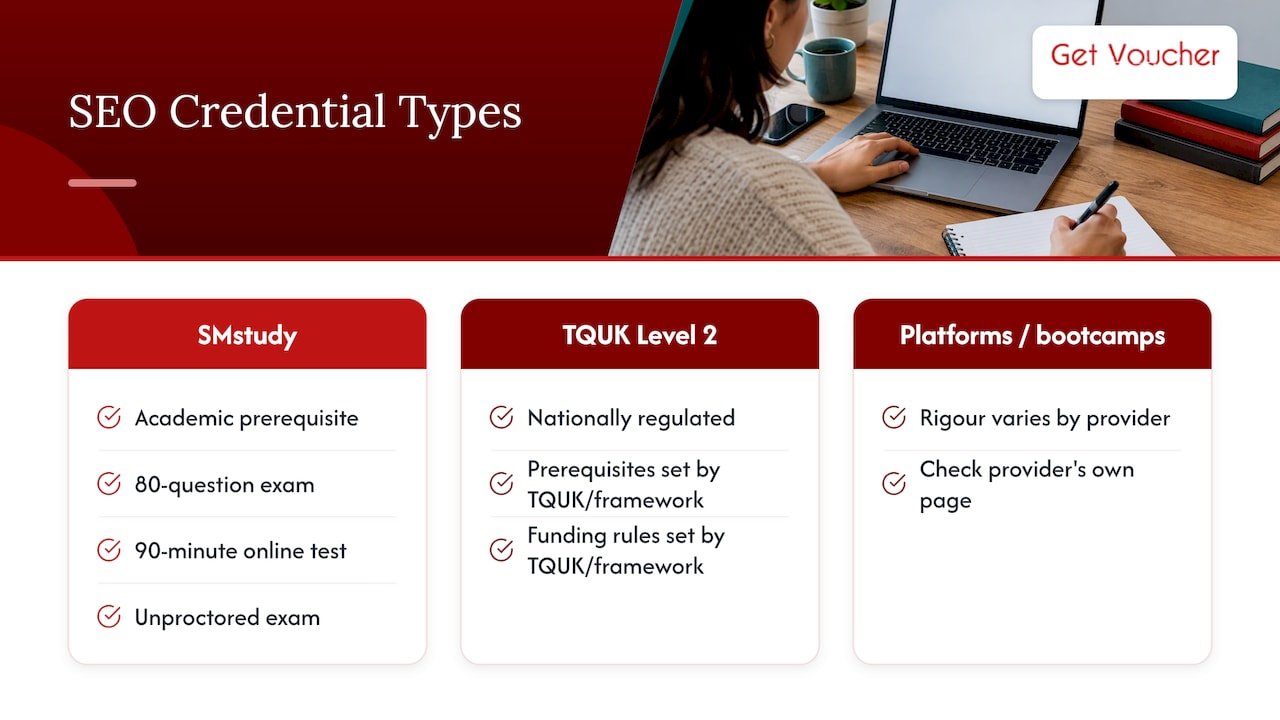
Certification options for SEO sit on a spectrum from free skills badges to regulated qualifications, and each one asks something different of you before and during the assessment. The table below sets out the main types so you can see where effort, cost and recognition diverge.
The SMstudy credential sits apart because it has a defined academic prerequisite rather than an open enrolment policy, and its exam is a fixed 80-question, 90-minute online unproctored test rather than a rolling course assessment. The TQUK Level 2 Certificate is a nationally regulated qualification in its own right, distinct from industry-issued certificates, and its prerequisites and funding rules are set by TQUK and the relevant national framework, not by any single training provider. Platform credentials and bootcamps vary too much in rigour to generalise, so always check the provider’s own page before assuming equivalence.
How to choose an SEO certification for your experience, goals and budget
Matching a certification to your situation starts with being honest about four things: where you are now, what job you want, what you can spend, and whether you need a credential a regulator recognises.
- Experience level: beginners usually benefit most from free, practical courses before committing to a paid exam.
- Job target: in-house roles often value tool fluency and reporting, while agency and freelance work reward breadth across technical, content and AI-adjacent skills.
- Budget and time: a free course can be finished in days, while a structured professional certification may need weeks of study around Chapter-based material.
- Need for regulated recognition: if your goal involves funded training routes or formal qualifications frameworks, a regulated certificate carries different weight than an industry one.
When you shortlist a certification, read the provider’s own prerequisites page rather than relying on summaries. Some credentials assume you already hold a related certification, as the SMstudy pathway does with its Digital Marketing Professional and Chapter 7 requirement, while others have no gatekeeping at all. Exam format matters too: an unproctored online test changes how you prepare compared with a proctored exam or a project-based assessment, though neither format is inherently more credible than the other.
On AI and GEO, look for syllabus content that goes beyond keyword mechanics into how answers get generated and ranked across AI-driven search surfaces. Commentary on 2026 search trends points to skills that influence personalised, multimodal AI answers as increasingly central to the discipline, which is a useful filter when comparing course outlines.
Pro Tip: Before paying for any certification, search the exact exam name alongside “prerequisites” and “format” on the provider’s own site rather than trusting a summary table, including this one.
GetVoucher recommended pathway: from free course to SMstudy professional credential
Our certification catalogue is built around the idea that learners progress faster when free foundational training leads naturally into one structured, paid credential rather than a scattered mix of courses. For SEO, that pathway looks like this:
- Step one: complete a free foundational course such as Semrush Academy’s SEO essentials to build baseline fluency in technical and on-page SEO.
- Step two: work through the Digital Marketing Professional course, which forms part of the prerequisite study for the SMstudy SEO credential.
- Step three: sit the SMstudy Certified SEO Professional exam using a voucher purchased through our certifications catalogue.
Certification vouchers provide access to self-paced video training and provider study materials in one place, which cuts the time you would otherwise spend hunting across separate course sites, PDFs and video libraries. For readers weighing up budget against depth, our guide to digital marketing certification costs breaks down what each tier typically involves. If search marketing specifically is your focus rather than broader digital marketing, the Search Marketing Expert programme offers a more targeted structure.
Practical preparation checklist: study hours, tools and minimal portfolio evidence
Preparation time depends heavily on your starting point and how many hours a week you can commit, so treat the following as estimates rather than fixed targets.
- Beginners: budget several weeks of part-time study to cover fundamentals and complete a free course before attempting any paid exam.
- Intermediate learners: allow several months to work through prerequisite material, such as the Digital Marketing Professional course, before sitting a structured exam like SMstudy’s.
- Advanced practitioners: expect a longer runway if you are adding regulated qualifications or multiple certifications in sequence.
- Build tool fluency: practise with Google Search Console, GA4, Semrush and Screaming Frog, since employer job specifications for trade business SEO roles routinely list these as required skills.
- Create a minimal portfolio: write three short case notes covering a problem, the action taken and a measured result such as traffic, rankings or conversions.
- Practise AI and GEO tasks: work on structured data markup, entity mapping and evaluating how AI-generated answers cite sources, since employers increasingly expect combined SEO and AI/GEO skills.
Pro Tip: indexing after technical fixes often requires ongoing monitoring over weeks. Practitioner discussions on indexing delays note that search engines can take weeks to recrawl content, so build monitoring into your study practice rather than expecting instant results. Submitting updates through a standard such as IndexNow is one proactive step worth learning early.
Author perspective: certification as a career signal in 2026
Certification works best as a floor, not a ceiling. It standardises baseline knowledge so an employer can trust you know what a crawl budget or a canonical tag is, but it does not replace a short record of measurable work. Average marketing salaries fell in 2026 according to one industry salary analysis, which suggests a certificate alone will not reliably move your pay. If you already have two or three case notes showing real outcomes, spend your next hours deepening that portfolio before adding another exam. If you have neither credential nor evidence, the exam is the faster signal to acquire first.
— Rayan
GetVoucher offering and where to buy vouchers and bundles
We sell certification vouchers across digital marketing, Scrum and Agile, Six Sigma, negotiation and other professional skills, with access to self-paced video training that reduces how much you need to search across separate course providers.
For the SEO pathway described above, you can purchase the Digital Marketing Professional voucher and progress towards the SMstudy Certified SEO Professional exam through our certifications catalogue, or start from our main landing page to see current bundles across every category we cover.
FAQ
Is SEO dead now with AI?
No, but the skillset is shifting. Industry commentary on AI and search in 2026 describes SEO expanding into Generative Engine Optimisation, where success depends on influencing AI-generated answers rather than ranking blue links alone.
Is SEO still worth it in 2026?
SEO remains a listed requirement across many marketing job specifications, including technical SEO and tool fluency with platforms such as Semrush and Screaming Frog. Whether it is “worth it” for you depends on your target role, since AI and GEO skills are increasingly expected alongside traditional SEO.
Is SEO high paying?
Pay varies widely by role, seniority and location, and one industry salary survey found that average marketing salaries fell in 2026. A certification does not guarantee a particular salary; practical, measurable results tend to matter more in hiring and pay decisions.
What is the best SEO course for beginners?
For beginners, a free course such as Semrush Academy’s SEO essentials is a practical starting point since it covers fundamentals with hands-on tasks and no prerequisites.
What is the best free SEO certification?
Semrush Academy offers free SEO courses covering fundamentals, technical SEO and AI optimisation, each ending in a final assessment and certificate at no cost.
What is a good advanced SEO certification to pursue?
The SMstudy Certified SEO Professional suits learners who already hold the Digital Marketing Professional certification and have worked through the Chapter 7 study material, since it is assessed through an 80-question, 90-minute online unproctored exam rather than an open-entry course.
Sources
- Semrush Academy f SEO essentials with Semrush
- The AI search playbook: 2026 second edition, Marketing Week
- Organic Search Specialist job details (Find a job)