




If you want trainer-led learning and a wider community, Scrum Alliance tends to fit. If you want an exam-first route you can attempt without mandatory training, Scrum.org tends to fit. Both sit on the Scrum Guide. If budget and schedule matter most, our voucher-backed, self-paced SCRUMstudy route is a third option.
Table of Contents
- How do Scrum Alliance and Scrum.org compare at a glance?
- What certification paths do the two providers offer?
- How do exams, validity and renewal differ?
- How do training, prep time and cost compare?
- What does certification say to employers?
- How would we choose between them?
- Is a self-paced voucher route right for you?
- FAQ
- Sources
How do Scrum Alliance and Scrum.org compare at a glance?
The two bodies teach the same framework but package it differently. Here is the short version:
- Mission and governance: Scrum Alliance runs a trainer and community model built around Certified Scrum Trainers. Scrum.org sets the assessment and publishes open learning material, with trainers delivering its courses.
- Route shorthand: Scrum Alliance entry credentials such as CSM and CSPO are tied to approved training. Scrum.org assessments such as PSM I and PSPO I can be attempted without attending a course.
- Assessment model: the two bodies do not assess learning the same way. Scrum Alliance links certification to its course, while Scrum.org centres on the assessment itself.
- Renewal: Scrum Alliance credentials carry renewal requirements. Scrum.org’s PSPO I has lifetime validity with no renewal fees, and its pricing is set by Scrum.org.
- Who each suits: exam-first learners lean towards Scrum.org. People who want a trainer, peers and ongoing community lean towards Scrum Alliance.
- A different route: our SCRUMstudy-based vouchers let you prepare at your own pace. They are separate credentials, and we do not sell Scrum Alliance or Scrum.org certifications.
Treat this as a starting map, not a ruling. Check each provider’s current pages before you commit.
What certification paths do the two providers offer?
Both bodies cover the two roles most candidates care about: Scrum Master and Product Owner. The path you take differs more than the content.
- Scrum Alliance: the entry points are Certified ScrumMaster (CSM) and Certified Scrum Product Owner (CSPO). Both require approved training. The CSM has an exam; the CSPO has no certification exam, so do not expect one. CSPO course prices are set by each Certified Scrum Trainer, so they vary from trainer to trainer.
- Scrum.org: the entry points are Professional Scrum Master (PSM I) and Professional Scrum Product Owner (PSPO I). You can attempt the assessment without a course, and many candidates pair it with optional training.
- Next steps: both providers offer advanced levels after the entry tier. Prerequisites and assessment formats differ by credential, so read the current requirements for the exact one you want.
- Role alignment: the Scrum Guide makes the Product Owner accountable for maximising product value and for Product Backlog management. The Scrum Master is accountable for establishing Scrum as defined in the Guide. Neither provider changes those accountabilities.
Job titles are looser than the Guide. “Product Manager”, for instance, is an organisational title whose scope varies by employer, not a fixed Scrum role. Match a certification to the accountability you actually hold or want, not to a title.
The Guide also gets revised, and providers align courses to it. The revisions page shows the current edition, which is worth checking before you buy any course.
How do exams, validity and renewal differ?
Assessment design is where the two providers diverge most, and each provider’s rules apply only to its own credentials.
- Exam format: some assessments are proctored and some are not, and open or closed-book rules vary by provider and by exam. Never assume one provider’s format applies to another’s.
- Validity: some credentials are valid for life. Scrum.org’s PSPO I is one example, with no renewal fees. Others need periodic renewal through continuing-education credits or fees, which is the model many trainer-linked credentials follow.
- SCRUMstudy exams: our SCRUMstudy-based SMC and SAMC vouchers use online, unproctored exams. SCRUMstudy’s Scrum Fundamentals Certified requires a 40-question, 60-minute online unproctored exam.
- Credibility: a proctored exam is not inherently more credible than an unproctored one. What matters is how well the assessment tests your understanding.
- CV planning: lifetime credentials need no upkeep, while renewable ones need a calendar reminder and a small learning budget. Decide which maintenance style suits you before you pick.
If you hold a renewable credential, treat continuing education as a chance to learn something useful, not just to collect credits.
How do training, prep time and cost compare?
Cost depends less on the provider’s name than on the route you choose.
- Instructor-led, accredited training: you get live interaction, peer contact and a trainer to question. It takes more of your calendar and costs more up front.
- Self-paced online study: you set the pace and can fit study around work. You give up the live peer contact, so build your own practice, such as reading the Guide and discussing it with colleagues.
- Prep time: keep estimates cautious. Many working professionals need a few weeks of part-time study for an entry-level attempt, and less if they already work in Scrum teams. Your experience matters more than any average.
- Vouchers: a voucher can lower the upfront cost and let you start when you are ready. Never assume an exam-only voucher is the cheapest route in every case. Compare what each product includes.
- Costs to separate: exam fees, mandatory training, optional preparation, retakes and renewal are different costs, and providers combine them differently. Our guide to Scrum Master certification cost breaks them out.
What does certification say to employers?
A certification signals that you studied the framework and committed to it. It does not prove you can run a Sprint well, and employers know that.
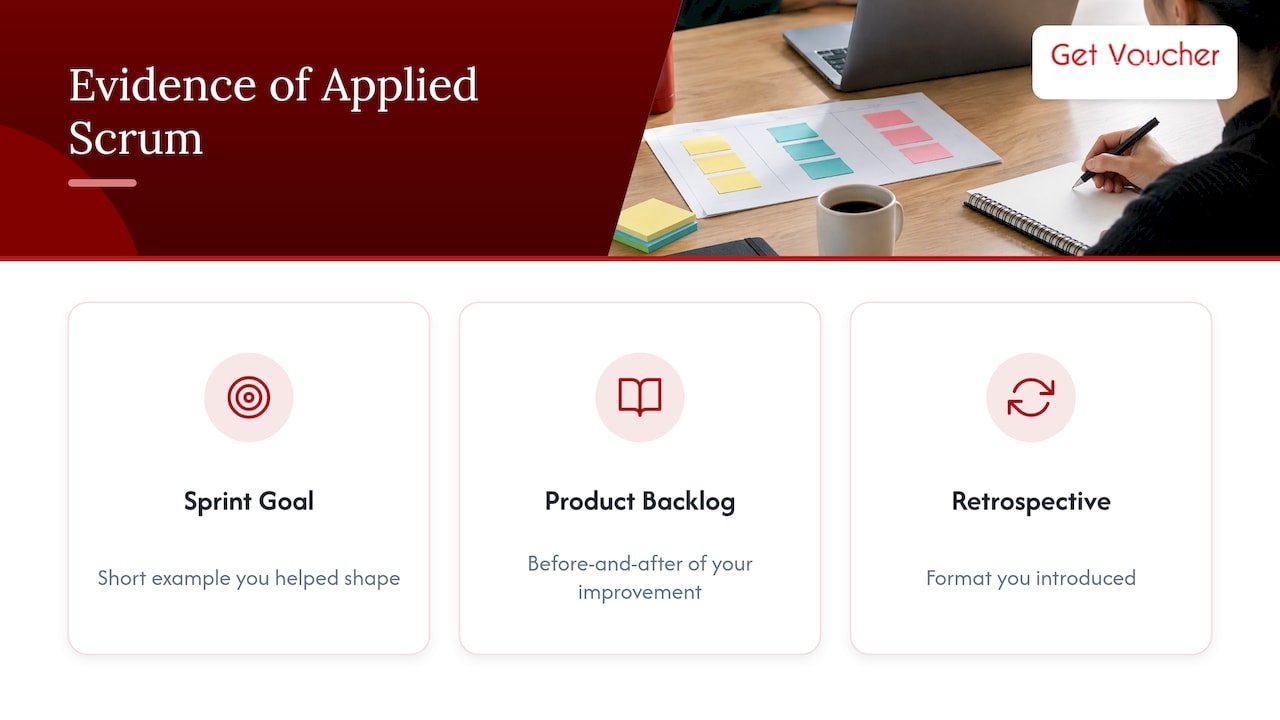
Pair the credential with evidence of applied work. A short written example of a Sprint Goal you helped shape, a before-and-after of a Product Backlog you improved, or a retrospective format you introduced all do more than a logo. This portfolio work is optional and sits outside any certification requirement.
Employer adverts are a useful market signal, though not proof. The official Scrum Alliance jobs board lists adverts that reference Scrum credentials, and general job boards mention a mix of certification types. Read a few for your target role and see which ones come up. For help presenting your experience, our piece on Scrum Master roles and responsibilities is a good companion.
If you also want an immersive, instructor-led option for broader skills, the Nomad Excel AI Bootcamp is a short, intensive workshop format worth knowing about.
How would we choose between them?
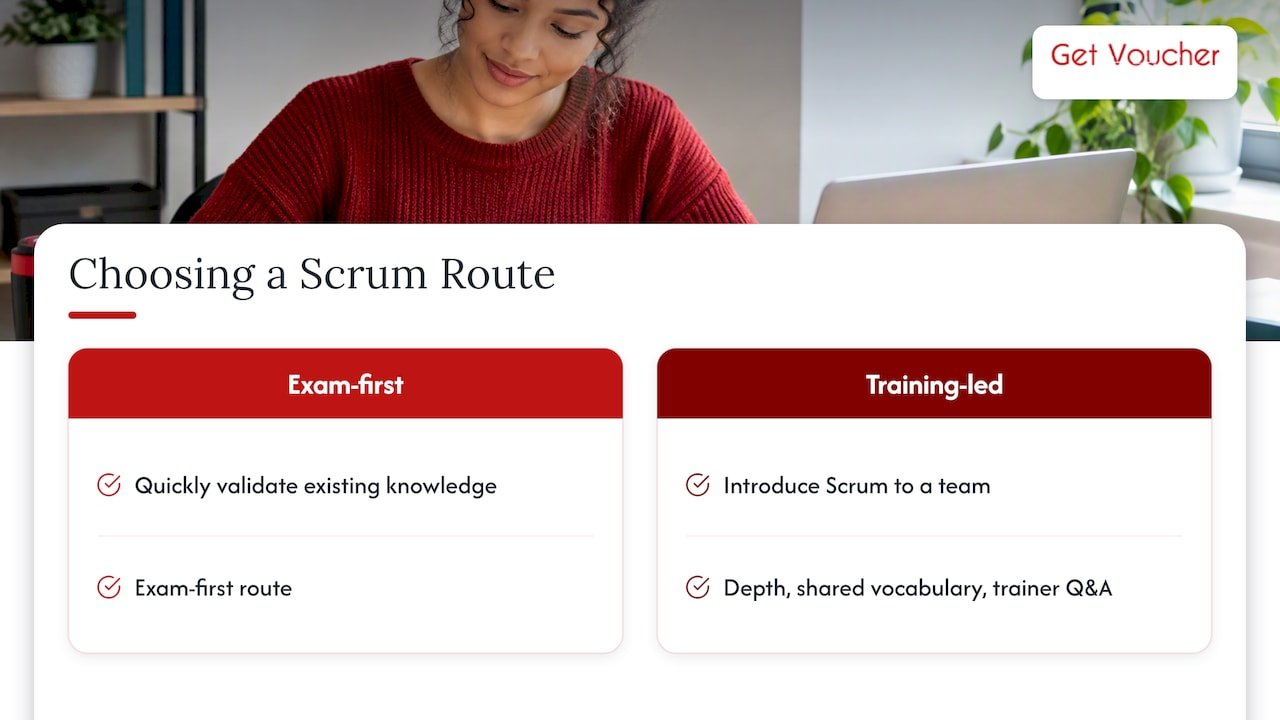
Our view is an editorial stance, not a claim of personal testing. If you need quick validation of what you already know, an exam-first route makes sense. If you are introducing Scrum to a team and want depth, shared vocabulary and a trainer to field questions, a training-led route usually pays off.
Lifetime-valid credentials suit people who dislike admin. Community-linked memberships suit people who value ongoing events and peers. For busy professionals, voucher-based self-paced preparation often removes the scheduling problem entirely.
Is a self-paced voucher route right for you?
We sell voucher-backed access to Scrum and Agile certifications from established providers, plus entry-level Scrum fundamentals. What each product includes varies, so check the page for the one you want.
- Lower upfront cost: our Scrum Master Certified (SMC®) voucher is £249 and Scrum Product Owner Certified (SPOC®) is £299.
- Flexible pacing: you study when it suits you, without a classroom date.
- One place to start: you can compare Scrum and Agile bundles in a single catalogue.
If you are unsure where to begin, start with Scrum Fundamentals Certified, then compare the full range on our Scrum and Agile category page or at Get-voucher.
FAQ
Is Scrum Alliance certification recognised?
The Scrum Alliance jobs board lists adverts that mention Scrum Alliance credentials. Recognition varies by employer and region, so check adverts for roles you want. A certification signals knowledge, not guaranteed competence.
Is Scrum Alliance reputable?
Scrum Alliance is an established certification body built around Certified Scrum Trainers and a community model. Reputation matters less than fit: look at its renewal rules, training requirements and cost against your goals before you decide.
Which Scrum certification is best?
There is no single best one. An exam-first route suits people who already know Scrum, while a trainer-led route suits those who want depth and peer contact. Match the credential to your role, budget and how you prefer to learn.
Is Scrum still relevant in 2026?
Scrum remains a defined framework with a current edition of the Scrum Guide. Whether it suits your organisation depends on your product and team context. Learning it is still a reasonable starting point for Agile roles.