




An Agile certification is a formal credential that validates your knowledge and practical ability to apply Agile principles in professional delivery teams. It confirms, to an employer or client, that you understand how Agile frameworks work and can put them into practice rather than just recite the theory.
Most certifications sit within a handful of frameworks: Scrum, Kanban, Lean, SAFe, and cross-framework options like PMI-ACP. Each tests a different mix of mindset, process knowledge, and role-specific skill. Before picking a course, decide which role you’re aiming at, Scrum Master, Product Owner, or general Agile practitioner, because that choice determines the certification that actually matches your day-to-day work.
- Scrum-focused roles suit those running or supporting sprint teams
- Product Owner paths suit those managing backlogs and stakeholder priorities
- Cross-framework credentials like PMI-ACP suit those who need breadth across Scrum, Kanban, and Lean
- Scaling frameworks like SAFe suit those working in larger, multi-team environments
If you’re weighing up options, GetVoucher’s certifications hub is a practical place to compare vouchers and starter courses before committing to a path.
Key Takeaways
Agile certification validates practical framework knowledge, and the right credential depends on matching your specific role, not chasing the most recognised name.
| Point | Details |
|---|---|
| Definition matters | An Agile certification formally validates your ability to apply Agile principles, not just recite theory. |
| Match role to credential | Scrum Master, Product Owner, and cross-framework paths test different skills; choose based on your actual job. |
| Check prerequisites early | Credentials like PMI-ACP require experience and training hours before you can sit the exam. |
| Certification pays off with experience | Certified professionals report roughly a 20% salary uplift, but it works best paired with delivery experience. |
| Renewal keeps credentials current |
Renewal requirements vary by certification body. Some credentials require periodic renewal, while others remain valid for life. |
| GetVoucher provides the access route | GetVoucher offers vouchers and study materials for SMC, SPOC, and SAMC through VMEdu and SCRUMstudy. |
Table of Contents
- What is Agile certification, and what types exist?
- Who should get which Agile certification?
- What skills do Agile certifications actually validate?
- How do you get Agile certified, step by step?
- What’s the real career and salary benefit of certification?
- How can you prepare using GetVoucher’s courses and vouchers?
- What happens after you’re certified: renewal and next steps?
- An editorial take on choosing your first Agile certification
- Get certified through GetVoucher’s voucher platform
- Sources
What is Agile certification, and what types exist?
Agile certification isn’t a single credential. It’s a family of related qualifications, each built around a different framework or role, and understanding the differences early saves you from picking the wrong one.
The distinctions matter because employers rarely treat all Agile certifications as interchangeable. A Scrum Master credential signals something different to a hiring manager than a scaling-framework qualification does, and choosing based on job title rather than framework name is a common early mistake.
- Scrum-focused credentials. These range from entry-level options such as Scrum Fundamentals through to practitioner and advanced levels. The Scrum Guide remains the reference point for Scrum’s roles, events, and artefacts, and most Scrum certification syllabuses build directly on it. GetVoucher’s Scrum Fundamentals Certified course is a common starting point for readers new to the framework.
- Product Owner credentials. These validate backlog management, prioritisation, and stakeholder communication rather than team facilitation. They suit people accountable for product direction and value delivery, not process coaching.
- Cross-framework certifications. PMI-ACP is the clearest example. It covers Scrum, Kanban, and Lean under one credential, which is why PMI positions it as suited to practitioners who move between methodologies rather than committing to one.
- Scaling and enterprise frameworks. SAFe and AgilePM address coordination across multiple teams and programmes. These matter once you’re operating beyond a single team, where Scrum’s team-level guidance alone doesn’t cover portfolio-level decisions.
- ICAgile tracks and micro-credentials. ICAgile organises certifications into skill-based tracks, fundamentals, delivery, coaching, and enterprise agility, which suits specialists who want targeted competencies rather than a full framework qualification. This model also works well for professionals outside software delivery who need an Agile mindset without adopting a strict methodology.
Who should get which Agile certification?
Your career stage and current role should drive the decision far more than what’s trending in job adverts.
- New to Agile teams: start with Scrum Fundamentals or an equivalent foundation course before committing to a role-specific credential.
- Aspiring or practising Scrum Masters: a role-focused Scrum credential, such as GetVoucher’s Scrum Master Certified (SMC), validates facilitation and coaching skills directly.
- Product-focused professionals: a Product Owner track like Scrum Product Owner Certified (SPOC) fits better than a generalist Scrum credential, since it tests backlog and prioritisation skills specifically.
- Technical project managers: breadth often serves better than depth in one framework. Guidance from Project Management Formula notes that technical PMs often benefit from PMI-ACP once they’ve built enough hands-on Agile experience to meet its prerequisites.
- Delivery leads eyeing organisational impact: scaling credentials such as SAFe or an advanced practitioner qualification like SCRUMstudy Agile Master Certified (SAMC) become relevant once you’re influencing multiple teams rather than one.
A staged approach often works best for technical PMs specifically: Scrum fundamentals first, for immediate team-level utility, then PMI-ACP once the required experience hours accrue. That order gives you a working credential quickly while building toward the more strategically weighted one.
What skills do Agile certifications actually validate?
Certifications aren’t just theory tests. The better ones validate skills you’ll use the same week you pass the exam.
- Agile mindset and iterative planning, including how to structure sprints, backlogs, and incremental delivery rather than upfront big-bang planning.
- Backlog management and prioritisation, particularly relevant for Product Owner tracks, covering how to sequence work against shifting business value.
- Facilitation and coaching, tested more heavily in Scrum Master credentials, covering how to run retrospectives, remove blockers, and coach team self-organisation.
- Stakeholder communication and metrics, including how to report progress using velocity, burndown charts, or cycle time rather than status-update language.
- Scenario-based judgement, where exams present a delivery problem and ask you to apply the correct Agile principle rather than just define a term.
Pro Tip: Certification proves you understand the framework, but employers still expect you to demonstrate it on real delivery work. Pair any credential with a project example you can talk through in an interview, not just the certificate itself.
How do you get Agile certified, step by step?
The path from decision to certificate follows a fairly predictable sequence, though prerequisites vary noticeably between credentials.
- Check prerequisites first. PMI-ACP is a useful example of how demanding these can be. It requires documented Agile experience hours plus formal training hours before you can even sit the exam. Foundation-level Scrum certifications, by contrast, typically have no experience requirement at all.
- Choose a study route. Options include instructor-led courses, self-paced video training, and voucher-based access to official materials. Self-paced routes suit working professionals who can’t commit to fixed class schedules.
- Work through mock exams. Exam formats differ: some are straightforward multiple-choice knowledge tests, while others, PMI-ACP among them, weight scenario judgement and applied experience more heavily. Study accordingly.
- Check your exam format. Agile certification exams may be delivered online as either proctored or unproctored assessments, depending on the certification provider.
- Allow realistic preparation time. Foundation-level certifications can often be prepared for in a matter of weeks; credentials with experience prerequisites, like PMI-ACP, take longer simply because the eligibility hours take time to accrue.
According to career-market analysis, certified professionals often report roughly a 20% salary uplift compared with similar non-certified peers, a meaningful incentive when weighing up the time investment.
What’s the real career and salary benefit of certification?
Certification works as a signal, not a guarantee. It tells an employer you’ve invested formally in Agile methodology, which matters most when your CV is being screened against dozens of similar applications.
Certified professionals earn, on average, roughly a 20% premium over non-certified peers doing comparable work, according to Dice’s career-advice analysis. The same analysis notes that certification works best combined with demonstrable delivery experience, not as a substitute for it.
That combination matters more than the certificate alone. Employers assessing Scrum Master or Product Owner candidates typically look for a credential plus a track record of actual sprint delivery, stakeholder handling, or backlog ownership. Certification opens the conversation; experience closes it. For professionals eyeing a lateral move, say from a general PM role into a dedicated Agile role, certification also provides a documented reference point that experience alone can’t offer on a CV.
How can you prepare using GetVoucher’s courses and vouchers?
GetVoucher works as a voucher platform, giving you access to certification pathways from VMEdu, the training provider, and SCRUMstudy, the certification body behind several widely recognised Scrum credentials. In practice, that means you buy a voucher through Get-Voucher.com, then use it to access structured study materials and take your online certification exam.
Three credentials map cleanly onto the role paths discussed above:
- Scrum Master Certified (SMC): validates facilitation, coaching, and sprint-level delivery skills, matching the Scrum Master role directly.
- Scrum Product Owner Certified (SPOC): validates backlog management and stakeholder prioritisation, matching the Product Owner role.
- SCRUMstudy Agile Master Certified (SAMC): an advanced-level credential suited to practitioners moving toward senior delivery or coaching responsibilities.
If you want both team-facing and product-facing competencies in one purchase, the Dual Agile Pack combining Scrum Master and Product Owner certification covers both without buying two separate vouchers.
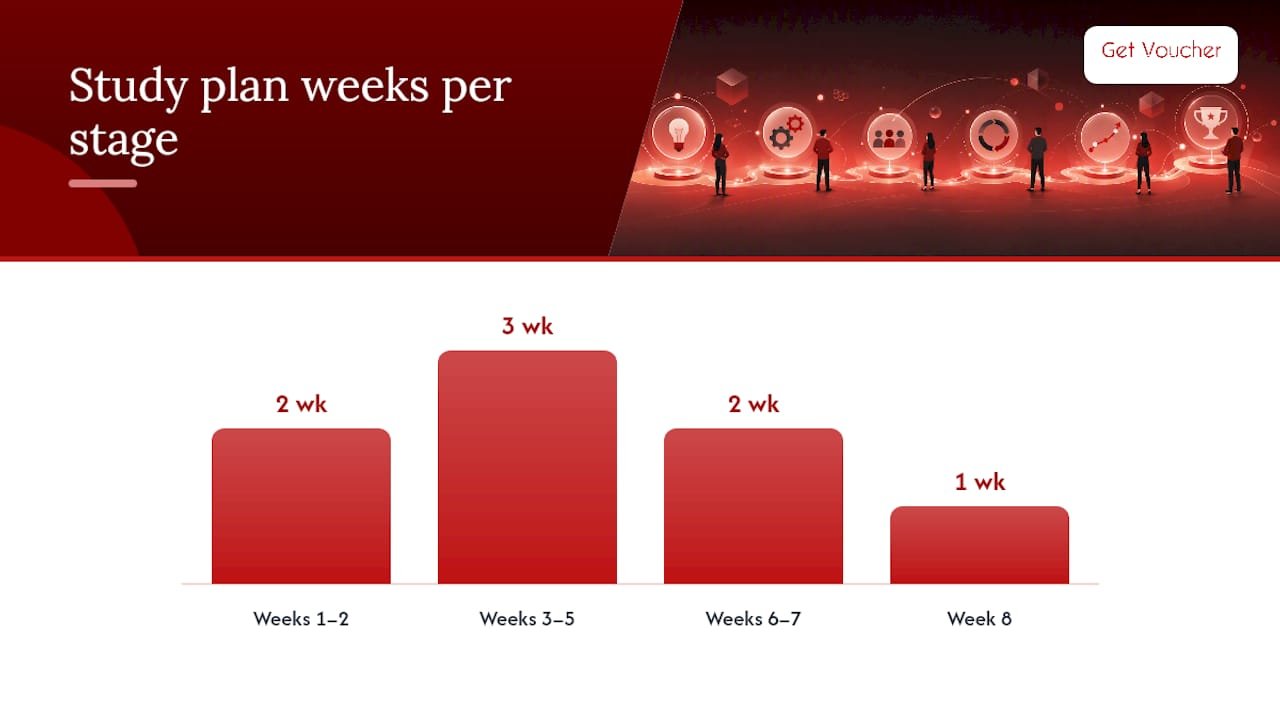
A practical six to eight week study plan looks like this:
- Weeks 1 to 2: work through self-paced video training for your chosen credential.
- Weeks 3 to 5: revisit weaker topics and start timed mock exams.
- Weeks 6 to 7: sit full-length practice exams under exam conditions.
- Week 8: take your online certification exam once your mock scores are consistent.
Pro Tip: Plan when you intend to take your exam once your mock exam scores stabilise. An open-ended study plan with no target date tends to drift.
Certification amplifies experience rather than replacing it. Industry career guides consistently note that the strongest candidates pair a formal credential with demonstrable delivery work.
If you’re weighing role-specific study support before committing, GetVoucher’s guides on becoming an effective Scrum Master and becoming an effective Product Owner break down the practical skills behind each exam. Certifications for frameworks like SAFe or AgilePM aren’t yet listed on GetVoucher; if you’re after one of those, contact GetVoucher directly for pricing and availability as coverage expands.
What happens after you’re certified: renewal and next steps?
Renewal requirements vary between Agile credentials. Some require periodic renewal or recertification, while others remain valid indefinitely.
- Track renewal cycles. Requirements vary by certifying body, so check your specific credential’s renewal window rather than assuming a standard timeline.
- Log continuing professional development (CPD). This typically involves ongoing learning, training, or practical Agile work logged against your credential.
- Plan your next credential early. Common progressions include moving from a foundation-level Scrum credential toward an advanced practitioner qualification, or toward coaching and scaling roles as your responsibilities grow.
- Use structured renewal guidance. GetVoucher’s page on maintaining your SCRUMstudy certification sets out what’s involved in keeping a SCRUMstudy credential current.
If you’re aiming beyond team-level Scrum work, GetVoucher’s SCRUM Agile Master Certified (SAMC) course is a natural next step for practitioners moving toward senior or coaching responsibilities.
An editorial take on choosing your first Agile certification

The mistake most guides encourage, without meaning to, is treating certification choice as a popularity contest. Readers ask “which certification is most recognised” when the better question is “which certification matches what I actually do at work on Monday morning.” A Product Owner spending their week on backlog prioritisation gains little from a Scrum Master credential’s facilitation focus, however well-regarded that credential is in general terms.
The research here supports a narrower, more useful conclusion: role fit beats framework prestige. PMI-ACP’s breadth genuinely serves technical PMs who move between methodologies, but it’s overkill for someone running a single Scrum team who needs facilitation skills, not cross-framework theory. Conversely, a foundation-level Scrum certification is a poor fit for someone already coordinating multiple teams across a programme.
What the reader should prioritise first isn’t the “best” certification. It’s an honest look at their current role, then a credential that validates the skills that role already demands. Everything else, salary uplift, career mobility, employer recognition, follows from that fit rather than from chasing whichever credential ranks highest on a listicle.
— Rayan
Get certified through GetVoucher’s voucher platform
GetVoucher gives you a single place to buy vouchers for the certifications discussed here, Scrum Master Certified (SMC), Scrum Product Owner Certified (SPOC), and SCRUMstudy Agile Master Certified (SAMC), rather than hunting across separate provider sites for pricing, materials, and exam booking.
That matters most for working professionals juggling a full-time role alongside study. GetVoucher pairs your voucher with self-paced video training, cutting the time you’d otherwise spend piecing together study resources from scattered sources. Once you’ve matched your role to a credential using the guidance above, browse the full certifications catalogue to find the right voucher, or start with the Dual Agile Pack if you want both Scrum Master and Product Owner competencies covered in one purchase. Check your account dashboard once enrolled for the instructions to access your online exam when you’re ready.
Sources
- Dice
- Agile Certified Practitioner (PMI-ACP) Certification | PMI
- The Scrum Guide
- Agile Certifications | ICAgile