




For many working professionals, a common recommended route is the Scrum Product Owner Certified (SPOC®) credential or the Dual Agile Pack, chosen because of their accessible assessment models and clear progression from fundamentals to practitioner level. Senior candidates eyeing enterprise or scaled-agile roles may instead need a scaled-agile or PMI credential, covered in the “how to choose” section below.
Table of Contents
- What product owner certifications actually validate
- Which certification type suits which career stage
- How to choose a product owner certification
- GetVoucher’s recommended product owner pathways
- Preparation plans, study routes and typical costs
- What most learners get wrong about product owner certification
- Getting started with GetVoucher’s product owner vouchers
- FAQ
- Sources
What product owner certifications actually validate
A certification validates knowledge of a framework’s vocabulary, roles and practices. It does not prove that you can run a backlog under pressure or negotiate with five stakeholders who all want different things this sprint. Treat any product owner credential as evidence that you understand the concepts, not as a guarantee of workplace performance.
Several issuing bodies dominate the space, and each one signals something slightly different:
- Scrum.org issues the Professional Scrum Product Owner (PSPO) series, assessed through proctored online exams.
- Scrum Alliance issues the Certified Scrum Product Owner (CSPO), built around an approved training course rather than a test.
- Scaled Agile issues SAFe credentials aimed at product ownership within larger, multi-team environments.
- PMI offers agile-adjacent credentials such as the PMI-ACP, useful for professionals already working inside PMI-aligned organisations.
- SCRUMstudy issues the Scrum Product Owner Certified (SPOC®), assessed through an online unproctored exam.
- APMG and ICAgile issue a range of Agile and product-focused credentials, often recognised in specific industries or regions.
A certification tends to help most at the interview stage, where it signals structured learning and a shared vocabulary with hiring managers. Career advice guidance recommends matching your certification choice to your career goals and available study time rather than assuming any single credential works for everyone. Once you are in the role, demonstrated experience with real backlogs, roadmaps and stakeholder conflicts tends to matter more than the letters after your name.
Which certification type suits which career stage
Matching the credential family to where you actually are in your career saves both money and time.
- New to Scrum and product ownership: start with a fundamentals-level credential that introduces roles, events and artefacts without assuming prior experience.
- Practising product owners: a practitioner-level credential, such as SPOC® or a Scrum.org PSPO exam, validates competency in backlog management, stakeholder engagement and value-driven prioritisation.
- Senior or enterprise-facing roles: scaled-agile or product-management-style credentials address product ownership across multiple teams, programmes or portfolios, which single-team credentials rarely cover.
- Transitioning from another role: project managers, business analysts and engineers moving into product ownership often benefit from pairing a Scrum Master credential with a product owner one, since the combination covers both delivery mechanics and prioritisation.
Indeed’s guide to product owner certifications lists Professional Scrum Product Owner (PSPO), Certified Scrum Product Owner (CSPO) and SAFe Product Owner/Product Manager (POPM) among the credentials commonly considered, and notes that employability is a frequent reason professionals pursue them. None of these is inherently the “right” choice. The right choice depends on where your backlog sits today and where you want it to sit in two years.
How to choose a product owner certification
Choosing well means working through a short checklist rather than picking the most-advertised name; for practical advice on selecting a partner and emphasizing fit, evidence and outcomes, see How to Choose the Right Software Development Partner.
- Clarify your goal. Decide whether you need the credential for hireability, for structured learning, or to signal readiness for enterprise-scale work.
- Check the assessment model. Some credentials are course-only with no test, some use online unproctored exams, and some use proctored exams with set question counts and pass marks. Decide which format suits how you learn and how much time you have.
- Check issuing-body recognition where you work. Employer familiarity with a given issuing body varies by industry and region, so ask around before committing.
- Work out the full cost and time commitment. Include study materials, the exam or course fee, and any renewal obligations, which are set by the issuing body rather than being universal across credentials.
- Ask providers direct questions before paying. Confirm exam format, retake policy and whether course materials are included in the price.
Pro Tip: Before enrolling, write down the one workplace problem you want the certification to help you solve. It keeps you from choosing a credential because it is popular rather than because it fits.
GetVoucher’s recommended product owner pathways
GetVoucher offers three product owner pathways worth knowing in detail, each with a distinct assessment model that should not be compared for difficulty against credentials from other issuing bodies.
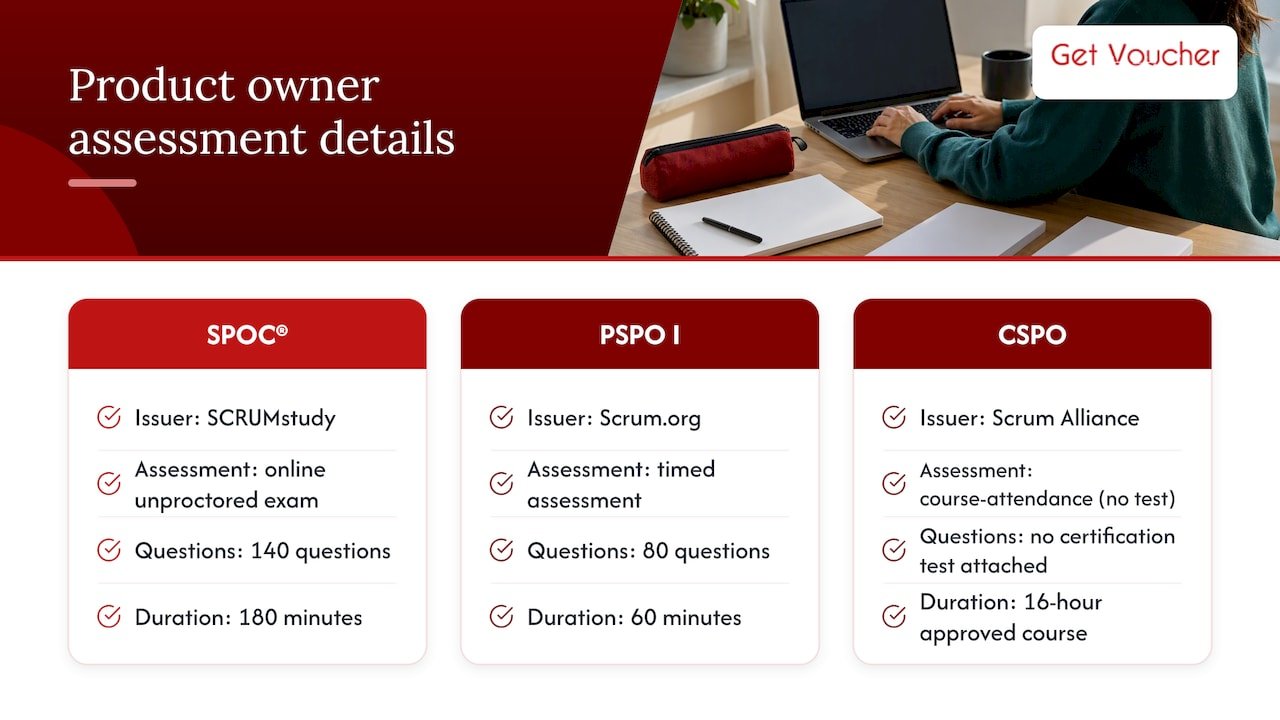
Scrum Product Owner Certified (SPOC®), issued by SCRUMstudy, uses a 140 question, 180 minute online unproctored exam with no formal prerequisite. You can access the SPOC® course page to review the current voucher price, which should always be confirmed against the live catalogue before purchase.
PSPO I, issued by Scrum.org, uses an 80 question, 60 minute assessment with an 85% pass mark and lifetime certification once achieved. This is a separate issuing body with its own rules, and its renewal terms are set entirely by Scrum.org rather than by any other provider.
CSPO, issued by Scrum Alliance, requires a 16-hour approved course with no certification test attached. Because CSPO’s assessment model is course-attendance rather than examination, it cannot be meaningfully compared for difficulty against SPOC® or PSPO I: the three use entirely different methods of validating knowledge, and treating them as equivalent or ranking them against one another is not a valid comparison.
For learners who want both Scrum Master and Product Owner grounding in one pathway, the Dual Agile Pack combines both credentials, which suits transitioners moving from adjacent roles such as project management or business analysis. For complete newcomers, the Scrum Fundamentals Certified course offers a low-barrier entry point with no prior Scrum knowledge assumed.
Several product owner credentials dominate hiring conversations today, with Indeed’s product owner certification guide naming PSPO, CSPO and SAFe POPM among the ones professionals most commonly pursue to strengthen employability.
Renewal and continuing education requirements differ by issuing body: Scrum.org’s PSPO carries lifetime certification with no renewal fee, while Scrum Alliance’s CSPO requires periodic renewal through its own continuing education system. Treat each body’s rules as separate rather than assuming one pattern applies across the board.
Preparation plans, study routes and typical costs
How long you need to prepare depends heavily on where you are starting from.
- 0 to 6 weeks: suitable for fundamentals-level study, where the goal is familiarity with roles, events and terminology rather than deep practical application.
- 6 to 12 weeks: typical for practitioner-level preparation, combining self-paced video with practice questions ahead of an exam.
- 12 or more weeks: often needed for enterprise or scaled-agile credentials, where course hours and case-study work are more substantial.
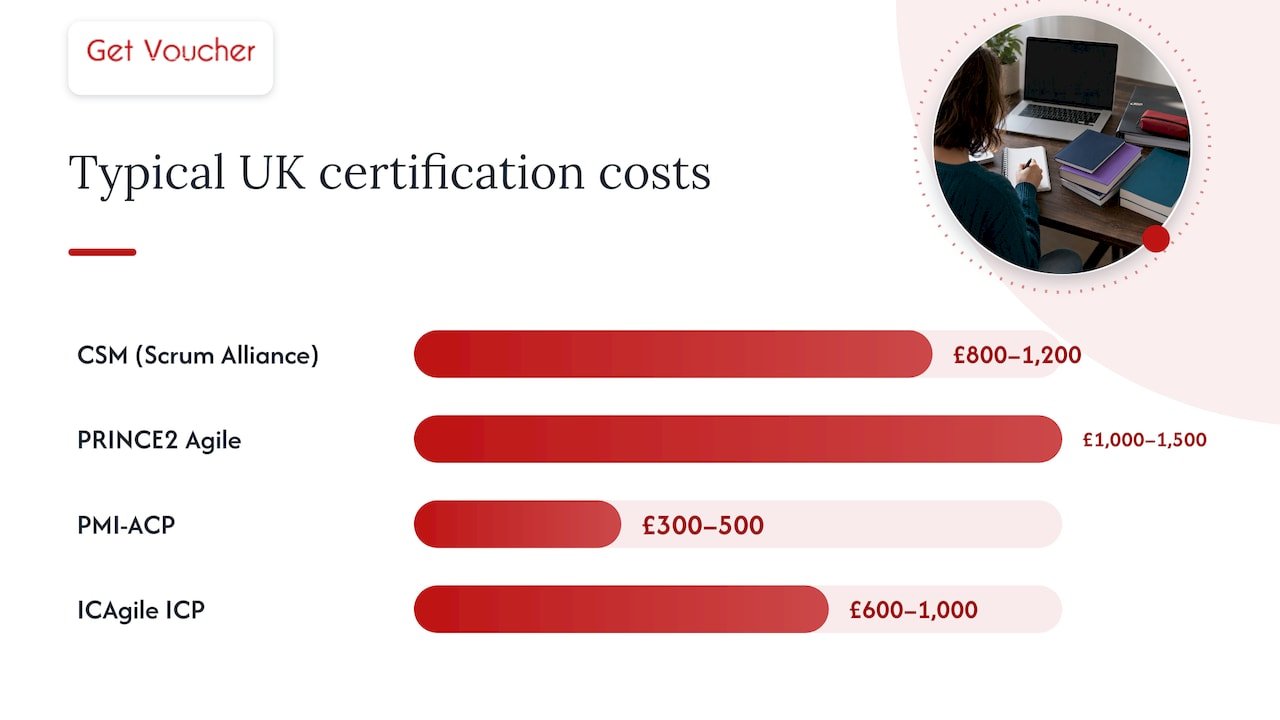
On cost, industry data on Agile certification in the UK shows a wide spread: Certified ScrumMaster through Scrum Alliance averages £800 to £1,200, PRINCE2 Agile Practitioner averages £1,000 to £1,500, PMI-ACP averages £300 to £500, and ICAgile Certified Professional averages £600 to £1,000. These are UK industry averages for the named credentials specifically, not universal prices, and they illustrate why checking the exact cost of your chosen credential before enrolling matters.
For format, self-paced video training suits busy professionals who cannot commit to fixed class times, while instructor-led courses suit learners who want structured pacing and live feedback. Buying a voucher through a platform such as GetVoucher gives access to validated course materials in one place rather than requiring you to piece together free videos and documents from several sources. Always check the live price on GetVoucher’s certifications page before purchasing, since catalogue prices can change.
What most learners get wrong about product owner certification
The most common mistake is picking a credential because of its name recognition rather than its assessment model. Someone who thrives with structured coursework and dislikes timed exams will struggle with an unproctored, time-boxed test, regardless of how reputable the issuing body is. Match the format to how you actually study, not to what looks best on a certificate.
The second mistake is assuming a certification alone will change your role. It demonstrates knowledge of a framework’s practices, nothing more; the promotion or job offer still depends on how you apply that knowledge once the exam is behind you.
For newcomers, start with a fundamentals course and resist the urge to jump straight to a practitioner-level exam. For practising product owners, pick a practitioner credential whose assessment style suits your schedule. For senior professionals, check whether your target organisation actually uses scaled-agile frameworks before investing in a scaled-agile credential nobody on your team will recognise.
— Rayan
Getting started with GetVoucher’s product owner vouchers
GetVoucher brings certification pathways across Scrum, Agile, digital marketing and quality management into one catalogue, so you can compare a SPOC® voucher against a Dual Agile Pack without hunting across separate provider sites.
Using the platform is straightforward:
- Browse the certifications catalogue and pick the pathway that matches your career stage.
- Buy the voucher, which gives access to course materials and exam scheduling details.
- Work through self-paced video training at your own pace, then schedule your assessment when ready.
Always check the current price against the live catalogue before you buy, since figures can change. Start by reviewing GetVoucher’s full range of certification vouchers to see which pathway fits your next career step.
FAQ
Which certification is better, CSPO or PSPO?
Neither is universally better: CSPO is assessed through a 16 hour approved course with no test, while PSPO I uses an 80 question, 60 minute exam with an 85% pass mark. The right choice depends on whether you prefer course-based learning or a timed assessment, and on which issuing body your target employers recognise.
Is a CSPO certification worth it?
CSPO certifies understanding of product owner practices as taught in Scrum Alliance’s approved course format, and Indeed’s certification guide lists it among the credentials professionals commonly pursue for employability. Whether it is worth it depends on your specific career goal and whether your target employers recognise Scrum Alliance credentials.
Is Scrum still relevant in 2026?
Scrum remains a widely used framework for product and software delivery, and issuing bodies such as Scrum.org and Scrum Alliance continue to maintain active certification programmes. Relevance depends on your organisation’s delivery model, so check whether your target employers actually run Scrum before committing to a Scrum-specific credential.
Is PSPO I difficult?
PSPO I uses an 80 question, 60 minute online assessment with an 85% pass mark, a format that rewards strong familiarity with the Scrum Guide rather than general work experience alone. Difficulty is personal, and comparing it against other credentials with different assessment formats, such as course-based CSPO or unproctored SPOC®, is not a meaningful comparison.
Sources
- Agile certification in the UK: A comprehensive guide
- Product owner certifications to consider (With FAQs) — Indeed