



Use DMAIC for complex, data-rich, recurring problems that need root-cause verification; use PDCA or PDSA for fast, iterative learning and small tests of change. The two are not rivals: PDCA cycles sit comfortably inside DMAIC’s Improve phase, and both NHS and academic process-improvement research back that blended approach.
Table of Contents
- DMAIC explained: phases, artefacts and when it pays off
- PDCA/PDSA explained: the iterative learning cycle and use cases
- Side-by-side comparison by the decision dimensions readers actually use
- Decision guide: how to choose
- Practical hybrids: using PDCA inside DMAIC
- How Six Sigma training builds DMAIC and PDCA skills
- Author perspective: three pragmatic heuristics for busy teams
- Explore GetVoucher courses to learn DMAIC and PDCA skills
- FAQ
- Sources
DMAIC explained: phases, artefacts and when it pays off
DMAIC stands for Define, Measure, Analyse, Improve and Control, and it is the structured Six Sigma roadmap for improving an existing process. According to NHS guidance, it is described as a robust, multistage framework built around rigorous statistical measurement, analysis and control, and it fits problems that are important, recurring or poorly understood, where you need a defensible baseline, verified causes and sustained control once a fix is in place.
Each phase has its own job and its own output:
- Define sets the problem statement, scope and customer requirements, usually captured in a project charter.
- Measure establishes a baseline using agreed metrics, often validated through a measurement system analysis.
- Analyse tests hypotheses about root causes using statistical tools rather than opinion.
- Improve designs, trials and selects the countermeasure that addresses the verified cause.
- Control locks the gain in place with a control plan, monitoring charts and clear ownership.
The tools attached to each phase reflect that rigour. Teams typically use a SIPOC diagram in Define to map suppliers, inputs, process, outputs and customers; a process capability study in Measure to quantify current performance; a fishbone diagram and hypothesis testing in Analyse to narrow down causes; and statistical process control (SPC) charts in Control to confirm the process stays within limits after the fix.
DMAIC earns its overhead when customer requirements are measurable, when stakeholders disagree about what is actually causing a problem, or when the cost of the issue recurring is high, making it essential to follow essential tips to accelerate AI-driven engineering success to align data collection and decision criteria effectively. It replaces managerial anecdote with an evidence chain running from customer requirement to verified cause to controlled outcome, which is precisely why it works well for disputed causes: nobody can argue with a capability study the way they can argue with an opinion.
Pro Tip: If your team cannot agree on the root cause after a short discussion, that disagreement is itself a signal that you need DMAIC’s measurement and analysis phases, not another meeting.
The misuse to watch for is applying DMAIC to problems that do not need it. A one-off scheduling clash, a single mislabelled form or a quick frontline fix does not justify weeks of data collection and a formal charter. NHS guidance and a two-year coronary heart disease collaborative study of around 20 projects both caution against reaching for DMAIC by default, since many improvement opportunities do not need advanced statistical analysis at all. DMAIC also demands facilitation and leadership skills: someone has to hold stage gates, resist the urge to jump straight to a solution, and keep the team honest about what the data actually shows rather than what everyone already assumed.
PDCA/PDSA explained: the iterative learning cycle and use cases
PDCA stands for Plan, Do, Check and Act, often written as PDSA (Plan, Do, Study, Act) in healthcare settings. NHS and Cambridge Institute for Manufacturing resources both describe it as a small-test learning cycle used across improvement work, well suited to iterative learning and small tests of change where a team needs to learn quickly without a full Six Sigma project structure behind it.
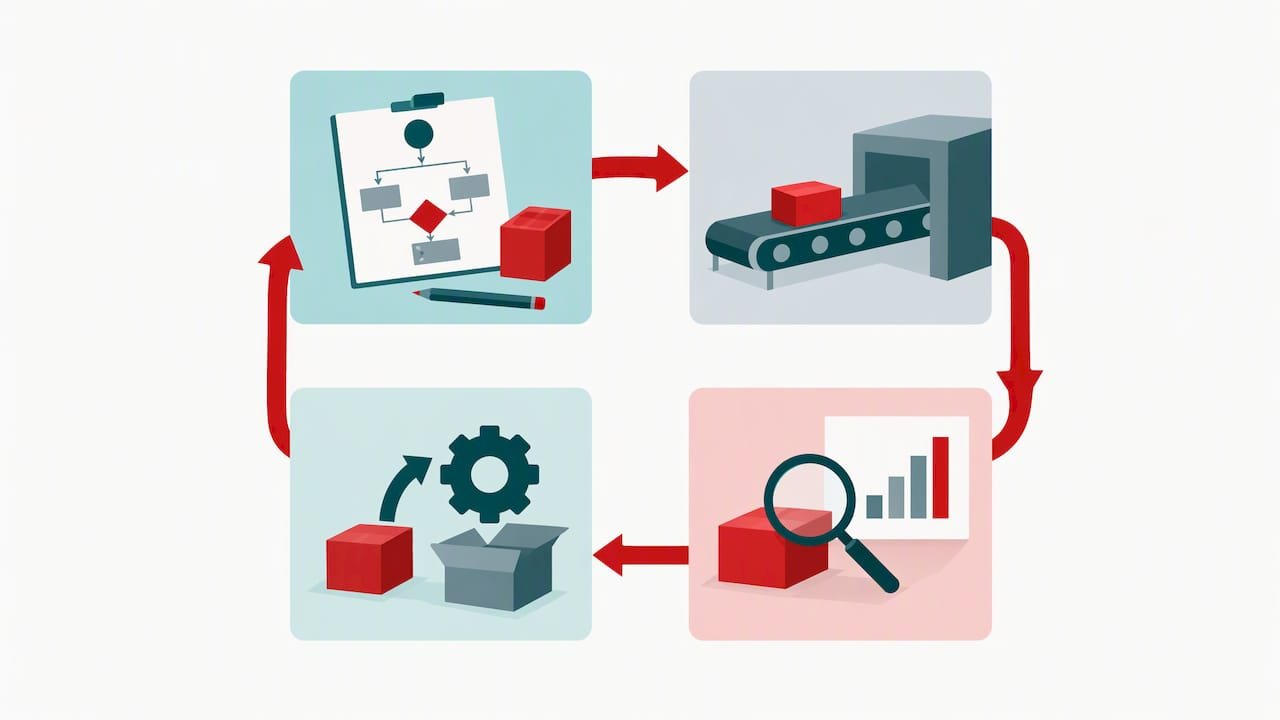
Each step has a distinct purpose. Plan defines what you expect to happen and how you will know. Do run the change on a small, controlled scale. Check (or Study in the PDSA variant) compares what actually happened against the prediction. Act decides whether to adopt, adapt or abandon the change. The shift from “Check” to “Study” in healthcare versions is deliberate: it pushes teams to interrogate why the result occurred rather than simply confirming whether it matched expectations, which turns each cycle into a genuine learning event rather than a pass or fail test.
A good test of change follows a short, repeatable checklist:
- State a clear hypothesis: what do you predict will happen and why?
- Keep the scope small, one ward, one shift or one form, not a full rollout.
- Measure quickly, using whatever data is already close at hand.
- Agree the next step before you start, so a disappointing result still moves the work forward.
PDCA suits kaizen events, frontline fixes, reversible process changes and software retrospectives, anywhere a team can run several cycles in days rather than months and where a failed test costs little. It is worth noting that PDCA is not owned by any single discipline. NHS Lean Six Sigma guidance describes it as a general improvement cycle used across Total Quality Management, Lean and Six Sigma alike, which is one reason it turns up inside so many other frameworks rather than standing apart from them.
Side-by-side comparison by the decision dimensions readers actually use
Reading theory about either method only gets you so far. What actually helps is comparing them against the dimensions that drive a real decision: what the problem looks like, how much data you have, how fast you need to move and what happens if you get it wrong.
Best for (problem type):
- DMAIC: complex, recurring problems with disputed or unclear root causes.
- PDCA: small, reversible changes where the team can learn by doing.
Scale and governance required:
- DMAIC: typically a chartered project with a sponsor, defined scope and stage gates.
- PDCA: informal, often run by a single team or even one person.
Data and measurement needs:
- DMAIC: a validated baseline and statistical analysis of causes.
- PDCA: a quick, practical measure, enough to judge whether the change worked.
Speed and iteration:
- DMAIC: weeks to months, moving through five sequential phases.
- PDCA: days, with the option to run several cycles in succession.
Typical artefacts and tools:
- DMAIC: charter, SIPOC, capability study, fishbone diagram, control plan.
- PDCA: a one-page test plan and a before-and-after comparison.
Risks and common misuses:
- DMAIC: overkill for trivial issues, and stalls without skilled facilitation.
- PDCA: can become aimless experimentation without a clear hypothesis.
DMAIC is the right call when the cost of guessing wrong is high and the evidence trail needs to withstand scrutiny, a point NHS guidance makes directly: DMAIC’s statistical rigour exists precisely to replace guesswork with a defensible chain from customer requirement to verified cause.
Three short scenarios show how this plays out in practice. A hospital trust sees readmission rates creeping up across several wards, with clinical staff disagreeing about whether the cause is discharge paperwork, medication timing or follow-up scheduling: this is complex, data-rich and politically sensitive, so DMAIC is the right call, since it forces the team to measure before arguing. A retail team notices a till queue building up at a specific time of day and wants to try repositioning a self-checkout unit: this is small, reversible and cheap to test, so a PDCA cycle run over a single afternoon settles it. A manufacturing line wants to cut scrap rate using a new jig design: the team runs a quick PDCA pilot on one shift to check the jig works at all, then folds the successful design into a full DMAIC project to verify the root cause of scrap across the whole line and lock in the control plan, a hybrid pattern.
A quick checklist for your own decision: if causes are disputed, data is available and the fix is expensive to get wrong, lean towards DMAIC; if the change is small, reversible and you can measure results within days, start with PDCA; if you are unsure, run a PDCA pilot first and escalate to DMAIC only if the problem turns out to be bigger or more contested than expected.
Decision guide: how to choose
Turning the comparison into an actual decision does not need to be complicated. Walk through these questions in order:
- Is the root cause disputed or unclear? If stakeholders genuinely disagree, lean towards DMAIC’s analysis phase to settle it with data.
- How much is at stake if you get it wrong? High cost of recurrence or regulatory exposure points towards DMAIC’s control discipline.
- How mature is your data? If you already have reliable baseline metrics, DMAIC’s measurement phase is less of a burden; if you are starting from nothing, a PDCA test can establish a rough baseline first.
- Is the change reversible? Reversible, low-risk changes are ideal PDCA territory; irreversible or costly changes deserve DMAIC’s stage gates.
- How much time do you have? A same-week fix favours PDCA; a multi-month improvement programme can justify DMAIC’s overhead.
As a rough guide, a PDCA cycle can run with one or two people over a few days, while a DMAIC project typically needs a sponsor, a facilitator and a small cross-functional team over several weeks to a few months, depending on the problem’s scope.
Pro Tip: Treat “we are not sure yet” as a valid answer. Run one small PDCA test to learn more about the problem, then decide whether it needs DMAIC’s full rigour.
Certain red flags should push you straight to DMAIC regardless of how the other questions land: causes that different departments blame on each other, a failure that has recurred more than once despite previous fixes, anything touching regulatory compliance or patient safety, or a change that would be expensive or embarrassing to reverse.
Practical hybrids: using PDCA inside DMAIC
The two methods combine more often than the comparison table suggests. NHS and academic quality improvement guidance document that PDCA or PDSA is routinely used inside DMAIC’s Improve phase, and tools from either approach can be borrowed at any stage of a PDSA cycle. The logic is straightforward: DMAIC’s Define, Measure and Analyse phases do the hard work of establishing what the problem actually is and why it happens, and then PDCA takes over to test candidate fixes quickly before you commit to a full rollout.
Two examples show the saving without losing control. A hospital team verifies through DMAIC analysis that discharge delays stem from a specific handover form, then runs a two-week PDCA pilot of a redesigned form on one ward before updating the trust-wide control plan. A manufacturing team confirms a defect’s root cause through capability analysis, then tests two alternative fixtures using a rapid PDCA comparison with pre- and post-measurements, selecting the winner before writing it into the Control phase’s SPC charts.
Three rules keep this safe:
- Keep your DMAIC baseline measurements running throughout the PDCA pilot, so you can compare like with like.
- Predefine the acceptance criteria for the PDCA test before you run it, not after you see the results.
- Update the control plan only once a PDCA cycle has succeeded, never on the strength of a single promising run.
For a broader view of how DMAIC and PDCA sit within wider improvement thinking, our explainer on Lean and Six Sigma sets out how the two disciplines diverge on flow versus variation.
How Six Sigma training builds DMAIC and PDCA skills
Learning to run DMAIC well is less about memorising five phase names and more about practising the tools inside them: SIPOC mapping, capability studies, fishbone analysis and control charting all take repetition to apply confidently. Our Six Sigma Yellow Belt (SSYB™) course introduces the DMAIC structure and foundational tools, while our Six Sigma Green Belt (SSGB™) and Lean Six Sigma Green Belt (LSSGB™) courses go further into statistical analysis and control planning, the parts of DMAIC that most teams find hardest without structured practice.
Self-paced video training alongside downloadable study materials allows learners to work through the Measure and Analyse phases at their own speed rather than requiring classroom coaching, and practical exercises provide an opportunity to apply PDCA-style tests before using them in a live project.
Author perspective: three pragmatic heuristics for busy teams
Three heuristics keep teams out of trouble. Start small: a PDCA pilot almost always teaches you something useful before you commit to a full DMAIC project. Escalate when needed: the moment causes are disputed or the cost of failure climbs, stop iterating informally and bring in DMAIC’s rigour. Measure proportionately: match the weight of your measurement effort to the weight of the decision, not to what looks impressive in a report. Running DMAIC well also takes real facilitation skill, someone willing to slow a room down and insist on evidence before a decision gets made.
— Rayan
Explore GetVoucher courses to learn DMAIC and PDCA skills
Building genuine confidence with DMAIC and PDCA comes from practising the tools, not just reading about them, and that is where structured, self-paced study earns its keep over piecing together free videos and scattered guides.

A few starting points worth a look:
- Six Sigma Green Belt (SSGB™): covers the full DMAIC toolkit, from capability studies to control planning.
- Lean Six Sigma Green Belt (LSSGB™): adds Lean’s flow and waste perspective alongside Six Sigma’s statistical rigour.
- Green Belt in 80 Hours: Six Sigma certification: a structured route for professionals who want certification without classroom scheduling.
Each is a one-off voucher purchase with self-paced online access, so you can fit DMAIC and PDCA practice around existing work rather than a fixed course timetable. Have a look at the Six Sigma Green Belt course page to see what the curriculum covers.
FAQ
When should DMAIC not be used?
DMAIC is not worth the overhead for trivial, one-off or clearly understood problems where a quick fix will do. NHS guidance notes that many improvement opportunities do not need advanced statistical analysis, making a lighter PDCA or PDSA cycle the better fit for small, reversible changes.
Is PDCA lean or Six Sigma?
PDCA belongs to neither exclusively. NHS Lean Six Sigma guidance describes it as a general improvement cycle used across Total Quality Management, Lean and Six Sigma, which is why it appears inside so many different frameworks rather than being tied to one.
Is PDCA a kaizen?
PDCA is not kaizen itself, but the two are closely linked: kaizen events frequently use PDCA cycles as their working structure for testing small, rapid changes. The Cambridge Institute for Manufacturing describes PDCA, also known as the Deming cycle, as a practical tool that has been expanded into variants used for exactly this kind of deployment.
Is DMAIC lean or Six Sigma?
DMAIC is a Six Sigma framework, not a Lean one. NHS Lean Six Sigma guidance distinguishes the two: Six Sigma, and therefore DMAIC, focuses on reducing variation and defects, while Lean focuses on flow and eliminating waste, with Lean Six Sigma combining both.