




Lean targets waste and flow; Six Sigma targets variation and defects. Most working professionals end up using both, because few real processes suffer from only one problem. Choose Lean when the job is speeding up a clogged process, choose Six Sigma when the job is understanding why output keeps drifting off target, and reach for Lean Six Sigma when a project needs both a faster flow and a tighter tolerance.
TL;DR:
- Lean is best for rapidly improving flow issues like bottlenecks and long lead times, with visible results often within days or weeks.
- Six Sigma is more suitable for complex processes with high variability or defects, requiring several months for statistically significant improvements.
- Combining Lean and Six Sigma means using Lean tools to address waste and flow alongside Six Sigma tools to reduce variation, depending on the problem being solved.
- Resources and team skills determine whether projects focus on visual, rapid improvements or detailed data analysis, with belts supporting graduated levels of expertise.
- A two-week Lean pilot can help assess whether process flow fixes alone resolve most problems before committing to a full Six Sigma DMAIC project.
Table of Contents
- Lean vs Six Sigma at a glance
- How Lean and Six Sigma actually work
- When to choose Lean, Six Sigma, or both
- Which belt should you start with?
- Getting Lean and Six Sigma to work together
- Stop asking which method is “better”
- Start your Lean Six Sigma pathway with GetVoucher
- Where these comparisons come from
- Sources
Lean vs Six Sigma at a glance
The fastest way to see where each method earns its keep is to line them up against the same criteria. Lean and Six Sigma solve different halves of the same operational problem, which is exactly why the comparative analysis published on Strathprints frames them as complementary rather than competing.
- Primary focus: Lean removes non value adding steps and improves flow; Six Sigma reduces variation and defect rates.
- Typical tools: Lean uses value stream mapping, 5S, kaizen events and kanban boards; Six Sigma uses DMAIC, statistical process control and design of experiments.
- Data requirement: Lean runs on observation and shop floor data; Six Sigma needs measured process data and statistical testing.
- Time to results: Lean can show visible gains in days or weeks; Six Sigma projects typically run for several months.
- Best for: Lean suits bottlenecks, excess inventory and long lead times; Six Sigma suits inconsistent quality, high defect counts and complex processes with many variables.
If the problem is “things take too long,” start with Lean. If it is “the output is never quite the same twice,” Six Sigma is the better first move.
How Lean and Six Sigma actually work
Lean starts from a single question: does this step add value for the customer, or not? Anything that doesn’t is waste, and the Lean Enterprise Institute lists categories such as overproduction, waiting, unnecessary transport, excess inventory, unneeded motion, defects and untapped talent. The core toolkit is deliberately visual: a value stream map (VSM) traces every step a product or request goes through, exposing delays and handoffs nobody had mapped before. 5S tidies the physical or digital workspace, kaizen runs short, focused improvement sprints, and kanban boards limit how much work is in progress at once. A hospital ward using Lean might VSM the patient discharge process and discover that paperwork, not medical care, causes most of the delay.
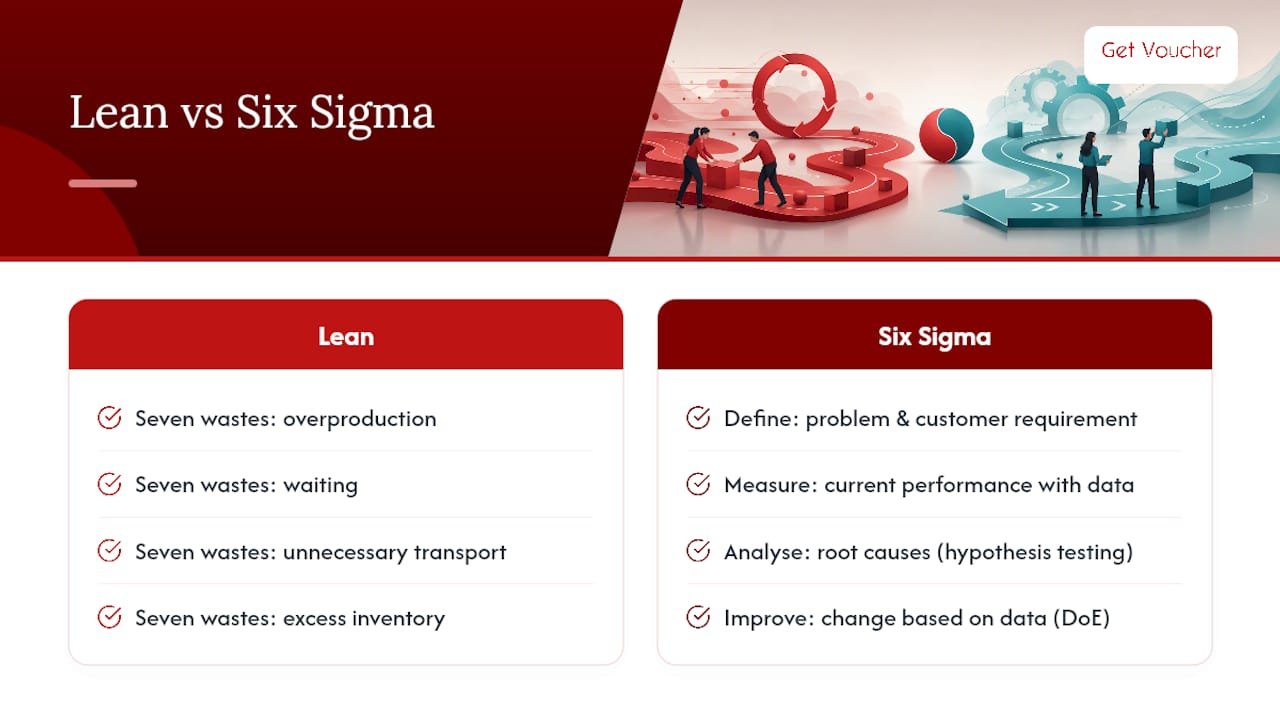
Six Sigma is statistical by design. It follows the DMAIC roadmap: Define the problem and customer requirement, Measure current performance with real data, Analyse root causes using tools like hypothesis testing, Improve the process based on what the data shows, and Control it with ongoing monitoring. ASQ’s Six Sigma resources describe statistical process control (SPC) as the backbone of the Control phase, using control charts to flag when a process drifts outside acceptable limits. Design of experiments (DoE) lets teams test several variables at once to find what actually drives a defect rate, rather than guessing. A manufacturer chasing an unexplained scrap rate would run DMAIC precisely because the cause isn’t visible to the eye. It has to be measured out of the data.
Lean Six Sigma folds both into one sequence. A VSM often features in the Define or Measure phase to visualise the process before the numbers arrive, and kaizen events frequently sit inside the Improve phase once the statistical analysis has identified where to act. ASQ’s summary of Lean Six Sigma describes it as a fact-based, data-driven philosophy that reduces variation and eliminates waste while standardising work, which is a fair description of what happens when the two toolkits run together on the same project.
When to choose Lean, Six Sigma, or both
Work through this before committing a team to either method:
- Name the problem type. Is it a flow issue (delays, backlogs, excess handling) or a variation issue (inconsistent output, defects, unpredictable quality)? Many problems are both, which points towards Lean Six Sigma from the outset.
- Check your data. Six Sigma needs measurable process data over time. If nobody has been recording defect rates or cycle times, start with Lean’s visual tools while you build a measurement habit.
- Match the timescale to the stakes. A quick kaizen event can resolve a workflow bottleneck in a few days. A full DMAIC project generally takes longer than a rapid Lean improvement because it includes structured measurement, analysis, improvement and control phases.
- Audit your resources. Lean asks for engaged frontline staff and a facilitator. Six Sigma needs someone comfortable with statistical tools (often supported by software such as Minitab) and management sponsorship to see a multi-month project through.
- Plan the learning curve alongside the project. If your team lacks Six Sigma skills, factor in Yellow or Green Belt training before the analysis phase, not during it.
Pro Tip: Run a two-week Lean pilot before committing to a full DMAIC project. If the flow fixes alone solve most of the pain, you’ve saved months of statistical work you didn’t need.
Which belt should you start with?
Belt levels map fairly directly onto how deep the statistical work gets, and onto the kind of role each level supports.
- Yellow Belt covers the fundamentals: core Lean concepts, basic Six Sigma vocabulary, and how DMAIC is structured. It suits team members and supervisors who need to support projects without leading the analysis.
- Green Belt goes further into statistical tools, project leadership, and applying DMAIC to a real workplace problem. This level fits process leads, quality engineers and project managers who run improvement work alongside their main job.
- Black Belt builds on advanced statistical methods including design of experiments and deeper hypothesis testing, and typically leads multiple concurrent projects. It suits full-time process improvement specialists and managers overseeing several Green Belts. The yellow belt vs green belt distinction really comes down to depth of statistical training and scope of ownership; the green belt vs black belt jump adds project leadership across a wider portfolio.
If you’re new to both methodologies, ASQ’s guidance notes that Six Sigma’s statistical demands are heavier than Lean’s, which is why many learners start with Lean fundamentals or a Lean Six Sigma Green Belt before tackling a standalone Six Sigma Green Belt. Budget realistic study time. Self paced video training and practice exams help, but statistical concepts take longer to bed in than Lean’s visual tools.
Getting Lean and Six Sigma to work together
Lean and Six Sigma can be applied together or selectively depending on the problem. Lean tools can address waste and flow, while Six Sigma tools can be used where variation, defects and root-cause analysis require deeper measurement and statistical analysis. A Lean Six Sigma implementation primer confirms this is the common pattern in practice, and it makes sense. There’s no point running a statistically rigorous analysis on a process that’s still full of unnecessary steps.

Governance matters more than most teams expect. Leadership sponsorship and clearly defined responsibilities across Yellow, Green and Black Belt roles can help keep improvement projects aligned and moving forward. The two most common pitfalls are treating Six Sigma as a purely statistical exercise with no business context, and underestimating the change management needed to make Lean stick on the shop floor. A distribution centre might run a kaizen event to fix a picking bottleneck, then apply DMAIC three months later once data reveals a stubborn error rate the flow fix didn’t touch. That’s integration in practice, not theory.
Stop asking which method is “better”
The framing of “lean vs six sigma” as a contest misses how these methods actually get used. Practitioner commentary from Kainexus makes a fair point: the useful question isn’t which methodology wins, it’s which tool matches the problem in front of you today. Treating them as rivals leads teams to force statistical rigour onto a simple flow problem, or to bolt a kaizen event onto a defect rate that needed hypothesis testing all along.
What’s underappreciated is how the choice maps to temperament as much as problem type. Some professionals thrive on Lean’s visual, fast feedback loop and never feel the pull towards deeper statistics. Others find Lean’s ambiguity frustrating and only relax once they have a control chart in front of them. Neither instinct is wrong, but it does mean the “which one should I learn” question deserves an honest answer about how you like to work, not just what your current project needs.
The comparison also gets misused as a proxy for the tqm vs six sigma debate, and the two aren’t the same conversation. Total Quality Management is a broader cultural philosophy about organisation wide quality ownership, whereas Six Sigma is a specific, statistically anchored methodology that can sit inside a TQM culture or stand alone. Conflating them leads to confused training budgets and mismatched expectations about what a Six Sigma project can realistically fix.
— Rayan
Start your Lean Six Sigma pathway with GetVoucher
GetVoucher gets you into a recognised certification pathway without the wait or expense of traditional classroom training, because the vouchers give direct digital access to VMEdu’s self-paced course materials the moment you’re ready to start.

If you’ve decided a combined approach fits your role, the Dual 6Sigma Pack bundles Six Sigma Green Belt and Lean Six Sigma Green Belt certification from 6sigmastudy, the certification body under the VMEdu umbrella, giving you both toolkits without buying two separate courses.
Prefer to specialise first? The standalone Six Sigma Green Belt or Lean Six Sigma Green Belt course pages cover the full syllabus so you can see exactly what’s included before committing. Black Belt and other advanced VMEdu pathways are planned for the coming months.
If you need one sooner, contact GetVoucher directly for current pricing and availability.
Browse the full certifications catalogue to compare every pathway side by side, and pick your starting course today.
Where these comparisons come from
The distinctions covered above draw on a small set of authoritative sources rather than general opinion:
- Strathprints’ comparative analysis — the peer-reviewed case for treating Lean and Six Sigma as complementary.
- ASQ’s Six Sigma resources — the DMAIC framework and statistical scope.
- Lean Enterprise Institute — the formal definition of Lean, waste and flow.
- ASQ Ask the Experts — the definitional basis for Lean Six Sigma as a combined philosophy.
Sources
- Lean vs Six Sigma (comparative analysis) — Strathprints
- Six Sigma resources — ASQ
- What is lean? — Lean Enterprise Institute
- What is Lean Six Sigma? — ASQ Ask the Experts
Start with a PDCA Pilot: DMAIC vs PDCA for Busy Teams
[…] a broader view of how DMAIC and PDCA sit within wider improvement thinking, our explainer on Lean and Six Sigma sets out how the two disciplines diverge on flow versus […]