




Scrum is not a synonym for Agile. Agile is the philosophy, a set of values and principles for delivering work iteratively; Scrum is one specific, prescriptive framework that puts those values into practice through short, timeboxed cycles. If your team needs structure, defined roles and a predictable rhythm, trial Scrum first. If your work arrives unpredictably and needs continuous flow rather than fixed cycles, Kanban or a Scrum-Kanban hybrid usually fits better.
TL;DR:
- Scrum works best for small, cross-functional teams building products through iterative Sprints, rather than for work that requires a purely continuous-flow approach.
- The success of Scrum depends on maintaining transparency, regular inspection, and timely adaptation, with all ceremonies timeboxed and focused.
- Agile provides flexible values and principles, but without a concrete framework like Scrum or Kanban, teams risk inconsistency and lack of shared rhythm.
- Choosing the right approach depends on work predictability, team size, and stakeholder involvement, with scaling frameworks like SAFe used for multiple Scrum teams.
- Certifications such as Scrum Fundamentals Certified help validate understanding, but practical implementation requires matching the framework to the work environment.
Table of Contents
- What is Agile: the philosophy behind the framework
- What is Scrum: roles, artefacts and the sprint container
- Scrum vs Agile: how do they actually compare?
- When should you choose Scrum over other Agile approaches?
- What are Scrum’s pillars and events, and how do you run them well?
- Why does ‘ScrumBut’ undermine the whole point of Scrum?
- How do you choose the right approach and build a certification path?
- Where did Agile and Scrum actually come from?
- What are the real benefits and drawbacks of each approach?
- What do real Scrum and Agile implementations look like?
- Why certification matters more than people think
- Which GetVoucher certifications get you there fastest?
- Sources
What is Agile: the philosophy behind the framework
Agile is not a methodology you install. It is a mindset, formalised in 2001 when seventeen software practitioners wrote the Agile Manifesto, setting out four values and twelve principles that prioritise individuals and interactions over rigid processes, working software over exhaustive documentation, customer collaboration over contract negotiation, and responding to change over following a fixed plan.
Those twelve principles push teams towards iterative delivery, frequent customer contact, and short feedback loops rather than one long delivery cycle. Nothing in the manifesto tells you which meetings to hold or which roles to appoint. It tells you what to value, and several frameworks have grown up to answer the “how”:
- Scrum: fixed-length sprints, defined roles, structured ceremonies.
- Kanban: continuous flow, visualised work, limits on work in progress.
- Extreme Programming (XP): engineering practices like test-driven development and pair programming.
- SAFe (Scaled Agile Framework): coordinates Agile practices across multiple teams and departments.
Scrum is the most widely adopted of these, which is precisely why so many teams say “we’re Agile” when what they actually mean is “we run Scrum.”
What is Scrum: roles, artefacts and the sprint container
Scrum is a lightweight framework built on empiricism and lean thinking, according to the Scrum Guide, the document that defines it officially. Empiricism means decisions get made from what teams observe and learn, not from upfront prediction. Everything in Scrum exists to support that: short cycles, visible work, and regular checkpoints where the team adjusts course.
The framework prescribes a small set of required elements:
- Accountabilities (Roles): a Product Owner accountable for maximising product value and effective Product Backlog management, a Scrum Master accountable for establishing Scrum and supporting the Scrum Team’s effectiveness, and Developers accountable for creating a usable Increment each Sprint.
- Events: Sprint Planning, the Daily Scrum, Sprint Review and Sprint Retrospective, all contained within the Sprint itself.
- Artefacts: the Product Backlog, Sprint Backlog and the Increment, each designed to make progress and priorities visible.
Scrum works best with small, cross-functional teams, generally small enough to keep communication direct rather than routed through layers of hierarchy. The Scrum Guide is blunt about one thing: Scrum “exists only in its entirety” as a container for other techniques and practices. Drop a role or skip a ceremony and, strictly, you’re no longer running Scrum. You’re running something else and calling it Scrum, which is a distinction worth remembering before your team claims the label.
Scrum vs Agile: how do they actually compare?
Agile sets the destination and the values; Scrum is one vehicle for getting there, with its own rules of the road. The comparison usually confuses people because they’re evaluating two different types of thing: a philosophy against one implementation of it.
| Axis | Agile (philosophy) | Scrum (framework) |
|---|---|---|
| Scope | Values and principles guiding delivery | One specific, structured method |
| Prescriptiveness | Flexible, interpreted differently by teams | Fixed roles, events and artefacts |
| Accountabilities (Roles) | Not defined | Product Owner, Scrum Master, Developers |
| Cadence | No fixed rhythm required | Fixed-length Sprints (typically 1 to 4 weeks) |
| Artefacts | None mandated | Product Backlog, Sprint Backlog, Increment |
| Best-fit team size | Any size, any structure | Small, cross-functional teams |
| Typical context | Any iterative delivery effort | Product development with a stable team |
Read the table as a filter, not a scoreboard. If your context matches most of Scrum’s column, Scrum is worth trialling as your entry point into Agile. If it doesn’t (your team is large, your work arrives as unpredictable service requests, or you have no fixed team), you’re still Agile by adopting iterative, feedback-driven practices; you’d simply be looking at a different framework to express them, such as Kanban or a scaled approach.
When should you choose Scrum over other Agile approaches?
Certain signals point clearly towards Scrum, others point away from it, and a few sit in between where a hybrid makes more sense.
- Choose Scrum when you’re building a product with an evolving Product Backlog, need frequent stakeholder feedback, and have a small cross-functional team that can work towards a Sprint Goal within a consistent Sprint length.
- Choose Kanban or flow-based Agile when your work is service or operations-based, incoming requests are unpredictable, and forcing everything into a two-week sprint would mean constantly breaking the plan.
- Choose a hybrid (Scrumban) when you like Scrum’s cadence and retrospectives but your work volume is too variable for strict sprint commitments.
- Choose a scaled approach (SAFe, LeSS) when multiple Scrum teams need to coordinate on a single product or programme, and Scrum alone doesn’t address cross-team dependencies.
Teams moving off waterfall project management often start with Scrum specifically because its structure feels familiar: fixed cycles, defined roles, a review at the end. Once the team masters continuous improvement, some deliberately loosen the prescriptive elements in favour of flow, which is a natural progression rather than a failure of Scrum.
What are Scrum’s pillars and events, and how do you run them well?
Scrum rests on three pillars, and skipping any one of them is usually where implementations quietly fail. Transparency means the backlog, the Sprint Goal and progress are visible to everyone, not hidden in a manager’s spreadsheet. Inspection means the team regularly checks its work against the goal. Adaptation means it actually changes course when inspection reveals a problem, rather than ploughing ahead because the sprint is “already planned.”
Each Scrum event has a distinct purpose:
- Sprint Planning sets what will be built and how, giving the team a Sprint Goal to aim at.
- Daily Scrum is a short synchronisation, not a status report to a manager.
- Sprint Review inspects the Increment with stakeholders and adjusts the backlog based on what’s learned.
- Sprint Retrospective inspects how the team worked and identifies changes that can improve its effectiveness.
Pro Tip: Timebox the Daily Scrum to 15 minutes regardless of team size, and resist the urge to solve problems inside it. If a conversation needs more than two minutes, take it offline immediately after and protect the meeting’s original purpose.
Why does ‘ScrumBut’ undermine the whole point of Scrum?
“ScrumBut” describes a team running Scrum’s ceremonies while quietly skipping the parts that make it work: “we do Scrum, but we skip retrospectives” or “we do Scrum, but the Product Owner doesn’t have real authority.” Industry explainers describe the more advanced version as Zombie Scrum, where every ceremony happens on schedule but nobody expects them to produce anything.
Watch for these red flags:
- Meetings that happen because the calendar says so, not because anyone has a clear question to answer.
- A Product Owner who can’t say no to stakeholders or reprioritise the backlog.
- Retrospectives that produce the same three complaints, sprint after sprint, with no follow-through.
The remedy is rarely a new tool. It’s restoring the feedback loop: give the Product Owner real authority, make retrospective actions visible in the next sprint, and ask honestly whether velocity or quality has actually improved over the last three sprints.
How do you choose the right approach and build a certification path?
Work through this checklist before committing your team to any single framework:
- Team signals: Is the team small, stable and cross-functional, or large and fluid? Scrum favours the former.
- Leadership buy-in: Will leadership protect sprint boundaries and empower the Product Owner, or will priorities shift mid-sprint regardless?
- Engineering practices: Does the team already use practices like continuous integration? Scrum is a container, not a full delivery stack, and needs those practices layered on top to succeed.
- Delivery cadence: Does the work naturally batch into two-week chunks, or does it arrive as a continuous, unpredictable stream?
When trialling a framework or hiring a coach, ask direct questions: How will you measure whether this is working after three sprints? What happens when the Product Owner and a senior stakeholder disagree on priority? Who owns the decision to change the process itself?
Certification then becomes a career accelerant, not a box-ticking exercise. Entry-level routes cover Scrum fundamentals and role basics; broader credentials like PMI-ACP demonstrate multi-framework fluency across several Agile approaches. Industry comparisons of routes like PMI-ACP, CSM and PSM I suggest pairing a focused Scrum credential with a broader multi-framework one for career depth and breadth. GetVoucher’s Scrum Fundamentals Certified course is a practical starting point for exactly this first step.
Where did Agile and Scrum actually come from?
Scrum predates the Agile Manifesto by nearly a decade. Jeff Sutherland and Ken Schwaber developed it in the early 1990s, drawing on lean manufacturing ideas and a 1986 Harvard Business Review paper that used a rugby “scrum” as a metaphor for tightly coordinated, cross-functional teamwork, a name that stuck.
Agile as a named movement arrived later, in February 2001, when Sutherland, Schwaber and fifteen other software practitioners met at a ski resort in Utah to write down what already worked across their various methods, including Scrum, XP and others. The result was the Agile Manifesto: four values, twelve principles, no prescribed process. It named a philosophy that several practitioners had already been living out through different frameworks.
That sequence explains a lot of today’s confusion. Scrum existed first as a working method; Agile arrived afterwards as the philosophy that explained why methods like Scrum worked. Because Scrum was already the dominant framework in the room when Agile was named, it became, for many organisations, the default answer to “how do we do Agile?” The Scrum Guide itself has been revised repeatedly since, most recently in 2020, to strip back unnecessary prescription and keep the framework genuinely lightweight rather than accumulating process for its own sake.
What are the real benefits and drawbacks of each approach?
Agile’s biggest strength is flexibility. Because it’s a set of values rather than a rulebook, teams can shape their own process, borrowing Scrum’s cadence here, Kanban’s flow visualisation there, XP’s engineering discipline where it’s needed. That flexibility is also its weakness: without a concrete framework, “being Agile” can mean almost anything, including teams that have simply renamed their old process and changed nothing about how they work.

Scrum’s strength is the opposite: structure. Defined roles remove ambiguity about who decides what. Fixed sprints create a predictable rhythm stakeholders can plan around. Built-in retrospectives force regular reflection that many teams would otherwise skip entirely. The drawback is that Scrum’s rigidity doesn’t suit every context. Forcing unpredictable support or operations work into two-week sprints often creates artificial deadlines and constant sprint disruption rather than genuine focus.
There’s a real cost to getting this wrong in either direction. Teams that adopt Scrum without the engineering practices to support it (automated testing, continuous integration) often find their sprints become unsustainable death marches rather than sustainable cycles. Teams that stay “purely Agile” without ever settling on a concrete framework often struggle with the opposite problem: no shared rhythm, unclear ownership, and constant reinvention of process. The honest answer is that both approaches carry risk if adopted superficially, and both deliver real value when the underlying principles, not just the ceremonies, are actually followed.
What do real Scrum and Agile implementations look like?
A ten-person product team building a customer-facing app is the archetypal Scrum fit: stable backlog, direct stakeholder access, two-week sprints that let the Product Owner reprioritise based on user feedback after every Sprint Review. This is the scenario Scrum was designed for, and it’s where the framework tends to deliver the most visible improvement over ad hoc planning.
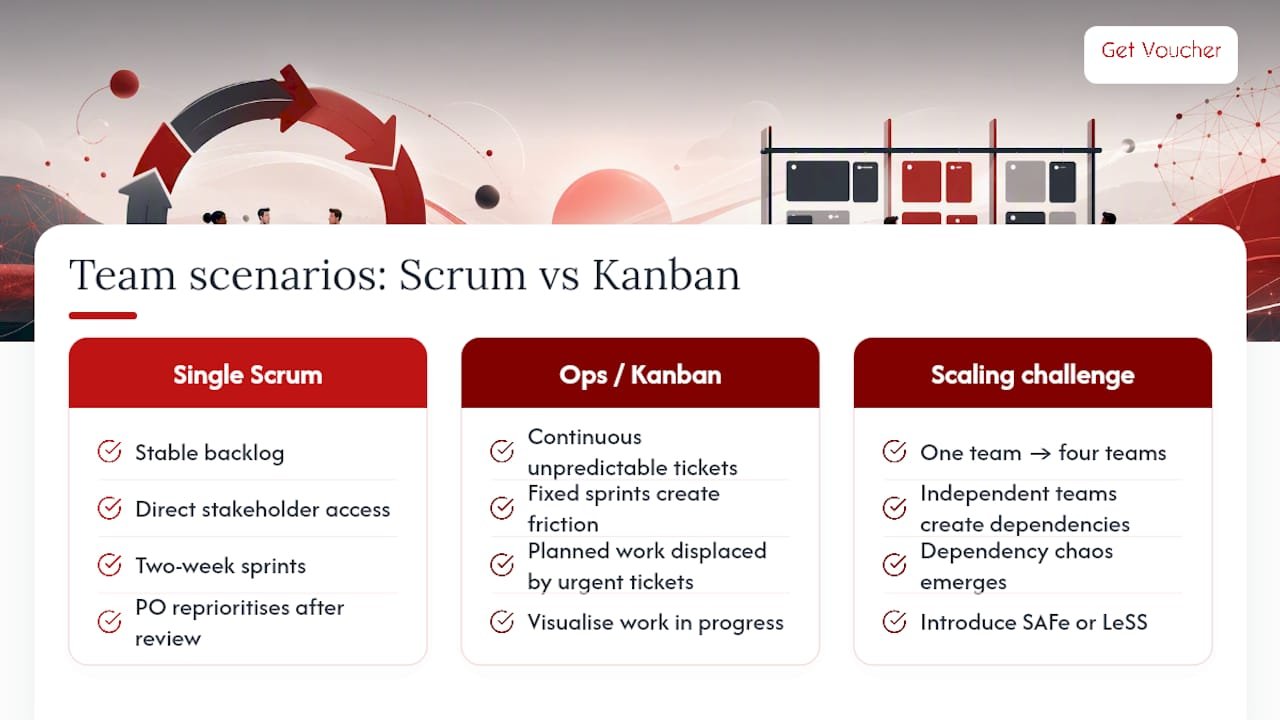
Contrast that with an IT support or operations team, where tickets arrive continuously and unpredictably. Forcing that work into fixed sprints usually creates friction, because half the “planned” sprint gets displaced by urgent tickets that can’t wait two weeks. These teams typically do better with Kanban, visualising work in progress and limiting how much sits in each stage, without pretending the work fits into fixed cycles it doesn’t respect.
A mid-sized software company scaling from one team to four often illustrates the third scenario: it starts with a single Scrum team, succeeds, then discovers that four independent Scrum teams working on the same product create dependency chaos. That may be the point where organisations consider additional scaling practices or frameworks such as SAFe or LeSS to manage broader cross-team dependencies. Scrum itself also allows multiple Scrum Teams working on the same product to share the same Product Goal, Product Backlog and Product Owner. Each scenario reflects the same underlying rule: match the framework to the shape of the work, not the other way round.
Why certification matters more than people think
Structured learning compresses a lot of trial and error most teams eventually stumble through on their own. Employers increasingly treat a Scrum or Agile credential as a genuine hiring signal, particularly for Scrum Master, Product Owner and delivery roles, because it shows you understand the framework’s mechanics before you’re the one accountable for team outcomes.
If you’re deciding where to start, look at where the gaps actually sit in your current role rather than chasing the most advanced certificate first. A grounded fundamentals course, followed by a role-based credential once you’ve applied the basics, tends to build capability that survives contact with a real, messy project.
— Rayan
Which GetVoucher certifications get you there fastest?
GetVoucher works with VMEdu as the main training provider and certification bodies including SCRUMstudy, SMstudy and 6sigmastudy, giving you a single place to find vouchers rather than hunting across separate provider sites for pricing and access.

If Scrum fits your context, the Scrum Fundamentals Certified course is the natural entry point, covering the roles, events and artefacts this article has walked through. Ready to combine role coverage? The Dual Agile Pack bundles Scrum Master and Product Owner certification together, useful if you’re not yet sure which role you’ll grow into. If your team sits closer to flow-based operations work, Scrum for Operations and DevOps Expert Certified adapts Scrum’s principles for that context specifically.
Buying a voucher through GetVoucher works simply: you purchase the voucher for your chosen certification, redeem it against the course, and get digital access to the provider’s learning materials and exam scheduling. Certifications in areas like Business Analysis, Risk Management and Kanban-specific credentials from brands such as KANBANstudy and RMstudy are planned for the coming months; contact GetVoucher directly for current pricing and availability on those pathways. Browse the full current range on the certifications page before deciding where to start.