




There is no universal Scrum exam. Each provider sets its own number of questions, time limit, pass score, delivery method and training requirement, so the answer to “what is the format?” depends entirely on which certification you are sitting. The table below puts the main ones side by side, and the sections after it explain what each difference means for how you prepare.
Table of Contents
- Scrum exam formats compared
- Why one provider’s format tells you nothing about another’s
- SCRUMstudy exams: SFC, SMC and SAMC
- Scrum.org PSM I: short, strict and open-book
- Scrum Alliance CSM®: course first, then a 50-question exam
- What the questions actually look like
- How to prepare for each format
- Our perspective
- Getting a SCRUMstudy voucher
- FAQ
- Sources
Scrum exam formats compared
The figures below are the ones we hold for each provider. Providers can change their exams, so confirm the details on the provider’s own page before you book.
| Provider and certification | Questions | Duration | Delivery / proctoring | Pass score | Mandatory training |
|---|---|---|---|---|---|
| SCRUMstudy, Scrum Fundamentals Certified (SFC) | 40 | 60 minutes | Online, unproctored | Confirm with SCRUMstudy | Confirm with SCRUMstudy |
| SCRUMstudy, Scrum Master Certified (SMC®) | 100 | 120 minutes | Online, unproctored | Confirm with SCRUMstudy | Confirm with SCRUMstudy |
| SCRUMstudy, SCRUM Agile Master Certified (SAMC™) | Confirm with SCRUMstudy | Confirm with SCRUMstudy | Online, unproctored | Confirm with SCRUMstudy | Confirm with SCRUMstudy |
| Scrum.org, Professional Scrum Master I (PSM I) | 80 | 60 minutes | Online, open-book according to Scrum.org | 85% | No course is needed to sit it; course attendees receive an assessment password |
| Scrum Alliance, Certified ScrumMaster (CSM®) | 50 | 60 minutes | Taken after the required course | 74% | Yes, a 16-hour course |
Two things stand out. First, the numbers are not interchangeable: 100 questions in 120 minutes is a very different pace from 80 questions in 60 minutes. Second, “online” does not tell you anything about how strict or how easy an exam is. Delivery, content and pass mark are separate variables, and you should not infer one from another.
GetVoucher sells the SCRUMstudy certifications in this table. We do not sell Scrum.org or Scrum Alliance credentials, and they appear here so you can compare formats fairly.
Why one provider’s format tells you nothing about another’s
People search for “the Scrum exam” as if it were one test, like a driving theory test. It is not. Scrum is a framework described in the Scrum Guide, and several independent organisations have built certifications around it. Each designs its own assessment, writes its own questions and decides what a passing candidate looks like.
That has practical consequences:
- Pass marks are not comparable. A candidate who needs 85% on one exam and 74% on another is not facing a “harder” and “easier” test in any simple sense, because the question styles and difficulty differ.
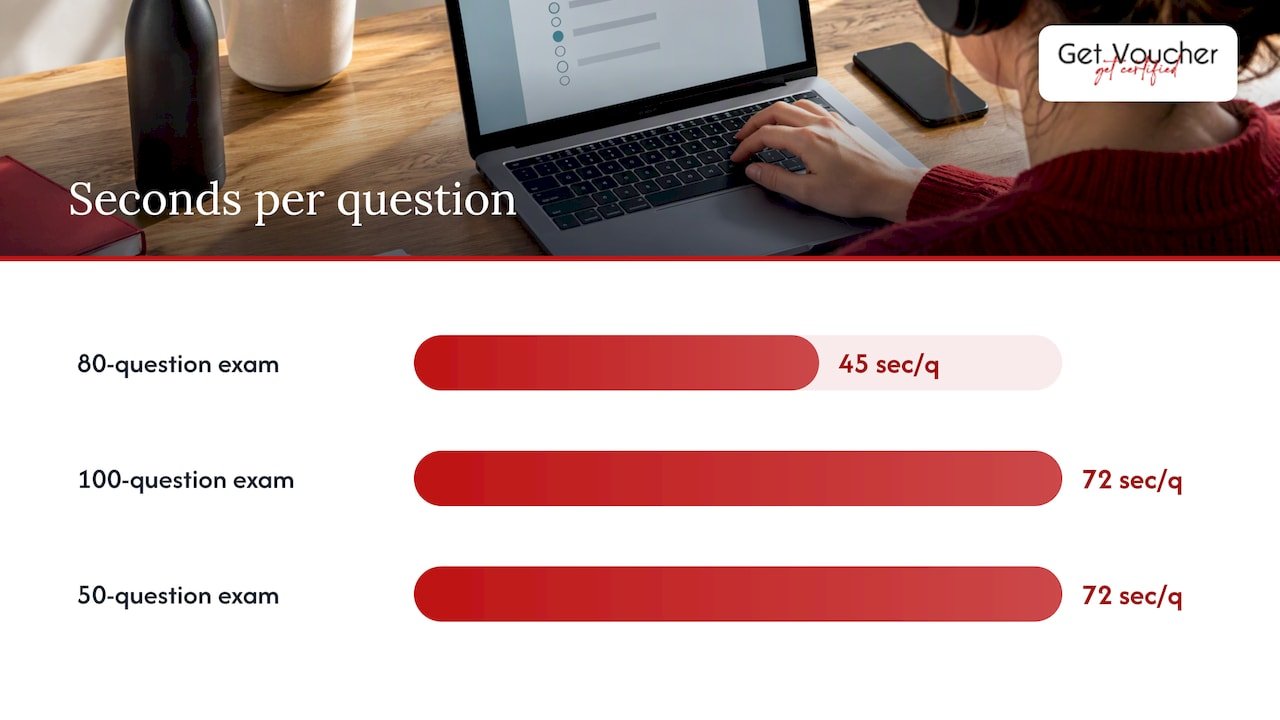
- Time per question differs. Work it out for each exam. At 80 questions in 60 minutes you have 45 seconds a question. At 100 questions in 120 minutes you have 72 seconds. At 50 questions in 60 minutes you have 72 seconds. Pacing practice has to match the exam you will sit.
- Training rules differ. Some pathways require a course before you can take the exam, others do not. Costs therefore break down differently: exam fee, mandatory training, optional preparation, retakes and renewal are separate lines.
- Exam difficulty should not be generalised. Reviews of one provider’s exam say nothing reliable about another’s.
If you are still choosing between providers, our comparison of Scrum Alliance and Scrum.org covers learning models, cost and renewal in more depth.
SCRUMstudy exams: SFC, SMC and SAMC
SCRUMstudy exams are delivered online and are unproctored. That is simply a description of delivery, and it does not make them more or less credible than a proctored exam elsewhere.
Scrum Fundamentals Certified (SFC). The SCRUMstudy SFC exam has 40 questions and a 60-minute limit, taken online without a proctor. It is the entry point in the SCRUMstudy range and is free through GetVoucher, which makes it a low-risk way to see how this style of question feels. You can see what is included on the Scrum Fundamentals Certified page.
Scrum Master Certified (SMC®). The SMC® exam has 100 questions and a 120-minute limit, online and unproctored. The longer paper means stamina and consistency matter more than speed. Our SMC® voucher costs £249.
SCRUM Agile Master Certified (SAMC™). SAMC™ is also assessed through an online, unproctored exam, not a generic proctored assessment. Our voucher costs £349. Confirm the current question count and duration with SCRUMstudy before you book, because we do not want you planning around a number we cannot verify.
What is included varies by product. Some vouchers come with self-paced video training and downloadable study materials, others differ, so read the product page for the specific certification rather than assuming every purchase includes the same things. Support for scheduling or delivery also depends on the product.
Validity and renewal
Validity is provider-specific. Our research source notes that SCRUMstudy certifications generally require recertification every three years or the earning of another SCRUMstudy certification. Details are in our guide to maintaining your SCRUMstudy™ certification.
Scrum.org PSM I: short, strict and open-book
The Professional Scrum Master I assessment has 80 questions to answer in 60 minutes, with an 85% pass score, according to Scrum.org’s own guidance on preparing for the PSM I assessment. Scrum.org describes it as open-book, but it also warns that candidates underestimate it. With 45 seconds a question, there is little time to look anything up. If you have to search for the answer to a question, you have probably already lost the time you needed.
A few other details worth knowing:
- Source material. Scrum.org says its assessments draw on the most recent English Scrum Guide for rules, artifacts, events and roles. Read the Guide itself, not only summaries of it.
- Feedback. Scrum.org does not tell you which individual questions you got wrong. It gives a breakdown by Scrum competency area to guide further study.
- Training link. People who attend the PSM or Professional Scrum Foundations course receive two attempts at the PSM I assessment if they sit it within 14 days of the course. Class participants on the Professional Scrum Master course receive a password to attempt the assessment.
- Validity. PSM I has lifetime validity with no renewal fees. Pricing is set by Scrum.org, so check its site for the current fee.
Not every Scrum.org assessment is open-book in the same way, so do not carry this description over to other assessments without checking each one.
Scrum Alliance CSM®: course first, then a 50-question exam
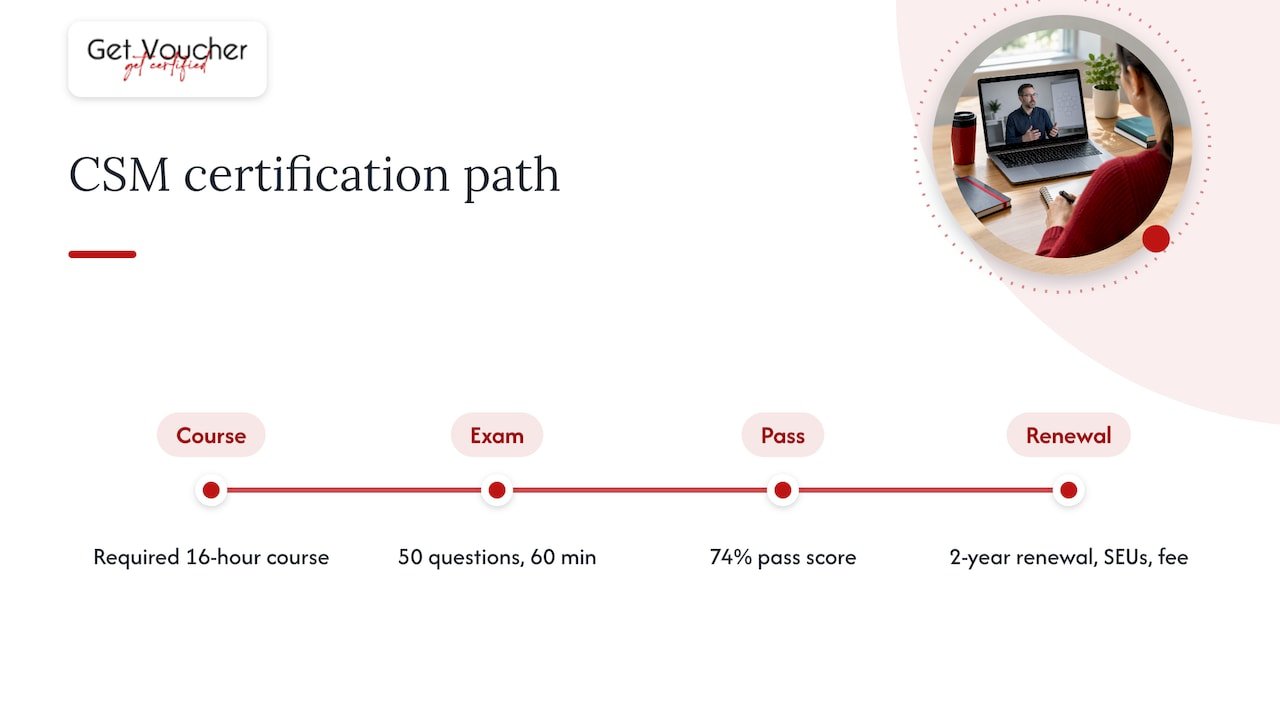
The Scrum Alliance Certified ScrumMaster® (CSM®) path begins with a required 16-hour course. After it, the exam has 50 questions in 60 minutes with a 74% pass score. Renewal runs on a two-year cycle with Scrum Education Units (SEUs) and a renewal fee.
The key point is that the CSM learns you in a course-led model, while Scrum.org’s PSM I is an assessment-led model. They do not assess learning in the same way, so a study plan built for one will not transfer neatly to the other.
A related point of confusion is the Certified Scrum Product Owner (CSPO). It requires approved training but currently has no certification exam, so there is no CSPO exam format and no CSPO exam fee. The course price is set by each Certified Scrum Trainer. Do not confuse it with the CSM exam.
What the questions actually look like
Readers often search for “Scrum exam questions” expecting a list. Rather than quote questions from exam banks, here is the kind of knowledge each format tests:
- Scrum Guide definitions. The accountabilities (Scrum Master, Product Owner, Developers), events and artifacts, and the commitments attached to each artifact.
- Rules with numbers. A Scrum Team is typically 10 or fewer people, and a Sprint lasts one month or less. Multiple Scrum Teams working on one product can share a Product Owner, Product Backlog and Product Goal.
- Accountability traps. The Scrum Guide makes the Product Owner accountable for maximising product value and for Product Backlog management. It does not make the Product Owner solely responsible for the Sprint Goal or for what the team commits to. Refinement and the Sprint Review are not “run by” the Product Owner either. Questions are often built around this kind of mistaken belief.
- Scenarios. A situation is described and you choose the response most consistent with Scrum. Where several answers sound sensible, the Scrum Guide’s wording decides.
- Scrum versus Agile. Scrum is one framework, Agile is a broader set of values and principles. Keep the two apart. Our piece on Scrum vs Agile sets out the distinction.
Free sample papers on the web vary widely in quality. Some are written by training companies, some are old, and few match the current Scrum Guide, so treat them as a pacing exercise rather than a prediction.
How to prepare for each format
Start with the exam, not the topic. Ask four questions before you open a study guide.
- Which provider and certification? Everything below follows from this.
- How many seconds per question? Practise at that pace with timed sets.
- Is training mandatory? If so, factor in its cost and time. If not, decide whether optional preparation is worth it for you.
- What do renewal and retakes cost? This is the part that gets forgotten until later.
For a 100-question, 120-minute paper, build up to two full hours in one sitting. For an 80-in-60 paper, do repeated timed runs and note which Scrum Guide sections cost you time. Two weeks of steady evenings is a common plan, but timelines are personal and depend on your experience. Treat any quoted number, including ours, as a rough guide.
A free first step is to read the Scrum Guide twice, then attempt the SFC. The Complete Scrum & Agile Guide lays out how the credentials relate to each other.
Our perspective
We see candidates make the same mistake repeatedly: they pick the exam by its reputation or its headline price and only afterwards discover the format does not suit them. A candidate who reads quickly and likes long papers may feel comfortable with 100 questions over two hours. A candidate who knows the Scrum Guide thoroughly and works fast may prefer a short, strict paper. Neither is better in the abstract.
So our advice is to match the format to the person, and to resist the idea that a certificate proves how well you will perform in a real team. A certification shows you have studied a body of knowledge and passed an assessment. It does not guarantee employment, salary or progression, and employers weigh credentials differently.
We also think exam-only vouchers are not always the cheapest route overall. Once you count mandatory training, retakes and renewal, the cheapest option depends on the provider and on how prepared you already are. That is why we describe inclusions product by product. Our Scrum Master certification cost guide breaks the costs down.
— Rayan
Getting a SCRUMstudy voucher
If the SCRUMstudy format suits you, these are the Scrum and Agile vouchers we sell, at the prices published on our site:
| Certification | Price |
|---|---|
| Scrum Fundamentals Certified | £0 |
| Scrum Developer Certified (SDC®) | £99 |
| Scrum for Operations and DevOps Expert Certified | £239 |
| Scrum Master Certified (SMC®) | £249 |
| Scrum Product Owner Certified (SPOC®) | £299 |
| SCRUM Agile Master Certified (SAMC™) | £349 |
| Dual Agile Pack: Scrum Master & Product Owner | £519 |
Start with the free SFC if you want a feel for the question style, then move up. Browse the full Scrum & Agile category or the Dual Agile Pack if you want both Scrum Master and Product Owner credentials.
FAQ
Is there one standard Scrum exam format?
No. Scrum.org, Scrum Alliance and SCRUMstudy each run their own exams with different question counts, time limits, pass marks and training rules. Check the details for the specific certification you want and ignore figures quoted for another provider.
How long is a Scrum exam?
It depends on the provider. The SCRUMstudy SFC runs for 60 minutes and the SMC® for 120 minutes. Scrum.org’s PSM I allows 60 minutes, and the Scrum Alliance CSM® exam also allows 60 minutes after the required 16-hour course.
How many questions are in a Scrum Master exam?
The SCRUMstudy SMC® has 100 questions, the Scrum.org PSM I has 80 and the Scrum Alliance CSM® has 50. The SCRUMstudy SFC, an introductory exam, has 40. These numbers are not comparable like for like, because the question styles and pass marks differ.
Is the Scrum exam open-book or proctored?
Online and unproctored do not mean open-book, so do not infer one from the other. SCRUMstudy’s SMC® and SAMC™ exams are online and unproctored. Scrum.org describes the PSM I as open-book, though the time limit leaves little room to look things up. Check the rules for each exam.
Do I need to take a course before the exam?
Only for some pathways. The Scrum Alliance CSM® requires a 16-hour course. Scrum.org’s PSM I does not require one to sit the assessment, though course attendees receive a password and attempts. Confirm SCRUMstudy requirements for your chosen certification on its official page.
Sources
- How To Prepare For The Professional Scrum Master I (PSM) Assessment, Scrum.org
- Professional Scrum Master I Certification, Scrum.org
- Professional Scrum Master course, Scrum.org