




You pass a Scrum Master exam by knowing exactly which exam you are sitting, learning the current Scrum Guide until you can apply it rather than recite it, and testing yourself under timed conditions before the real thing. The details differ by provider: the question count, the time limit, the pass mark and even whether training is compulsory are all set by the body that issues the credential. This guide gives you a study plan that works across providers, then shows where each exam differs.
Table of Contents
- Start by identifying which exam you are taking
- Why the Scrum Guide is your main text
- Separate Scrum from Agile and from job titles
- A four-week study plan
- Using practice tests well
- Exam techniques that help
- What does it cost to sit the exam?
- Our perspective: pass the exam, then keep the learning
- If you are considering the SCRUMstudy route
- Common mistakes to avoid
- After the exam
- FAQ
- Sources
Start by identifying which exam you are taking
“The Scrum Master exam” does not exist as a single test. Several organisations run their own, and advice written for one can mislead you on another. Before you open a single practice question, write down the provider, the exam name and its format.
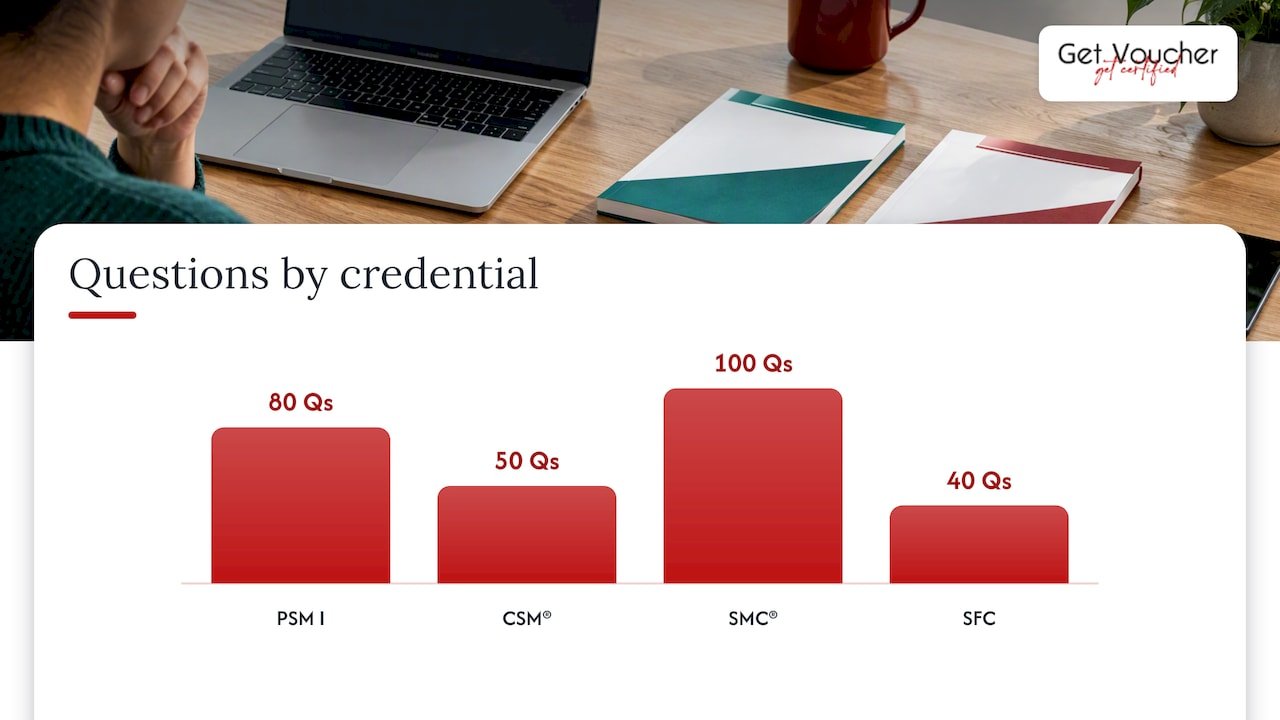
Here are the formats we can state with confidence:
| Credential | Provider | Questions | Time | Pass mark | Notes |
|---|---|---|---|---|---|
| PSM I | Scrum.org | 80 | 60 minutes | 85% | Pricing is set by Scrum.org; lifetime validity, no renewal fees |
| CSM® | Scrum Alliance | 50 | 60 minutes | 74% | Taken after the required 16-hour course |
| SMC® | SCRUMstudy | 100 | 120 minutes | Provider-specific | Online, unproctored |
| SFC | SCRUMstudy | 40 | 60 minutes | Provider-specific | Online, unproctored |
Note what the table does not say. It does not say any of these exams is easy or hard: difficulty depends on your background, your preparation and the way each provider writes its questions. It also does not say whether an exam is open-book. Online delivery or the absence of a proctor tells you nothing about that, so check the provider’s own exam rules before you assume anything. Scrum Alliance and Scrum.org also do not assess learning in the same way: CSM follows a mandatory course, while PSM I is an assessment you can book without one.
For a fuller side-by-side, see our Scrum exam format guide, which covers questions, duration and pass marks by provider.
Why the Scrum Guide is your main text
Every serious Scrum exam rests on the Scrum Guide. Scrum.org’s own advice on preparing for PSM I is blunt on this point: read the Scrum Guide again shortly before the exam and take the Scrum Open assessment repeatedly. That advice is from 2021, so make sure you are reading the current edition of the Guide, not a copy circulating in an old study pack.
Read it in three passes:
- Once for the story. Understand how the Sprint, its events and the three accountabilities fit together.
- Once for the vocabulary. Note every defined term: Product Goal, Sprint Goal, Definition of Done, Increment, Product Backlog, Sprint Backlog.
- Once for the exact wording. Exam questions often turn on a word such as “accountable”, “may” or “must”.
Facts worth being able to state from memory
These are the points candidates most often blur:
- A Scrum Team is typically 10 or fewer people.
- A Sprint lasts one month or less.
- The Product Owner is accountable for maximising the value of the product and for Product Backlog management. Accountable does not mean the Product Owner does everything: the Developers and others can do the work.
- Sprint Goal achievement and Sprint commitments belong to the whole Scrum Team, not to the Product Owner alone.
- Backlog refinement and the Sprint Review are not events the Product Owner runs. Read how the Guide describes them and answer from that wording.
- Several Scrum Teams working on one product can share a Product Owner, a Product Backlog and a Product Goal.
If a practice question seems to contradict one of these, the question is probably built on an older edition or on a team’s local habits. Trust the Guide.
Separate Scrum from Agile and from job titles
A lot of wrong answers come from mixing three things: Scrum, Agile in general and the job titles used by employers. Scrum is a framework with defined accountabilities, events and artifacts. Agile is a broader set of values and approaches that includes, but is not limited to, Scrum. Our guide to Scrum versus Agile draws the line clearly.
Job titles add another layer. “Product Manager” is an organisational job title whose responsibilities vary by company and context. It is not a fixed Scrum role, and it is not the same thing as the Product Owner accountability described in the Guide. When an exam asks about Scrum roles, answer for the Scrum accountabilities, not for what your employer happens to call someone.
A four-week study plan
Timelines depend on how much Scrum you already practise, so treat this as a template, not a promise. Someone working inside a Scrum Team daily may need less time. Someone new to the framework may need more. Adjust, and let your practice scores, not the calendar, decide when you book.
Week 1: Foundations
Read the Scrum Guide through once without notes. Then list the three accountabilities, the five events and the three artifacts with their commitments, from memory. Check your list against the Guide and mark gaps.
Week 2: Depth on roles and events
Work through each accountability in turn. For every event, write down its purpose, its timebox, who attends and what must come out of it. If your provider’s course materials or video training are part of your purchase, use them here to fill the gaps the Guide leaves.
Week 3: Practice under time pressure
Start timed practice. Match the real exam: for PSM I that means 80 questions in 60 minutes, which is under 45 seconds per question. For SCRUMstudy SMC® it is 100 questions in 120 minutes. Review every wrong answer and write the Guide reference that settles it. Do not just memorise the answer.
Week 4: Consolidate and rehearse
Retake practice papers you have not seen recently. Focus only on weak topics. Reread the Guide the day before or the morning of the exam, then stop. Check your internet connection, browser and ID requirements if the exam is online.
Using practice tests well
Practice questions are useful for pacing and for spotting weak areas. They are poor as a source of truth. Quality varies widely, some banks contain errors, and a few still reflect pre-2020 versions of the Guide. A sensible approach:
- Use the free practice tool from your own exam provider first, if there is one. Scrum.org, for example, publishes an open assessment for exactly this purpose.
- Treat any score as a rough signal. A single 100% on a question bank you have already memorised proves little.
- When a third-party explanation disagrees with the Guide, the Guide wins.
- Avoid “brain dump” sites. They break provider rules, and their answers are often unreliable.
Exam techniques that help
Read the whole question, then the options. Many items hinge on a single qualifier. “Who is accountable” and “who does the work” are different questions.
Eliminate before choosing. On multiple-choice items, remove options that contradict the Guide, then choose between what remains.
Watch the clock. Set a rough per-question budget and mark difficult items to revisit rather than burning five minutes on one.
Answer for Scrum, not for your workplace. Your team may skip the Sprint Review or let a manager assign work. The exam wants the framework as written.
Do not assume it is open-book. Whatever you have heard, follow the provider’s published rules for the exam you booked.
What does it cost to sit the exam?
Cost depends on the provider and on what you need to buy: the exam attempt, any mandatory training, optional preparation, retakes and renewal. Never compare one provider’s exam fee with another’s total cost. Scrum.org sets the official PSM I price, and the credential has lifetime validity with no renewal fees. Scrum Alliance’s CSM requires the 16-hour course first, and the price of that course depends on the trainer who runs it. An exam-only route is not automatically the cheapest overall, because it may leave you paying for preparation separately.
Our two cost guides go through this in detail: Scrum Master certification cost in 2026 and how to choose the cheapest credible route.
Our perspective: pass the exam, then keep the learning
We see the same pattern among people who come to us. Candidates who treat the exam as a memory test often pass a practice paper and then struggle with scenario questions, because they learned phrases rather than the reasons behind them. Candidates who ask “why does Scrum work this way?” tend to find the unfamiliar questions easier to reason through.
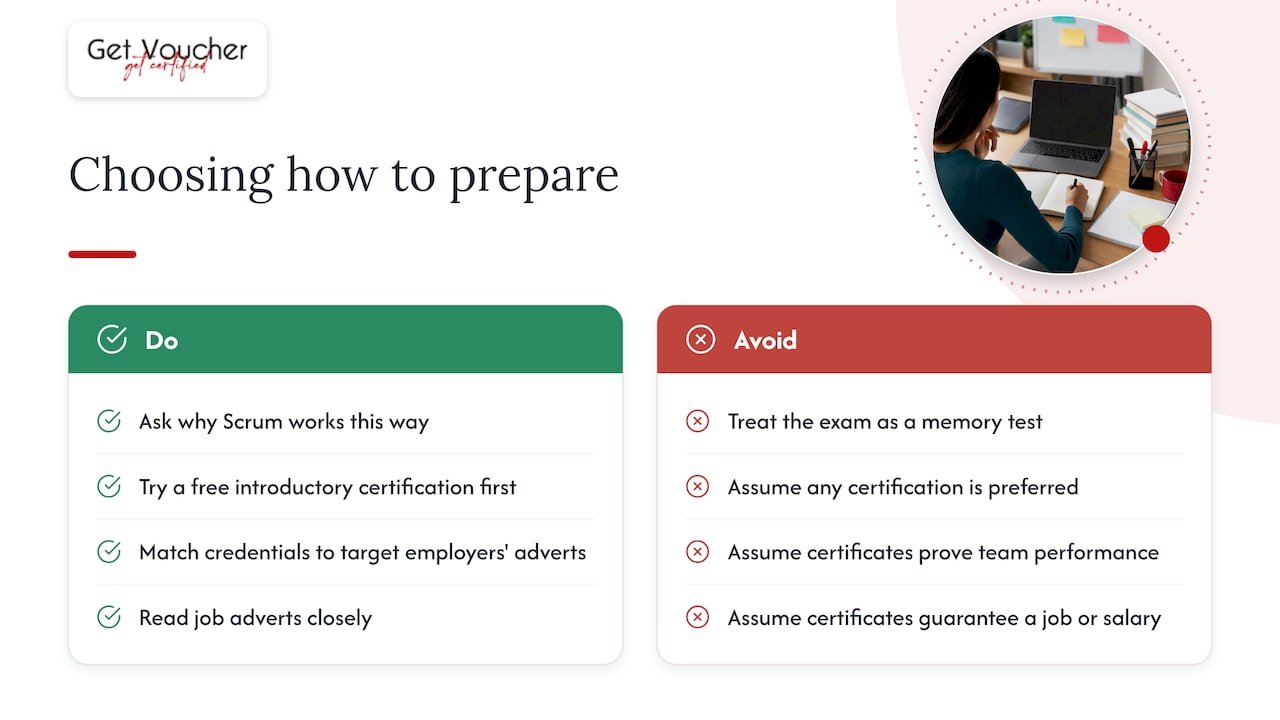
We also think the choice of credential should follow your situation. If you are new to Scrum, a free introductory certification lets you test the material before you pay for anything. If you already work in a Scrum Team and want a formal credential, go straight to the exam that fits your target employers’ job adverts, and read those adverts closely rather than assuming any certification is preferred. A certificate shows you completed a particular assessment. It does not prove how you will perform in a real team, and it does not guarantee a job or a salary.
We sell vouchers for SCRUMstudy certifications. We do not sell Scrum.org or Scrum Alliance credentials, and we say so clearly because readers deserve to know which exams we can actually help them book.
— Rayan
If you are considering the SCRUMstudy route
GetVoucher offers voucher access to SCRUMstudy certifications. What you receive differs by product, so check each product page for the resources, materials and scheduling support included before you buy. Our current published prices:
| Certification | Price |
|---|---|
| Scrum Fundamentals Certified | £0 |
| Scrum Master Certified (SMC®) | £249 |
| SCRUM Agile Master Certified (SAMC™) | £349 |
| Dual Agile Pack: Scrum Master and Product Owner | £519 |
The SCRUMstudy SFC exam has 40 questions in 60 minutes and is an online, unproctored exam. SMC® and SAMC both use online unproctored exams, and SMC® has 100 questions in 120 minutes. Unproctored does not mean easier or less credible, and proctored does not mean more credible. It simply describes how the exam is delivered.
If you are not sure where to start, the free SFC is a low-risk way to meet the material. You can also compare roles and certifications on our Scrum certification page or browse the full Scrum and Agile catalogue.
Common mistakes to avoid
- Studying for the wrong provider. A PSM I question bank will not prepare you for a SCRUMstudy exam’s format, and vice versa.
- Relying on one source. The Guide, the provider’s learning materials and timed practice each do a different job.
- Confusing CSM with CSPO. CSPO requires approved training but currently has no certification exam, so there is no CSPO exam to prepare for. The CSM exam is a separate matter.
- Using outdated material. Check the edition date of any book, video or practice bank.
- Cramming the night before. Light review beats a late-night marathon.
- Ignoring the soft skills. Facilitation and coaching questions reward judgement. Our piece on becoming an effective Scrum Master covers the practice side.
After the exam
If you pass, record your credential details and note any renewal rules. Those are provider-specific: some credentials have no renewal, others ask for continuing education or fees, and you should never assume one provider’s rules apply to another. If you do not pass, read the provider’s retake policy before you rebook, and use your score breakdown, if given, to target the weak areas. For wider career planning, our complete Scrum and Agile guide lays out the options.
FAQ
Is the PSM I exam easy to pass?
No single answer fits everyone. PSM I has 80 questions in 60 minutes with an 85% pass mark, which leaves little room for guessing. Candidates with real Scrum experience and a thorough knowledge of the Scrum Guide are better placed, but difficulty depends on your preparation.
How many questions are on the CSM exam?
Scrum Alliance’s CSM® exam has 50 questions in 60 minutes, with a 74% pass mark. You take it after the required 16-hour course. The format applies to that credential only and should not be assumed for other providers.
Do I need to take a course before the exam?
It depends on the provider. CSM requires the 16-hour course first. PSM I does not require a specific course, though preparation is still needed. For SCRUMstudy, check what each product includes before purchase.
How long should I study?
There is no reliable universal figure. People who already work in Scrum Teams may need less time than newcomers. Use timed practice scores and your ability to explain the Guide’s reasoning to decide when you are ready.