



There is no single certification that makes you an agile coach. The path that works is a sequence: a framework foundation (usually Scrum), a few years of practice with real teams, then a coaching-specific credential that tests how you coach rather than what you remember. This guide sets out that sequence stage by stage, shows what each step costs and tests, and is clear about what a certificate can and cannot prove.
If you are a Scrum Master, project manager or delivery lead wondering what comes next, read it as a map rather than a checklist. Your route will depend on your sector, your employer and the teams you work with.
Table of Contents
- What an agile coach is, and why there is no single credential
- The four stages of an agile coach path
- Stage 1: foundations with a free Scrum certificate
- Stage 2: practitioner certification as Scrum Master or Product Owner
- Stage 3: build breadth beyond one framework
- Stage 4: coaching credentials and coaching craft
- What employers look for besides certificates
- Our view on the path
- Where to start with GetVoucher
- FAQ
- Sources
What an agile coach is, and why there is no single credential
An agile coach helps teams and the wider organisation work in a more agile way. That means working with individuals, teams, leaders and the structures around them, not simply explaining a framework. Agile is framework-neutral: Scrum is one framework, Kanban and other Lean-Agile approaches are others. A coach is expected to know several and to judge which fits the situation.
The profession is now formally recognised in the UK public sector. In September 2026 the Government Digital and Data function announced that the agile coach role has been added to its Digital and Data Profession Capability Framework. The framework’s Agile and Lean practices skill describes expert-level practice as coaching and leading teams in Agile and Lean practices, determining appropriate delivery approaches and advocating for innovative ways of working within an organisation.
Notice what that description leaves out: a named exam. Expert practice is defined by what you can do. That is why certification for coaches is a patchwork rather than a ladder, and why you should treat any “one certificate to become an agile coach” promise with caution.
The four stages of an agile coach path
Think of the path in four overlapping stages. Time spent in each varies widely, so we give no fixed timelines.
| Stage | Purpose | Typical evidence |
|---|---|---|
| 1. Foundations | Learn the vocabulary and one framework properly | Entry-level certificate, such as a Scrum fundamentals credential |
| 2. Practitioner | Run a team or product as a Scrum Master, Product Owner or similar | Practitioner-level certificate plus real delivery experience |
| 3. Breadth | Understand scaling, product, flow, leadership and change | Additional certificates, communities, mentoring |
| 4. Coaching craft | Coach individuals, teams and leaders with skill and ethics | Coaching-specific credential, supervised practice, references |
Stages overlap. Many coaches begin coaching skills work while still a Scrum Master, and many keep adding framework knowledge long after they are coaching leaders.
Stage 1: foundations with a free Scrum certificate
Start where the cost of being wrong is lowest. Our Scrum Fundamentals Certified voucher is priced at £0. The SCRUMstudy Scrum Fundamentals Certified (SFC) exam is an online, unproctored exam of 40 questions in 60 minutes. It will not make you a coach, but it shows you whether you enjoy the subject before you spend anything.
While you study, read the current Scrum Guide itself. It is short, and it keeps you honest on points that are often muddled in practice:
- A Scrum Team is typically 10 or fewer people.
- A Sprint lasts one month or less.
- The Product Owner is accountable for maximising the value of the product, including Product Backlog management. They are not the only person responsible for a Sprint Goal or Sprint commitments.
- Several Scrum Teams working on one product can share a Product Owner, Product Backlog and Product Goal.
Coaches who get these basics slightly wrong lose credibility fast, because teams will test them. If you need help picking your first credential, our guide on choosing a first Agile certification walks through it, and what Agile certification means covers the basics.
Stage 2: practitioner certification as Scrum Master or Product Owner
A coach with no hands-on delivery experience struggles to be believed. Stage 2 is about earning that experience, with a recognised practitioner credential alongside it.
The providers differ, and the differences matter. Keep them separate in your mind and in your CV:
| Credential | Provider | Training and exam model |
|---|---|---|
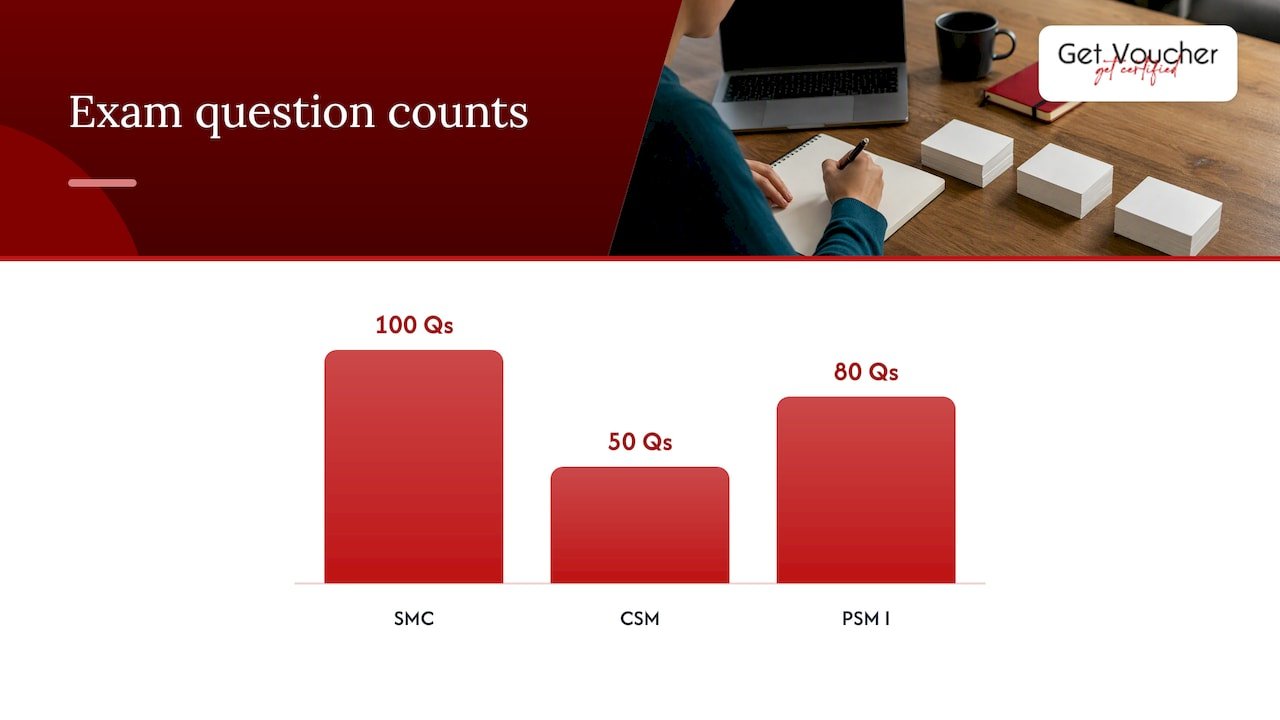
| SMC® | SCRUMstudy | 100 questions, 120 minutes, online and unproctored |
| SAMC™ | SCRUMstudy | Online, unproctored exam |
| CSM® | Scrum Alliance | Required 16-hour course, then a 50-question, 60-minute test with a 74% pass score |
| PSM I | Scrum.org | 80 questions, 60 minutes, 85% pass score |
The Scrum Alliance help centre confirms the CSM details: a trainer-led course is mandatory, and candidates have two attempts within 90 days of receiving their welcome email. Scrum Alliance and Scrum.org do not assess learning in the same way, so never treat their credentials as interchangeable.
Two cautions apply. First, “online” or “unproctored” tells you nothing about whether an exam is open-book, so check each provider’s own rules. Second, a proctored exam is not automatically more credible than an unproctored one. Difficulty and recognition vary by credential, and we do not generalise across them.
GetVoucher sells the SCRUMstudy credentials only. We do not sell Scrum Alliance or Scrum.org credentials, and they are mentioned here so you can compare your options honestly.
Costs to compare
When you add up the cost of a Scrum Master credential, separate five things: the exam fee, any mandatory training, optional preparation, retakes and renewal. Providers bundle these differently, so an exam-only voucher is not automatically the cheapest route. Our published prices are one-off:
- Scrum Master Certified (SMC®): £249
- Scrum Product Owner Certified (SPOC®): £299
- SCRUM Agile Master Certified (SAMC™): £349
- Scrum Developer Certified (SDC®): £99
- Dual Agile Pack, Scrum Master and Product Owner: £519
What each voucher includes, whether study materials, video training or scheduling support, differs by product, so check the product page before you buy. Browse the full Scrum and Agile range for details.
Stage 3: build breadth beyond one framework
The Oxford Brookes International Centre for Coaching and Mentoring Studies focuses on coach and mentor development, and its work suggests that relying on one framework is often seen as a limitation by experienced coaches. Treat that as a prompt to widen your range:
- Product thinking. The Product Owner role is worth understanding properly, even if you never hold it. Our SPOC® voucher, or the Dual Agile Pack, covers the SCRUMstudy view of it.
- Delivery in operations. If you coach platform or operations teams, the Scrum for Operations and DevOps Expert Certified voucher costs £239.
- Scaling. If your organisation uses SAFe, study it from current Scaled Agile sources. SAFe is not simply scaled Scrum. It supports Scrum, Kanban and wider Lean-Agile practices, and whether it suits a situation depends on dependencies, architecture and coordination needs, not on team count alone. Its current terminology includes the Planning Interval, which replaced older wording. External SAFe credentials are separate from the Scrum certifications we sell.
- Process improvement. Some coaches add Lean or Six Sigma knowledge. DMAIC is used in Six Sigma, Lean and broader process improvement, and it is not inherently slow or complex. Our process improvement certification guide is a starting point, and the Six Sigma Yellow Belt is free.
Optional extras are exactly that. None of the wider certifications we sell is a standard route to coaching. They are complementary learning you choose because your teams need it.
Stage 4: coaching credentials and coaching craft
This is the stage most Scrum-only roadmaps skip. Agile coaching is coaching as well as agile, and the coaching profession has its own standards.
The research behind this guide points to professional bodies such as the Association for Coaching and the EMCC as the dominant voices in the UK. Oxford Brookes research on coach development notes that many coaches engage with competency-based development mainly when they are pursuing or upgrading a credential, which is a useful reminder to build the habit before you need the certificate. The International Coaching Federation publishes its Core Competencies, which are worth reading even if you never apply for an ICF credential, because they describe the skills of listening, questioning and ethical practice that framework courses often touch only lightly.
Your options at this stage include:
- Agile-specific coaching certificates. Courses such as ICAgile’s ICP-ACC or Scrum Alliance’s coaching-track programmes exist, and each has its own prerequisites and assessment. Check the provider’s current page rather than relying on a blog summary, including ours.
- Accredited coaching qualifications. These are offered by universities and coaching bodies and often involve supervised practice. Oxford Brookes, for example, runs postgraduate programmes in coaching and mentoring at master’s level.
- Leadership and management qualifications. Coaches working with senior leaders often benefit from structured leadership learning, such as the digital leadership curriculum that combines online modules with cohort-based training.
The point is not to collect all three. Pick the one that fills your largest gap, and be able to say why.
What employers look for besides certificates
UK government guidance is blunt on this. The GOV.UK Service Manual says that training gives you the basics, but the real learning comes from putting it into practice. A certificate is evidence of study. It is not evidence of performance, and we make no claim that any certificate leads to a job, a salary or a promotion.
What tends to persuade a hiring panel is a portfolio of evidence you can describe plainly:
- Teams you have worked with, and what changed for them.
- Conflict you helped resolve, and how you approached it.
- Workshops and retrospectives you facilitated, and what you learned from the ones that went badly.
- How you handed ownership back to the team so the change lasted.
A practical portfolio is useful but optional. It is not an official requirement of any certificate we sell, and not every certification involves a project or a proctored exam.
That last point on handover is increasingly central. A systematic mapping study of agile coaching research from the University of Glasgow notes that agile coaching is a key enabler of adoption but remains thinly researched. A later Glasgow study on sustaining agility examines how coaches plan for agility to continue after their involvement ends. Both support the same practical instinct: a good coach works towards being needed less.
Our view on the path
We sell certification vouchers, so you might expect us to tell you to buy more of them. We would rather say this: the cheapest, clearest first step is the free one, and the most important step is the one no voucher can sell you, which is time with real teams.
What we see in how learners use our catalogue is a pattern of progression: introductory credential, practitioner credential, then complementary skills as a role demands them. That is how we have built the range, from free Scrum Fundamentals up to the Dual Agile Pack. We are also careful about what we claim. A certificate shows you have studied one provider’s body of knowledge and passed that provider’s assessment. It does not show you can coach, and anyone who implies otherwise is overselling.
If you are mid-career and cannot pause work, a flexible online route suits the early stages well. Our guide to becoming an agile coach while keeping your job covers the practicalities, and the wider Scrum and Agile guide places each credential in context.
— Rayan
Where to start with GetVoucher
If you are at stage 1 or 2, begin with the free Scrum Fundamentals Certified voucher. When you are ready for a practitioner credential, SMC® is £249 and SPOC® is £299. If you want both perspectives, the Dual Agile Pack is £519. You can see everything on the GetVoucher homepage.
FAQ
Is there an official agile coach certification?
No single certification is universal. UK government now recognises the agile coach as a role in its capability framework, but it describes skills and levels rather than one exam. Most coaches combine a framework certificate, practical experience and a coaching-focused credential.
Do I need to be a Scrum Master first?
Not by rule, but it is a common route because it gives you hands-on time with a team. Some coaches arrive from delivery management, project management or product roles. Check the prerequisites of any coaching credential you want, because they are provider-specific.
How long does the path take?
It varies too much for us to give a reliable figure. Study for an entry credential can be short, but coaching skill comes from practice with teams over a longer period. Plan around the experience you want to gain, not a date.
Is agile coaching a good career?
That depends on your sector, your employer and your appetite for work that is mostly about people and change. We make no promises about salary or progression. Read current job adverts in your own area and compare their requirements with your experience.
Sources
- One role, many departments: defining agile coaching across government (CDDO)
- Skills A to Z, Government Digital and Data Profession Capability Framework
- What to expect from the Certified ScrumMaster (CSM) test, Scrum Alliance Help Center
- International Centre for Coaching and Mentoring Studies, Oxford Brookes University
- Oxford Brookes research on coach development (RADAR)
- ICF Core Competencies
- Find agile training, learning and support, GOV.UK Service Manual
- Agile coaching research: a systematic mapping study (University of Glasgow)
- Sustaining Agility: How Agile Coaches Ensure Changes Endure (University of Glasgow)