




For aspiring Scrum Masters, GetVoucher’s Scrum Master Certified (SMC®) pathway is a practical entry route into SCRUMstudy’s credential family. Product Owner candidates should look at Scrum Product Owner Certified (SPOC®), while developers and complete beginners often start free with Scrum Fundamentals Certified. These sit within SCRUMstudy’s own family. Scrum.org (with PSM I) and Scrum Alliance (with CSM) run separate credential families with different exam rules, so check which body your employer expects before you commit.
Table of Contents
- How Scrum credential families differ: Scrum.org, Scrum Alliance and SCRUMstudy
- Role based pathways: Scrum Master, Product Owner and developer routes
- Exam formats, booking and preparation workflows
- Costs, timelines and credential maintenance
- How to choose the right Scrum certification
- GetVoucher’s role in Scrum certification
- What actually matters when choosing a Scrum certification
- Ready to start? Your next steps with GetVoucher
- Sources
- FAQ
How Scrum credential families differ: Scrum.org, Scrum Alliance and SCRUMstudy
Three organisations dominate the Scrum certification space, and they are not interchangeable. Each sets its own exam format, prerequisites, pass mark and renewal terms, so conflating them leads to wasted money or the wrong credential for your employer’s expectations.
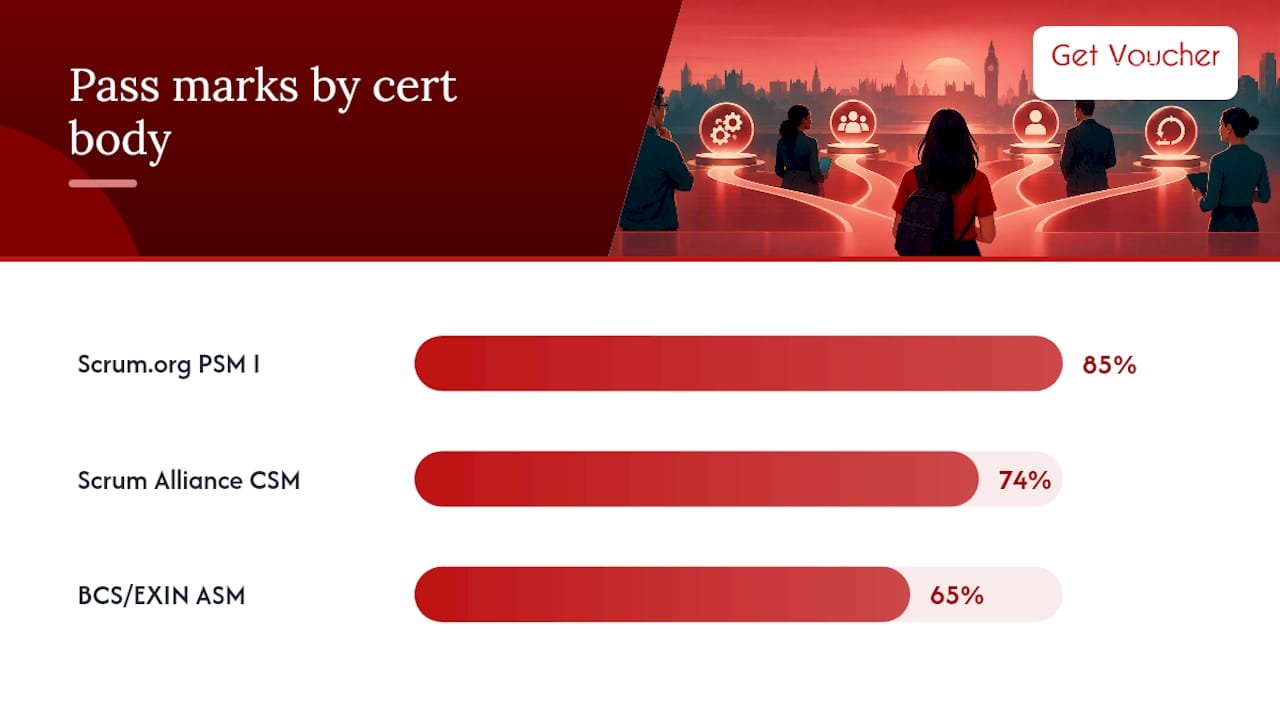
Scrum.org runs the Professional Scrum Master (PSM I) assessment. The exam has 80 questions, a 60-minute time limit, and requires an 85% pass mark. There is no mandatory course requirement before sitting it, and once earned, PSM I carries lifetime validity with no renewal fee.
Scrum Alliance runs the Certified ScrumMaster (CSM) credential on a different model entirely. It requires a mandatory 16-hour approved course as a prerequisite before you can even attempt the exam. The assessment itself is 50 questions, also with a 60-minute time limit, and the pass mark is 74%. The exam is delivered as an online unproctored assessment. Unlike PSM I, CSM is not permanent: it runs on a two-year renewal cycle with a continuing education requirement to keep it active.
A third route, distinct from both Scrum.org and Scrum Alliance, comes from BCS working with EXIN: the Agile Scrum Master practitioner exam. This is a 90 minute closed-book exam with 40 multiple-choice questions and a 65% pass mark (26 out of 40), and attendance at an accredited training course is mandatory, with completion of the Foundation Certificate strongly recommended beforehand. The BCS qualification page confirms the same exam length, question count and pass mark.
SCRUMstudy, the body behind GetVoucher’s Scrum credentials, operates its own certification family under VMEdu as the training provider. Its Scrum Master Certified (SMC®) and Scrum Product Owner Certified (SPOC®) credentials sit alongside the Scrum Fundamentals Certified (SFC) free introductory course, each with its own study materials and assessment structure through the SCRUMstudy body specifically, separate from Scrum.org’s and Scrum Alliance’s own exam rules.
A distinction that matters more than which logo is on the certificate: Scrum Master credentials, across every body mentioned here, assess facilitation and team dynamics. Product Owner credentials assess backlog management and stakeholder communication. These are parallel skill sets serving different accountabilities on a Scrum team, not stages of the same ladder. Nobody needs to pass a Scrum Master exam before attempting a Product Owner one, or the reverse.
When comparing bodies, keep these distinctions in mind:
- Scrum.org PSM I: 80 questions, 60 minutes, 85% pass mark, no mandatory course, lifetime validity.
- Scrum Alliance CSM: mandatory 16 hour course, 50 questions, 60 minutes, 74% pass mark, online unproctored, two year renewal with continuing education.
- BCS/EXIN Agile Scrum Master: 90 minutes, 40 questions, 65% pass mark, mandatory accredited course attendance.
- SCRUMstudy (via VMEdu): separate credential family covering SMC®, SPOC®, SFC and further role-based certificates, with its own study and assessment structure.
Public-sector hiring guidance, such as DWP Digital’s careers pages, describes delivery roles using Scrum alongside other frameworks in mixed-method environments, with practices like three-week sprints blended into broader delivery models. That is a reminder that a certificate alone does not describe how any one employer actually runs its sprints.
Role based pathways: Scrum Master, Product Owner and developer routes
Choosing a certification starts with your actual role, not with which credential sounds more senior. Scrum Master, Product Owner and developer paths test different things and suit different people.

Scrum Master path. If you facilitate ceremonies, remove impediments and coach a team’s working practices, Scrum Master Certified (SMC®) from SCRUMstudy is a reasonable entry point. It assesses facilitation and team dynamics rather than product strategy. Role descriptions for agile delivery roles, such as the DVLA’s Agile Delivery Manager posting, describe Scrum Master duties as resolving impediments, coaching and facilitation, which lines up with what this credential family tests. From SMC®, SCRUMstudy offers a progression to SCRUM Agile Master Certified (SAMC™), a broader credential covering agile practices beyond a single team’s ceremonies.
Product Owner path. If your work centres on the backlog, prioritisation and stakeholder communication, Scrum Product Owner Certified (SPOC®) is the SCRUMstudy credential built for that focus. It assesses backlog and stakeholder management rather than team facilitation. This is not a follow-on from the Scrum Master path; it is a separate accountability that many Product Owners hold without ever sitting a Scrum Master exam.
Developer path. Technical team members who want a credential focused on how developers operate inside Scrum can look at Scrum Developer Certified (SDC®). Complete beginners in any role, meanwhile, often start with the free Scrum Fundamentals Certified course, which carries no formal prerequisites and gives a grounding before committing to a paid, role-specific credential.
Typical study timelines vary by starting point:
- A complete novice working through Scrum Fundamentals Certified alone, with no prior agile exposure, often needs a few weeks of part-time reading before attempting a paid credential.
- Someone already working in a Scrum team who moves to SMC® or SPOC® can usually prepare in a shorter window, since the concepts reinforce day-to-day practice.
- Experienced practitioners aiming for an advanced credential like SAMC™ typically need to revisit broader agile scaling concepts beyond single-team ceremonies.
Pro Tip: Pick the credential that matches what you actually do most days: facilitation points to Scrum Master, backlog ownership points to Product Owner, and neither is a prerequisite for the other.
Exam formats, booking and preparation workflows
Preparing for a Scrum certification is mostly about matching your study plan to the exam format of the specific body you have chosen, since formats differ sharply.
- Confirm the body and format first. Scrum.org’s PSM I is a computer-based test of 80 questions in 60 minutes with an 85% pass mark and no mandatory course; Scrum Alliance’s CSM requires the 16 hour course before you can even book the 50-question, online unproctored assessment; BCS/EXIN’s Agile Scrum Master exam is a 90 minute, 40-question closed-book test requiring accredited course attendance.
- Get the voucher or course access sorted. With GetVoucher, this step means purchasing the relevant SCRUMstudy voucher, such as SMC® or SPOC®, which gives access to structured online study materials tied to that specific credential.
- Work through the self-paced materials. Video lessons and reading guides let you study around a working schedule rather than block out classroom days, which suits most working professionals more than fixed-date courses.
- Sit practice questions before the real exam. Reviewing sample question sets in the same format as your chosen body’s exam, whether that is 80 questions in 60 minutes or 40 questions in 90 minutes, builds familiarity with pacing.
- Book the exam once you consistently pass practice attempts. Some bodies deliver exams as online proctored assessments with identity checks and a monitored session; others, such as Scrum Alliance’s CSM, use an online unproctored format instead, so check which applies to your credential before test day.
- On the day, treat timing as the main risk. An 85% pass mark on PSM I, or 74% on CSM, leaves little room for questions you skip and mean to return to, so pace yourself against the clock from the first question.
Common failure modes are rarely about knowledge gaps alone: candidates lose time re-reading long scenario questions, or misjudge how strict a proctored session is about a clear desk and a quiet room. Reading your chosen body’s exam handbook before booking avoids most of these surprises.
Costs, timelines and credential maintenance
Budgeting for a Scrum certification means separating three things: the credential price, the study time it realistically takes, and what happens after you pass.
Some Scrum Master and Product Owner certifications are listed at set prices, while Scrum Fundamentals Certified is often available free, giving beginners a no-cost way to test their interest before paying for a role-specific credential.
Renewal and validity rules differ sharply by body, and this is where most confusion happens:
- Scrum.org’s PSM I carries lifetime validity: once you pass the 80 question, 60 minute exam at 85%, there is no renewal cycle to manage.
- Scrum Alliance’s CSM runs on a two year renewal cycle with a continuing education requirement, on top of the mandatory 16 hour course and 74% pass mark needed to earn it in the first place.
- BCS/EXIN’s Agile Scrum Master credential is earned through a 90 minute, 40 question exam at a 65% pass mark, following mandatory accredited course attendance.
- SCRUMstudy credentials, including SMC® and SPOC®, have their own separate maintenance terms set by that body rather than by Scrum.org or Scrum Alliance; GetVoucher’s guidance on maintaining a SCRUMstudy certification covers what that involves.
A realistic example timeline for a Scrum Master starting from scratch: a few weeks studying Scrum Fundamentals Certified for free, followed by a further stretch preparing for SMC® once the basics are familiar, then, months or years later, revisiting broader scaling concepts before attempting SAMC™. A Product Owner’s timeline runs in parallel rather than after: Scrum Fundamentals Certified, then SPOC®, with no need to pass a Scrum Master exam at any point.
Buying a voucher upfront through GetVoucher fixes the credential cost before you start studying, which removes one variable from an otherwise open-ended preparation timeline.
How to choose the right Scrum certification
A short checklist beats guesswork when several credential families are competing for your attention.
- Match the credential to your actual role. Facilitation and coaching point to a Scrum Master credential; backlog and stakeholder work points to a Product Owner credential; neither should be treated as a stepping stone to the other.
- Check what your employer or sector actually expects. Public-sector delivery roles, for instance, often value broad delivery skills alongside any single certificate, so ask before assuming one body’s badge is expected.
- Compare exam format honestly. An 80 question, 60 minute, 85% pass mark exam with no course requirement (Scrum.org) is a different commitment to a mandatory 16 hour course plus a 50 question online unproctored assessment (Scrum Alliance), and different again from a 90 minute, 40 question closed-book exam requiring accredited attendance (BCS/EXIN).
- Weigh the renewal burden. A lifetime-valid credential suits someone who wants a one-time investment; a two year renewal cycle with continuing education suits someone happy to keep engaging with a community over time.
- Be wary of vague recognition claims. Course marketing that promises guaranteed hiring outcomes or unspecified industry recognition is a red flag; a credential validates knowledge of a framework, not a guaranteed job outcome.
- Pick a training format that fits your week. Self-paced online materials suit busy professionals fitting study around existing work; a mandatory classroom or live online course suits people who want fixed structure and a cohort.
Pro Tip: If you are unsure whether you need Scrum Master or Product Owner skills first, GetVoucher’s Dual Agile Pack bundles both fundamentals so you can decide which accountability suits you after studying both.
GetVoucher’s role in Scrum certification
The platform is a voucher platform, not a certification body: it sells access to credentials issued by recognised bodies, with training providers acting behind the materials. That distinction matters when you read any credential’s rules, since exam format, pass criteria and renewal terms are set by the issuing body, not by GetVoucher.
Learners can access Scrum Master Certified (SMC®), Scrum Product Owner Certified (SPOC®), SCRUM Agile Master Certified (SAMC™), Scrum Fundamentals Certified, and Scrum Developer Certified (SDC®), through platforms that provide related study materials and vouchers. Purchasing a voucher gives access to self-paced video training designed to reduce the need for separate paid coaching or scattered study resources.
More advanced scaled Scrum certifications, including SSMC and SSPOC, are planned for wider certification catalogues in the coming months; interested learners can contact the voucher platform for pricing, details and availability ahead of launch.
Everything above describing exam format, pass marks and renewal rules is a factual description of each issuing body’s own published terms; recommendations on which credential suits your role are editorial guidance based on that same information, not a claim about guaranteed recognition or career outcomes.
What actually matters when choosing a Scrum certification
Most advice on Scrum certification treats the choice as a single ladder: start here, climb to there. That framing does not hold up. A Scrum Master credential and a Product Owner credential test different accountabilities, and plenty of capable practitioners hold one without ever touching the other. The more useful question is not “what is the next certificate up” but “what does my actual work involve this year.”
The detail most guides skip is how differently the bodies treat renewal. A lifetime-valid credential and one with a two year continuing education cycle are not the same purchase, even if the study content looks similar on the surface. If you dislike ongoing maintenance, that difference should weigh as heavily as the exam format itself.
Prioritise matching the credential to your daily accountability first, then compare exam mechanics, then only think about progression once the first credential is behind you.
— Rayan
Ready to start? Your next steps with GetVoucher
Once you know which role you are certifying for, the practical part is straightforward: pick the matching voucher, work through the study materials at your own pace, and book the exam when practice attempts feel comfortable.
A few starting points worth bookmarking:
- Browsing the certifications catalogue shows every current Scrum voucher alongside GetVoucher’s wider professional certification range.
- The Scrum Master Certified (SMC®) course page covers what is included with the £199 voucher for that path.
- The Scrum Product Owner Certified (SPOC®) course page lays out the equivalent £199 voucher for backlog and stakeholder-focused readers.
- Complete beginners can start with Scrum Fundamentals Certified at no cost before committing to a paid credential.
Buying a voucher through GetVoucher fixes your certification cost upfront and unlocks the self-paced materials tied to that specific SCRUMstudy credential, so you are not left piecing together separate guides and videos from different sources. If you are weighing up the newer scaled-Scrum options, contact GetVoucher directly for pricing and availability on SSMC and SSPOC ahead of their planned addition to the catalogue. Visit Get-voucher to see the full range and start with the voucher that matches your role.
Sources
FAQ
What is a Scrum certification?
A Scrum certification is a credential that validates knowledge of Scrum roles, ceremonies and artefacts, issued by a specific body such as Scrum.org, Scrum Alliance or SCRUMstudy. Each body sets its own exam format, pass mark and renewal rules, so “Scrum certification” is not one single test but a family of separate credentials.
Is Scrum still relevant in 2026?
Scrum remains a widely used framework for organising team-based delivery work, often used alongside other approaches rather than in isolation. Public-sector delivery guidance, such as DWP Digital’s careers pages, describes Scrum being blended with other frameworks in mixed-method environments rather than replaced outright.
Is it worth getting Scrum certified?
A Scrum certification demonstrates knowledge of the framework’s roles and practices to the level tested by that specific body’s exam, which can support a case for a role change or promotion. It does not guarantee a hiring outcome or a pay rise, since employers weigh certificates alongside demonstrated experience and other delivery skills.
Is AI replacing Scrum Master?
There is no verified data showing AI tools replacing the Scrum Master role outright. Employer role descriptions, such as DVLA’s Agile Delivery Manager posting, continue to emphasise facilitation, coaching and stakeholder management, which are people-focused skills that current tools support rather than substitute for.