




An OKR certification is a practical credential for leaders and professionals who must set measurable objectives, align teams and run repeatable review cycles. This guide explains who benefits most, how provider pathways and exams actually work, what good training covers, and how to choose, prepare for and maintain a credential that holds up in daily practice.
Table of Contents
- What an OKR certification is and who it suits
- How provider pathways and exam formats differ
- What courses and certifications teach: skills, exercises and practical practice
- How to choose the right OKR certification
- Preparing for the exam and common logistics
- Progression and maintaining credentials
- When certification is the right investment
- How GetVoucher can help
- FAQ
- Sources
What an OKR certification is and who it suits
An OKR certification validates your knowledge of the Objectives and Key Results method: a goal-setting approach built around ambitious objectives paired with measurable key results, reviewed on a set cadence. Most programmes combine self-paced lessons with an assessment that checks whether you can apply the method, not just recite its vocabulary.
Certain roles gain the most from formal training. Line managers who set team goals, product owners coordinating roadmaps, HR and performance leads running review cycles, Agile practitioners expanding beyond sprint-level planning, and senior leaders driving strategic initiatives all find direct use for the structure OKRs provide.
A credible programme should leave you able to:
- Draft objectives that are ambitious but specific enough to act on.
- Define key results that are measurable rather than descriptive.
- Map how team-level goals connect to organisational priorities.
- Run a review cadence that catches drift early and adjusts course.
Certification demonstrates knowledge and validates competency in these areas. It does not guarantee that your organisation will execute OKRs well once you return to the job, which depends on leadership buy-in, consistent review habits and a culture that tolerates missed targets as information rather than failure.
How provider pathways and exam formats differ
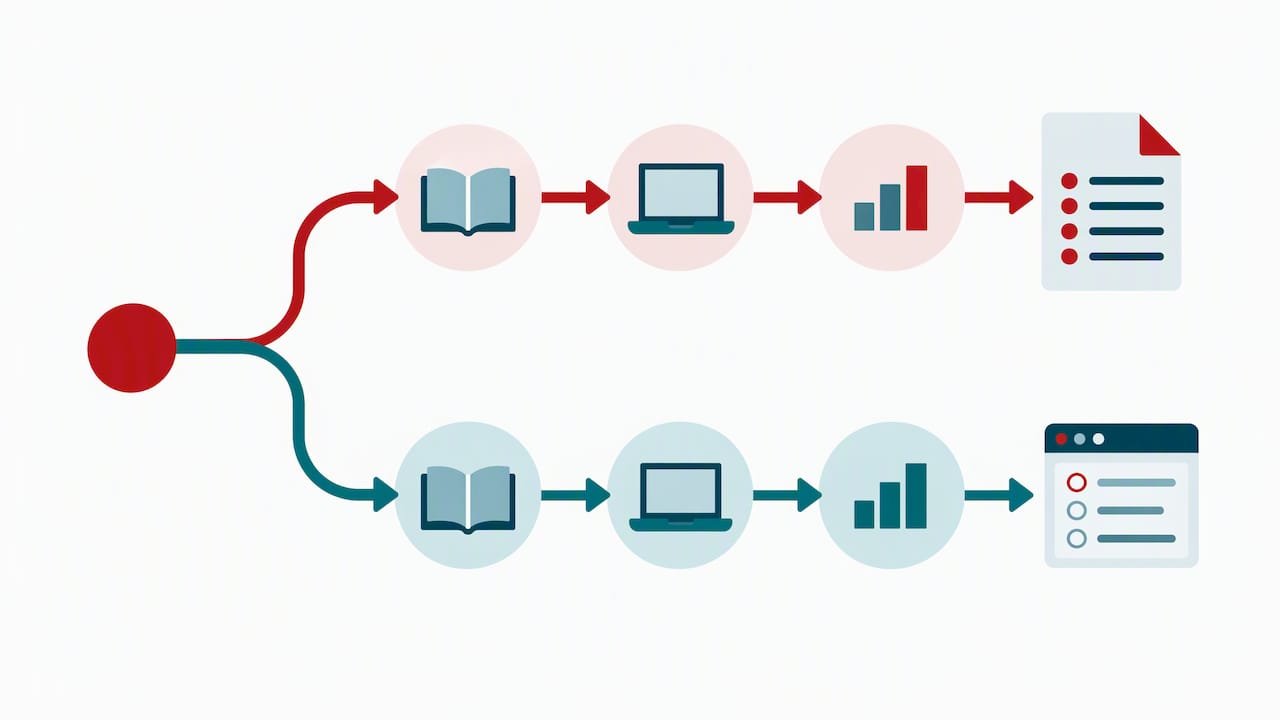
OKR certification is not standardised across providers. Programmes differ in level names, prerequisites, exam format (proctored or unproctored), question counts and durations, and how credentials are renewed. Before buying, check whether a pathway is positioned as entry-level, practitioner-level or coach-level, and whether any level assumes you have already passed another.
OKRstudy, one established issuing body in this space, documents its own 2026 catalogue as follows (provider-specific facts, not an industry standard):
- OKRFC (Foundation): an entry credential with no prerequisite.
- OKRPC (Practitioner): a mid-level credential that candidates may progress to after Foundation.
- OKROC (Coach) and OKRAC (Advanced Coach): higher-level credentials aimed at those coaching OKR adoption.
- OKRAIC (OKR with AI Certified): a separate credential with no prerequisite, no exam requirement, and lifetime validity.
OKRstudy lists its main exams as online unproctored, with durations varying by level rather than a single fixed length. Always confirm current question counts, durations and prerequisites directly on the issuing body’s enrolment pages before you commit, since catalogues change.
What courses and certifications teach: skills, exercises and practical practice
The strongest OKR programmes teach through doing, not just through definitions. Look for a syllabus that covers writing measurable objectives, defining and testing key results, mapping alignment across teams, designing a review cadence and facilitating the reviews themselves.
Beyond the core skills, practical exercises separate a useful course from a theoretical one:
- Drafting live OKRs for your own team or a realistic scenario, not a generic template.
- Running a short alignment workshop that connects individual goals to a shared priority.
- Building a simple measurement model for a key result before committing to it.
- Practising a retrospective-style review that asks what to keep, change or drop.
A UK Government Digital Service case study on service-specific performance indicators illustrates this well: teams used quarterly objectives alongside weekly performance reviews to test changes and assess outcomes, pairing OKR-style goal setting with tighter, more frequent measurement. The lesson for learners is that implementation skill, built through repeated practice, matters more than memorising terminology.
Pro Tip: Choose a course that makes you draft and defend at least one full set of OKRs before the final assessment, not just complete multiple-choice quizzes.
How to choose the right OKR certification
Choosing well starts with matching the certification to a specific skills gap rather than picking the most familiar name. Ask yourself what you need to do differently at work: write better objectives, run tighter reviews, or coach others through adoption. That answer should point you towards a level and a provider.
Work through these steps before you purchase:
- List the two or three outcomes you need (for example, writing measurable key results or running a quarterly review cycle).
- Check whether the syllabus includes practical drafting and review exercises, not only reading material.
- Confirm the exam format, duration and number of attempts allowed.
- Check recertification terms: is the credential lifetime-valid, or does it need renewal within a set period?
- Compare the time and cost commitment against your own availability and budget.
Watch for these red flags:
- No published syllabus or sample objectives.
- Vague claims about career outcomes with no supporting detail.
- No information on exam format or duration anywhere on the provider’s site.
- A credential marketed as universally recognised with no issuing body named.
- No mention of recertification or validity period.
| Criterion | What to check | Why it matters |
|---|---|---|
| Learning outcomes | Syllabus lists specific skills, not themes | Confirms the course closes your actual gap |
| Exam format | Proctored or unproctored, stated duration | Affects scheduling and preparation style |
| Recertification | Lifetime-valid or time-limited renewal | Affects long-term cost and maintenance effort |
| Practical practice | Includes drafting and review exercises | Builds workplace-ready skill, not just recall |
Preparing for the exam and common logistics
Most OKR certification journeys follow a similar sequence: you enrol, get access to learning materials, work through the syllabus at your own pace, schedule the exam, complete any required technical checks, sit the exam, then download your certificate from your learner account once you pass.
Logistics vary by provider, so confirm the detail rather than assuming it. Typical points to check include your timezone setting at scheduling, a stable internet connection for the duration of the exam, and whether the exam is unproctored (meaning no live monitor, but still timed and rule-bound).
Before your slot, run these checks:
- Confirm you can log into your learner account without issues.
- Verify the timezone shown on your booking matches your actual location.
- Test your device and internet connection well ahead of time, not minutes before.
Pro Tip: Run a short internal pilot, drafting one real team’s OKRs and reviewing them after two weeks, alongside your exam preparation. It gives you material to draw on in the assessment and at work.
Progression and maintaining credentials
Recertification generally follows one of three routes: retaking an exam, completing a self-certification or continuing professional development (CPD) process, or upgrading to a higher-level credential that supersedes the one you hold. OKRstudy’s own model, as provider-specific guidance, lists OKRFC as lifetime-valid while OKRPC, OKROC, OKRAC and OKRAIC follow a three-year recertification cycle.
Once certified, the more useful next step is usually practical: run a pilot OKR cycle with your own team, lead a quarterly review, or mentor a colleague through drafting their first set of objectives. A recommended next step for those coaching others is a higher-level credential, though this should be treated as conditional advancement rather than a mandatory sequence.
Build maintenance into your calendar rather than treating it as an afterthought:
- Note your credential’s renewal date as soon as you receive it.
- Keep a simple log of practical OKR work you have led, useful evidence for CPD routes.
When certification is the right investment
Certification earns its cost when you need credibility fast, particularly if you are introducing OKRs to sceptical stakeholders or stepping into a role where a recognised credential opens the conversation. It is less valuable as a first step if your organisation has never tried goal setting this way: a short internal pilot, even an imperfect one, often teaches more than a course taken in isolation.
The two are not competitors. The most effective leaders usually combine both: a credential for shared vocabulary and structure, then a real cycle of drafting, reviewing and adjusting objectives to make the method stick. Research into coaching’s role in performance management, explored in this HR guide to coaching, makes a similar point about training alone rarely being enough without ongoing support.
— Rayan
How GetVoucher can help
OKR certifications may be added to certification catalogues in the coming months, and interested learners can contact relevant platforms for details and availability. Where available, course access and certification preparation support may be provided alongside existing catalogues.
What GetVoucher already does well apply directly to planning an OKR learning path:
- Simplifies the search across certification pathways in Agile, Scrum, Digital Marketing, Quality Management and other professional skills.
- Provides access to structured, self-paced online courses.
- Helps learners compare pathways and progress from entry-level to more advanced credentials over time.
If you are building wider skills alongside OKRs, such as Scrum, Agile delivery or quality management, browse the current certifications catalogue or visit the GetVoucher homepage to check availability and get in touch about OKR offerings.
FAQ
What is an OKR certification?
An OKR certification is a credential that validates your understanding of the Objectives and Key Results method, including how to write measurable objectives, define key results and run review cycles. Programmes vary by provider in level, exam format and recertification rules, so details should always be confirmed on the issuing body’s own pages.
Are OKRs still relevant for modern organisations?
OKRs remain in active use, including in public-sector contexts: a UK Government Digital Service case study describes teams using quarterly objectives alongside weekly reviews to test changes and track outcomes. The UK Senior Civil Service performance framework for 2026 to 2027 also requires leadership objectives to link to organisational priorities, showing continued use of this style of goal setting at a senior level.
What is the difference between an OKR and a KPI?
An OKR pairs an ambitious objective with a small set of key results that measure progress towards it, while a KPI (key performance indicator) is typically an ongoing metric tracked over time rather than tied to a specific goal cycle. Many teams use both together, setting OKRs for a defined period and watching KPIs continuously to spot issues between review cycles.
What are the core elements of the OKR method?
Most descriptions of the method centre on an objective (a qualitative, ambitious goal), a small number of key results (measurable outcomes that show progress), a defined time cycle, a regular review cadence, and alignment between individual, team and organisational goals. Definitions vary slightly between providers and authors, so a specific certification syllabus is the best place to check exact terminology.
Do OKR certifications require a proctored exam?
Exam format varies by issuing body, and some current OKRstudy credentials are listed as online unproctored rather than proctored. Always check the specific exam format, duration and conditions on the provider’s own enrolment page before you register, since these details can change.
Sources
- How service-specific performance indicators can improve a service
- Performance management framework for the Senior Civil Service 2026 to 2027 performance year