




PRINCE2 governs the project investment; Agile governs how the work gets delivered. Choose PRINCE2 when a sponsor needs formal control over a fixed budget and scope. Choose Agile when requirements are likely to shift and customer feedback needs to shape the product. Most organisations running complex work in 2026 need both, designed deliberately rather than left to chance.
TL;DR:
- PRINCE2 governs project investments with structured stages, roles, and tolerance thresholds, while Agile focuses on flexible, customer-driven delivery cycles.
- Successful hybrid projects clearly define decision rights, align stage boundaries with delivery milestones, and keep documentation lightweight to avoid friction.
- Combining PRINCE2 and Agile certifications, like PRINCE2 with SCRUMstudy’s Scrum Master or Product Owner, helps practitioners bridge governance and delivery effectively.
- Organizational culture and leadership’s willingness to devolve decision-making are key factors in the success of hybrid implementations, not the methodology choice itself.
- Mismatched governance with an uncertain scope or rigid delivery with high-stakes budgets are primary causes of failure, emphasizing the need to tailor the approach to project needs.
Table of Contents
- PRINCE2 vs Agile: what each one actually is
- How do PRINCE2 and Agile compare in practice?
- When should you choose PRINCE2, Agile, or a hybrid?
- How do you integrate PRINCE2 governance with Agile delivery?
- Which certifications help you bridge governance and delivery?
- Why does organisational culture decide whether either method actually works?
- What do real-world PRINCE2 and Agile implementations look like?
- How do PRINCE2 and Agile teams collaborate differently?
- What tools support PRINCE2 and Agile project management?
- A practitioner’s take: stop performing, start integrating
- Get certified for whichever side of the hybrid you own
- Where this article’s guidance comes from
- Sources
- FAQ
PRINCE2 vs Agile: what each one actually is
PRINCE2 is a governance method. It structures a project around a business case, defined stages, clear roles, and tolerances that tell a project board when to escalate a decision. It doesn’t tell you how to build anything. It tells you who decides, when to check in, and what “acceptable deviation” looks like before someone has to stop and ask permission. That’s deliberate: PRINCE2 is built to be tailored to whatever delivery technique sits underneath it.
Agile is a delivery philosophy, not a governance model. Frameworks like Scrum and Kanban organise work into short cycles, prioritise a backlog, and use regular customer feedback to adjust direction as understanding improves.
Comparing the two head-to-head is a category error, similar to asking whether a company’s board of directors is “better” than its engineering team. They answer different questions. A useful two-question test cuts through the confusion:
- Who needs to control the money, scope, and risk exposure, and how formally?
- How much will the requirements change once real delivery starts?
Answer both honestly and the right combination usually becomes obvious, which is exactly the argument PeopleCert’s community guidance makes: stop asking which methodology wins and start asking which combination solves your actual problem.
How do PRINCE2 and Agile compare in practice?
Set side by side, the two approaches diverge on almost every operational dimension, even though they’re solving complementary problems rather than competing ones.
- Purpose: PRINCE2 exists to protect the business case and manage investment risk. Agile exists to maximise the value delivered per iteration.
- Planning style: PRINCE2 plans in stages, each authorised individually by the project board. Agile plans in short cycles, typically one to four weeks, replanned continuously as the backlog evolves.
- Roles and accountability: PRINCE2 defines a Project Board, Senior Responsible Owner, and Project Manager with named decision rights. Agile defines a Product Owner who owns priority and a Scrum Master or facilitator who protects the team’s working process.
- Cadence and deliverables: PRINCE2 delivers management products at stage boundaries. Agile delivers working increments at the end of every sprint.
- Documentation: PRINCE2 expects a business case, risk register, and stage plans as standard governance artefacts. Agile favours lightweight documentation, often a backlog and a simple Definition of Done, over formal reports.
- Change management: PRINCE2 routes changes through a formal control process and tolerance thresholds. Agile treats changing priorities as normal and reprioritises the backlog each cycle.
- Risk handling: PRINCE2 tracks risk formally against tolerance bands. Agile absorbs risk through short feedback loops that surface problems early.
A regulated infrastructure build, where a fixed budget and audited compliance trail matter more than speed, tends to sit closer to the PRINCE2 end. A digital product with unclear requirements and a need for constant user feedback sits closer to the Agile end. Most enterprise software delivery lands somewhere between the two, which is where PRINCE2 Agile earns its name: it uses a hexagon model to balance time, cost, benefits, risk, quality, and scope simultaneously rather than treating them as a single fixed constraint.
When should you choose PRINCE2, Agile, or a hybrid?
Match your project’s actual signals to the approach rather than defaulting to whichever methodology your organisation already knows.
- Choose PRINCE2 when the budget is fixed, the sponsor needs a formal audit trail, or regulatory sign-off gates each phase.
- Choose Agile when requirements are genuinely uncertain, the customer needs to see working output early, and the team can absorb changing priorities without renegotiating a contract each time.
- Choose a hybrid when you have both: a governance layer that must answer to a board, and a delivery team that needs room to iterate underneath it.
The pragmatic hybrid blueprint is simple to describe even if it takes discipline to run. Governance protects the business case, the budget envelope, and the escalation path. Delivery owns the sprint backlog, the technical approach, and day-to-day sequencing. Nobody outside the team should be dictating story order, and nobody inside the team should be quietly overspending the tolerance the board agreed.
The most common mistake is bolting Agile ceremonies onto an unchanged PRINCE2 stage structure without adjusting either side. Stand-ups happen, but the project board still expects a Gantt chart. That produces friction, not integration.
Pro Tip: Before you design a hybrid, write down which three decisions absolutely must go through the project board, and agree that everything else belongs to the delivery team. Most hybrid failures come from never making that list explicit.
How do you integrate PRINCE2 governance with Agile delivery?
Building a working hybrid is less about picking new templates and more about redrawing decision boundaries clearly enough that nobody has to guess.
- Set decision rights and tolerances first. Agree explicitly what the Project Board controls (budget, scope boundary, overall risk appetite) and what the delivery team controls (sprint content, technical sequencing).
- Align stage boundaries with release cadence. Instead of treating a PRINCE2 stage as a long waterfall gate, set stage boundaries to coincide with a release or a set number of sprints, so governance checkpoints line up with real delivery milestones.
- Embed demos into checkpoints. Rather than a slide deck reporting progress, show the working increment itself at each stage boundary. Sector guidance on avoiding governance theatre recommends this precisely because it keeps reporting honest.
- Map roles explicitly. The Project Board and SRO connect to the Product Owner’s prioritisation decisions; the Project Manager connects to the Scrum Master’s process facilitation. Write down who talks to whom.
- Keep documentation lean. A risk register and business case still matter, but a sprint backlog and Definition of Done can replace stacks of delivery paperwork nobody reads.
Treat tolerance thresholds as the mechanism that lets a team pivot within agreed limits, rather than as a fence that stops all movement until the board reconvenes.
Which certifications help you bridge governance and delivery?
Building genuine hybrid competence usually means combining a governance credential with a delivery one, since neither alone covers the full skill set a hybrid project demands.
Project managers moving toward PRINCE2 typically pair that qualification with a Scrum-based Agile certification to cover the delivery half of the equation. SCRUMstudy, the certification body for Agile credentials distributed through VMEdu, offers three that map cleanly onto hybrid roles:
- Scrum Master Certified (SMC®) suits project managers stepping into a facilitation role on an Agile delivery team, covering sprint ceremonies and team process.
- SCRUM Product Owner Certified (SPOC®) suits anyone taking on backlog ownership and prioritisation, the delivery-side equivalent of a PRINCE2 business case owner.
- SCRUM Agile Master Certified (SAMC™) builds on foundational Scrum knowledge for practitioners who want deeper agile mastery once the basics are covered.
Combining any of these with PRINCE2 knowledge gives a practitioner both the governance vocabulary a board expects and the delivery fluency a Scrum team expects. GetVoucher provides access to these SCRUMstudy certifications, delivered through VMEdu, alongside a dual Agile pack covering both Scrum Master and Product Owner content together. Additional certifications, including further PRINCE2 pathways, will be available in the future. Contact GetVoucher directly for any questions.
Why does organisational culture decide whether either method actually works?
Neither PRINCE2 nor Agile succeeds on the strength of its documentation. Both succeed or fail based on whether the organisation running them actually believes in the behaviours each one requires.
A command-and-control culture can implement PRINCE2’s stages and tolerances perfectly on paper while quietly undermining the escalation process, because the actual power still sits with whoever shouts loudest in a meeting. The framework isn’t broken; the culture around it never adopted the discipline the framework assumes.
Agile suffers the inverse problem. A hierarchical organisation can run daily stand-ups and call them Scrum while still expecting the Project Manager to dictate sprint content and treating the Product Owner as a messenger rather than a decision-maker. That’s Agile in name only, and teams that live through it tend to become cynical about the whole approach, not just the poor implementation.
The organisations that get real value from either method share one trait: leadership tolerates the discomfort of genuinely devolving a decision. For PRINCE2, that means the board actually respects tolerance thresholds instead of second-guessing every judgement call. For Agile, that means executives let the Product Owner own priority calls without overriding the backlog every fortnight. Culture, not the framework choice, is usually the real variable behind a hybrid’s success or failure.
What do real-world PRINCE2 and Agile implementations look like?
Public accounts of both approaches tend to cluster around a familiar pattern: success correlates with fit, not with which methodology gets chosen.
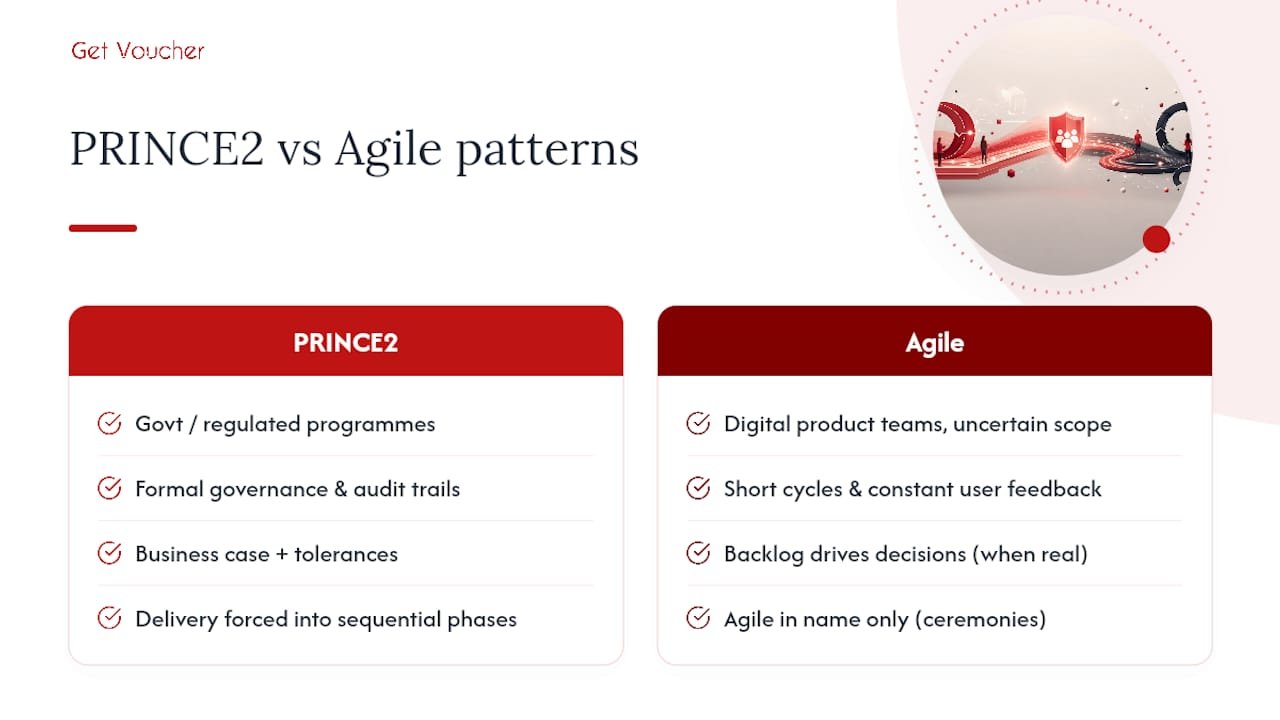
Government and regulated-sector programmes that need formal audit trails, fixed budgets, and staged sign-off have long favoured PRINCE2’s structure precisely because a business case and tolerance framework satisfy auditors in a way an unstructured backlog never will. Where these implementations struggle, it’s rarely the governance itself at fault. It’s usually a delivery team forced to work in rigid, sequential phases when the underlying technical work needed iteration and early feedback.
Digital product teams tell the opposite story. A team building a new customer-facing platform with unclear requirements typically benefits from Agile’s short cycles and constant user feedback, catching a wrong assumption after one sprint rather than after eighteen months of specification. Failures on this side usually trace back to “Agile” existing in name only. Ceremonies happen, but a manager outside the team still dictates sprint content, and the backlog never actually drives decisions.
The pattern that recurs across both is this: methodology choice rarely causes failure by itself. Mismatched governance against an uncertain problem, or absent governance against a high-stakes budget, causes failure. That’s precisely the argument for treating governance and delivery as two separate design decisions rather than one blanket methodology choice for an entire organisation.
How do PRINCE2 and Agile teams collaborate differently?
Communication rhythm is one of the starkest practical differences between the two approaches, and it’s often what a team notices first when moving from one to the other.
PRINCE2 structures communication around formal checkpoints. Highlight reports go from the Project Manager to the Project Board on a fixed schedule, typically weekly or per stage. Exception reports get raised only when a tolerance is breached. Communication is deliberately asynchronous and documented, built so decisions leave a paper trail a board can review later.
Agile teams communicate constantly and informally. A daily stand-up surfaces blockers in real time. Sprint reviews put working software in front of stakeholders directly, replacing a written status update with something the customer can actually click through. Retrospectives turn team friction into a process change within days, not at the next scheduled governance review.
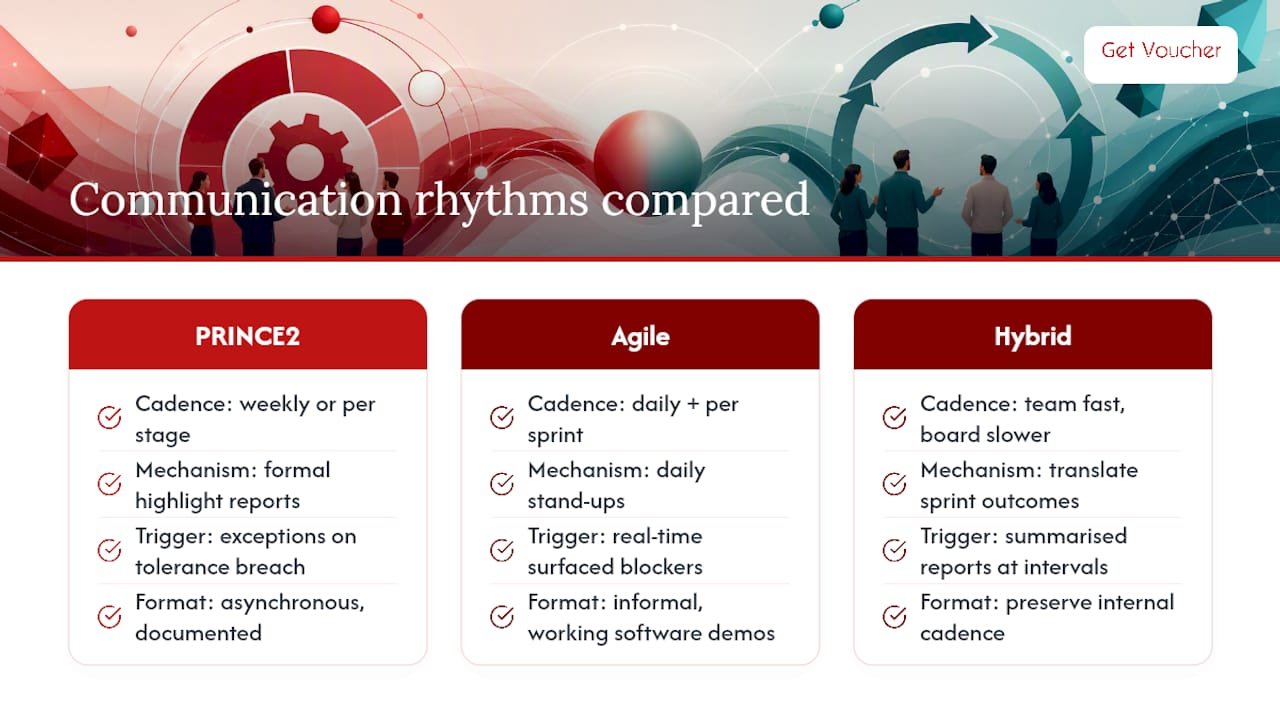
The friction in a hybrid setup usually shows up here first. A Project Board used to a formal fortnightly report gets uneasy when a delivery team wants to reprioritise the backlog daily without asking permission. The fix isn’t forcing Agile teams into PRINCE2’s reporting rhythm, or forcing a board to sit through every stand-up. It’s translating: the board gets a summarised version of sprint outcomes at agreed intervals, while the team keeps its own fast internal cadence untouched. Icebreaker exercises and structured facilitation techniques, of the kind Gatherilla’s guide to Scrum team activities covers, can help daily and retrospective ceremonies stay genuinely useful rather than becoming another box-ticking meeting.
What tools support PRINCE2 and Agile project management?
Tooling tends to follow the methodology’s information needs rather than the other way round, so the software stacks for each look quite different even inside the same organisation.
PRINCE2 environments typically rely on structured planning tools that hold a Gantt-style stage plan, a risk register, and a business case document, often inside a broader project or portfolio management suite that supports formal sign-off workflows. Reporting tools that generate highlight reports and track tolerance against baseline are common companions.
Agile teams lean on backlog and board-based tools that visualise a sprint or Kanban flow, track burn-up or burn-down against a sprint goal, and support retrospective notes. Release management platforms become important once a hybrid setup needs to line up PRINCE2 stage boundaries with actual release dates. Options like those surveyed in Golden Path Digital’s overview of release management software help teams coordinate that alignment without losing track of what shipped when.
A genuine hybrid needs both categories talking to each other, or at minimum a shared reporting layer that translates sprint-level detail into stage-level governance summaries. Few organisations get this integration right on the first attempt. The more common failure mode is running two disconnected toolchains and manually copying status between them each week, which quietly reintroduces the reporting overhead both frameworks were meant to reduce.
A practitioner’s take: stop performing, start integrating
The biggest risk in hybrid delivery isn’t picking the wrong framework. It’s performing Agile rituals over an unchanged PRINCE2 skeleton. Stand-ups happen; the board still gets a Gantt chart and treats the backlog as decorative. That’s Agile theatre, and it’s worse than picking neither approach honestly.
The mantra worth repeating to any sponsor nervous about “losing control” is simple: protect the why, enable the how. Governance owns the business case and the tolerance thresholds. Delivery owns the backlog and the sprint. Practitioners who hold SMC or SAMC credentials alongside PRINCE2 knowledge tend to translate between the two worlds far more credibly than those who only speak one language.
— Rayan
Get certified for whichever side of the hybrid you own
Whether you’re closer to the governance side or the delivery side of a PRINCE2 vs Agile hybrid, Certification services providing access to credentials recommended in this article are available, simplifying the process of obtaining multiple qualifications by working with VMEdu and certification body SCRUMstudy.

If you’re leaning toward a Scrum Master role inside a hybrid team, start with Scrum Master Certified (SMC®). If you’re closer to backlog ownership, the dual Agile pack covering both Scrum Master and Product Owner content gets you both perspectives in one bundle, useful given how often hybrid projects blur the two roles. Practitioners wanting deeper agile mastery once the fundamentals are in place can progress to SAMC. Browse the full certifications catalogue to see what’s currently available, and get in touch directly if you’re after a certification not yet listed.
Where this article’s guidance comes from
The governance and hybrid framing throughout this piece draws on established, publicly available guidance rather than opinion alone.
- PRINCE2 Agile in 1000 words, AXELOS’s own explainer of how PRINCE2 Agile adapts themes and processes for Scrum and Kanban delivery.
- What is PRINCE2 Agile?, covering the hexagon model and how it balances competing project constraints.
- Stop Asking “Agile, Waterfall or PRINCE2?”, PeopleCert’s community argument for hybrid design over binary methodology debates.
- PRINCE2 vs PRINCE2 Agile: Key Differences Explained, a practical breakdown of comparison dimensions used to shape this guide.
Sources
- What is PRINCE2 Agile? | PM Study Circle
- PRINCE2 Agile in 1000 words | Axelos
- Stop Asking “Agile, Waterfall or PRINCE2?” – PeopleCert Community
FAQ
Is PRINCE2 still relevant in 2026?
Yes. PRINCE2 remains widely used wherever formal governance, audited business cases, and staged sign-off matter, particularly in regulated and public-sector projects, and it’s designed to be tailored alongside Agile delivery through PRINCE2 Agile guidance.
Is PRINCE2 an Agile framework?
No. PRINCE2 is a governance method covering roles, stages, and tolerances; it doesn’t prescribe how work gets delivered. PRINCE2 Agile is a separate guidance layer that explains how to combine PRINCE2’s governance with Agile delivery techniques like Scrum and Kanban.
Which is harder, PMP or PRINCE2?
Difficulty depends on your background and prior exposure to formal project governance; both cover structured planning and stakeholder management, though their exam formats and terminology differ enough that direct comparisons rarely hold up without naming your specific starting point.
Which is better, PMP or Agile?
They aren’t direct substitutes. PMP covers broad project management principles across delivery styles, while Agile certifications like SCRUMstudy’s SMC or SPOC focus specifically on iterative delivery practices, so the better fit depends on whether your role centres on governance or hands-on delivery.
Should I learn PRINCE2 or Agile first?
Start with whichever matches your current role: PRINCE2 if you’re managing budgets and stakeholder governance, or a SCRUMstudy Agile certification such as SMC if you’re working inside a delivery team. Many practitioners eventually learn both, since hybrid projects reward fluency in each.