




The study schedule that works around a job is a short, fixed, recurring one: count the hours you genuinely have, put study in the same slots every week, give each slot one named task, and leave buffer and rest in the plan. For most people that means a few weekday sessions of 30 to 90 minutes and one longer weekend block, not heroic late nights. If you are preparing for a professional certification such as Scrum, Six Sigma or digital marketing, the same method applies, and you can start it today with a pen and one week of honest tracking.
This guide takes you through that method step by step, with a sample week, a weekend plan, and the places where schedules usually break.
Table of Contents
- Start with a time audit, not a timetable
- Decide the goal before you divide the hours
- Fix your study blocks and keep them the same
- Weekdays versus weekends
- Match the plan to your work calendar
- Protect rest and build in slack
- Stay focused in the time you have
- Plan the exam logistics early
- Where a voucher fits the schedule
- Our view: start small and let the plan grow
- FAQ
- Sources
Start with a time audit, not a timetable
Most failed schedules begin with a number the person wished were true. Before you decide how many hours to study, work out how many you have.
The University of Pittsburgh advises starting with a weekly time audit: calculate how you spend your time, see what is left for study, and then adapt your expectations to that. Western Sydney University’s scheduling guide lists what to record: work, travel, meals, sleep, exercise, recreation, family and study. Whatever remains is your real budget.
If you want a second walkthrough of assessing the hours you have before committing to a plan, this piece on managing study time for exams covers the same starting point.
Do it like this:
- Draw a grid of seven days. Fill in sleep, work hours and your commute first.
- Add the fixed extras: meals, exercise, childcare, regular social commitments.
- Count the blank hours that remain. The University of Sydney suggests exactly this: list everything else first, then count the blank hours that may be available.
- Mark which blank hours you would actually use. A free hour at 11 pm after a ten-hour day is on paper only.
Oregon State University makes the same point from the other direction: put work, meals, exercise and bedtimes into the weekly schedule before allocating study time, rather than treating study as the only fixed priority.
A worked example
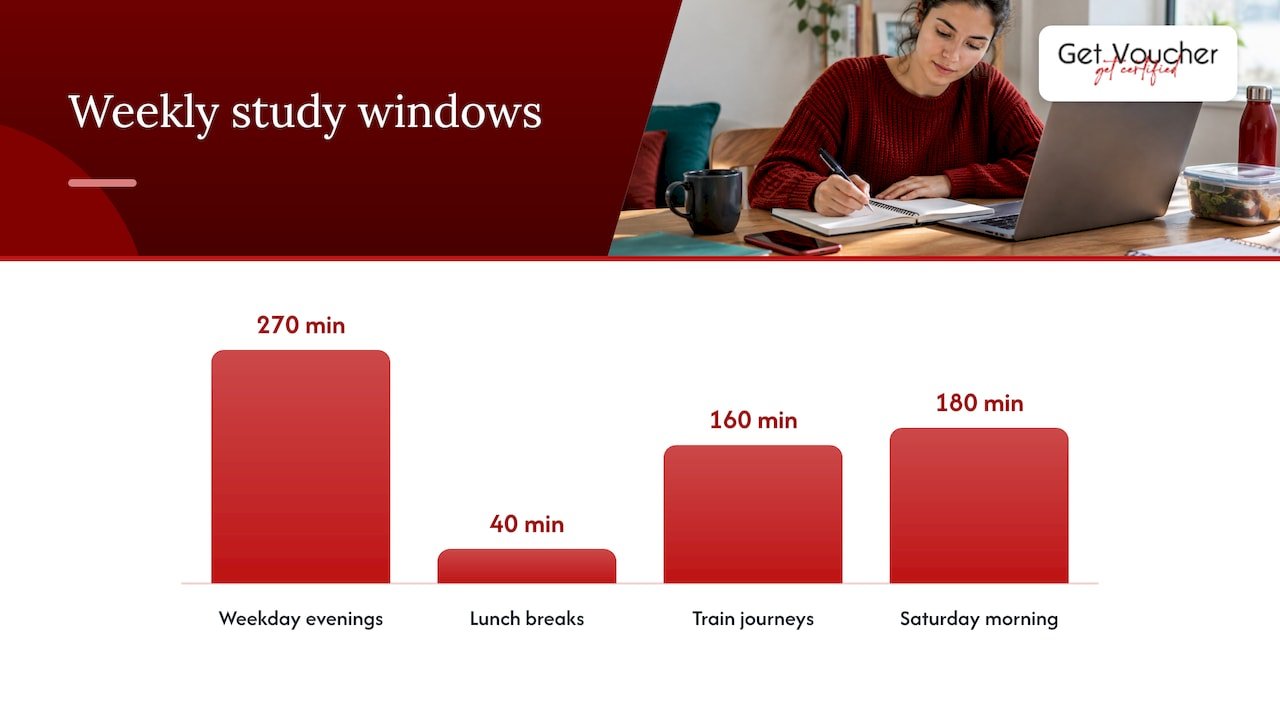
Imagine someone working 9 to 5 with a 40-minute commute each way. After the audit they find: three weekday evenings with about 90 free minutes after dinner, two lunch breaks a week they can protect for 20 minutes, a train journey of 40 minutes on four days, and a Saturday morning of three hours. That is a workable budget, and it was found by counting rather than hoping. Anything the audit does not support, such as four-hour weeknight sessions, stays out of the plan.
Decide the goal before you divide the hours

A schedule needs something to schedule. The University of Portsmouth recommends asking, before each session, what must be achieved, how long it will take and where it fits around work and other commitments.
For a certification, work backwards from the provider’s own materials:
- Find the official syllabus or Body of Knowledge for your exact certification. Each provider publishes its own, and your plan should follow that one rather than a general reading list.
- Check the exam format. Formats are provider-specific. For example, the SCRUMstudy Scrum Fundamentals Certified (SFC) exam is a 40-question, 60-minute online unproctored exam, while the SCRUMstudy SMC® exam is 100 questions in 120 minutes, also online and unproctored. The SMstudy Digital Marketing Professional exam is likewise 100 questions in 120 minutes, online and unproctored. Do not assume another certification works the same way.
- Split the syllabus into weekly chunks. The University of Sydney’s method is to break a big task into weekly subtasks: its example divides an essay with four weeks left into eight steps, aiming for two per week. A syllabus works the same way: eight chapters, eight weeks, or four weeks at two chapters each.
- Set a personal exam week, then schedule backwards from it, keeping the final week for revision only.
If your target is a Six Sigma Green Belt, our eight-week Green Belt study plan shows how one syllabus is laid out week by week up to exam day.
Fix your study blocks and keep them the same
The single most useful habit is a recurring slot. The University of Pittsburgh recommends a repeating weekly schedule that assigns tasks to particular days or times, with time-blocking in a planner, app, calendar or whiteboard. Portsmouth adds that using the same study times each week can reduce procrastination, because you stop deciding each evening whether to study.
Good blocks share three features:
- A named task. The University of Sydney advises that a daily plan name a specific task in a specific slot, not “sometime that day”. “Chapter 3, then ten practice questions” is a task. “Study Scrum” is not.
- Your best hours for the hardest material. Sydney also suggests using your most alert time of day for difficult reading and writing. If you are sharpest at 6.30 am, put new concepts there and keep tired evenings for review.
- A realistic length. Blocks of 45 to 90 minutes with a break suit most evenings after work. A long block belongs at the weekend.
A sample week
This is an illustration, not a prescription. Adjust it to your audit.
| Day | Slot | Task | Length |
|---|---|---|---|
| Monday | Commute | Re-read last week’s notes | 30 min |
| Tuesday | Evening | New chapter, notes | 75 min |
| Wednesday | Lunch break | Flashcards or short review | 20 min |
| Thursday | Evening | New chapter, practice questions | 75 min |
| Friday | Off | Rest, no study | 0 |
| Saturday | Morning | Longer block: chapter plus mixed practice | 2 to 3 hours |
| Sunday | Short slot | Review the week, plan the next | 30 min |
That totals roughly six to seven hours. If your audit only supports three, shrink the plan rather than leaving it to fail. The article-length answer to “how many hours should I study?” is the number your audit found.
Weekdays versus weekends
A common pattern splits the week into short weekday sessions and longer weekend blocks. UTS Online’s example schedule for someone working 9 to 5 does this: weekday evening study, some commute and lunch-break study, and longer weekend blocks, while keeping family, exercise, relaxation and social time. It also stresses that the schedule should vary with your work hours and preferences.
What belongs on weekdays
Weekday time is scarce and tired, so use it for what suits short bursts:
- Recall practice and flashcards.
- One focused chapter or topic, not three.
- Reviewing the previous session’s notes.
The University of Pittsburgh describes a pattern for active review: five minutes straight after learning, then 15 to 30 minutes in the following 24 to 48 hours. A short commute or lunch-break review slots neatly into that. Portsmouth likewise notes that study in short bursts means you do not need an eight-hour session, and suggests using train or bus time for reading.
What belongs at the weekend
A weekend block suits tasks that need continuity:
- Working through a full practice exam under timed conditions.
- Joining up topics, for example how Scrum events fit together across a Sprint.
- Catching up on anything that slipped during the week.
If you only have one weekend day, protect a morning block of two to three hours and keep the afternoon free. Treat a weekend plan as a weekly top-up, not a second job. Studying twelve hours on Sunday and nothing else tends to leave you tired for Monday, which is when the schedule breaks.
Match the plan to your work calendar
Your job has rhythms, and ignoring them is a common reason schedules collapse. Writing in Inside Higher Ed, Liz Wasden suggests learning the busy and quiet cycles of your workplace, mapping them across the year and scheduling heavier study in quieter periods, with your own deadlines set accordingly. RMIT Online similarly recommends allowing variation around busy or seasonal work periods.
In practice:
- Put your exam date away from quarter-end, audits, product launches or whatever your own peak period is.
- Build a lighter version of the plan, perhaps three 30-minute sessions, for crunch weeks, so you never drop to zero.
- Portsmouth suggests talking to your manager about schedule changes, occasional home working or protection from major projects. If your certification benefits your role, that conversation is often easier than you expect.
Protect rest and build in slack
A schedule with no slack is a schedule you will abandon. Oregon State University recommends overestimating how long tasks take and scheduling flex time as a cushion, and says breaks help maintain focus and prevent burnout. RMIT Online advises scheduling rest, exercise and breaks rather than cramming late at night.
Three rules keep a plan alive:
- Keep work and study separate. RMIT warns that routinely studying in work hours, or working during study time, means one or both will suffer. Using a real lunch break is different from using a meeting.
- Leave one session a week empty. It becomes your catch-up slot when something overruns.
- Keep one evening free of study. Wasden describes reserving a Friday evening away from computers and assignments as recovery time. Pick your own evening, but pick one.
Stay focused in the time you have
Short sessions only help if the time is used well. The University of Pittsburgh recommends a distraction-controlled study space, silenced notifications, clear boundaries with family or housemates, and the Pomodoro pattern: 25 minutes of work, then a five-minute break. The University of Sydney adds small, achievable goals and rewards to track progress.
If nerves about the exam itself are the problem rather than the schedule, our guide to evidence-backed exam anxiety strategies covers what the research says.
Plan the exam logistics early
The last piece of a working person’s schedule is the exam itself. Booking, account activation and voucher redemption are separate steps, and each provider handles them differently, so find out how yours works before you commit to a date. Our provider-by-provider guide to scheduling a Scrum exam explains the differences, and if your exam is taken online, the remote exam requirements guide lists the equipment, internet, ID and room checks to prepare for. Doing this two or three weeks ahead stops a technical problem from eating your final revision week.
A certification shows that you have met a provider’s assessment standard. It does not by itself prove performance on the job or guarantee a particular career outcome, so choose one because it fits the skills you want to build.
Where a voucher fits the schedule
GetVoucher works with providers such as VMEdu and certification bodies including SCRUMstudy, SMstudy and 6sigmastudy, and sells vouchers for their courses and exams. What each voucher includes depends on the certification, so check the product page for the training, materials and exam arrangements of the one you choose.
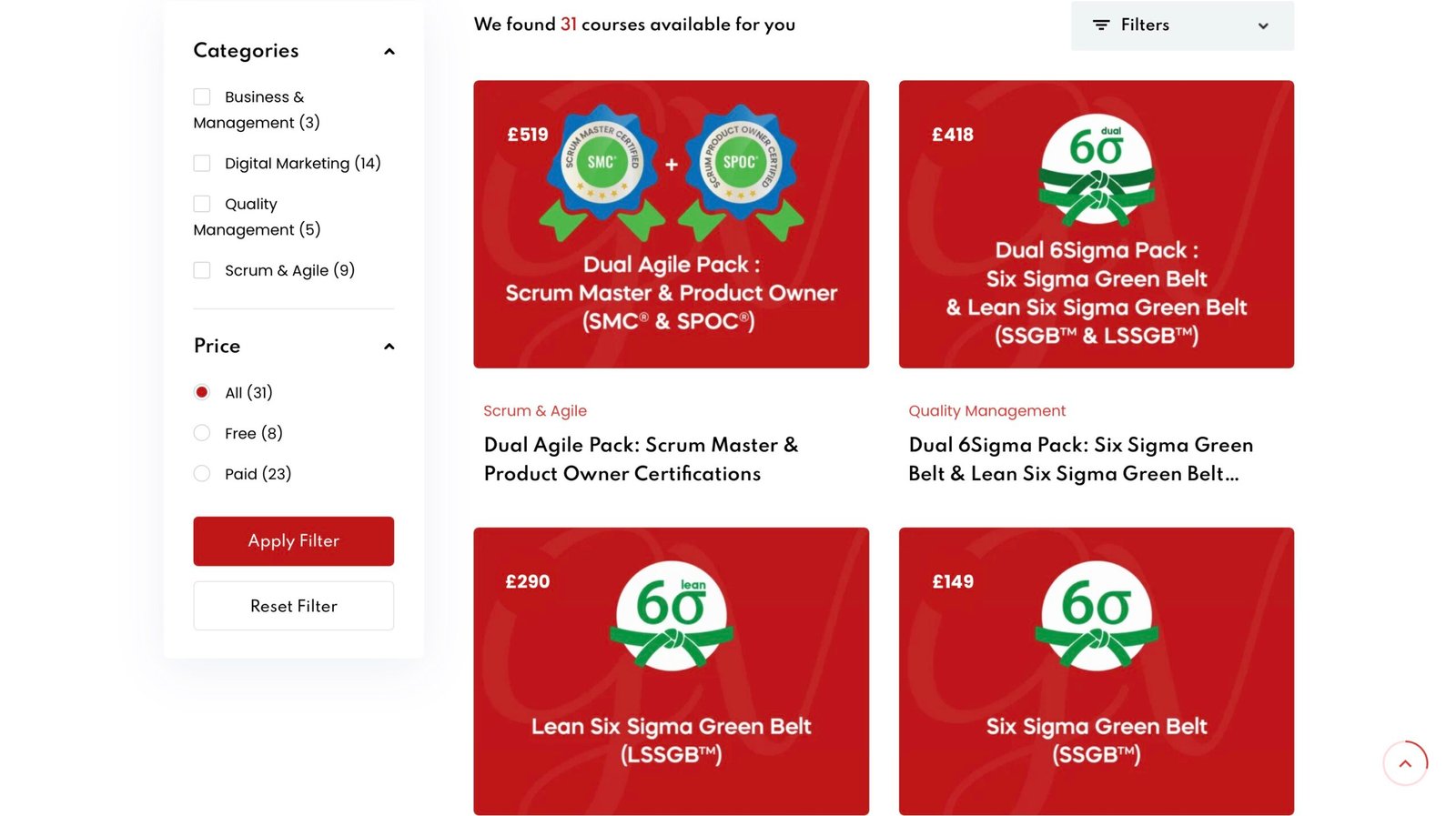
For a schedule, the useful point is that online, self-paced learning lets you fit study into the blocks above rather than around a class timetable. Examples from our catalogue include the Scrum Master Certified (SMC®) at £249, the Six Sigma Green Belt (SSGB™) at £149 and the Digital Marketing Professional at £199. If you want a free starting point to test your routine, Scrum Fundamentals Certified and Six Sigma Yellow Belt (SSYB™) are both £0.
You can browse every certification on the GetVoucher homepage.
Our view: start small and let the plan grow
Working learners rarely lack motivation. They lack a plan sized to their week. We build our catalogue around that: online, flexible certifications that you can start without committing to classroom training, with free introductory options such as Scrum Fundamentals Certified and Six Sigma Yellow Belt so you can test your routine before taking on a paid exam.
Our advice is to begin with two or three sessions a week and add a longer weekend block only once the habit holds. Progress in a certification path, from an introductory credential towards a more advanced one, is easier when each step is a manageable piece of your week and not a sprint.
Choose the certification that matches where you want to go, check its own syllabus and exam format, and build the schedule backwards from your exam week.
Rayan
FAQ
How many hours a week should I study while working full-time?
Use the number your time audit produces, not a general figure. Many people find that three to seven hours a week is what remains after work, sleep and commitments, but yours may differ. Check your certification’s official materials for its recommended preparation, then set the exam date to fit your weekly hours.
Is a weekend study schedule enough on its own?
A weekend-only plan can work, but short weekday reviews help you retain what you learn. The University of Pittsburgh suggests brief review sessions within 24 to 48 hours of learning. Even two 20-minute weekday sessions alongside a weekend block give you that repetition.
What is the best time of day to study after work?
It depends on your energy and responsibilities. The University of Sydney recommends using your most alert time for difficult material. If you are sharpest in the morning, study before work; if evenings suit you, keep them for review and practice questions.
What should I do when a busy week wrecks the plan?
Switch to your lighter version of the plan and use your empty catch-up slot. Oregon State University recommends flex time as a cushion for exactly this. Do not try to repay the missed hours in one night; spread them across the next two weeks.
Sources
- Time Management Strategies, University of Pittsburgh
- Scheduling your time, Western Sydney University
- Time management, University of Sydney
- Strategies for Creating an Effective Weekly Schedule, Oregon State University
- Balancing part-time study with full-time work, University of Portsmouth
- Example study schedule, UTS Online
- Time management study tips for working professionals, RMIT Online
- Career strategies for balancing grad school and full-time work, Inside Higher Ed
- How to Manage Study Time for CCRN Exam Success