




The best online Agile course is the one that matches your goal. For a first look at the vocabulary, pick a short or free introduction. For a credential to put on a CV, pick a certification with a clear exam format and price. For classroom-style depth, pick a university or accredited-trainer course. This guide compares the main kinds of option, shows what separates a course from a certification, and gives you a simple way to choose.
A note on how we write this: GetVoucher sells vouchers for SCRUMstudy certifications and has a commercial relationship with the providers it works with, including VMEdu. We cover our own range alongside external options, and we keep the two clearly separate.
Table of Contents
- Course, microcredential or certification: what you are actually buying
- Scrum is one framework, Agile is the wider idea
- The main online Agile options compared
- Comparing the costs without being misled
- How to choose: five questions
- A note on employer recognition
- Worldwide learners: what to check before you enrol
- Perspective: why we favour a structured, self-paced route
- Our Agile vouchers
- FAQ
- Sources
Course, microcredential or certification: what you are actually buying
The word “course” covers three quite different products, and mixing them up is the most common reason people pay for the wrong thing.
- A course or learning programme. You watch, read and practise. You may get a completion certificate. This proves you finished the learning, nothing more.
- A microcredential. A short, single-topic credential. Scrum Alliance describes its microcredentials as short-form learning, most taking 4 to 8 hours, available on demand or live, and validated with a digital badge.
- A certification. A credential issued by a certification body, usually after an exam or an assessed class. Rules differ sharply between bodies.
The differences matter in practice. Scrum Alliance says its microcredentials are standalone and lifelong, whereas its certifications expire after two years and need SEUs and a renewal fee. ICAgile, by contrast, states that its certifications reflect completion of a class, and that it does not administer or require a specific exam: assessment is set by the training provider running the course.
So two credentials with similar names can mean very different things: one proves you sat a course, another proves you passed a timed exam, a third is a badge for a few hours of study. Always ask which one the product delivers.
Scrum is one framework, Agile is the wider idea
Before comparing, get the terms straight, because many “Agile courses” are really Scrum courses. Agile is a broad set of values and approaches. Scrum is one specific framework, defined in the Scrum Guide, with three accountabilities (Scrum Master, Product Owner and Developers) and a handful of events. Kanban, Lean and scaled frameworks sit alongside it.
A few Scrum Guide points worth knowing before any course:
- Scrum Teams are typically 10 or fewer people.
- Sprints last one month or less.
- The Product Owner is accountable for maximising product value and for managing the Product Backlog.
- The team works towards a Sprint Goal rather than committing to a fixed batch of tasks.
- Several Scrum Teams working on one product can share a Product Owner, a Product Backlog and a Product Goal.
If a course blurs Scrum and Agile together, or presents Product Manager as a fixed Scrum role, treat it cautiously. Product Manager is an organisational job title whose responsibilities vary by employer. Our guide to Scrum versus Agile explains the split in more detail.
The main online Agile options compared
The table groups the routes you are most likely to meet. Exam details are given only where the provider’s own rules are clear to us. Always confirm current prices and policies on the provider’s page, because they change.
| Route | Best for | Format | Credential type |
|---|---|---|---|
| Google Agile Project Management Essentials | Beginners wanting a structured introduction to Agile project management | Online, self-paced learning platform course | Course completion certificate |
| University-style online courses (for example edX programmes and Oxford Lifelong Learning’s Agile Project Management) | Learners who want academic structure and tutor input | Online, usually scheduled or cohort-based | Course completion, with no certification exam implied |
| ICAgile-accredited courses | People who want a class-based, competency-focused pathway | Class from an accredited training provider | Certification awarded on completing the class; assessment set by the provider |
| Scrum Alliance microcredentials | Busy professionals wanting a focused, single-topic badge | On demand or live, around 4 to 8 hours | Lifelong digital badge |
| Scrum Alliance and Scrum.org Scrum Master credentials | Practitioners targeting the best-known Scrum credentials | Provider-specific course and/or exam | Provider-specific certification |
| SCRUMstudy certifications via GetVoucher | Working professionals who want a flexible, self-paced route with a clear exam | Online learning and an online unproctored exam | SCRUMstudy certification |
The external options are not ours, and GetVoucher does not sell Scrum Alliance or Scrum.org credentials. Our Scrum Alliance versus Scrum.org comparison sets out how those two bodies differ, including the fact that they do not assess learning in the same way.
Free and low-cost starting points
If you are testing whether Agile suits you, start free. Google’s course and many university platforms let you learn the basics before you spend anything. Within our own range, the Scrum Fundamentals Certified voucher is listed at £0. The SCRUMstudy Scrum Fundamentals Certified (SFC) exam is 40 questions in 60 minutes, taken online and unproctored.
A free introduction is also a sensible first rung for the paid options below, since it shows you how the provider teaches and tests before you commit.
Class-based and university courses
University and accredited-trainer courses suit people who learn better with a tutor, deadlines and peers. They typically cost more and take longer than self-paced options, and the credential is only as meaningful as the assessment behind it. Check what the course awards: a completion certificate, a certification, or a badge. Our guide on how Scrum certifications expire shows why this distinction affects long-term value.
Scrum certifications with an exam
This is where most people searching for Agile training online end up, because an exam-backed certification is the easiest thing to list on a CV. Exam rules are provider-specific, so keep them separate:
- SCRUMstudy SMC®: a 100-question, 120-minute online unproctored exam.
- SCRUMstudy SAMC™: also an online unproctored exam.
- Scrum.org PSM I: an 80-question, 60-minute exam with an 85% pass score.
- Scrum Alliance CSM®: a 50-question, 60-minute exam with a 74% pass score, after the required 16-hour course.
- Scrum Alliance CSPO: requires approved training but currently has no certification exam, so there is no CSPO exam fee.
Do not read online or unproctored as meaning open-book, and do not assume a proctored exam is inherently more credible than an unproctored one. Each provider sets its own rules. If you need help with booking, our provider-by-provider scheduling guide separates exam booking, account activation and voucher redemption.
Comparing the costs without being misled
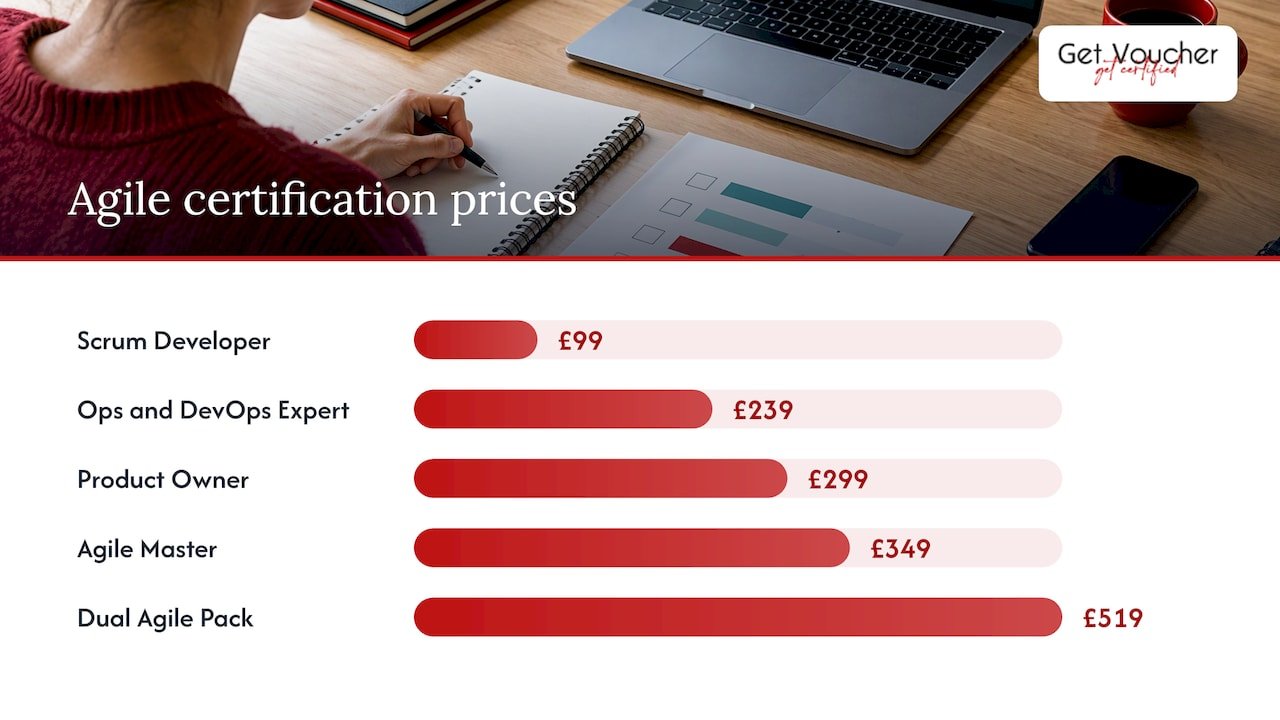
Price comparisons online often mix exam fees, mandatory training, optional preparation, retakes and renewal. Those are separate costs and they vary by provider. An exam-only voucher is not automatically the cheapest route either, since it depends on what you already know and whether the provider requires a course.
Here is what our catalogue lists for the Agile range, as published on our site. Inclusions differ per product, so check each product page for what comes with it.
| Certification | Price |
|---|---|
| Scrum Fundamentals Certified | £0 |
| Scrum Developer Certified (SDC®) | £99 |
| Scrum for Operations and DevOps Expert Certified | £239 |
| Scrum Master Certified (SMC®) | £249 |
| Scrum Product Owner Certified (SPOC®) | £299 |
| SCRUM Agile Master Certified (SAMC™) | £349 |
| Dual Agile Pack: Scrum Master and Product Owner | £519 |
For wider cost context, see our breakdown of SCRUMstudy exam costs and the guide to Scrum Master certification costs. If you are weighing external credentials, note that price ranges quoted by providers can be dated, so use the provider’s own current page for the figure you rely on.
How to choose: five questions
The right course follows from your situation. Work through these in order.
- What do you need the course to prove? If it is just knowledge, a completion certificate is enough. If you want a credential, choose one with a defined exam or assessment.
- Which role are you aiming at? Scrum Masters, Product Owners and Developers each have a different focus. Our role-matching guide walks through it.
- How much time can you commit? A microcredential may take a few hours. A class-based route takes scheduled days. Self-paced video training suits shift workers and parents, though preparation time varies from person to person, so treat any estimate cautiously.
- What does it cost in total? Add exam fee, training, retakes and renewal for that specific provider.
- Does it expire? Some credentials need renewal, others do not. This is provider-specific.
If you also want to build the habits that make Agile work inside an organisation, rather than only collecting credentials, this piece on ways to increase workplace agility is a good complement to whichever course you pick.
Matching goals to routes
- Complete beginner, unsure: a free introduction, then decide.
- Project manager adding Scrum: a Scrum Master level certification, with Product Owner learning if your projects need it.
- Career changer: a fundamentals credential first, then a role-based one. Treat any credential as one piece of evidence alongside experience, since a certificate does not by itself prove real-world competence or guarantee a job, salary or promotion.
- Developer in a Scrum team: a developer-focused credential such as SDC®.
- Running Scrum and DevOps together: an operations-focused pathway.
A note on employer recognition
People often ask which Agile qualification employers prefer. We cannot give you a ranking that holds across the market, and anyone who does is going on opinion. Recognition varies by employer, sector and country. The practical approach is to look at job adverts for the roles you want, see which credentials they name, and pick accordingly. A credential is best treated as a way to validate and structure your learning, not a promise of an outcome.
Worldwide learners: what to check before you enrol
If you study from outside the UK, confirm a few things on the provider’s page before paying:
- The currency of the price and whether tax or VAT is added at checkout.
- How the exam is delivered in your region, and whether it is proctored or not.
- Whether the voucher has a redemption deadline, and whether that is separate from the deadline to complete the exam.
- The provider’s refund and extension policy. For UK consumers, check official consumer-rights guidance too.
Prices in our catalogue are in pounds sterling.
Perspective: why we favour a structured, self-paced route
Most people who search for Agile training are not short of content. They are short of a clear path. There are free videos, long articles and expensive classroom weeks, and it is hard to tell which of them leads to something you can show for your effort.
This is why we built GetVoucher around progression. You can begin with a free fundamentals credential, move to a role-based certification such as Scrum Master or Product Owner, and add complementary skills in areas like Six Sigma, marketing or negotiation as your work demands. SCRUMstudy certifications are designed so working professionals can study online at their own pace, without committing to a classroom week.
We would add one caution, in the interest of your time: choose the credential for the work you do, not for the badge. A certification is a structured way to learn and to validate what you know. Used alongside real practice on a team, it is where it earns its keep.
Rayan
Our Agile vouchers
If a self-paced SCRUMstudy route fits your plan, our Agile range covers the Scrum Master, Product Owner and Developer paths, with the Scrum Master and Product Owner bundled in a dual pack. SMC® is £249 and SPOC® is £299, and each product page lists what that voucher includes.
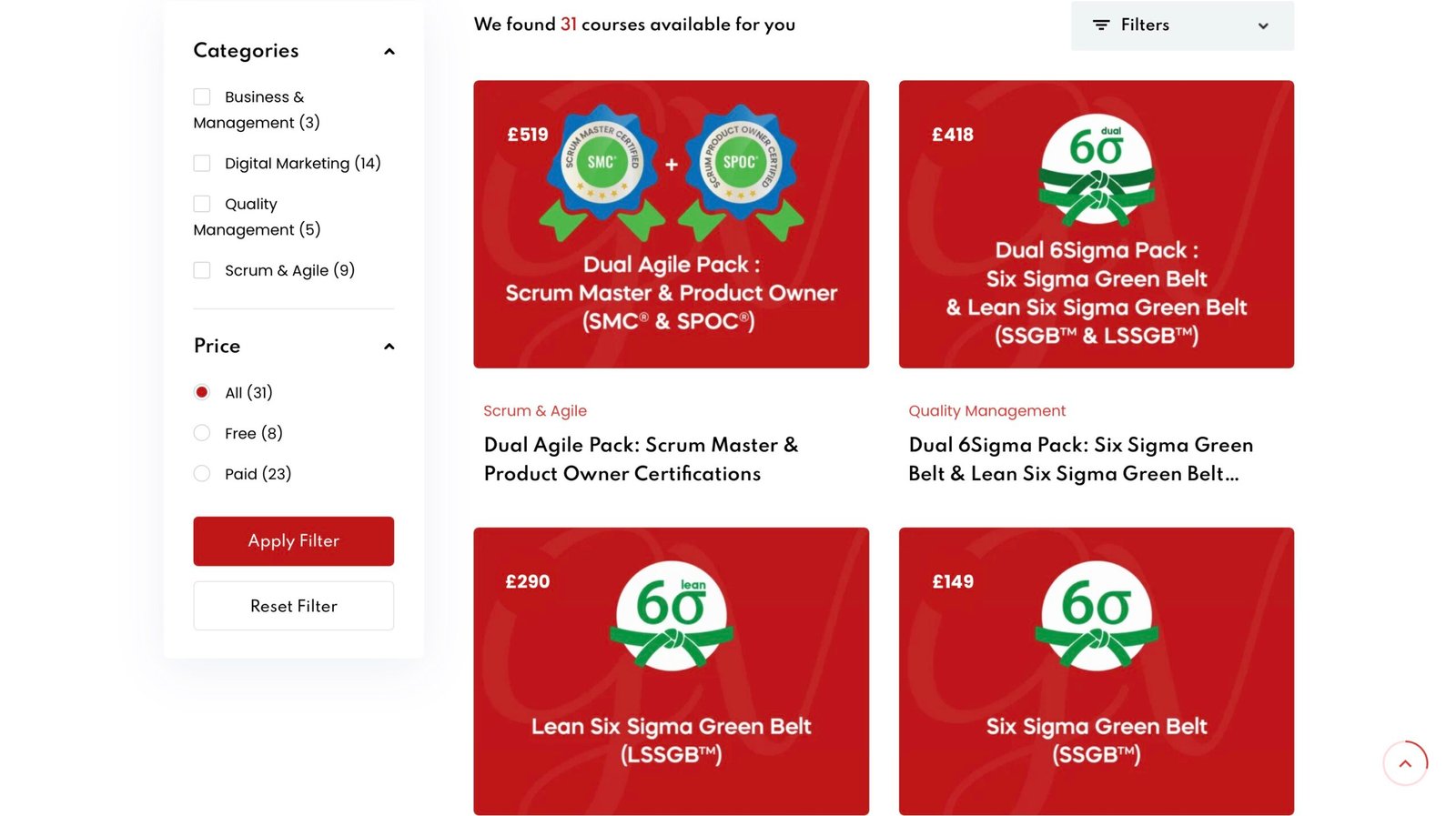
Browse the Scrum Master Certified (SMC®) voucher or see the full GetVoucher certification catalogue.
FAQ
What is the best online Agile course for beginners?
A free or short introduction is the best start, because it costs little and shows you whether Agile suits you. Google’s Agile course and free fundamentals credentials such as our Scrum Fundamentals Certified voucher are examples. Move to a paid certification once you know the role you want.
Is an Agile course the same as an Agile certification?
No. A course teaches you; a certification is awarded by a body after an exam or assessed class, and rules differ by provider. Some credentials, such as Scrum Alliance microcredentials, sit in between as short, single-topic badges.
Do I need to sit a proctored exam?
It depends entirely on the provider and the certification. SCRUMstudy SMC® and SAMC™ use online unproctored exams, while other bodies set their own formats. Check the exact rules on the provider’s page before you book.
How long does an online Agile certification take?
It varies with your experience and the provider. Microcredentials may take only a few hours, while class-based routes follow a schedule. Self-paced courses let you set the pace, so plan your own timeline conservatively.
Sources
- Scrum Alliance: Build Agile Skills Through our Certification Process
- Scrum Alliance: Explore Scrum Alliance Microcredentials
- ICAgile: About ICAgile certifications
- Ways professionals can increase their workplace’s agility