



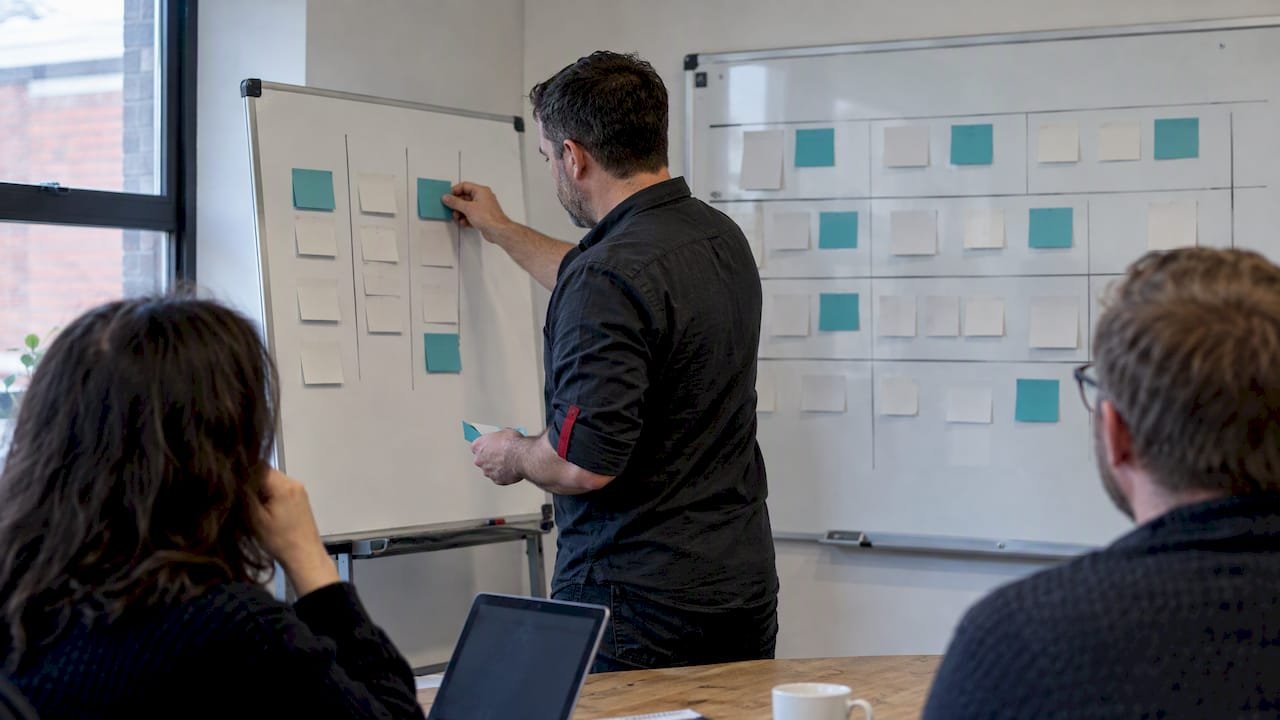
Use Scrum for team-level delivery: the Scrum Guide describes small teams of roughly 5–9 people working in Sprints of 2–4 weeks. Use SAFe when many interdependent teams need shared planning and portfolio alignment. A 2024 empirical study found that the scaling label matters less than you might expect, so build team skills first. Our Scrum training pathways can help.
Table of Contents
- What Scrum is: accountabilities, events and team scope
- What SAFe is: program increments, ARTs and added coordination roles
- SAFe vs Scrum at a glance: scale, cadence, governance and backlogs
- Key differences between SAFe and Scrum across practical decision axes
- How to choose between SAFe and Scrum: a diagnostic checklist and pilot plan
- What recent studies and guidance say about scaling approaches
- How DevOps and continuous delivery fit into SAFe and Scrum
- Our perspective: start with pilots, not roll-outs
- How our Scrum training helps you build the capability scaling depends on
- FAQ
- Sources
What Scrum is: accountabilities, events and team scope
Scrum is a lightweight framework for small, cross-functional teams. The Scrum Guide sets team size at 5–9 members and Sprint length at 2–4 weeks, and it treats the Sprint as a container for all the work needed to reach a Sprint Goal. The framework rests on empiricism: you inspect what you built, adapt what you do next, and let evidence drive decisions rather than long upfront plans.
The Scrum Guide names three accountabilities. The 2020 update replaced “roles” with “accountabilities” to stress that they are not job descriptions.
- Developers are accountable for creating a usable Increment every Sprint.
- Product Owner is accountable for maximising the value of the product and for effective Product Backlog management.
- Scrum Master is accountable for establishing Scrum and helping the team and organisation get the most from it.
Note that “Product Manager” is an organisational job title whose responsibilities vary by context. It is not a fixed Scrum accountability, and Sprint commitments belong to the whole Scrum Team, not to the Product Owner alone.
The Sprint includes events such as Sprint Planning, the Daily Scrum, the Sprint Review and the Sprint Retrospective. Each one is a formal chance to inspect and adapt.
Scrum is intentionally minimal, and the Scrum Guide itself says it should be used whole. Leaving out parts, such as skipping retrospectives or dropping the Sprint Review, tends to hide problems rather than remove them. If you are weighing an Agile approach for a single team or a handful of teams, this is the baseline you are comparing against.
What SAFe is: program increments, ARTs and added coordination roles
SAFe, the Scaled Agile Framework, is an enterprise-scale framework. It is one of several scaling options, alongside Scrum@Scale, LeSS and Disciplined Agile, and IBM’s overview notes that these alternatives generally trade prescriptiveness for lighter coordination. It is not simply scaled Scrum. SAFe adds its own structure for dependencies, architecture and portfolio governance, and it draws on Lean and broader Agile thinking as well as team-level practices.
Its building blocks work like this:
- Agile Release Trains (ARTs) group multiple Agile teams around a shared value stream so they plan and deliver together.
- Program Increments (PIs) are the planning cadence of an ART. Teams align on objectives for a PI through a joint planning event rather than each planning in isolation.
- Added coordination roles and artefacts include a Release Train Engineer who facilitates the train, business owners who represent stakeholder interests, and backlogs above team level for programme and portfolio work.
- Multi-team events such as PI planning and ART syncs keep teams aligned on shared objectives and dependencies.
Team-level work does not disappear. SAFe keeps team iterations, and it supports Scrum and Kanban at team level rather than replacing them. A team inside an ART can run Scrum, with its Sprints, accountabilities and events, while the ART layer coordinates across teams.
For terminology, rely on current Scaled Agile sources, because SAFe’s vocabulary and structure are versioned and change between releases. Be aware that SAFe credentials are issued by an external provider and are separate from the Scrum certifications we offer.
The practical point: SAFe answers a coordination problem, not a team-craft problem. If your teams are not yet delivering well on their own, adding an ART layer rarely fixes that.
SAFe vs Scrum at a glance: scale, cadence, governance and backlogs
- Scope and scale: Scrum covers one Scrum Team of 5–9 people. SAFe covers many teams organised into ARTs, with portfolio concerns above them.
- Cadence and planning rhythm: Scrum plans each Sprint of 2–4 weeks. SAFe adds the PI cadence on top, while teams keep their own iterations.
- Backlog architecture: Scrum has one Product Backlog with one Product Owner accountable for it. SAFe layers team, programme and portfolio backlogs.
- Role and decision ownership: Scrum has three accountabilities. SAFe adds coordination roles such as the Release Train Engineer and business owners.
- Coordination mechanisms: Scrum relies on its events and direct collaboration. SAFe adds PI planning, ART syncs and structured dependency management.
- Typical overhead: Scrum is minimal by design. SAFe carries more training, governance and ceremony in exchange for cross-team alignment.
Key differences between SAFe and Scrum across practical decision axes
The table above gives the shape. These are the contrasts that tend to decide real choices.
- Scale means dependencies, not headcount. Team count alone never determines whether SAFe is appropriate. What matters is how many interfaces your product has, how tangled the architecture is, and how often one team’s work blocks another’s. Ten independent teams on separate products may need little more than Scrum.
- Accountabilities evolve. One Product Owner can steward one product backlog. When many teams contribute to one product, ownership has to be decomposed, and Scrum Master work shifts toward cross-team impediments.
- Cadence changes feedback loops. Sprints give feedback every 2–4 weeks. A PI cadence gives longer-horizon alignment and predictability, but only if teams still inspect and adapt inside it.
- Backlog decomposition affects handoffs. Layered backlogs improve visibility of large initiatives but add refinement steps. Every extra level is a place where intent can get diluted.
- Dependencies can be managed by structure or by design. SAFe structures work to surface and coordinate dependencies. The alternative is to reduce them through modular architecture and clear interfaces. APM guidance identifies interdependency management between teams as the primary source of scaling complexity and recommends disciplined interface and portfolio governance.
- Overhead is the price of alignment. Training, governance and ceremony cost time. Whether that cost buys enough coordination depends on your dependency density.
- Hybrids are common. Many organisations build Scrum competence first, then pilot an ART or adopt selected scaling elements.
Pro Tip: Before comparing frameworks, map your teams’ dependencies on a single page. If most blockers are architectural, fix the interfaces first; no planning event will remove a hard coupling.
Scaled Scrum vs Scrum is useful background if you are weighing lighter alternatives to SAFe.
How to choose between SAFe and Scrum: a diagnostic checklist and pilot plan
No single answer decides this. Work through these questions as trade-offs:
- How modular is your product architecture, and how stable are its interfaces?
- How dense are the dependencies between teams?
- How many teams must deliver against shared objectives?
- Do you need portfolio-level governance and funding alignment?
- Do regulatory or quality constraints demand formal traceability?
- What budget exists for training and change?
Answers pointing toward Scrum: few teams, loosely coupled work, clear product ownership, limited governance needs, and a strong wish to keep overhead low. Answers pointing toward SAFe: many interdependent teams, shared architecture, portfolio-level planning needs, and an organisation willing to invest in training and governance. Mixed answers usually mean a hybrid or staged route.
A sensible pilot sequence looks like this:
- Start with single-team Scrum and make it work well.
- Try a Scrum of Scrums where two or three teams share dependencies.
- If coordination still strains, pilot a small ART through one or two PIs.
Track delivery predictability, dependency wait time, defect trends and team feedback. Run each pilot long enough to see more than one full cycle before reviewing, and keep the review honest about what you would change.
Pro Tip: Treat team competence and interface discipline as prerequisites, not extras. A framework layered on weak team practice scales the weakness.
The Complete Scrum & Agile Guide (2026) gives a broader view of how frameworks and certifications fit together.
What recent studies and guidance say about scaling approaches
The evidence should temper any confident claim that one scaling method is best.
- A 2024 study of 15,078 Agile team members compared SAFe, LeSS, Scrum of Scrums and custom methods. Differences in team effectiveness were small in practical terms, which suggests choosing the approach that suits your culture and experience.
- Related empirical research indicates that internal disciplines, such as standardised practices, clear interfaces and social capital, often matter more to multi-team success than the branded strategy.
- Research on scaling out distinguishes coordinating different components from repeating disciplined practice across similar teams, and finds that standardised team practice can reduce coordination costs.
- Practitioner accounts, such as this retrospective guide, report that adopting SAFe in full can bring significant overhead, and that many successful organisations adapt elements rather than implement them verbatim.
Taken together, the message is consistent: the framework name is a weaker predictor of success than architecture, interface discipline and team capability.
How DevOps and continuous delivery fit into SAFe and Scrum
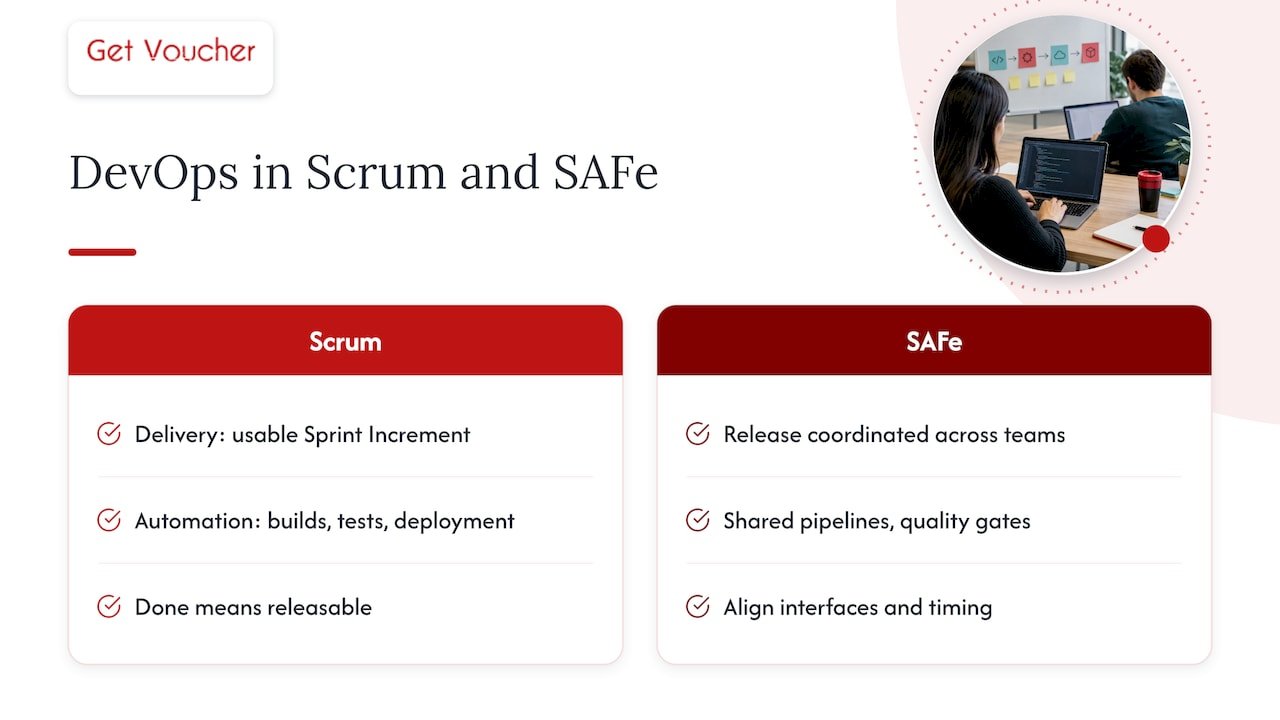
Neither framework delivers continuous delivery by itself. Scrum asks for a usable, done Increment every Sprint, and that standard is hard to meet without automated builds, testing and deployment. Many Scrum teams therefore adopt DevOps practices such as continuous integration so that “Done” means releasable, not just coded.
In a SAFe setting, the same practices operate across teams. Because several teams contribute to one release, shared pipelines, common quality gates and agreed interfaces keep integration from becoming a late, painful event. The coordination layer helps align release timing, but it cannot compensate for fragile deployment practices underneath it.
Operations involvement matters in both. Pulling operations colleagues into planning and review shortens the gap between building something and running it. Teams that treat operations as a downstream handoff tend to rediscover the same problems every release.
If your teams are starting this journey, the Scrum for Operations and DevOps certifications we offer are a structured way to build a shared vocabulary between delivery and operations. Whichever framework you choose, judge it by one question: can your teams release small, safe changes frequently?
Our perspective: start with pilots, not roll-outs
We would diagnose first and pilot small before committing an entire organisation to anything. Invest in architecture, interface discipline and team competence ahead of framework choice, because the research suggests those matter more than the label. Shared training and certification can then speed up consistent practice across teams.
— Rayan
How our Scrum training helps you build the capability scaling depends on
Structured Scrum training gives every team a common language and shortens onboarding, which matters whether you stay with Scrum or later add a scaling layer. We offer entry points that suit different starting positions:
- Scrum Fundamentals Certified is our free introductory certification, a low-friction way to get a whole team speaking the same Scrum language.
- Scrum Master Certified (SMC®) costs £249 and suits people who will lead Scrum adoption and improve team practice.

Both are Scrum certifications, separate from external SAFe credentials, and they build the team-level strength any scaling effort needs. Browse the full range, including our Scrum Product Owner and DevOps options, on the GetVoucher certification hub and pick the first step that fits your team.
FAQ
Which certification is better, CSM or SAFe?
Neither is better in general, because they certify different things. Scrum certifications focus on team-level practice, while SAFe credentials, which are issued by an external provider, focus on scaled coordination. Choose by the role you hold and the framework your organisation actually uses. You can compare our Scrum Master and Product Owner guidance to match a certification to your role.
Is Scrum still relevant in 2026?
Yes. The Scrum Guide still defines Scrum as a lightweight framework for small teams, and SAFe itself supports Scrum at team level. Scrum remains the common baseline that scaling approaches build on, so team-level skills stay valuable.
What is the difference between SAFe and Agile?
Agile is a broad set of values and principles, while SAFe is one specific framework for applying Agile and Lean ideas across many teams. Scrum is another framework, aimed at single teams. SAFe is not Agile itself, and it is not simply scaled Scrum.
Is SAFe certification worth it?
It depends on whether your organisation runs SAFe and whether your role involves cross-team coordination. A certificate does not prove real-world performance by itself, so weigh the cost against your actual context. Where you only work at team level, strengthening Scrum skills first is often the more practical step.