




The cheapest route to a recognised product owner credential is the exam-only path, typically a self-study crack at PSPO I for around US$200 in exam fees. If you need a mandatory-course credential such as CSPO or SAFe POPM, expect an all-in price generally in the mid to high hundreds or more once training, materials and membership are bundled together.
Table of Contents
- At-a-glance cost overview for the main product owner credentials
- What fees usually include: training, exam, materials, membership and extras
- How to budget and reduce the total cost
- Why GetVoucher is a practical option for lowering cost and simplifying purchase
- Author perspective: balancing cost with quality
- How to buy a GetVoucher voucher: step-by-step and recommended options
- FAQ
- Sources
- Authoritative provider pages and GetVoucher product pages for checking exact fees and rules
At-a-glance cost overview for the main product owner credentials
Before comparing numbers, it helps to understand that product owner certifications fall into two broad categories: those that require you to sit a paid course before you can even attempt the exam, and those that let you study independently and pay only for the assessment. This distinction drives most of the price difference you’ll see between providers.
The Certified Scrum Product Owner (CSPO) credential from Scrum Alliance sits in the mandatory-course category. According to the Scrum Alliance Help Center, earning CSPO means completing a 16-hour course delivered by a Certified Scrum Trainer, and course registration typically includes training materials along with a complimentary two-year Scrum Alliance membership. You cannot sit a separate CSPO exam without first attending this training, which is why the price always includes a live or virtual class rather than just an assessment fee.
The Professional Scrum Product Owner I (PSPO I) credential from Scrum.org works differently. There’s no mandatory course requirement: you can study using free resources, including the Scrum Guide, and then pay only the exam fee when you’re ready to sit it. Paid training is available if you want structured preparation, but it’s optional rather than a prerequisite.
SAFe’s Product Owner/Product Manager (POPM) certification follows a model closer to CSPO. It usually bundles a two-day mandatory training session with an exam attempt included in the course price, so you’re paying for instruction and assessment as one package rather than two separate line items.
Project-management-adjacent options, such as PMI’s Agile Certified Practitioner (PMI-ACP), sit somewhat apart from the product owner conversation specifically, since they certify broader agile competency rather than the product owner role itself. If you already hold a PMI credential or are weighing PMI-ACP against a pure product owner path, it’s worth treating it as a complementary rather than a direct substitute.
Here’s how the main routes compare on structure and renewal expectations:
- CSPO (Scrum Alliance): mandatory 16-hour course required; renewal typically runs around every two years and includes a fee plus Scrum Education Units (SEUs).
- PSPO I (Scrum.org): no mandatory course; exam-only route is available to self-studiers; certification is typically treated as lifetime with no renewal fee once earned.
- SAFe POPM: mandatory two-day course with exam attempt included; renewal is typically annual and carries its own fee.
- PMI-ACP: requires PMI membership and experience hours rather than a short course; renewal follows PMI’s continuing certification requirements rather than Scrum-specific rules.
A PSPO I exam attempt costs roughly US$200, while a bundled CSPO course commonly falls in the US$1,000 to US$2,000-plus range once training and membership are included. That gap is the single biggest factor separating a budget-conscious certification choice from a premium one, and it’s why understanding what each fee actually buys matters more than comparing headline numbers in isolation.
One point worth flagging before you commit to any provider: pathways, prerequisites and renewal rules are set entirely by the certifying body, not by any reseller or training partner. Scrum Alliance’s CSPO process is not interchangeable with Scrum.org’s PSPO process, and the two should never be treated as equivalent qualifications with different price tags. They’re separate credentials, issued by separate organisations, with separate rules.
What fees usually include: training, exam, materials, membership and extras
The headline price you see advertised rarely tells you what you’re actually paying for. Breaking down the components helps you compare offers properly instead of assuming a higher number means more value, or a lower one means a shortcut.
- Training delivery. For CSPO and SAFe POPM, the course itself, whether live, virtual or hybrid, is the largest cost component, since it’s a mandatory prerequisite rather than an optional add-on.
- Materials and workbooks. Most mandatory-course credentials bundle slide decks, workbooks or templates into the course fee rather than charging separately, though some trainers sell supplementary materials on top.
- Membership. Scrum Alliance registration for CSPO typically includes a complimentary two-year membership as part of the course fee, giving you access to your certification record and community resources for that period.
- The exam itself. This is where the two models diverge sharply. Many CSPO course listings fold certification access and issuance into the course price without a separate exam charge, while PSPO I charges purely for the assessment: a timed, multiple-choice test that you can attempt independently of any course.
- Retake fees. If you don’t pass on your first attempt, most providers charge an additional fee for each retake, which is worth checking before you book, especially for exam-only routes where a fail means paying again from scratch.
The PSPO I exam itself is worth understanding in a bit more detail, since it’s the model most self-studiers choose. It’s a timed, scenario-based, multiple-choice assessment taken online, and Scrum.org documents the passing score and time limit on its own certification pages, which is the place to confirm current specifics before you book, since exam formats can be revised by the provider.
Costs that don’t appear on the course order page but still hit your wallet include practice test bundles, reference books beyond what’s included, and, for any in-person session, travel and accommodation. A trainer running a two-day CSPO course in a major city will often charge more than the same course delivered virtually, and if you’re flying in and booking a hotel for an in-person session, that can add a few hundred dollars to a thousand or more depending on location, well beyond the course fee itself.
Pro tip: Before paying for any mandatory-course certification, ask the trainer directly whether the exam, materials and membership are bundled into the price or billed separately, since listings aren’t always explicit about this.
Free resources also deserve a mention here. Scrum Alliance’s own resource library includes materials like the Scrum Guide that you can study without paying anything. The catch is that free study doesn’t substitute for a recognised credential: if the role or employer expects a certification, you’ll still need to pay for the exam or course where one is required, even if your underlying knowledge is already solid.
How to budget and reduce the total cost
Once you understand what’s included in a given fee, the next question is how to bring the number down without sacrificing the credential’s value. A handful of practical levers can meaningfully reduce what you pay out of pocket.
- Choose an exam-only route when eligible. If you already have working Scrum experience, going straight for PSPO I rather than a mandatory-course credential avoids the training fee entirely and leaves you paying only for the assessment.
- Use vouchers or bundles instead of booking separately. Platforms that sell certification vouchers can combine course access, materials and exam scheduling into a single purchase, which tends to reduce the friction and sometimes the total cost compared with piecing things together from multiple vendors.
- Ask your employer to fund it. Many organisations treat certification as a learning and development expense, particularly when you can tie it directly to a current or upcoming role responsibility.
- Watch for early-bird and group discounts. Trainers and providers regularly discount course fees for early registration or for teams booking together, which can meaningfully reduce the headline price.
- Pick virtual over in-person where the content is equivalent. Dropping travel and accommodation costs is often the single biggest saving available to you, especially if the in-person option doesn’t offer something the virtual version lacks.
The trade-off to weigh honestly is learning experience against price. A lower-cost, self-study exam route suits someone who already has hands-on Scrum exposure and just needs the credential on paper. A higher-cost, trainer-led course makes more sense if you’re newer to the role and want structured guidance, live Q&A and a cohort to learn alongside.
Pro tip: If you’re asking your employer to cover the cost, frame the request around a specific upcoming project or responsibility rather than general career development, since budget approvals move faster when tied to immediate business need.
If you’re pursuing employer funding or a voucher purchase, a short checklist keeps the process straightforward: confirm which credential your manager actually wants you to hold, get a written quote or screenshot of the course price, check whether the fee includes the exam and membership, and submit the request alongside a one-line note on how the certification supports your current workload.
Why GetVoucher is a practical option for lowering cost and simplifying purchase
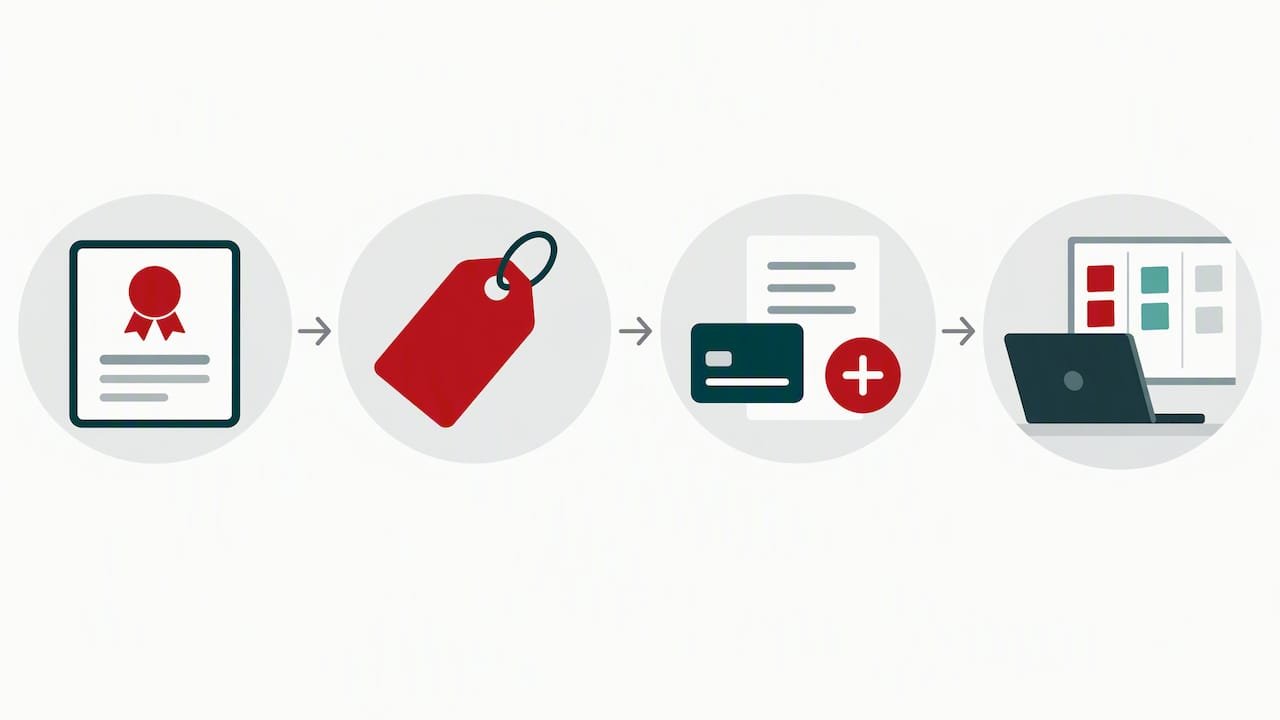
We built our voucher model around a simple problem: comparing certification prices across different providers’ websites, then separately booking training, materials and exam scheduling, wastes time and often costs more than it needs to. Buying a voucher through us bundles the pieces you’d otherwise chase individually, typically digital access to the course platform, downloadable study materials, and support for scheduling your exam, into a single, clear purchase.
For product owner specifically, our Scrum Product Owner Certified (SPOC®) course is priced at £299 as a one-off purchase, giving you course access and the structure you need to prepare without having to assemble resources from several different places.
If you’re planning a career move into agile delivery more broadly rather than product ownership alone, our Dual Agile Pack: Scrum Master & Product Owner Certification combines both credentials in one voucher, which suits career changers who want to demonstrate range across both roles rather than committing to a single narrow path before they’ve settled on a direction.
A few things make comparing our voucher options straightforward:
- Self-paced video training is included with many certification vouchers, which can reduce the need for separate paid coaching.
- Downloadable materials are often accessible after purchase.
- Scheduling support for exams can help simplify booking.
- Clear progression paths can help learners start with foundational or lower-cost credentials and progress to more advanced ones as roles develop.
If you’re still deciding between Scrum Alliance, Scrum.org and SAFe-style pathways, our own comparison of SPOC, CSPO and PSPO walks through how each maps to different career goals, which is worth a read before you commit to a specific voucher.
Author perspective: balancing cost with quality
Paying more for a trainer-led course makes sense when the networking and live interaction genuinely matter to your next move, such as pivoting into product ownership from an unrelated field where you have no existing agile credibility to lean on. The classroom time, in that case, is doing more than teaching content: it’s building a professional circle and giving you practice articulating product decisions out loud.
Where I’d push back on conventional advice is the assumption that a pricier, mandatory-course credential is automatically the safer choice. If you’ve already run sprints, managed a backlog or worked alongside a product owner, an exam-only route tests exactly the knowledge you already hold, at a fraction of the cost. The premium only pays for itself when you’re genuinely starting from scratch.
— Rayan
How to buy a GetVoucher voucher: step-by-step and recommended options
Buying a certification voucher with us follows the same straightforward flow regardless of which credential you’re after, and getting started takes a few minutes rather than a lengthy enrolment process.
Here’s what the process looks like from purchase to exam day:
- Choose your credential on our certifications catalogue, where you can browse by subject area and compare product owner, Scrum Master and combined bundle options side by side.
- Complete your purchase, which delivers your voucher digitally, with no waiting for physical materials to arrive.
- Access your course platform and materials, including self-paced video training and downloadable resources, as soon as your order confirms.
- Work through the content at your own pace, revisiting modules as needed before you feel ready to sit the assessment.
- Use our scheduling support to book your exam once you’re prepared, rather than navigating a separate provider portal from scratch.
If product ownership is your specific goal, our Scrum Product Owner Certified (SPOC®) page is the direct starting point, priced at £299 one-off. For career changers who want both Scrum Master and product owner credentials in one purchase, the Dual Agile Pack bundles both at a combined price, which is worth considering if you’re not yet sure which role you’ll land in.
If you’re newer to agile concepts generally and want a foundation before committing to a product-specific credential, our Scrum Fundamentals Certified course is a free starting point that builds the vocabulary and context you’ll need later.
Whichever path fits your timeline and budget, you can browse every available option and start your order on our main GetVoucher catalogue.
FAQ
What are the best product owner certifications?
The main recognised options are Scrum Alliance’s CSPO, Scrum.org’s PSPO I, and SAFe’s POPM, each issued by a different certifying body with its own prerequisites and renewal rules. Which one is “best” depends on whether your employer or industry favours a specific framework, so it’s worth checking job postings in your target market before choosing.
Is CSM or PMP better?
CSM (Certified ScrumMaster) and PMP (Project Management Professional) certify different roles entirely: CSM focuses on Scrum facilitation, while PMP covers broader project management across methodologies, including but not limited to agile. Neither is strictly “better”; the right choice depends on whether your target role is Scrum-specific or spans traditional project management as well.
How much does it cost to get Scrum certified?
Costs vary significantly by credential and provider: an exam-only route such as PSPO I runs around US$200 in exam fees, while mandatory-course credentials such as CSPO typically bundle training, materials and membership into a single fee. Our own Scrum Product Owner Certified (SPOC®) voucher is priced at £299 one-off, covering course access and preparation materials.
How do I become a product owner?
Becoming a product owner typically combines hands-on experience managing a product backlog with a recognised certification that validates your understanding of the role, such as CSPO, PSPO I or SPOC®. Certification demonstrates familiarity with agile product practices, though employers generally also look for practical experience working within a Scrum team before hiring into the role.
Authoritative provider pages and GetVoucher product pages for checking exact fees and rules
Exam fees, course inclusions and renewal rules are set by each certifying body and can change, so confirm current details directly before you book. The Scrum Alliance Help Center covers the official CSPO pathway and course requirements, while Scrum Alliance’s resource library offers free background reading on Scrum team roles. For a cost breakdown approach applied to a different certification field, Total Cyber Academy’s CISSP cost guide shows how exam and total-cost figures can be presented transparently.
On our own site, the SPOC® product page and the Dual Agile Pack page carry current pricing and inclusions for the vouchers referenced throughout this guide.