




A product owner certification validates your knowledge of backlog management, prioritisation and stakeholder engagement, without guaranteeing workplace performance on its own. It suits working professionals, career switchers and business analysts moving into product roles. GetVoucher’s Scrum Product Owner Certified (SPOC), delivered through VMEdu and certified by SCRUMstudy, offers a practical, self-paced route worth comparing against training-led and exam-led alternatives.
Table of Contents
- What does a product owner certification actually cover?
- Who should take a product owner certification, and when does it help most?
- Which skills and topics do product owner courses teach?
- Training-led vs exam-led certification: how to choose
- SPOC on GetVoucher: what it teaches, who it suits and how the exam works
- Why a voucher platform helps, and what it doesn’t promise
- Why the “just get certified” advice misses the point
- Ready to start? Here’s your next step with GetVoucher
- Where to verify these facts yourself
- Sources
- FAQ
What does a product owner certification actually cover?
A product owner certification tests and formalises the knowledge behind one of Agile delivery’s most demanding roles. The National Careers Service describes the digital product owner as someone who defines product vision, manages backlogs and balances user needs against business value. Certification maps onto that job, but it complements professional development rather than replacing hands-on practice.
Curriculum content varies by provider, though most courses converge on a shared core:
- Backlog management and refinement
- Prioritisation frameworks for deciding what gets built next
- Stakeholder engagement and communication
- Product vision and roadmap thinking
- Working relationships with Scrum teams and delivery cadence
Specific techniques, including MoSCoW, WSJF, user story mapping or a Product Goal Canvas, get taught on some syllabuses and not others. Content differs across certification bodies, so read a course outline before assuming it teaches a particular method. This matters more than it sounds: two people holding “a product owner certification” might have studied genuinely different toolkits.
Who should take a product owner certification, and when does it help most?
Certification for product owners tends to suit a handful of recognisable profiles, each with a slightly different reason for enrolling.
- New or aspiring product owners using a course to build structured knowledge before stepping into the role for the first time.
- Product managers moving laterally into ownership responsibilities who need a shared vocabulary with Scrum teams.
- Business analysts already close to backlog work who want formal recognition of skills they practise informally.
- Career switchers entering Agile product management from adjacent fields such as project coordination or business operations.
Certification helps most at three moments: when entering the role for the first time, when formalising practice you’ve picked up informally, and when a job posting explicitly lists a credential as a requirement or preference. It helps least as a substitute for time in the seat. The Stanford Online comparison of certificates and certifications makes the distinction plainly: certification validates understanding, while applied capability develops through practical experience solving real backlog and stakeholder problems.
Which skills and topics do product owner courses teach?
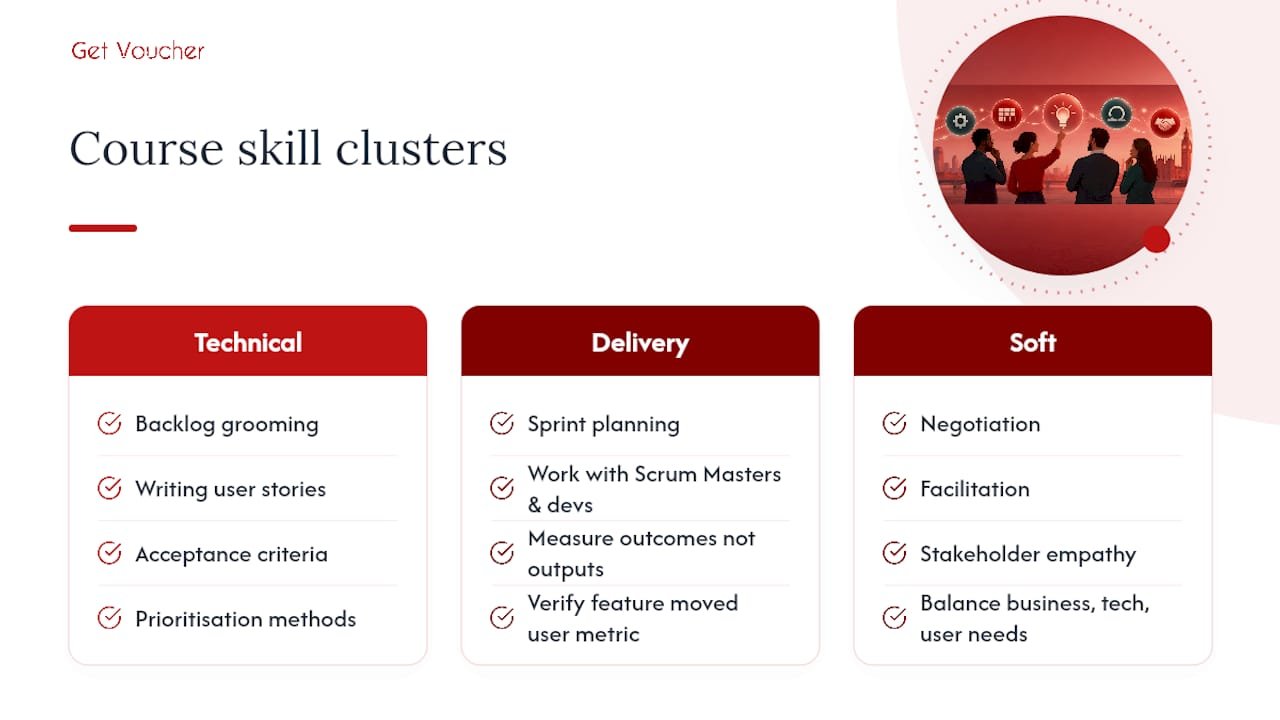
Course content clusters into three broad skill types, and the strongest candidates tend to develop all three rather than leaning on one.
Core technical skills sit closest to the day job: backlog grooming, writing user stories, defining acceptance criteria and applying whichever prioritisation method a given provider teaches.
Delivery skills connect the backlog to the team’s rhythm. That means sprint planning, working alongside Scrum Masters and developers, and measuring outcomes rather than just outputs, so the product owner can tell whether a shipped feature actually moved the needle for users.
Soft skills often get underweighted in course marketing yet dominate the real job. Négociation, facilitation, and stakeholder empathy decide whether a backlog reflects genuine business priorities or just the loudest voice in the room. Guidance from Société Générale’s careers pages frames product ownership as sitting at the intersection of business, technology and user needs, which is exactly why the soft-skill layer carries so much weight.
Not every course teaches every item on this list. Provider syllabuses differ meaningfully, and a course that spends three hours on stakeholder facilitation might spend twenty minutes on it elsewhere.
Pro Tip: Before enrolling, ask for the actual syllabus, not the marketing page. A one-page module list tells you more about what you’ll practise than any testimonial does.
Training-led vs exam-led certification: how to choose
Product owner credentials generally split into two assessment philosophies, and picking the wrong one for your learning style wastes both time and money.
Training-led routes, exemplified by the Certified Scrum Product Owner (CSPO) from Scrum Alliance, centre on instructor-led courses with collaborative exercises. Completion of the course itself typically confers the credential, and Scrum Alliance requires renewal every two years to keep it active.
Exam-led routes, exemplified by the Professional Scrum Product Owner I (PSPO I) from Scrum.org, work differently. Candidates self-study, then sit an 80-question, 60-minute assessment with an 85% pass mark. Pass it once, and the certification carries no expiry, since Scrum.org issues it as a lifetime credential.
A quick self-check before choosing:
- Do you learn better through live discussion or independent study?
- How much time can you realistically commit before an exam date?
- Does your employer’s job posting name a specific provider?
- Are you comparing total cost, including any resit or renewal fees?
The core trade-off in one line: training-led credentials buy structure and peer interaction; exam-led credentials buy a one-time proof point with no ongoing renewal admin. Neither approach is inherently stronger, and the right one for you often has more to do with your calendar and your budget than any theoretical superiority. If you’re the sort of learner who finishes what you start only when a class deadline forces the pace, training-led suits you. If you’re comfortable working through material solo and sitting a timed test cold, exam-led saves you the course fee.
SPOC on GetVoucher: what it teaches, who it suits and how the exam works
Scrum Product Owner Certified (SPOC) is issued by SCRUMstudy, with course delivery via VMEdu, and it sits closer to the exam-led camp than the training-led one, though its self-paced format gives it a character of its own.
Learning focus. SPOC covers backlog management, prioritisation, sprint involvement and stakeholder communication, structured around SCRUMstudy’s own Scrum Body of Knowledge (SBOK) framework.
Who it suits. The course fits new product owners building foundational knowledge, business analysts formalising existing backlog experience, and career switchers who want a self-paced option rather than a fixed classroom schedule.
Prerequisites. SPOC has no formal prerequisite, which makes it accessible to candidates entering product ownership from outside traditional software delivery backgrounds.
Exam format. The SPOC assessment is a 140-question, 180-minute online unproctored exam, taken independently once the candidate has worked through the self-paced materials.
Practical points worth knowing before you enrol:
- Access comes through a voucher purchased via GetVoucher’s SPOC course page
- Study materials are delivered as self-paced video training rather than scheduled live sessions
- The unproctored exam format means you sit it in your own time, on your own equipment
- SCRUMstudy issues the certification once the exam is completed and passed
Why a voucher platform helps, and what it doesn’t promise
GetVoucher’s role in this is deliberately narrow: it’s the access layer between you and established certification providers, not the body that writes the syllabus or grades the exam.
That access layer still solves a real problem. Working professionals rarely have time to hunt across scattered provider sites, compare voucher terms and chase down study materials from three different sources. GetVoucher consolidates that into one purchase path, with partnerships running through VMEdu as the main provider and certification bodies including SCRUMstudy, SMstudy and 6sigmastudy.
What a voucher platform genuinely offers:
- Direct access to vouchers for recognised certification courses and exams
- Self-paced video training that reduces reliance on separate paid coaching
- A visible progression path from free introductory courses toward paid, advanced credentials
- Coverage across Agile, product ownership, quality management, digital marketing and negotiation, rather than a single narrow niche
What it doesn’t offer, and shouldn’t claim to: a guarantee that certification alone translates into strong on-the-job performance. That gap, as the Government Digital and Data Profession capability framework makes clear, has to be closed by tailoring Agile and Lean knowledge to your own organisation’s context. No voucher, however well priced, does that part for you.
Why the “just get certified” advice misses the point
The conventional advice on product owner certification treats the credential as the finish line. It isn’t. The Government Digital and Data Profession capability framework is blunt about this: Agile and Lean knowledge matters, but practitioners still have to adapt delivery to their own organisation’s context, and no course can pre-package that judgement for you.
Where I think most guidance goes wrong is in treating training-led and exam-led routes as competing on quality, when they’re really competing on fit. A disciplined self-study learner wastes money on a live cohort course they didn’t need. A learner who thrives on peer discussion will underperform in a solo, timed, unproctored exam regardless of how much they know. Choose the format that matches how you actually learn, not the one with the most recognisable name.
If you take one thing from this, take this: prioritise understanding why a prioritisation call gets made over memorising the name of the framework used to make it. Employers increasingly look for both the certificate and evidence you’ve applied the thinking behind it. The certificate opens the conversation. The evidence closes it.
— Rayan
Ready to start? Here’s your next step with GetVoucher
GetVoucher is the alternative to piecing together scattered provider sites, standalone study guides and separately booked exams. Purchase the SPOC voucher once, and you get self-paced video training and exam access bundled through a single checkout, rather than five browser tabs and three payment forms.
Getting started is straightforward. Visit the Scrum Product Owner Certified (SPOC) course page, purchase your voucher, and work through the self-paced materials at whatever speed suits your schedule, then sit the 140-question, 180-minute online unproctored exam when you’re ready.
If you’re newer to Agile altogether, the free Scrum Fundamentals Certified course builds groundwork before you commit to SPOC. Readers weighing up both major Agile roles may also want the Dual Agile Pack, which pairs Scrum Master and Product Owner credentials for those considering either path.
Looking for a certification not yet listed on the platform, such as a specific KANBANstudy, RMstudy or BAlearning credential? Those pathways are planned for the coming months. Contact GetVoucher directly for current pricing and availability on any certification outside the existing catalogue, or browse the full certifications directory for what’s available today.
Where to verify these facts yourself
Cross-check any certification decision against primary sources rather than course marketing alone.
- The National Careers Service digital product owner profile verifies real-world role duties and expectations
- The Government Digital and Data Profession capability framework verifies the Agile and Lean capability standards UK public sector roles reference
- Stanford Online’s certificate versus certification guide verifies the distinction between validated knowledge and demonstrated workplace ability
- SCRUMstudy’s own published listings verify SPOC’s current exam format and syllabus details ahead of enrolment
Sources
- Digital product owner | Explore Careers | National Careers Service
- Government Digital and Data Profession capability framework
- Certificate vs certification — Stanford Online
FAQ
Which certification is best for a product owner?
No single certification is objectively best. SPOC (SCRUMstudy) suits self-paced, exam-led learners with no prerequisite barrier; PSPO I (Scrum.org) suits candidates who want a lifetime credential after an 80-question, 60-minute, 85% pass mark test; CSPO (Scrum Alliance) suits people who learn best through instructor-led training with periodic renewal.
Is CSPO better than PSPO?
Neither is universally better; they serve different learning styles and employer expectations. CSPO (Scrum Alliance) is training-based and renews every two years, while PSPO I (Scrum.org) is exam-based, tested via an 80-question, 60-minute assessment with an 85% pass mark, and issued as a lifetime certification.
Is a product owner certification worth it?
Certification validates your knowledge of backlog management, prioritisation and stakeholder communication, which the National Careers Service confirms sit at the core of the role. It doesn’t guarantee workplace performance on its own, so its value depends on pairing it with genuine hands-on practice.
How much does a product owner certificate cost?
Pricing varies by certification body and provider. SPOC (SCRUMstudy, via VMEdu) is available through GetVoucher for £199 as a one-off purchase on the SPOC course page; for certifications not yet listed on GetVoucher, current pricing is available on request.
Does SPOC require any prior experience?
SPOC has no formal prerequisite, so candidates can enrol without prior Agile certification or job experience. The course is structured to build foundational product owner knowledge from the ground up, through self-paced video training culminating in the 140-question, 180-minute online unproctored exam.