




A sales certification can validate your selling knowledge, though it cannot guarantee how you perform in a live negotiation. For most professionals weighing their options, a practical route is to start with GetVoucher’s Corporate Sales Associate certification and progress towards Corporate Sales Pro once you want a deeper, assessed syllabus. Both are built for working professionals, career switchers, and anyone assembling a portfolio of validated skills.
Table of Contents
- Quick checklist for choosing a sales certification
- What a sales certification actually is
- Who benefits and what skills are covered
- Corporate Sales Associate vs Corporate Sales Pro
- A decision framework before you buy a voucher
- Practical preparation and exam logistics
- How GetVoucher supports the certification journey
- Why the progression path matters more than the badge
- Start your pathway with GetVoucher
- Sources
- FAQ
Quick checklist for choosing a sales certification
Before you commit time or money, run through a short filter. It will tell you in minutes whether a certification fits your stage, your schedule, and your goals.
- Level match: confirm whether the credential is entry-level or professional, and whether that matches where you are in your career.
- Skills delivered: check the syllabus covers what you actually need, such as objection handling, negotiation, or pipeline management.
- Assessment type: find out whether the exam is proctored or unproctored, how many questions it has, and how you verify the credential with the issuing body afterwards.
- Time and cost: weigh the hours required for preparation and the price against your budget and timeline.
- Recognition versus portfolio value: treat the certificate as something that demonstrates knowledge of a syllabus, not as a guaranteed employer requirement.
- Free versus paid: a free certificate is a reasonable way to test the format and syllabus style before paying for a more advanced path.
If a certification clears these points for your situation, it is worth pursuing. If it does not, there is no harm in waiting or looking elsewhere.
What a sales certification actually is
A sales certification is an assessment-based credential: you study a defined syllabus, sit an exam, and receive a certificate that demonstrates knowledge of that syllabus. This is a different thing from sales training, which is often a workshop or coaching programme with no formal test at the end, and different again from a sales methodology, which is a specific selling framework (such as a questioning technique or a pipeline model) that a company might train its team on internally.
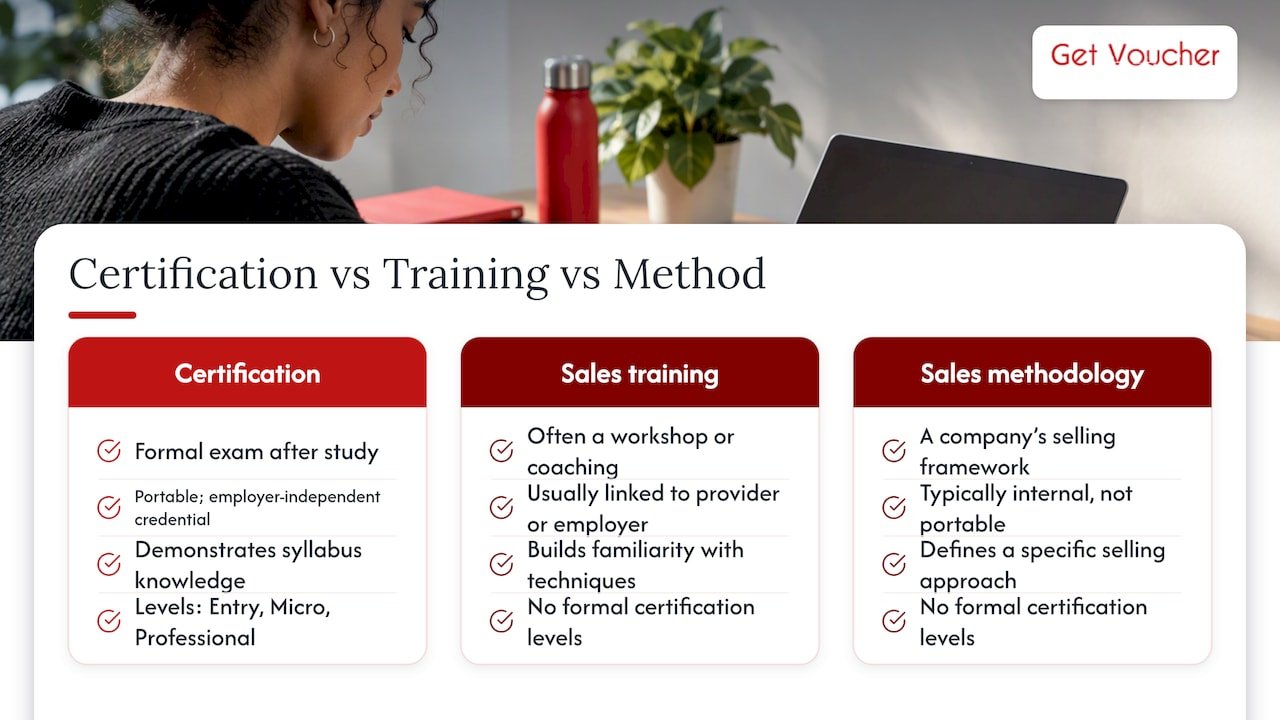
Certifications typically come in a few shapes. Entry-level certificates introduce foundational concepts and usually ask for no prior experience. Professional-level certificates go deeper into a syllabus and often carry a more substantial exam. Micro-credentials sit somewhere in between, focused on a narrow skill area.
The distinction matters because a training programme or an internal methodology workshop will build familiarity with a technique, but it will not usually produce a portable, assessed credential you can list separately from your employer’s internal records. A certification, by contrast, is designed to stand on its own.
Who benefits and what skills are covered
Sales certifications are most relevant to people in business development, account management, inside sales, and other customer-facing roles where structured selling conversations are part of the job. They also suit career switchers who need a recognisable way to demonstrate relevant knowledge when they have not yet held a sales title.
Across entry-level and professional syllabuses, the skill areas tend to cluster around:
- Prospecting and qualifying: identifying and assessing potential buyers before investing time in a conversation.
- Consultative questioning: structuring conversations around a buyer’s needs rather than a fixed script.
- Objection handling: responding to hesitation or pushback without derailing the conversation.
- Negotiation fundamentals: understanding value exchange and how to reach agreement, a skill area also addressed in dedicated professional courses such as the Programme on Negotiation run by LSE.
- Pipeline hygiene and CRM use: keeping opportunity data current enough to support forecasting and follow-up.
An entry-level certificate generally introduces these areas at a conceptual level, while a professional-level certificate tests them in more depth and with a longer exam.
Corporate Sales Associate vs Corporate Sales Pro
GetVoucher lists two sales credentials issued by SMstudy, with VMEdu as the main provider behind the learning platform: Corporate Sales Associate, a free entry-level certification, and Corporate Sales Pro (the SMstudy Certified Corporate Sales Professional, SCCS-P), a paid professional-level certification.
- Corporate Sales Associate: free, entry-level, and built around foundational selling concepts. It suits anyone new to sales roles, career switchers testing the waters, or professionals who want a quick, no-cost way to validate baseline knowledge before committing further.
- Corporate Sales Pro: a paid, more advanced syllabus that goes further into corporate sales processes. According to SMstudy’s own documentation, the exam format consists of multiple questions, delivered online and unproctored, with a set time limit. Exam format choices vary between certification bodies and do not imply greater or lesser rigour.
The Corporate Sales Pro certification requires no prior work experience, allowing candidates at any stage to sit the exam directly. This means it is accessible as a next step rather than a credential reserved for a particular profile.
The natural progression is to start with Corporate Sales Associate, use it to confirm the syllabus style and your comfort with the subject matter, then move to Corporate Sales Pro when you want a deeper, exam-assessed credential. There is no mandatory gating between the two on GetVoucher’s platform, so moving straight to Corporate Sales Pro is also an option for anyone confident in the material.
Pro Tip: Treat the free Corporate Sales Associate exam as a diagnostic. If you find the questions straightforward, you are likely ready to study for Corporate Sales Pro without a long gap in between.
Whichever path you choose, remember that passing either exam demonstrates knowledge of the syllabus. It does not certify how you will handle a live negotiation or a difficult buyer, since that depends on practice and context the exam cannot simulate.
A decision framework before you buy a voucher
Use these steps to turn research into a confident choice rather than an impulse purchase.
- Define your goal first: decide whether you want a quick knowledge check, a credential to list on a CV, or deeper preparation for a specific role.
- Check the assessment type: ask whether the exam is proctored or unproctored, how many questions it has, and how long you get, since this affects how you prepare.
- Confirm the issuing body: identify who certifies the credential (for example, SMstudy) and how you can verify it after you pass, rather than relying on the retailer’s description alone.
- Factor in time and cost: map the hours you can realistically commit against the price, and treat any published figure as a guide rather than a fixed rule.
- Ask about renewal and prerequisites: some credentials require renewal after a set period; others have none. Confirm this with the certification body’s own documentation rather than assuming.
A few red flags should make you pause: a provider that will not name the certification body, an exam format that is not disclosed anywhere, a claim that the certificate guarantees a job or pay rise, pricing that changes depending on vague urgency tactics, and a total absence of any way to verify the credential once you have passed.
Practical preparation and exam logistics
Preparation works best when it follows the syllabus rather than general reading. Start by mapping the topics the certification body publishes, then move into practice questions, and finish with a timed mock exam that mirrors the real format.
- Syllabus-first study: work through the official topic list before supplementing with outside material.
- Practice questions: use sample questions to get used to how concepts are tested, not just how they are explained.
- Timed mock exams: simulate the real time limit, particularly useful for a format like Corporate Sales Pro’s 120-minute window.
- Use voucher-provided resources: self-paced video training that comes bundled with a voucher can reduce the need to search separately for study material.
Exam formats vary across the certification industry: some run online and unproctored, some online and proctored, and others in person at a testing centre. None of these formats is inherently a higher standard than another; they are different design choices made by different certification bodies, including bodies that structure assessments such as the Certified Inside Sales Professional process documented by AA-ISP.
One sector-specific example of structured credentialing comes from retail: RISE Up, run by the NRF Foundation, offers retail-focused sales credentials aimed specifically at retail sales and service roles, illustrating how certification scope can narrow to a single industry.
Once you have a voucher, booking is usually a case of registering through the provider’s platform and selecting an available exam slot, which removes much of the separate scheduling admin.
How GetVoucher supports the certification journey
GetVoucher operates as a voucher platform, working with VMEdu as the main provider and SMstudy as the certification body behind Corporate Sales Associate and Corporate Sales Pro. Vouchers give access to the corresponding learning platform, including self-paced video training, which can reduce the time spent hunting across separate websites for study material. The full catalogue, including complementary Digital Marketing certifications, sits alongside the sales pathway for professionals who want to build related skills such as search marketing or affiliate marketing.
Why the progression path matters more than the badge
The conventional advice on sales certification treats the certificate itself as the prize. That misses the point. The real value sits in the structure a good pathway gives you: a clear starting point, a way to check your understanding, and a defined next step once you are ready for more depth.
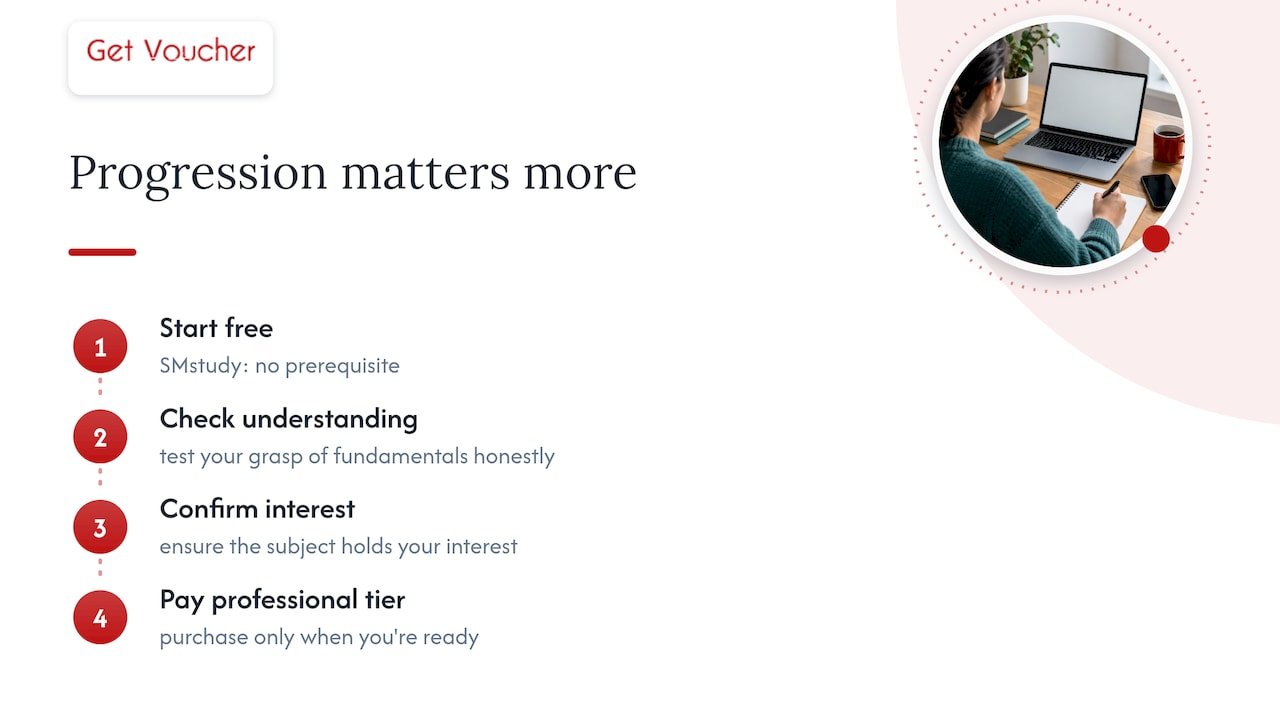
What gets overrated is the idea that a professional-level exam needs prior sales experience to be worth attempting. SMstudy’s Corporate Sales Professional carries no such prerequisite, and treating it as reserved for seasoned sellers discourages people who would benefit from attempting it early.
What matters most is matching the credential to where you actually are, not where you think you should be. Start free, test your grasp of the fundamentals honestly, and only pay for the professional tier once you know the subject matter holds your interest. That sequencing, more than the certificate itself, is what makes the time worthwhile.
— Rayan
Start your pathway with GetVoucher
You can begin with no financial commitment: the Corporate Sales Associate certification is free, and progressing to Corporate Sales Pro simply means buying the voucher, getting access to the learning platform, and booking your exam when ready. Browse the full certifications catalogue if you want to compare sales with other professional paths, and contact GetVoucher directly for pricing on any certification not yet listed.
Sources
FAQ
Which certification is best for sales?
There is no single best certification for every seller, since the right choice depends on your career stage and goals. Starting with a free entry-level credential such as Corporate Sales Associate and moving towards a paid professional-level option gives you a way to test the format before investing more.
What are the top 5 certifications?
There is no independently verified ranking of the top five sales certifications. Readers comparing options can look at entry-level and professional credentials such as Corporate Sales Associate and Corporate Sales Pro, alongside sector-specific programmes like RISE Up from the NRF Foundation and professional body credentials such as the CISP process from AA-ISP.
What are top 3 skills for sales?
Syllabuses across entry-level and professional sales certifications commonly cover prospecting and qualifying, consultative questioning and objection handling, and negotiation fundamentals. These areas recur because they map to the practical stages of a sales conversation, from first contact through to agreement.
What qualifications do you need in sales?
Most entry-level sales roles do not require a certification, though a credential such as Corporate Sales Associate can demonstrate baseline knowledge if you are switching careers. Professional-level certifications like Corporate Sales Pro carry no mandatory work experience prerequisite, so they remain accessible regardless of your background.