




Negotiation certification demonstrates knowledge of recognised negotiation processes and terminology, and the most practical route for most working professionals starts with a free entry-level credential before progressing to a paid, professional-level exam. For managers, sales leads, procurement staff and project delivery professionals, typical pathways include entry-level certifications progressing to professional-level exams.
Table of Contents
- What negotiation certification covers and who it suits
- Comparing NGstudy’s NCN-A and NCN-P pathways
- Core skills and syllabus areas common to recognised negotiation certificates
- How to choose the right negotiation certification for your role and career stage
- Progression roadmap: from NCN-A to NCN-P
- Continuing education or recertification requirements
- Accreditation and recognition of the certification
- Benefits and career impact of obtaining the certification
- Requirements and prerequisites for enrolment
- Comparing top negotiation certification programmes
- When certification is the right next step for busy professionals
- How GetVoucher helps you move from NCN-A to NCN-P
- FAQ
- Sources
What negotiation certification covers and who it suits
Negotiation certification programmes range from short, self-paced online courses to multi-week executive programmes delivered in person. Format and duration shape who each one suits: a self-paced certificate fits someone testing the waters or building a single skill, while a longer programme suits someone who needs sustained practice and peer interaction. LSE Executive Education, for instance, runs an executive negotiation programme with its own fee and delivery structure, illustrating how much variation exists across the market.
The right starting point depends on your role and how negotiation sits within it.
- Procurement professionals often need structured, repeatable processes for supplier and contract discussions.
- Sales managers typically want tactics for pricing, concessions and closing.
- Project leads use negotiation skills for scope, resourcing and stakeholder trade-offs.
- General managers tend to need a broad grounding before specialising further.
A short skills course works well as an introduction or refresher. A formal certification pathway makes more sense when you want a documented credential tied to a defined body of knowledge, which is where NCN-A and NCN-P come in.
Comparing NGstudy’s NCN-A and NCN-P pathways
NGstudy, the certification body behind both credentials, positions NCN-A as the entry point and NCN-P as the professional-level step. NGstudy’s certification overview describes NCN-A as introductory, built around core negotiation concepts, while NCN-P addresses single-issue negotiation specifically. Multi-issue and multi-party negotiation sit outside NCN-P’s scope and belong to higher credentials such as NCN-S, which NGstudy describes as carrying its own separate experience and education requirements.
The exam itself is a 100-question, 120-minute, online unproctored multiple-choice test, a format NGstudy states explicitly on its certification page.
| Feature | NCN-A | NCN-P |
|---|---|---|
| Level | Entry-level | Professional |
| Scope | Core negotiation concepts | Single-issue negotiation |
| Prerequisite | None | None required; NCN-A preferred |
| Assessment | Multiple-choice exam | 100 questions, 120 minutes, online unproctored |
| Typical learner | New to formal negotiation study | Managers wanting a documented professional credential |
Course materials for both levels, as NGstudy describes for NCN-A, include case studies, role plays and chapter tests. These are learning activities used during preparation, not parts of the exam itself. The exam that certifies you is the multiple-choice test, separate from whatever mix of simulations and reading you used to get ready for it.
Pro Tip: Treat case studies and role plays as rehearsal, not the test: budget separate time for timed, exam-style multiple-choice practice before sitting NCN-P.
Either credential demonstrates knowledge of negotiation frameworks and validates competency in the subject matter it covers. Neither should be read as proof of how you will perform in an actual negotiation, which depends on practice, context and judgement that an exam cannot fully capture.
Core skills and syllabus areas common to recognised negotiation certificates
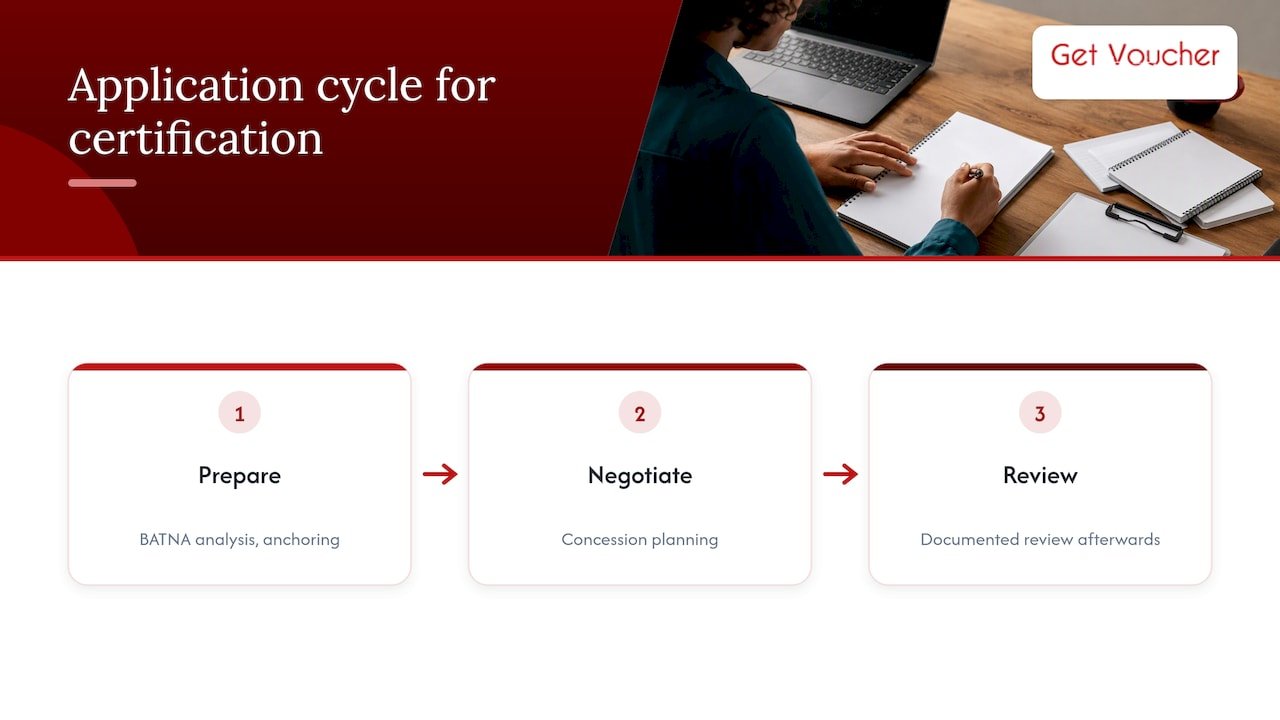
Most negotiation syllabuses, including NGstudy’s NBOK™ content, organise skills around a handful of recurring themes. Academic work on negotiation preparation, often referred to as NePPA, treats preparation as a cycle: before, during and after the table, rather than a one-off step.
- Structured preparation. Setting objectives, researching the other party and planning concessions before any conversation starts.
- BATNA analysis. Identifying your best alternative to a negotiated agreement so you know your walk-away point.
- Anchoring and framing. Shaping how an opening offer or proposal is perceived by the other side.
- Concession planning. Deciding in advance what you can trade, in what order, and at what cost.
- Context-specific skills. Procurement negotiation often extends into contract terms and whole-life cost thinking, which a dedicated procurement course may cover more deeply than a general certificate.
- Cross-cultural awareness. Adjusting style and expectations when negotiating across different business cultures.
Single-issue training, the kind NCN-P covers, focuses on these fundamentals applied to one variable at a time, such as price. Multi-issue and multi-party scenarios, where several variables and stakeholders interact at once, sit with specialist courses at a higher level.
How to choose the right negotiation certification for your role and career stage
Matching the credential to your actual job matters more than chasing the most advanced title available. Entry-level awareness suits someone new to formal negotiation study. Single-issue competency suits a manager who negotiates price, timelines or single contract terms regularly. Specialist multi-issue work, the territory of NCN-S and similar credentials, suits those handling complex, multi-party deals and who meet the separate experience requirements those levels set.
- Check the exam format first. Know whether it is multiple-choice, timed, proctored or unproctored before you commit study hours.
- Estimate study hours honestly. A self-paced certificate demands less sustained time than a multi-week executive programme.
- Confirm delivery mode. Online, in-person and blended formats suit different schedules and learning styles.
- Ask about provider transparency. A credible provider states its syllabus, assessment method and any prerequisites clearly on its own pages.
- Compare cost against what it covers. Tuition, materials, retake policy and exam fees are not always bundled together.
Pro Tip: Before buying a voucher, ask the provider directly about exam scheduling, proctoring arrangements and any team pricing if you are certifying several colleagues at once.
Red flags worth avoiding include vague claims about guaranteed career outcomes, unclear exam rules, or no published information about who issues the credential and what body maintains it.
Progression roadmap: from NCN-A to NCN-P
Moving from the free associate credential to the paid professional one follows a straightforward sequence, and GetVoucher’s course pages for NCN-A and NCN-P lay out each step.
| Step | Action | Detail |
|---|---|---|
| 1 | Complete NCN-A | Free, entry-level, builds core vocabulary and concepts |
| 2 | Plan study hours | Allocate dedicated time for NBOK™ topics before attempting NCN-P |
| 3 | Use preparation materials | Case studies, role plays and chapter tests as rehearsal |
| 4 | Register for NCN-P | Confirm exam format: 100 questions, 120 minutes, online unproctored |
| 5 | Sit the exam | Multiple-choice assessment, separate from preparation activities |
- Keep practice sessions timed so the real exam’s 120-minute limit feels familiar.
- Focus revision on single-issue negotiation processes rather than multi-party scenarios, since NCN-P does not assess the latter.
- Work through NGstudy’s official NBOK™ topics rather than relying solely on general negotiation reading.
The distinction between preparing and testing matters throughout: role plays and simulations build understanding, but the multiple-choice exam is what NGstudy actually grades.
Continuing education or recertification requirements
NGstudy’s published certification pages focus on the initial exam requirements for NCN-A and NCN-P rather than listing a recurring renewal cycle on those specific pages. For higher levels such as NCN-S, NGstudy states separate experience and education requirements that go beyond what NCN-A or NCN-P ask for, reflecting the added scope of multi-issue negotiation work.
If you plan to progress further after NCN-P, check NGstudy’s current documentation for the credential you are targeting, since prerequisites and any ongoing requirements are set by NGstudy and can differ by level. Treating certification as a staged pathway, rather than a single certificate, tends to suit professionals whose negotiation responsibilities grow over time, such as a procurement officer moving into contract leadership or a sales manager stepping into a regional role.
Accreditation and recognition of the certification
NGstudy is the certification body that issues both NCN-A and NCN-P, and it defines the syllabus, exam format and credential levels directly on its own certification pages. GetVoucher operates as the voucher platform through which learners can access these NGstudy pathways, working alongside providers such as VMEdu that support structured online learning resources.
Recognition of any professional certificate varies by industry, employer and region, and no single source confirms universal recognition across all sectors. What NGstudy’s documentation does confirm is the structure of its own credential levels, from NCN-A’s introductory scope through to NCN-P’s single-issue focus and NCN-S’s broader, experience-based requirements. When evaluating how a certificate might be viewed within your own organisation, checking with your employer or industry body remains the more reliable approach than relying on general claims.
Benefits and career impact of obtaining the certification
Negotiation certification validates competency in recognised processes and gives you a documented reference point for skills you might otherwise describe only informally on a CV. For a manager overseeing supplier contracts or a sales lead handling recurring price discussions, a structured syllabus, covering preparation, BATNA analysis, anchoring and concession planning, offers a shared vocabulary that can help teams align on approach.
Certification demonstrates knowledge of these frameworks rather than guaranteeing a particular career outcome or promotion. The practical value tends to show up in how consistently you apply what the syllabus covers: structured preparation before a negotiation, clearer concession planning during it and a documented review afterwards. Those habits, rather than the certificate alone, are what tend to influence outcomes at the table.
Requirements and prerequisites for enrolment
NCN-A carries no prerequisite, making it accessible to anyone starting out in negotiation study.
Higher levels work differently. NGstudy’s page for its specialist credential lists a recommended period of work experience alongside its own exam logistics, reflecting the broader scope that level covers compared with NCN-A or NCN-P. Before enrolling in any level, check the specific credential’s current page on NGstudy’s site, since prerequisites are set per level and can be updated by the certification body.
Comparing top negotiation certification programmes
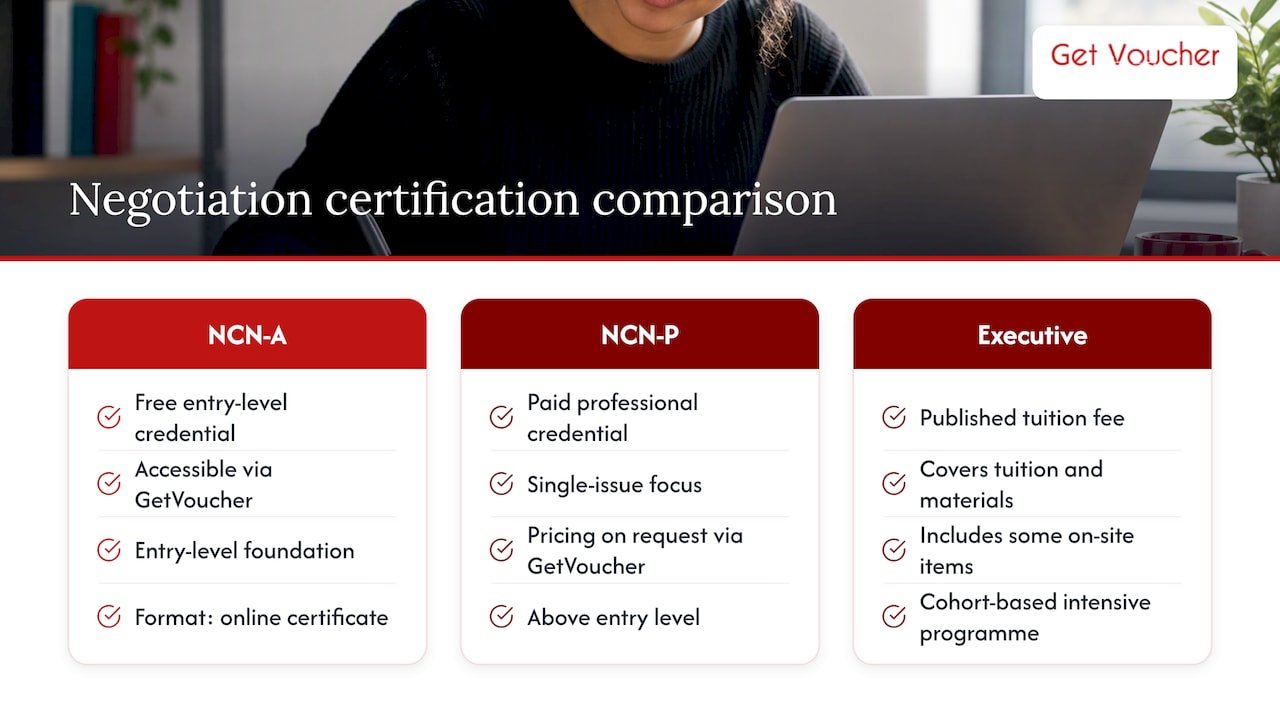
Negotiation certification options span a wide range of formats and price points. At one end, NGstudy’s NCN-A is a free, entry-level credential accessible through GetVoucher. NCN-P sits above it as a paid, professional-level single-issue credential, with pricing available on request through GetVoucher’s course page rather than published as a fixed figure.
At the other end of the market, executive programmes such as LSE’s negotiation programme publish a tuition fee, covering tuition, course materials and some on-site items, a very different format and investment compared with a self-paced online certificate. Choosing between these options comes down to how much time, budget and in-person interaction you want, and whether your goal is a foundational credential or an intensive, cohort-based programme. For readers managing contract-heavy procurement negotiations, resources like this look at common contract negotiation pitfalls illustrate why procurement-specific negotiation training sometimes needs to go beyond a general certificate.
When certification is the right next step for busy professionals
Certification earns its place when you need structured learning, a shared framework for your team, or documented proof of completion for a training budget. It is less useful as a substitute for practical, on-the-job negotiation experience, which no exam can fully replicate. If you are weighing the investment, check GetVoucher’s pathway pages for current availability and pricing before committing time to either level.
— Rayan
How GetVoucher helps you move from NCN-A to NCN-P
GetVoucher gives you a single place to access both NGstudy credentials without chasing separate providers or paperwork, pairing NCN-A as a free starting point with NCN-P as the paid next step once you are ready.

- Start with the free NCN-A voucher to build core negotiation concepts at no cost.
- Progress to NCN-P when you want a professional-level, single-issue credential.
- Browse the full certifications hub to compare related management and sales pathways.
Pricing for NCN-P should be checked on the voucher platform’s course page directly, separately from any exam pricing published by the certification body. For team certifications, contacting the voucher provider to confirm current availability is recommended.
FAQ
What qualifications do I need to be a negotiator?
There is no single, universal qualification required to work as a negotiator, since requirements vary by employer, industry and country. A certification such as NGstudy’s NCN-A or NCN-P demonstrates knowledge of recognised negotiation processes and can support your profile, particularly in roles like procurement, sales or project management.
What are the five C’s of negotiation?
Definitions of the “five C’s” vary across different training providers and are not a single standardised framework. Rather than relying on one specific version, focus on core syllabus areas that recur across recognised certifications, such as preparation, BATNA analysis, anchoring, framing and concession planning.
What are the 7 types of negotiation?
Negotiation literature uses several different classification systems, and no single list of seven types is standardised across all providers or certification bodies. NGstudy’s own certification structure instead distinguishes by scope and level, from NCN-A’s introductory concepts through NCN-P’s single-issue focus to NCN-S’s multi-issue, experience-based credential.
What are the best courses for learning about negotiation?
The right course depends on your goals and budget: a free entry-level credential like NCN-A suits someone starting out, while NCN-P suits those wanting a professional single-issue credential. For an intensive, in-person alternative, programmes such as LSE’s executive negotiation programme offer a different format at a higher published fee.
How is the NCN-P exam structured?
NGstudy states that the NCN-P exam consists of 100 multiple-choice questions to be completed in 120 minutes, delivered online and unproctored. There is no formal experience prerequisite, though completing NCN-A first is preferred.