




A Kanban certification validates your ability to visualise workflow, manage work-in-progress limits and drive continuous improvement, typically starting with a foundation-level credential before progressing to practitioner and advanced tracks. The KANBANstudy catalogue, developed by VMEdu, sets out this pathway clearly, and GetVoucher is preparing to list these vouchers in its own catalogue soon. Read on for the level-by-level breakdown before deciding where to start.
TL;DR:
- Certification levels build progressively from foundational vocabulary and board reading to managing multiple teams and systemic improvement.
- Core skills across all levels focus on visualizing work, limiting work in progress, and using flow data for continuous improvement.
- Exams are usually online, unproctored, with preparation involving syllabus review, practicing sample questions, and timed mock tests.
- Certification supports career growth by formalizing flow literacy for roles from team members to Agile coaches, often complementing Scrum experience.
- Renewal and costs vary by provider and tier, with some credentials requiring no expiry, but candidates must verify policies before scheduling exams.
Table of Contents
- What are the main Kanban certification levels and progression path?
- What skills and syllabus topics does each level cover?
- How does the Kanban certification exam work, and how should you prepare?
- How does Kanban certification support career progression?
- How does Kanban certification meshes with Agile and Scrum in practice?
- How long do Kanban certifications stay valid, and what does renewal involve?
- What does a Kanban certification cost, level by level?
- What benefits do certified professionals typically report?
- What are the common pitfalls when pursuing Kanban certification?
- Author perspective: how I would choose a first Kanban certification
- GetVoucher: how to access Kanban vouchers, study packs and next steps
- Sources
- FAQ
What are the main Kanban certification levels and progression path?
Kanban credentials follow a ladder structure rather than a single one-off exam. The KANBANstudy certification catalogue sets out this pathway, with each tier building on the skills validated by the one before it.
At the entry point sits the foundation tier, aimed at anyone new to flow-based working: team members, coordinators, or professionals moving from Scrum into a Kanban environment. This level confirms you understand core vocabulary (cards, columns, WIP limits) and can read a board without needing someone to translate it for you.
The practitioner tier sits above this, aimed at people who will actively manage or facilitate a Kanban system day to day. It validates a deeper grasp of flow metrics, policy design and how to run the regular cadences that keep a board honest rather than decorative.
At the top, advanced or coach-level credentials target experienced practitioners guiding multiple teams or entire departments through a Kanban transition. These typically assume real working exposure to flow systems rather than classroom theory alone.
- Foundation: vocabulary, board reading, basic WIP awareness
- Practitioner: metrics, policies, cadence facilitation, coaching a single team
- Advanced/coach: multi-team rollout, systemic improvement, mentoring other practitioners
The exact naming and prerequisites for each tier are confirmed on the official catalogue, and it is worth checking that page directly before committing to a level, since providers occasionally revise entry requirements.
What skills and syllabus topics does each level cover?
Every Kanban credential, regardless of provider, tends to build around the same practical core: making work visible, limiting how much of it happens at once, and using data to improve the system rather than guessing.
Foundation-level syllabi typically cover:
- Visualising flow on a board (columns, swim lanes, card design)
- Setting and respecting WIP limits
- Basic flow metrics: cycle time, lead time, throughput
- Reading a cumulative flow diagram without panic
Practitioner and coach-level syllabi add:
- Designing explicit workflow policies so teams stop relying on tribal memory
- Running effective replenishment and delivery cadences
- Diagnosing bottlenecks using flow data rather than intuition
- Applying improvement techniques such as classes of service and risk management
A team member who completes foundation training typically starts spotting why a board is clogged before a manager does. A practitioner-level graduate, by contrast, can usually redesign a broken workflow policy and defend the change with metrics rather than opinion.
How does the Kanban certification exam work, and how should you prepare?
Exam specifics vary by provider, so treat any figure here as an example rather than a universal rule. Professional Kanban I (PK I), an entry-level assessment from a different Kanban body, runs for 60 minutes with an 85% pass mark and is delivered on demand online. Scrum assessment publishes its own exact question count, time limit and passing score on its official page, worth checking directly if you are weighing that route.
For KANBANstudy’s own KEC, KPC, KMC, KPOC and KSDOC exams, the format is online and unproctored, meaning you sit the assessment remotely without a live invigilator watching over a webcam. Always confirm current duration, question count and pass score on the KANBANstudy certification catalogue before booking, since providers do periodically revise these details.
A sensible preparation sequence looks like this:
- Read the official syllabus for your target level in full before touching a course
- Work through structured video training or a short instructor-led course covering each topic
- Practise with sample questions to get used to the phrasing style examiners favour
- Run one or two timed mock attempts under exam conditions
- Book the exam once your mock scores sit comfortably above the published pass mark
Short practical projects on platforms like Coursera can reinforce theory with hands-on board management, useful if your day job has not yet exposed you to a live Kanban system.
Pro Tip: Because these exams are unproctored, the real risk is not cheating detection, it is under-preparation. Treat the online delivery as a convenience, not a reason to skip timed practice.
How does Kanban certification support career progression?
Certification does not replace experience, but it gives you a documented, structured account of skills you may already be applying informally. Employers and hiring managers reading a CV cannot see your judgement; they can see a credential.
Different roles tend to map to different levels:
- Team members and coordinators benefit most from foundation-level training, since it standardises vocabulary across a mixed team
- Delivery leads and Scrum Masters often move to practitioner level, where metrics and policy design directly support their daily facilitation work
- Agile coaches and transformation leads typically pursue advanced credentials, since multi-team rollouts require the systemic view those tracks cover
- Project managers working in hybrid environments often add Kanban credentials alongside existing PMI or Agile qualifications to demonstrate flow literacy
Kanban training complements rather than replaces Scrum learning. A Scrum Master who adds a Kanban credential typically gains a second lens for handling support work, unplanned tasks and continuous-delivery pipelines that sprint boundaries handle awkwardly. Certification may help you stand out in a hiring process or internal promotion round, though it works best paired with a track record of applying the framework on a real board rather than a slide deck.
How does Kanban certification meshes with Agile and Scrum in practice?
Kanban and Scrum solve overlapping problems with different rhythms. Scrum organises work into fixed-length sprints with defined ceremonies; Kanban has no iterations at all, focusing instead on continuous flow, where work moves the moment capacity allows rather than waiting for a sprint boundary.
Teams tend to reach for Kanban training when their work arrives unpredictably: support desks, operations teams, or any group where a two-week sprint commitment gets derailed by urgent tickets. Scrum training suits teams building a defined product increment where a fixed cadence and sprint review genuinely add discipline.
In practice, many teams blend both:
- Use Scrum’s sprint cadence for planned product work
- Layer Kanban’s WIP limits and flow metrics on top to manage unplanned interruptions within that same sprint
- Apply Kanban’s visual board even inside a Scrum framework, since nothing in Scrum forbids visualising flow
This hybrid, sometimes called Scrumban informally, explains why many practitioners hold both a Scrum credential and a Kanban one rather than treating them as competing choices.
How long do Kanban certifications stay valid, and what does renewal involve?
Validity periods and renewal requirements differ by certifying body, so the safest approach is to check the specific credential’s page before you sit the exam rather than assume a standard cycle applies. Some Kanban credentials carry no formal expiry once earned; others require periodic renewal through continuing education points, a refresher assessment, or a renewal fee, similar to how SCRUMstudy manages certification maintenance for its own credential holders.
If you are comparing multiple providers, treat renewal terms as part of the total cost of ownership, not a footnote. A credential with a five-year validity and no renewal fee works out considerably cheaper over a decade than one requiring annual points submissions or a paid refresher every two years. This matters more at practitioner and advanced levels, where the initial course investment is higher and you are less inclined to let the credential lapse and start again from scratch.
The official KANBANstudy catalogue states current validity terms for each of its own credential tiers, and that page should be your reference point rather than a summary from a third-party blog, since renewal policies do shift as providers update their frameworks. If in doubt, contact the certifying body directly before booking an exam you plan to let lapse.
What does a Kanban certification cost, level by level?
Costs vary meaningfully across providers and tiers, and no single figure applies universally, so treat any number you see quoted elsewhere as an example rather than a fixed rate. As an illustration from a different Kanban body, Professional Kanban I is listed at $200 per attempt on its own product page, giving you a rough sense of entry-level exam pricing in this space, though this figure belongs to that specific provider and exam, not to KANBANstudy.
Three cost components typically stack up across any certification path:
- The exam fee itself, which rises as you move from foundation to practitioner to advanced tiers
- Course or training fees, if you choose structured video training or an instructor-led option rather than pure self-study
- Renewal or maintenance costs, where applicable, spread across the validity period rather than paid upfront
Self-paced video training, where available, tends to reduce the need for expensive live coaching, since it lets you revisit difficult topics without booking additional sessions. This can meaningfully lower the total spend for someone disciplined enough to work through material independently rather than needing a classroom structure.
For exact current pricing on any KANBANstudy tier, the official certification catalogue is the definitive reference. GetVoucher does not currently list Kanban vouchers in its own catalogue, but pricing and availability details are available on request, covered further in the section on accessing vouchers below.
What benefits do certified professionals typically report?
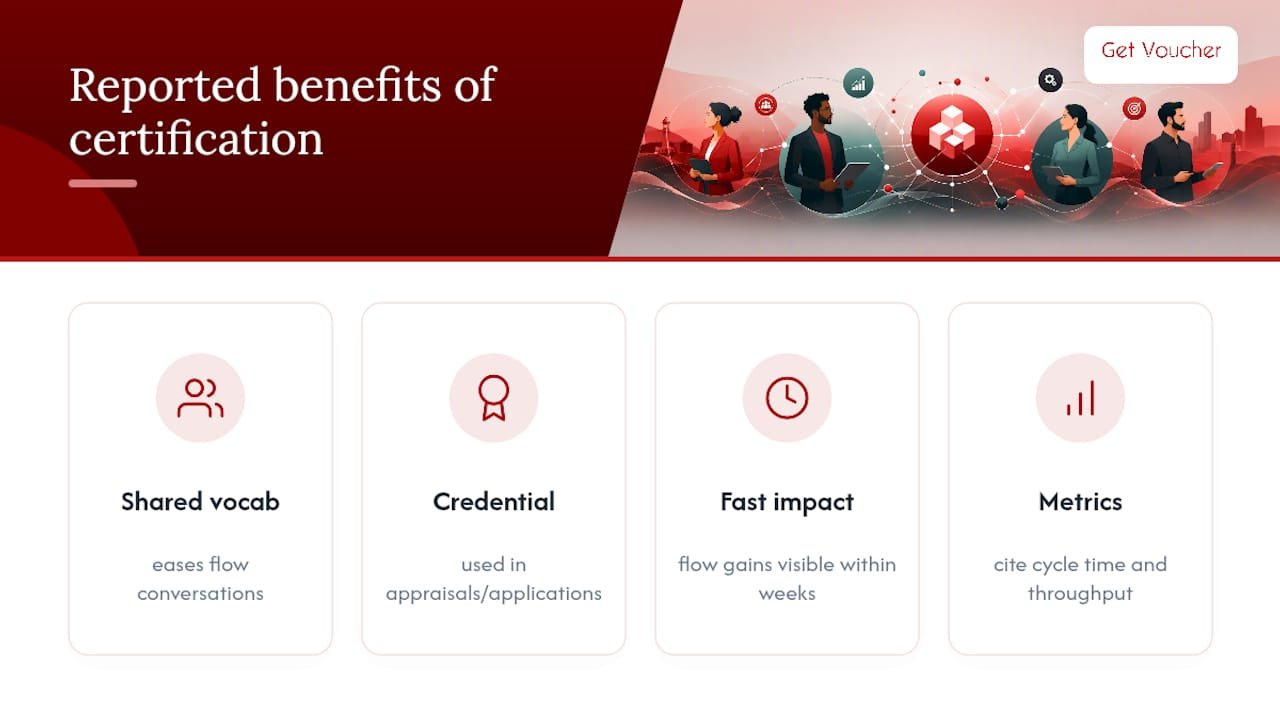
Certified Kanban practitioners commonly describe two practical gains: a shared vocabulary for discussing flow problems with colleagues, and a documented credential to point to during appraisals or job applications. Neither guarantees a promotion or a raise, but both remove friction from conversations that otherwise rely on informal, half-remembered training.
Flow-based improvements from applying Kanban well can appear within weeks of implementation, in contrast to structured process-improvement programmes like Six Sigma, which typically take months to show results given their statistical, project-based nature. This speed difference is one reason practitioners often report visible workplace impact from certification relatively quickly: you can apply a WIP limit or redesign a column structure the same week you learn it, rather than waiting for a formal project charter to clear approval.
Certification also tends to correlate with more confident participation in Agile transformation conversations, since practitioners can point to specific metrics (cycle time, throughput) rather than vague impressions of whether a team is “busy.” That said, career impact varies by organisation, existing experience and how visibly the credential is applied on the job, so treat any certification as a validated skill set rather than a guaranteed career lever.
What are the common pitfalls when pursuing Kanban certification?
The most frequent mistake is treating certification as a vocabulary exercise rather than a practical skill. Passing an exam on WIP limits means little if you cannot explain to a sceptical colleague why limiting work actually speeds delivery up rather than slowing it down.
A second common pitfall is skipping the foundation tier entirely and jumping straight to practitioner-level material out of impatience. This usually backfires, since practitioner syllabi assume fluency with foundation concepts like flow metrics and board design, and gaps there tend to surface painfully during timed practice questions.
Underestimating unproctored exam discipline is a third issue. Because KANBANstudy’s KEC, KPC, KMC, KPOC and KSDOC exams run online without live invigilation, some candidates assume this makes the exam easier and prepare less rigorously, only to find the pass mark just as demanding as any supervised test.
Finally, many candidates overlook renewal terms until a credential quietly lapses. Building a calendar reminder around your certification’s validity period, checked against the official catalogue, avoids an unwelcome surprise years down the line.
Author perspective: how I would choose a first Kanban certification
If you manage a single team’s daily board, start at foundation and stop overthinking it. If you are already facilitating flow across a team, go straight to practitioner, since foundation material will feel like revision. Ask yourself three questions: how much time can you realistically commit this month, what is your current role, and what specific problem do you need solved in the next quarter. Match the answer to a tier rather than the most impressive-sounding credential on the list.
— Rayan
GetVoucher: how to access Kanban vouchers, study packs and next steps
GetVoucher works as a voucher platform, sourcing certification access through established providers like VMEdu, rather than acting as a certifying body itself. That distinction matters: VMEdu develops and delivers the training content behind brands like SCRUMstudy and KANBANstudy, while GetVoucher focuses on making vouchers easier to find, purchase and use, often alongside self-paced video training that cuts down on the hunting-and-piecing-together approach many learners fall into with scattered free resources.
Kanban certifications from KANBANstudy are planned for the GetVoucher catalogue in the coming months. Until that listing goes live, contact GetVoucher directly for current pricing, course details and expected availability.
In the meantime, GetVoucher’s existing certifications catalogue already covers closely related Agile credentials, including the Dual Agile Pack covering Scrum Master and Product Owner certification, a sensible parallel track if you want Scrum and Kanban knowledge developing side by side. If process improvement sits alongside your Kanban interest, the Dual 6Sigma Pack is worth a look too. Browse the current catalogue now, or get in touch about Kanban voucher availability directly.
Sources
FAQ
How can I get certified in Kanban?
Choose a certification level matching your role, typically foundation if you are new to flow-based working, then study the official syllabus, practise sample questions and sit the exam through your chosen provider’s platform. The KANBANstudy catalogue lists current levels and requirements.
What are the six practices of Kanban?
Kanban’s method is usually described through six general practices: visualising workflow, limiting work in progress, managing flow, making policies explicit, implementing feedback loops, and improving collaboratively through experimentation. Different providers phrase these slightly differently, so check your chosen certification’s own syllabus for its exact terminology.
Is Kanban better than Scrum?
Neither is universally better; they suit different work patterns. Kanban fits continuous, unpredictable workflows like support or operations, while Scrum fits planned product work delivered in fixed sprints, and many teams use both together.
Is Kanban a lean or a Six Sigma method?
Kanban is a Lean tool, focused on visualising flow, limiting work in progress and improving cycle time, whereas Six Sigma focuses on statistical control and reducing process variation through defined projects. Organisations often start with Kanban for quick flow visibility, then layer in Six Sigma for targeted, data-heavy process problems once the basics are working.
Kanban vs Scrumban for Scrum Teams: Test Cadence, Commitment, and WIP
[…] Map Kanban Certification to 4 Job Roles With GetVoucher […]