



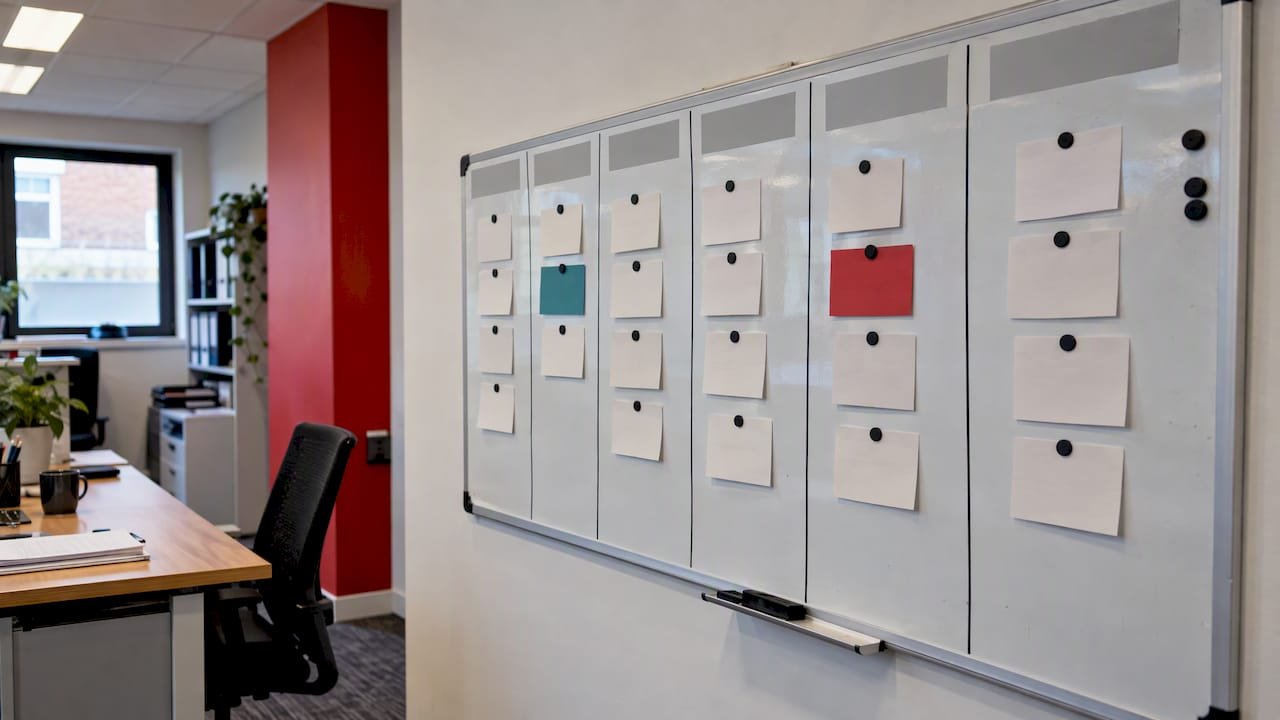
Kanban is a method for managing the flow of work, with no prescribed events or roles. Scrumban is a hybrid that keeps selected Scrum practices, such as regular planning and retrospectives, and adds Kanban’s visual board and WIP limits. If your work arrives as a steady, unpredictable stream (support tickets, operations, maintenance), Kanban is usually the natural fit. If you want a regular planning and review rhythm but need flow controls for day-to-day work, or you are moving away from Scrum, Scrumban is worth testing.
The rest of this guide shows where the two differ, what each one asks of a team, and how to decide without treating either as a rulebook. For a Scrum-team angle on the same question, see our companion piece on testing cadence, commitment and WIP in Scrumban.
Table of Contents
- Kanban and Scrumban at a glance
- What Kanban is and how it manages work
- What Scrumban is and where it came from
- The main differences between Kanban and Scrumban
- Scrumban versus Scrum: three points to get right
- Scrumban advantages and trade-offs to plan for
- When to use Kanban
- When to use Scrumban
- Which certification supports this learning
- Start with the right voucher
- FAQ
- Sources
Kanban and Scrumban at a glance
| Question | Kanban | Scrumban |
|---|---|---|
| What is it? | A method for improving the flow of value through a process | A hybrid of Scrum and Kanban; the exact mix is the team’s choice |
| Planning | Continuous, no fixed planning schedule | Often regular planning, or demand-driven planning triggers |
| Cadence | No prescribed time-boxes | Teams choose Scrum elements; many keep sprints, others drop the timebox |
| Roles | None required | Existing roles kept; some, all or no Scrum roles |
| WIP limits | Core to the method | Applied to the team’s board |
| Delivery | Steady, as work finishes | Can ship as soon as work is ready, not at a sprint boundary |
| Best for | Ongoing, unpredictable work | Changing priorities that still benefit from a regular rhythm |
The table is a summary of common guidance, not a universal specification. Scrumban in particular has no single official rulebook, so two teams can both say “we do Scrumban” and work quite differently.
What Kanban is and how it manages work
The Kanban Guide (May 2025) describes Kanban as a strategy for optimising the flow of value through a process. It rests on three practices: visualising the workflow, actively managing items in it, and improving the workflow. Explicit policies, limits on work in progress (WIP) and a pull system make those practices work in daily life.
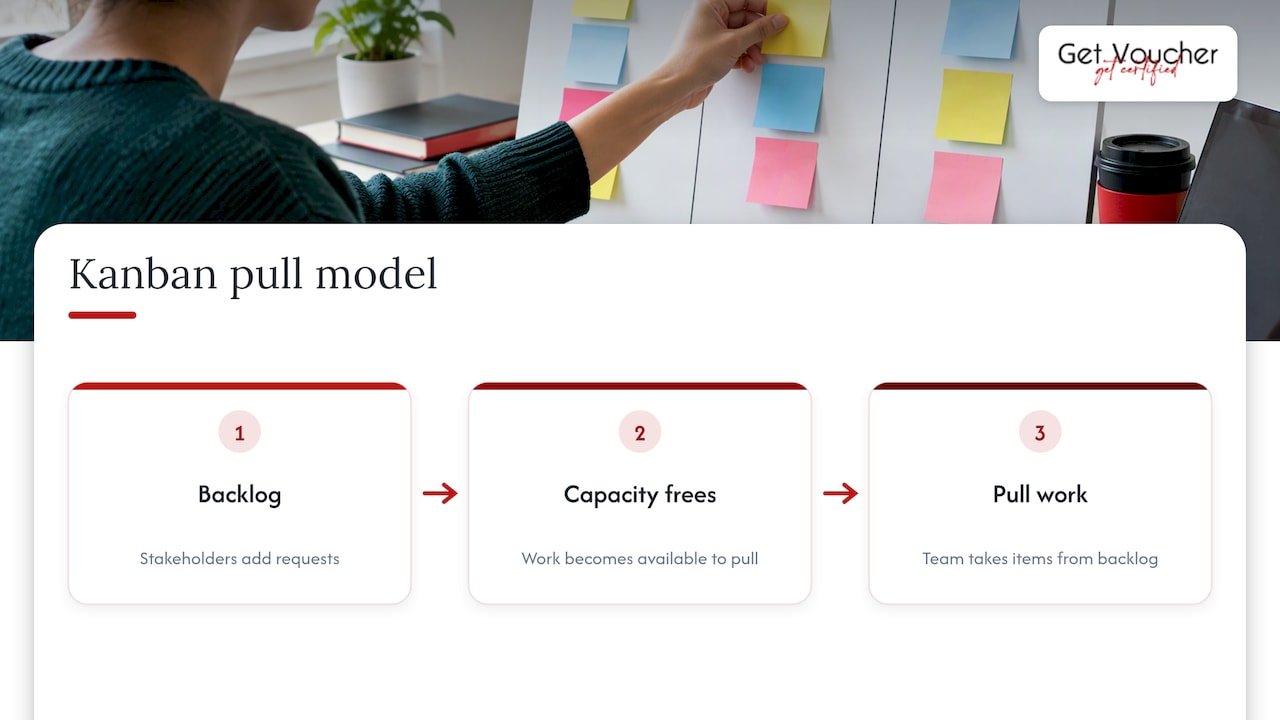
In practice that looks like a board with columns for each stage of your process. Each column has a limit. When a stage is full, nobody starts new work there: people help finish something already in progress. Microsoft’s documentation describes this as a pull model, where stakeholders add requests to a backlog and the team pulls work in as capacity becomes available, which helps protect quality and avoid overloading the team.
Kanban principles in plain terms
- Start with what you do now. The Agile Alliance describes the Kanban Method as a way to drive evolutionary change from your existing workflow, rather than a big-bang reorganisation.
- Make work visible. Every item, its stage and its blockers sit on the board.
- Limit WIP. Limiting work in progress increases focus and reduces context switching. If a limit is regularly exceeded, the same Microsoft page advises investigating the root cause rather than simply raising the limit.
- Manage flow. The Kanban Guide includes a Service Level Expectation (SLE): a forecast of how long an item should take from started to finished, expressed as a period of elapsed time and a probability. Teams commonly track flow measures such as WIP, cycle time and throughput, as the Open Guide to Kanban describes.
- Improve continually. Policies are reviewed and changed as the team learns.
A common misunderstanding is that Kanban means “no rules”. It has few prescribed roles or meetings, but a Kanban system still needs explicit policies and WIP limits to be Kanban at all.
What Scrumban is and where it came from
Scrumban combines Scrum’s delivery structure (sprints, stand-ups, retrospectives) with Kanban’s flow management (visualisation, pull and WIP limits), as Atlassian describes it. The 2018 Agile Playbook credits Corey Ladas with developing it in 2010 to help teams move from Scrum towards flow-based delivery.
That origin explains a lot. Scrumban started as a transition path, and many teams still use it that way. Ajay Reddy, author of a well-known book on the subject, distinguishes it from the Kanban Method because it takes Scrum as its core framework and is organised around teams. That is a useful reminder that different authors define Scrumban differently.
Practices you may meet in Scrumban
- A workboard with WIP limits, which Scrum Alliance says prevents overload and supports a steadier workflow.
- Planning triggers. Instead of planning on a fixed day, a team replenishes its ready queue when it falls below an agreed level, as the Scrumban overview on Wikipedia describes.
- Bucket-size planning. The Agile Playbook describes items moving through idea, goal and story buckets to support longer-term planning without rigid, regularly scheduled sessions.
- Retrospectives kept as a regular chance to inspect and improve.
None of these is mandatory for every Scrumban team. That is the point and the risk: you choose, so you need to be explicit about what you chose.
The main differences between Kanban and Scrumban
Cadence and planning
Kanban has no prescribed cadence. The ICAgile comparison notes there is no fixed planning schedule, so teams start work as needed while WIP limits prevent overload. Scrumban lets teams select Scrum elements, and most keep sprints. Others keep Scrum’s events but remove the sprint timebox, prioritising continuously instead, as the Agile Playbook describes.
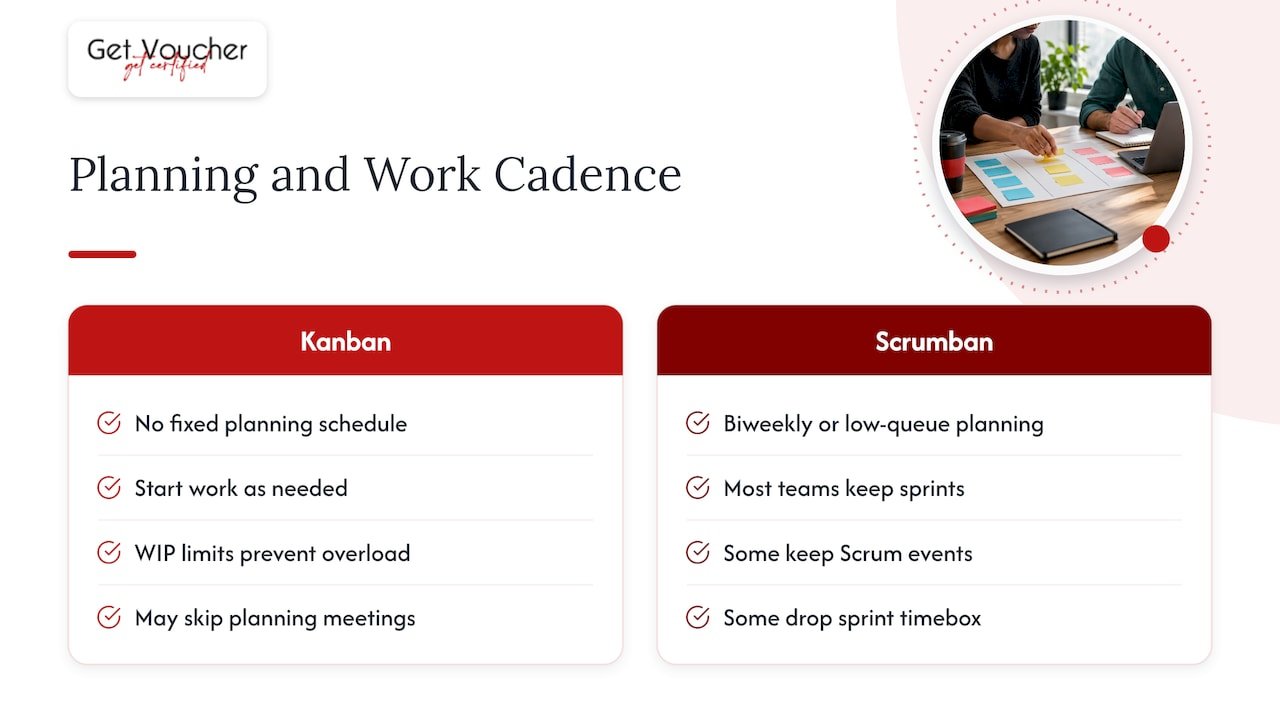
Planning is where this shows. A Kanban team might never hold a planning meeting as such; a Scrumban team might plan every two weeks, or only when the ready queue runs low.
Roles and accountability
Kanban requires no roles. Scrumban retains the roles a team already has, and may adopt some, all or none of Scrum’s. The Scrumban overview adds that team members pick their own tasks rather than receiving assignments from a project manager.
Delivery
Both support steady delivery. Scrumban can ship each item when it is ready rather than waiting for a sprint boundary, a point made by Zoho Sprints and Atlassian. Of course, a sprint-based Scrumban team will still tend to release on its sprint rhythm.
Relationship to theory
InformIT’s summary of Reddy’s work says Scrumban stresses flow and queuing theory, formalises continuous improvement within its ceremonies, and allows for specialised functional teams.
Scrumban versus Scrum: three points to get right
Many readers arrive from the Scrum side, so it is worth being precise. These points follow the current Scrum Guide, and they are exactly where Scrumban discussions go wrong.
- Sprints and team size. In Scrum, a Sprint lasts one month or less, and a Scrum Team is typically 10 or fewer people. If you drop the timebox, you are no longer doing Scrum’s Sprint; you are doing something else, and that is fine as long as you call it what it is.
- Commitment. The Scrum Team commits to the Sprint Goal, not to a fixed batch of tasks. The Sprint Backlog is a plan that evolves. So a change mid-Sprint is not automatically a breach: scope can be clarified and renegotiated with the Product Owner as the team learns more, provided the Sprint Goal is not endangered. It is the Sprint Goal that stays stable.
- Accountability. The Scrum Guide makes the Product Owner accountable for maximising the value of the product, including managing the Product Backlog. It does not make the Product Owner solely responsible for the Sprint Goal or for the team’s commitments. The whole Scrum Team shares those.
Two more clarifications. WIP limits are not part of the Scrum Guide, which is why they are the first thing many Scrum teams borrow from Kanban. And velocity is not defined in the Scrum Guide either, so it is not a rule of Scrum, and a Scrumban team that uses flow metrics such as cycle time instead is not breaking any Scrum rule by doing so.
There is also a difference between Scrumban and “Scrum with Kanban”, where a Scrum Team keeps the full framework and uses Kanban practices inside it. Scrum Alliance describes Kanban’s visual board and WIP limits as practices that can support Scrum teams, with work pulled only when capacity frees up. The distinction matters because Scrum with Kanban practices stays inside Scrum’s rules, while Scrumban adapts them.
Scrumban advantages and trade-offs to plan for
Scrum Alliance lists several advantages of Scrumban: flexibility to adjust priorities, transparency through visible tasks and bottlenecks, regular improvement through retrospectives, and fewer bottlenecks by capping WIP. Atlassian adds that delivering features as they complete can suit complex, ongoing projects.
To get those benefits, a team needs to settle a few things on day one:
- Which Scrum elements stay? Write them down: retrospective frequency, planning trigger, review cadence.
- What are the WIP limits, per column or per person? Start from the current count of in-flight items and tighten gradually.
- What is the service expectation? Borrow the SLE idea from the Kanban Guide: how long should an item take, with what probability?
- Who decides priority, and when? Without a planning rhythm, priority drift is the common failure.
Communication is the other quiet factor. When roles and events are optional, the working agreements carry the weight. Short, practical DISC communication strategies for small teams can help a newly hybrid team agree how it shares updates and handles disagreement about priorities.
When to use Kanban
The ICAgile comparison suggests Kanban for a steady stream of ongoing work, such as customer support or IT, where flow matters more than structured planning. A De Anza College guide to choosing a way of working says the same from the angle of work arrival: continuous and unpredictable work suits Kanban’s continuous pull. The Agile Playbook adds that operations and maintenance teams with small backlogs fit well.
Examples where Kanban is a natural candidate:
- An IT service desk where requests arrive daily and cannot be scheduled.
- A platform team handling a mix of bug fixes and small requests.
- A content or design team with a rolling list of small jobs.
When to use Scrumban
Consider Scrumban when you want flexible planning, some structure and quick delivery, or when you are transitioning from Scrum. The De Anza guide describes it as useful when a team wants a regular planning, review and retrospective rhythm but needs flow controls for daily execution. The Agile Playbook points to teams with constantly changing priorities that still want structured events.
A simple decision path:
- Does work arrive unpredictably and continuously? Lean towards Kanban.
- Do priorities change often, yet stakeholders want a regular checkpoint? Lean towards Scrumban.
- Is the team new to Agile and needs clear roles and events? Scrum itself may be the better starting point, with Kanban practices added later.
- Are you changing method because of one bad sprint? Look first at your Sprint Goals and backlog quality before changing framework.
Try the choice as an experiment for a few weeks, review it in a retrospective, and keep what helps.
Our perspective on Kanban and Scrumban
We see teams reach for Scrumban for two very different reasons: because it solves a real flow problem, or because they want to escape the discipline of Scrum without saying so. The first is a good reason. The second usually reproduces the same problems on a board.
Our view is that Scrumban works best when the team already understands the framework it is adapting. You cannot sensibly decide which parts of Scrum to keep until you know what each part is for: the Sprint Goal, the retrospective, the accountability of the Product Owner. The same is true in reverse for Kanban, whose WIP limits and service expectations only help when the team reads its own flow data honestly.
That is why we think certification is best treated as structured learning rather than a badge. A provider’s syllabus gives a team a shared vocabulary, and that makes a hybrid far easier to agree on. We would not claim a certificate proves how someone performs at work, but it does give a common starting point for the conversation. This is the thinking behind the pathways we offer: start with an introductory credential, then build towards role-specific ones as your work calls for them.
Rayan
Which certification supports this learning
The credentials below are the ones we sell, and each is provider-specific. Exam format, prerequisites and what is included differ by product, so check each product page before buying.
- Scrum Fundamentals Certified is priced at £0. SCRUMstudy’s SFC uses a 40-question, 60-minute online unproctored exam.
- Scrum Master Certified (SMC®) is £249. SCRUMstudy’s SMC® uses a 100-question, 120-minute online unproctored exam.
- Scrum Product Owner Certified (SPOC®) is £299, for those who want to go deeper on product value and backlog management.
- SCRUM Agile Master Certified (SAMC™) is £349, and also uses an online unproctored exam.
These are SCRUMstudy credentials following the SBOK® Guide, which is a different body of knowledge from the Scrum Guide, and they are separate from Scrum.org and Scrum Alliance credentials, which we do not sell. Kanban has its own learning routes; our guide to mapping Kanban certification to four job roles covers how they relate to different careers.
Start with the right voucher
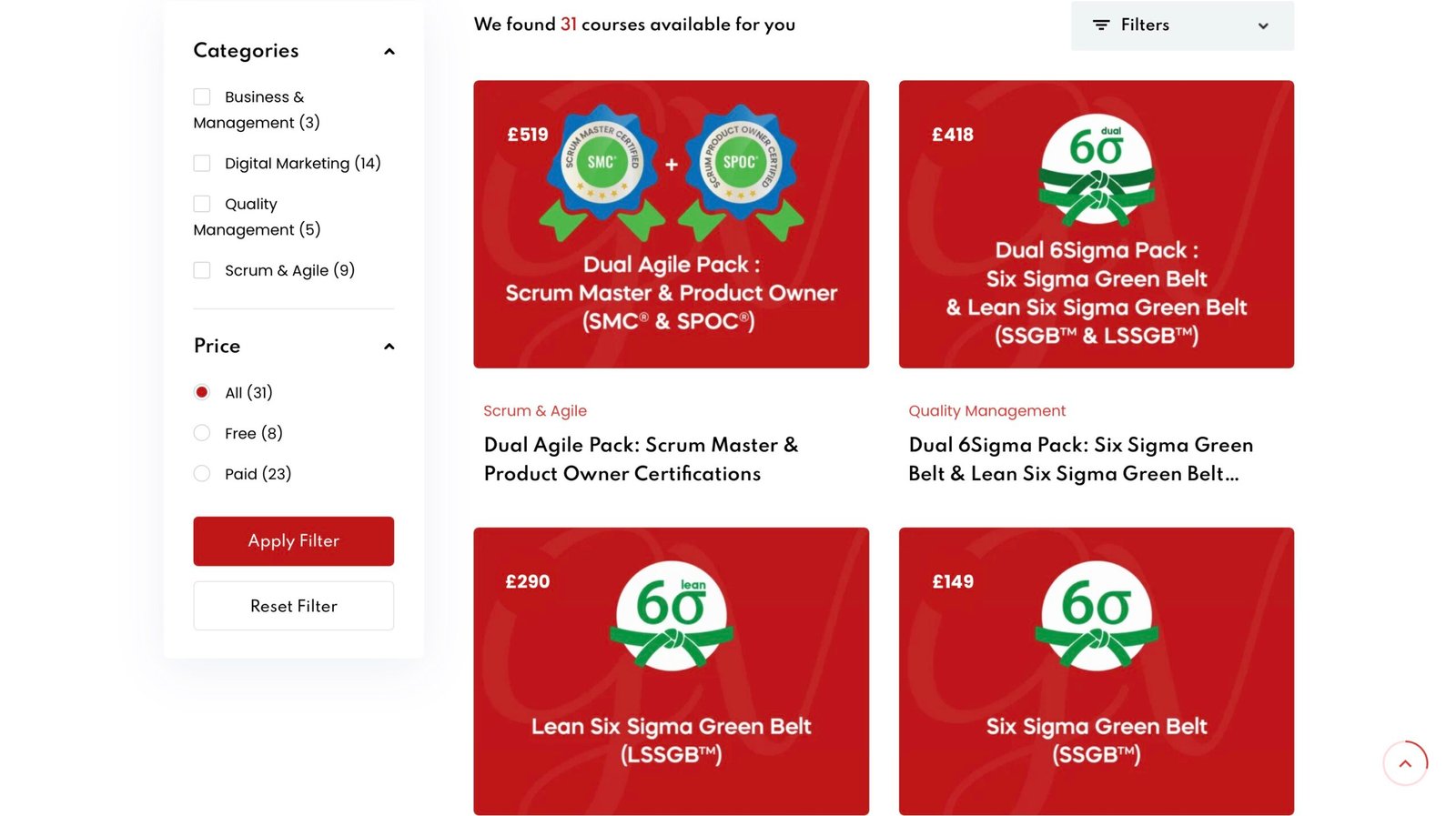
If you are deciding between Scrum, Kanban and a hybrid, the lowest-risk first step is the free Scrum Fundamentals Certified course, which gives you shared vocabulary before you adapt anything. For a team or a career move that needs both the Scrum Master and Product Owner perspectives, the Dual Agile Pack is £519. You can browse everything in our Scrum and Agile category.
FAQ
Is Kanban a methodology without rules?
No. Kanban has few prescribed roles or meetings, but the Kanban Guide still defines practices: visualising the workflow, actively managing items, and improving the workflow. Explicit policies and WIP limits are part of that. What Kanban does not do is dictate sprints or specific job titles.
Is Scrumban the same as Scrum with Kanban?
Not quite. Scrum with Kanban keeps Scrum intact and uses Kanban practices such as a visual board and WIP limits inside it. Scrumban is a hybrid in which the team chooses which Scrum elements to keep, and may drop the sprint timebox altogether.
Can I change priorities mid-sprint in Scrumban?
Scrumban teams often adjust priorities more freely, and Scrum Alliance lists that flexibility as an advantage. In Scrum itself, scope can be renegotiated with the Product Owner during a Sprint, as long as the Sprint Goal is not endangered. Agree your own rule for changes and write it down.
Do I need WIP limits to do Scrumban?
In most descriptions of Scrumban, yes: the board and its WIP limits are the Kanban half of the hybrid. WIP limits are not part of the Scrum Guide, so adding them does not conflict with Scrum. Start with limits close to your current load and tighten them as you learn.
Sources
- The Kanban Guide, May 2025
- Open Guide to Kanban, 2025.7
- What is Kanban? Microsoft Learn
- What is Kanban? Agile Alliance
- Scrumban, Atlassian
- Agile Playbook 2.1, Agile Alliance
- The Scrumban [R]Evolution, sample pages
- What is Scrumban? Scrum Alliance
- Kanban for Scrum Teams, Scrum Alliance
- Scrumban, Wikipedia
- Scrumban vs Kanban, ICAgile
- What Is Scrumban? Zoho Sprints
- Choosing the Right Way of Working, De Anza College
- The Scrum Guide 2020