




You can change the name on a certificate, but only the organisation that issued it can do so. Some issuers let you update your account name and regenerate the certificate in minutes. Others ask for ID, supporting documents, the original certificate and a fee, and then print a replacement. Editing the PDF or scan yourself is not a valid route.
This guide shows how the process works across awarding bodies and online course platforms, which evidence is usually asked for, what it can cost, and what to do when a request is refused. The examples are real policies from named issuers, because the rules differ from one issuer to the next. Use them as a map, then check your own issuer’s page before you send anything.
Table of Contents
- First, decide which kind of name problem you have
- Who can change it: the issuer, never you
- How issuers handle name changes: real examples
- What evidence to gather before you apply
- Step by step: how to request the change
- Fees, timescales and what is usually free
- When the issuer says no, or does not answer
- Our perspective: check the name before you pay for the exam
- Choosing a certification you can set up correctly first time
- Frequently asked questions
- Sources
First, decide which kind of name problem you have
The route depends on why the name is wrong. There are three common cases, and issuers often treat them differently.
| Situation | Typical example | What issuers usually want |
|---|---|---|
| Typing or spelling error | “Jon” instead of “John”, a missing middle name | ID showing the correct spelling, sometimes proof that the error was not yours |
| Legal name change | Marriage, civil partnership, divorce, deed poll | The legal document that records the change, plus photo ID |
| Display name problem | A username or nickname printed because the profile name was blank | Updating your profile name, or a support request |
Check the certificate against your passport or driving licence before you contact anyone. A name that looks wrong may simply be a shortened form you entered at registration, which changes the way the issuer handles the request.
Who can change it: the issuer, never you
A certificate is a statement made by the issuer. If you alter the PDF, the issuer’s signature, seal or verification record no longer matches what the document says. Guidance on credential correction from Emitcert makes the point that the correction should come from the issuer as a reissued credential, with the original replaced or withdrawn.
That has a practical consequence. An employer, university or professional body that checks your credential will check it against the issuer’s record. A document you edited yourself will fail that check, and it may be treated as falsification. Ask the issuer for a corrected version instead.
How issuers handle name changes: real examples
The policies below show the range you may meet. They are not interchangeable, so use the one that belongs to your issuer.
Awarding bodies for UK qualifications
UK qualification providers tend to be the strictest, because their certificates are regulated and often used for employment and further study.
- VTCT. For certificates issued from 1995 onwards, name changes go through the CertiTrack platform and require a replacement certificate to be purchased. For certificates issued before 1995 you call VTCT, and the combined fee listed on that page is £37.50. Accepted evidence includes a marriage or civil partnership certificate, a decree absolute, or a change of name deed or deed poll.
- AQA. The applicant posts the original certificate and emails a copy of their birth certificate. AQA charges £50.25 per request and aims to send the amended certificate within 20 working days. Its page also says that it cannot amend a name changed by deed poll after results were issued, and that it amends personal details only on the basis of a birth certificate.
- Pearson. For specified qualifications, the incorrect original must be returned before a corrected certificate is issued. For all other subjects, the original has to be securely destroyed after the correction.
- Highfield. Its certificate services policy (August 2025) asks for photographic identification and supporting evidence, requires the original to be returned before processing, and says a replacement has the same standing as the original.
Notice the differences. AQA works from a birth certificate and will not act on a deed poll made after results day. VTCT accepts a deed poll. If you changed your name by deed poll, that single detail decides which issuers can help you.
Learning providers outside the UK
If you studied or qualified abroad, or with a body based overseas, the same principles apply with local detail.
- QQI (Ireland). When the original certificate carries a former name, you state this on the replacement request so the record and the new certificate can be amended, and you provide proof of identity.
- ABIM (United States). Written notice and documentation are required, for example a marriage certificate, naturalisation papers or a court order.
- NCCPA (United States). The request is made through your online account with two supporting documents, such as a driving licence or passport. The record is updated within 3 business days of approved documentation arriving.
- IIBF (India). It will not consider e-certificate name corrections received more than one year after the exam. Its notice dates from 2022, so confirm that it still applies.
The IIBF case is a reminder that some issuers set a time limit. If you spot an error on a new certificate, report it straight away.
Professional bodies and exam-based credentials
Credentials taken at an exam centre or by an online invigilated session are often tied to the ID you showed on the day. HashiCorp asks for a support ticket with a selfie holding the ID used at the exam appointment and the reason for the adjustment, and the ticket must come from the name on that ID. The HR Certification Institute requires a specific name change form for legal name changes after a profile is created, according to its 2026 handbook. Danatec offers an online form for substantial changes such as a last name, and reviews each submission.
Online course platforms
Completion certificates from learning platforms are usually the easiest to fix, because the name is pulled from your profile.
- Udemy. You update your profile name and save the changes to the certificate in a web or mobile browser.
- Uxcel. You can update your account name and regenerate a certificate that was already issued. Its guidance also recommends using a legal or professional name so that employers and institutions recognise the document.
- edX. Changing the full name on your account updates the certificates you have earned, except older PDF certificates earned before October 2015, which edX can no longer update.
If your certificate shows a username, as often happens when the optional full name field was left empty, fixing the profile first is usually the whole solution.
What evidence to gather before you apply
Most issuers want three things: proof of who you are, proof of the name change, and sometimes the original certificate. Assemble them first, because a request that arrives incomplete is the commonest cause of delay.
- Photo ID in the new or correct name. A passport or driving licence is the usual choice.
- The document that records the change. For UK readers that means a marriage or civil partnership certificate, a decree absolute, or a deed poll or change of name deed. VTCT lists exactly these. For a spelling error, a birth certificate may be what the issuer asks for, as AQA does.
- The original certificate, if the issuer asks for it. AQA, Highfield and Pearson all deal with the original in some way, by return or secure destruction. Do not post a unique original without checking whether you need a copy, a tracked service or a replacement first.
- Your reference numbers. Candidate number, learner ID, certificate number and the date of award speed up the search for your record.
- A short covering note. State the name currently on the certificate, the name it should read, the reason, and which documents you attach.
If you also need the certificate accepted abroad, a corrected original comes first. Legalisation or translation applies to the final document, so options for wrong names on UK certificates are worth reading before you pay for any overseas processing.
Step by step: how to request the change
- Find the issuer’s own policy page. Search for the issuer’s name plus “change of name” or “replacement certificate”. Use their page, not a third-party form site.
- Check eligibility and deadlines. Look for cut-off dates, age limits on records, and the type of evidence accepted.
- Use the official channel. That may be an online portal, a form, a support ticket, an email or a phone call.
- Send the evidence. Keep copies of everything and note the date you submitted.
- Pay any fee. Use the exact payment reference the issuer requests. AQA, for example, specifies a reference format built from AOC and your name.
- Wait for the stated turnaround. AQA’s target is 20 working days, and NCCPA’s is 3 business days after approved documents arrive.
- Check the new certificate carefully. Compare every character of the name, the dates and the certificate number before you use it.
- Update your other records. Tell any employer, registration body or profile (such as a digital badge) that held the old certificate.
Fees, timescales and what is usually free
Expect a spread. A digital completion certificate that regenerates from your profile can be free and immediate. A regulated paper certificate can carry a fee in the region of £37.50 to £50.25 on the published pages above, and take weeks. Those figures belong to those issuers and may change, so treat the issuer’s current page as the authority.
Fees and rules also differ by cause. Some issuers waive the charge when the error is theirs, and charge when the change is yours, though practice varies. Ask before paying if the mistake was made by the issuer or the centre.
When the issuer says no, or does not answer
A refusal is usually about evidence, not about you. Accredible’s help page says that when a name change request is denied, the issuer does not have sufficient evidence to approve it. The quickest route is to contact the issuer directly and ask what is missing.
If the credential sits on Accredible and your request has not been approved after at least 3 business days, the same page says to contact Accredible support so that it can forward the request to the issuer. That is a nudge, not an override: the decision stays with the issuer.
If the policy itself rules you out, as with AQA and post-results deed poll changes, ask the issuer which alternative evidence it accepts. Often the answer is a supporting letter, or a statement that your certificate and your current ID can be presented together with the legal change document. For a UK employer or university, the deed poll or marriage certificate shown beside the old certificate is commonly enough, but only that organisation can tell you what it will accept.
Our perspective: check the name before you pay for the exam
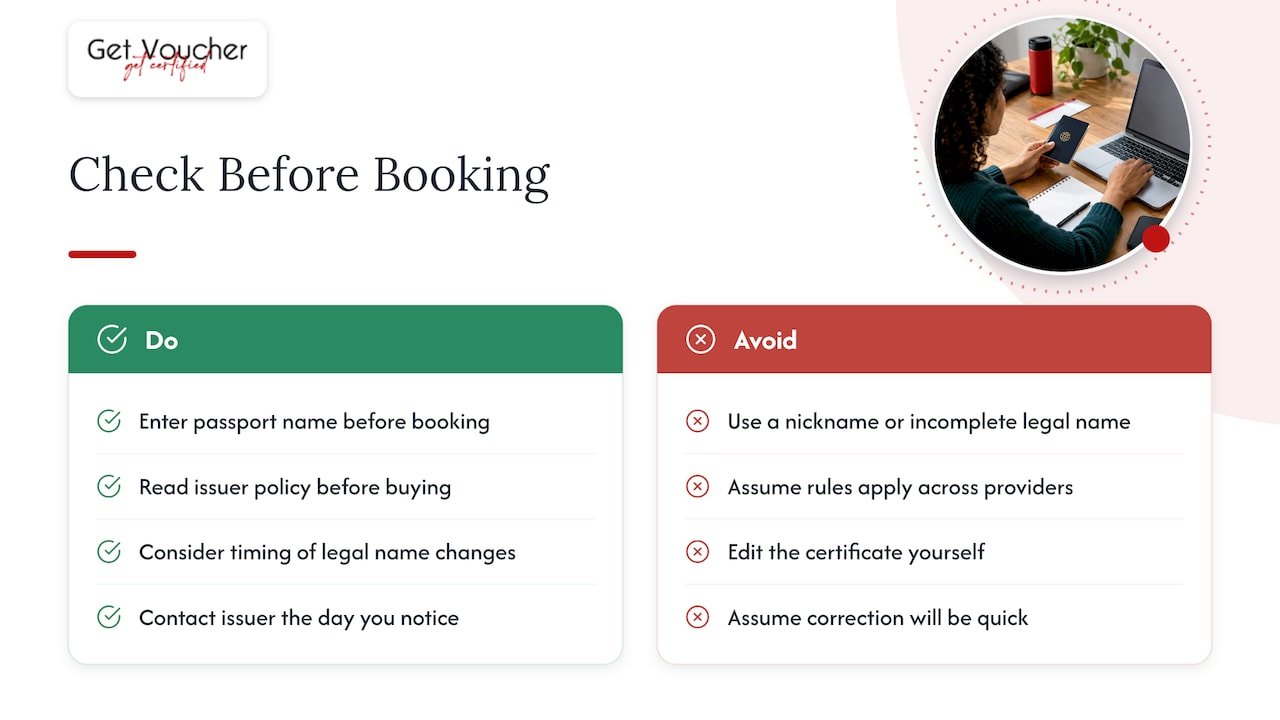
We sell certification vouchers, so we see how this problem begins. People rush through registration, type a nickname or leave the legal name field half-finished, and find the mistake only when the certificate arrives. Our advice is simple: enter your name on any certification account exactly as it appears on your passport, before you book or sit anything. If a legal name change is coming, such as a marriage or a deed poll, think about timing, because some issuers have a harder time amending records after the fact.
We also suggest reading the issuer’s name-change policy before buying a voucher, in the same way you would read its retake and renewal terms. Each provider sets its own rules, and what applies to one body says nothing about another. Our guide to voucher terms and certification retakes shows the kind of small print worth checking, and our guide to verifying unproctored certifications explains how credentials are checked by third parties. Never edit a certificate yourself, and never assume a correction will be quick. Raise it with the issuer’s support team the same day you notice it.
— Rayan
Choosing a certification you can set up correctly first time
If you are about to start a new credential, getting the account details right at the start saves this whole process. GetVoucher offers online certification vouchers across Scrum and Agile, digital marketing, quality management, Six Sigma and negotiation. Examples from our current catalogue include the Scrum Master Certified (SMC®) at £249, the Scrum Product Owner Certified (SPOC®) at £299 and the Six Sigma Green Belt (SSGB™) at £149, with Scrum Fundamentals Certified and Six Sigma Yellow Belt (SSYB™) both at £0.
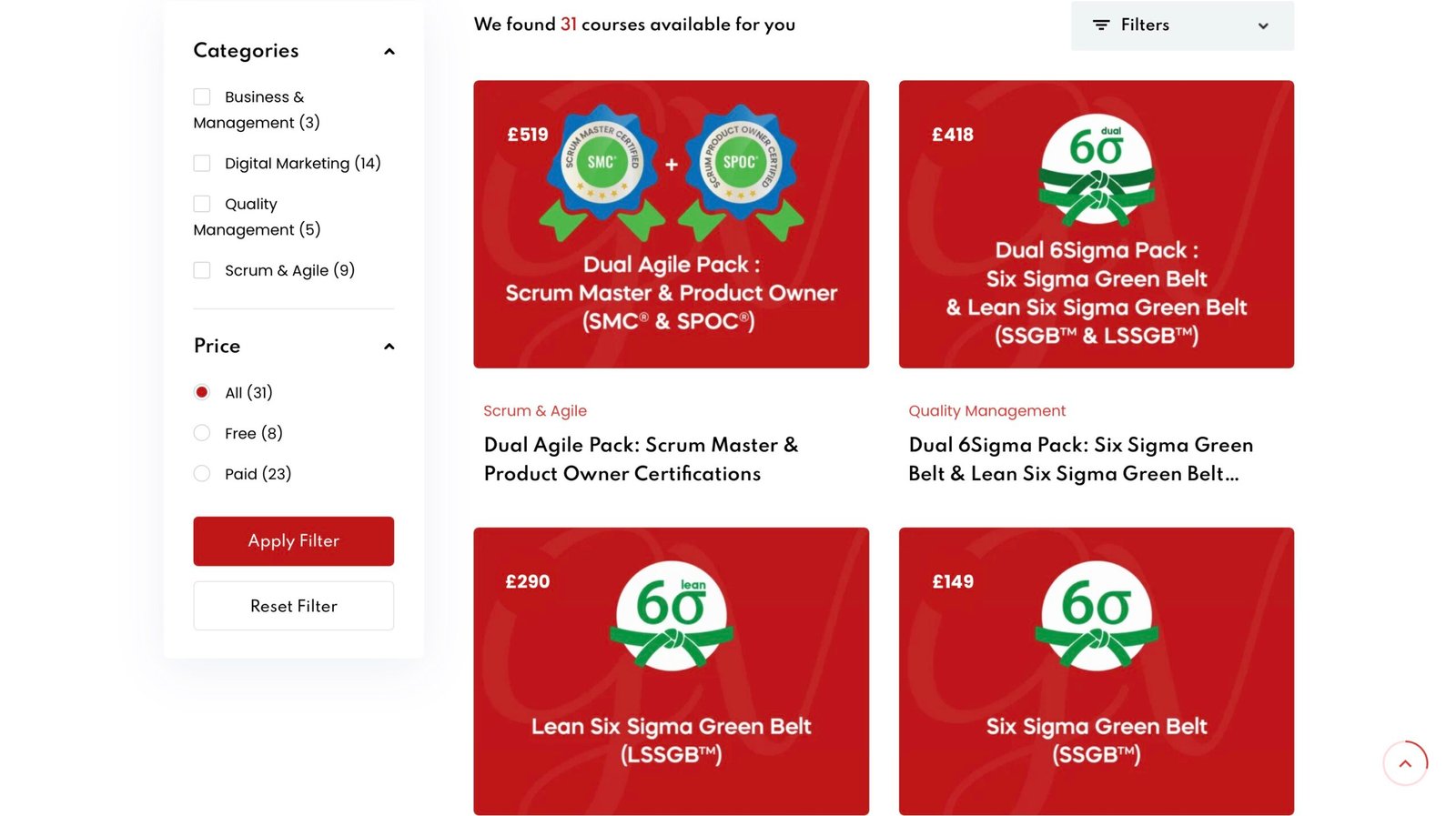
What each purchase includes differs by product, so read the product page before you buy. You can browse every option on our certifications page, or start with a free introductory credential such as Scrum Fundamentals Certified. For the name on your certificate, use the same legal name you would use on a job application, and confirm the provider’s name-change steps with the provider.
Frequently asked questions
Can I change the name on my certificate myself?
Only where the issuer gives you a tool for it, such as updating a profile name on a learning platform and regenerating the certificate. For any other certificate, the issuer must make the change. Editing a PDF or scan yourself breaks the link with the issuer’s record and can look like falsification.
What proof do I need after a marriage or deed poll?
UK awarding bodies such as VTCT accept a marriage or civil partnership certificate, a decree absolute, or a change of name deed or deed poll, together with photo ID. AQA is narrower: it works from a birth certificate and cannot amend a deed poll name change made after results were issued. Always check your own issuer’s list.
How long does it take to get a corrected certificate?
It varies widely. AQA aims for 20 working days from receiving what it needs, while NCCPA updates records within 3 business days of approved documents. Online platforms that read from your profile can be instant. The issuer’s policy page gives the current figure.
What if my name was spelt wrongly because of my own mistake?
You can usually still apply, but you may have to pay a fee or meet a deadline. IIBF, for instance, will not look at e-certificate corrections received more than a year after the exam. Contact the issuer promptly and be ready to show ID with the correct spelling.
Can a marriage certificate itself have its name changed?
That is a different process, handled by the registration authorities rather than a certification body. The guidance above covers professional, educational and course certificates. For a marriage certificate, contact the register office or the General Register Office for the country where the marriage was registered.
Sources
- VTCT: I have changed my name
- AQA: Amendments to original certificates
- Pearson qualifications: Certification
- Highfield Certificate Services Policy
- QQI: Requesting a replacement certificate
- ABIM: General Policies
- NCCPA: Name Changes
- IIBF: Name correction in e-certificate notice
- HashiCorp: How do I correct the name on my badge or certificate?
- HRCI: Recertification Policies and Procedures Handbook
- Danatec: How to request a change of information on your certificate
- Udemy: Change the language or name on your certificate of completion
- Uxcel: Managing your course completion certificate
- edX: My name on my certificate is not appearing how I wanted
- Accredible: How Do I Request a Name Change?
- Emitcert: Misspelt name on a certificate
- Rapid Apostille: Wrong name on a UK certificate