




Scrum commits a batch of work at the start of a fixed sprint, Kanban commits to work item by item as it’s pulled through a continuous flow, and Scrumban sits between the two, keeping Scrum’s planning rhythm while adopting Kanban’s explicit WIP limits and replenishment triggers. If you’re weighing these up, the Scrum Guide and your own cycle time data will tell you more than any framework label. GetVoucher’s learning paths cover Scrum fundamentals if you want structured grounding before you choose.
Table of Contents
- Cadence, commitment and WIP at a glance
- How the mechanics actually differ day to day
- When each approach actually fits your team
- A safe pilot plan for adopting Scrumban
- What the numbers should tell you after the switch
- What we think actually works
- Where to build the skills to lead the change
- FAQ
- Sources
Cadence, commitment and WIP at a glance
The fastest way to tell these approaches apart is to look at their practical differences rather than their names.
- Cadence: Scrum runs fixed-length sprints; Kanban flows continuously; Scrumban overlays periodic planning onto continuous delivery.
- Commitment point: Scrum commits a batch at sprint planning; Kanban commits only when an item is pulled; Scrumban uses a replenishment trigger instead of a batch commitment.
- WIP limit approach: Scrum limits work implicitly through sprint capacity; Kanban and Scrumban both use explicit numeric WIP limits per column.
- Typical roles and ceremonies: Scrum prescribes Scrum Master and Product Owner roles with daily Scrums, sprint review and retrospective; Kanban prescribes no roles and only a cadence of replenishment and delivery meetings; Scrumban typically keeps standups and retrospectives but drops sprint-length estimation.
- Core metrics: Scrum teams track velocity against sprint goals; Kanban and Scrumban teams track cycle time, lead time and throughput instead.
How the mechanics actually differ day to day
The differences above aren’t cosmetic. They change how a team behaves under pressure.
Cadence is the clearest contrast. A Scrum team plans once per sprint and protects that scope until the sprint ends, which gives stakeholders a predictable review rhythm but makes mid-sprint changes disruptive. A Kanban team has no sprint boundary at all: work simply flows, and priority changes happen whenever the queue is replenished. Scrumban keeps a planning cadence, often weekly or fortnightly, but treats it as a lightweight check-in rather than a full commitment ceremony.
Commitment follows the same pattern. In Scrum, the team commits to a batch of backlog items at sprint planning and is expected to deliver against that batch. In Kanban, there is no batch: an item is only “committed” once someone pulls it from the ready queue into active work. According to Tempo’s comparison of the three approaches, Scrumban’s hybrid nature keeps the periodic planning and review rhythms of Scrum while adopting the continuous replenishment triggers of Kanban, so commitment happens closer to the moment work actually starts.
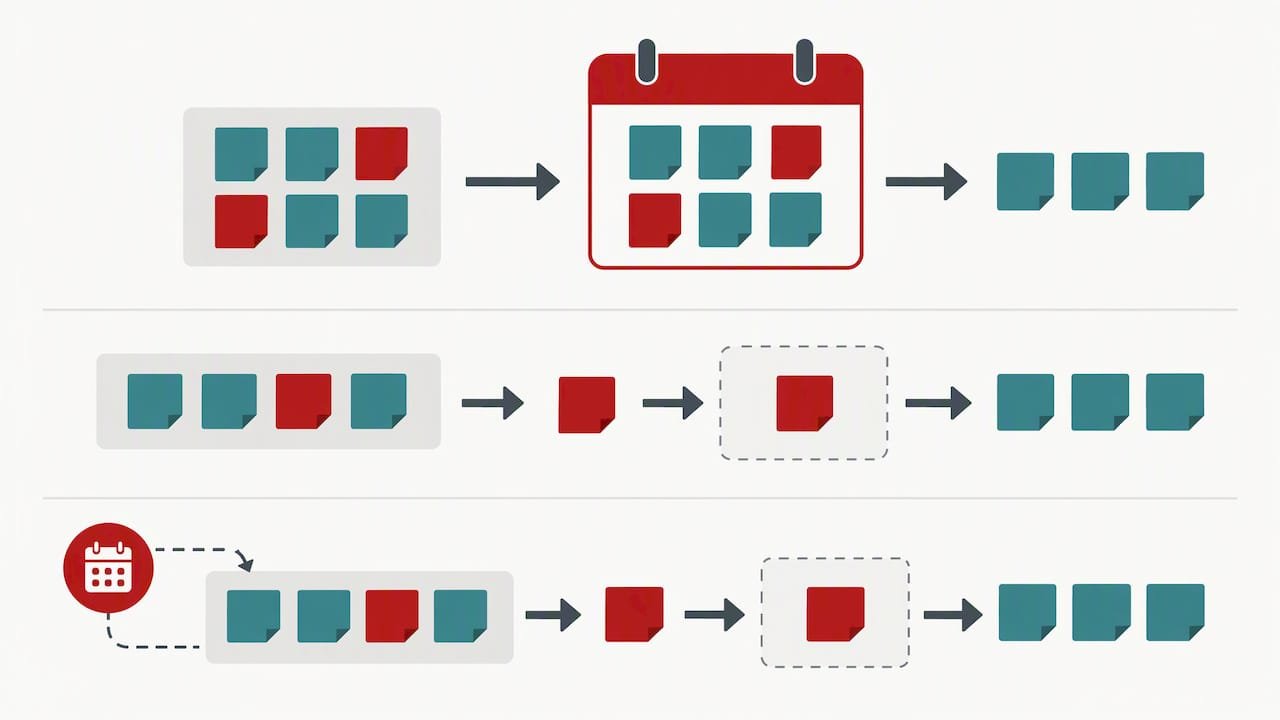
WIP limits show the most practical consequence. Scrum caps work indirectly through sprint capacity: once the sprint backlog is full, nothing new goes in until the next sprint. Kanban and Scrumban both set explicit numeric limits per workflow stage, which Kanban board guidance describes as core to creating a pull system and shortening feedback loops, rather than letting work pile up unseen.
Roles and board design follow from these choices. Scrum requires a Scrum Master and Product Owner and structures the board around a sprint. Kanban prescribes neither role and structures the board around flow columns and WIP caps. Scrumban teams typically:
- keep daily standups and retrospectives for inspect-and-adapt discipline
- drop sprint-length estimation in favour of lighter, continuous planning
- add explicit WIP limits and a replenishment trigger to the board
Estimation and metrics diverge accordingly. Velocity only makes sense where sprints exist, so Kanban and Scrumban teams lean on cycle time and throughput instead. Picture a team mid-sprint that gets hit with an urgent production issue: a strict Scrum team has to renegotiate sprint scope, while a Kanban or Scrumban team simply pulls the item in against its WIP limit and lets the data show the impact on cycle time afterwards.
When each approach actually fits your team
Match your context to the approach using these cues rather than picking by reputation.
- Frequent urgent interrupts favour Kanban or Scrumban. If priorities shift several times a week, a continuous pull system absorbs change far better than a sprint boundary.
- High product novelty favours Scrum. New, complex product development benefits from the structured iteration and the transparency that comes from fixed sprint reviews, a pattern Tempo notes gives teams clearer emotional closure on new work.
- Frequent stakeholder reviews favour Scrum or Scrumban. A regular review cadence keeps stakeholders engaged without forcing a full batch commitment if you choose the Scrumban variant.
- Operational or service work favours Kanban. Continuous, ticket-driven work rarely benefits from sprint ceremonies and flows better under WIP limits alone.
- Small teams with limited Product Owner availability favour Kanban or Scrumban. Scrum’s events depend on consistent Product Owner engagement to maximise product value, as the Scrum Guide describes, and a thin PO presence strains that model.
- Large, cross-team products favour Scrum-based scaling. Fixed cadences coordinate dependencies across teams more predictably than ad hoc pull alone.
The National Audit Office’s review of Agile in large digital programmes found no single Agile method is inherently superior: effectiveness depends on context and governance, not the label on the board. When your cues point in different directions, run a short pilot rather than debating the framework on paper.
A safe pilot plan for adopting Scrumban
Treat Scrumban as a deliberate change, not a default drift away from Scrum discipline.
- Baseline your current metrics. Record cycle time, throughput and current WIP before changing anything, so you have a comparison point.
- Set explicit WIP limits and a replenishment trigger. Cap each workflow column and define the signal that pulls new work into the ready queue.
- Keep standups and retrospectives. Retain inspect-and-adapt discipline and try lightweight planning that skips full estimation.
- Iterate in short cycles. Measure the impact of each change against your baseline before making the next one.
Pro Tip: Agile Alliance’s guidance on Scrumban warns that combining Scrum and Kanban features without a clear rationale produces anti-patterns, so adopt each change deliberately and measure it rather than blending ceremonies by default.
What the numbers should tell you after the switch
Several metrics matter more than velocity once you move towards flow-based work: cycle time (how long an item takes once started), lead time (how long it takes from request to delivery), throughput (items completed per period) and WIP (items in progress at once). Limiting WIP is described as core to Kanban’s pull system, with explicit WIP limits shown to shorten feedback loops compared with an unconstrained push of work.
- Use a cumulative flow diagram to spot where work is piling up between stages.
- Assign classes of service, such as expedite, fixed-date, standard and intangible, to prioritise without abandoning WIP limits.
- Treat small samples with caution: a handful of completed items won’t give a reliable cycle time trend, so measure over several weeks before drawing conclusions.
What we think actually works
Small, cross-functional teams tend to do well on Kanban or Scrumban once interrupts are frequent; operations teams almost always benefit from explicit WIP limits over sprint ceremonies; large product teams coordinating dependencies still lean on Scrum’s cadence for predictability. The evidence favours running a measured pilot over debating frameworks in the abstract, and where you’re short on internal Scrum or Kanban capability, a short, formal course against the current Scrum Guide beats guesswork.
— Rayan
Where to build the skills to lead the change
Choosing between Kanban, Scrum and Scrumban is easier once your team understands the mechanics behind each one, not just the labels. We put together certification vouchers and self-paced learning paths covering Scrum fundamentals through to Scrum Master and Product Owner credentials, so you can build that grounding without committing to classroom training.

If you’re weighing up a transition and want a structured starting point, our Scrum & Agile category lists the available certification paths, including the free Scrum Fundamentals Certified course for teams wanting grounding before they commit to a paid credential. Running a distributed team through the transition adds its own coordination questions, and practical guidance on operationalising Agile with distributed teams covers that angle well if your pilot spans remote contributors. Check our certifications page when you’re ready to move from fundamentals to a formal Scrum Master or Product Owner voucher.
FAQ
What is Kanban vs Scrum?
Kanban is a continuous, pull-based flow method with no fixed iterations, while Scrum organises work into fixed-length sprints with a batch commitment made at planning. Kanban tracks cycle time and throughput; Scrum tracks velocity against sprint goals, as described in Scrum Alliance’s comparison of the two attributes.
Is Scrum still relevant in 2026?
Scrum remains widely used for complex, novel product development where structured iteration and regular stakeholder review add clear value. Its relevance depends on context rather than the calendar year: the National Audit Office found no single Agile method is inherently superior, with effectiveness tied to how well a framework is governed.
Why is it called a Kanban?
Kanban takes its name from the visual signal card system used to limit and signal work in process, which is the mechanism behind its pull-based board design. The approach centres on visualising work in process limits to control flow rather than batching work into iterations.
What are the three types of Kanban?
Definitions vary across practitioner sources, but boards are commonly organised around classes of service such as expedite, fixed-date, standard and intangible work, which teams use to prioritise without breaking WIP limits. Beyond classes of service, Kanban is also described by scope, personal, team or portfolio level boards, depending on the practitioner guide you follow.
Is Scrumban the same as Scrum with Kanban?
Scrumban is often presented as a deliberate step between Scrum and Kanban rather than a simple mashup of both. As Scrum notes, genuine Scrumban removes batch commitment in favour of WIP limits and replenishment triggers, while a Scrum implementation that merely loses commitment discipline is arguably just Kanban in disguise.