




Content marketing is a discipline inside the digital-marketing mix: it creates useful, audience-centred material, while digital marketing is the wider set of paid and owned channels that distribute, discover and convert. Favour paid and targeted tactics when you need fast reach or lead capture, and invest in content when you need trust and lasting demand. CIM and Marketing Week frame it as a mix, and we at GetVoucher offer digital-marketing certification pathways.
Table of Contents
- What do content marketing and digital marketing each cover?
- What are the six key differences between them?
- When should you prioritise one over the other?
- How do you plan a joined content and digital campaign?
- What do current trends say about AI, GEO and measurement?
- My practical view: balance quick tests with a long content plan
- FAQ
- Sources
What do content marketing and digital marketing each cover?
Content marketing is a focused discipline that creates and distributes useful, relevant material to attract, educate, engage and retain a defined audience, as b4b Marketing describes it for UK businesses. CIM treats it the same way: a focused discipline within the wider digital-marketing mix. The formats CIM names include emails, blogs, videos, webinars and podcasts. Typical examples also include case studies, guides, infographics and thought leadership.
Digital marketing is the umbrella. It covers the digital channels used to build visibility, generate traffic, prompt actions and support conversions. That includes SEO, PPC and search engine marketing, paid social, display, email, influencer and affiliate campaigns, plus your website itself.
A simple way to see the overlap is to sort activity by channel type:
- Owned: your blog, email list, website and webinars. Most content formats live here.
- Paid: paid search, paid social and display. These put content or offers in front of people who do not know you yet.
- Earned: shares, mentions, backlinks and influencer coverage that a strong piece of content can attract.
So a guide you publish on your site is content marketing. Promoting that guide with paid social is digital marketing. Both happen at once in a joined campaign, which is why the boundary matters less than knowing what each piece is meant to do.
What are the six key differences between them?
The differences show up in six places. Read them as emphasis, not as a wall between two separate jobs.
Scope. Content marketing sits inside the digital mix. CIM’s curriculum draws exactly this line, listing content formats alongside paid search, display, websites, influencer and affiliate marketing as parts of the wider whole. It also offers a separate Content Marketing Strategy Masterclass rather than folding it into a general digital course.
Primary objective. Content prioritises education, trust and long-term demand. Digital tactics prioritise discovery, traffic and conversions. Marketing Week’s research says marketers must reconcile two time horizons, immediate sales and long-term brand strength, so the two should be judged as complementary.
Timeframe. Paid channels can deliver traffic the day a campaign goes live. Content usually compounds more slowly, because an article or video earns attention over months. Pressure on teams is rising too, and survey evidence shows content teams expect production volume to increase while many lack the right tools.
Teams are being asked to produce more content without the tools to manage it. The 2025 digital content survey finds expected volume rising while many teams lack suitable tooling, so planning for capacity matters as much as planning for ideas.
Tactics. Scan the two lists below.
- Owned editorial formats: blog posts, guides, case studies, video, podcasts, webinars, newsletters.
- Paid and distribution channels: PPC, paid social, display, retargeting, influencer and affiliate placements, SEO and email as the bridge between the two.
Cost structure. Content costs sit mostly in production: writers, designers, editors and video time. The asset then keeps working as evergreen material. Paid digital costs sit in media spend and campaign management, and the traffic stops when the budget does. Neither is automatically cheaper. They are paid for at different points.
Measurement. Use role-specific KPIs. Content might be judged on engagement, return visits and assisted conversions, while paid activity is judged on cost per lead and conversion rate. The practical trap is forcing every asset to prove an immediate sale. CIM frames content across the whole customer journey, which is why one conversion metric rarely fits.
Pro Tip: Give every asset one job and one primary KPI before you create it. A top-of-funnel guide judged on sales will always look like a failure.
When should you prioritise one over the other?
The honest answer is usually “both, in different proportions”. Match the emphasis to the business need:
- Launching a new product: lean on paid channels for fast reach, backed by a handful of explainer pieces so visitors have something to read.
- Generating leads now: favour paid search, email nurture and landing pages, using content as the offer (a guide or webinar) that earns the contact details.
- Building brand and authority: invest in content first, then amplify the best pieces.
- Working with a limited budget: start with owned content and email, add small paid tests only once you know which pieces perform.
In a hybrid workflow, content creates the assets and digital channels amplify and convert them. Content supplies the message. Digital channels supply discovery, distribution and conversion.
Before you commit budget, run through this short checklist:
- Objective: name the single commercial result you want, such as qualified leads or repeat visits.
- Timeline: decide whether you need results this quarter or can build for six to twelve months.
- Audience: identify where they already look for answers, and in which format.
- Budget: split it between production and amplification instead of spending it all on one.
- One measurable KPI: choose the number that will tell you whether the mix is working.
If you want a structured grounding in the channel side, our Digital Marketing page covers core topics. For teams building content skills, we compare options in our guide to the best content marketing courses.
How do you plan a joined content and digital campaign?
CIM describes a nine-step content-strategy framework, and the sequence below condenses its logic into practical steps. The thread running through it is objective, audience, content pillars, channels, KPIs, then publish and optimise.
- Define the commercial objective and the journey stage. State what the business needs (for example, more qualified enquiries) and which stage of the customer journey you are targeting: awareness, consideration or decision.
- Research audience needs and choose pillars and formats. Find the questions your audience asks, group them into content pillars, and pick the format that suits each: a guide for depth, a short video for reach, a webinar for trust.
- Map each asset to a distribution mix. Decide how every piece will be found: organic SEO, paid search, social, email, or a combination. CIM’s module material stresses audience needs, keywords, metadata, tone and performance measurement for exactly this reason.
- Set role-specific KPIs and an optimisation cadence. Choose discoverability, engagement, lead quality and conversion rate as appropriate to each asset, and set a regular review rhythm for early signals and pipeline impact.
- Allocate budget and schedule a test-and-learn timeline. Split spend between production and amplification, then run small tests first. Put more behind the pieces and channels that show traction, and retire those that do not.
After launch, publish and promote on a schedule, then optimise using analytics. CIM’s Level 6 specialist content strategy award emphasises selecting paid and owned channels and aligning activity to KPIs and marketing technology.
Pro Tip: Keep a one-page campaign brief with the objective, audience, pillars, channels and KPIs. If a new idea does not fit the brief, it waits for the next cycle.
Teams that want outside support for training or upskilling can look at Oxford Training Centre, which offers professional training courses with customisable corporate options.
What do current trends say about AI, GEO and measurement?
Content strategy now has to account for short-form video, personalisation, AI-assisted production and AI-search discoverability. These are tactics and operating considerations. They do not replace audience relevance, human editorial judgement or measurable business objectives. IAA London’s summary of 2025 research points the same way: quality, relevance, personalisation and authenticity matter more than simply producing more.
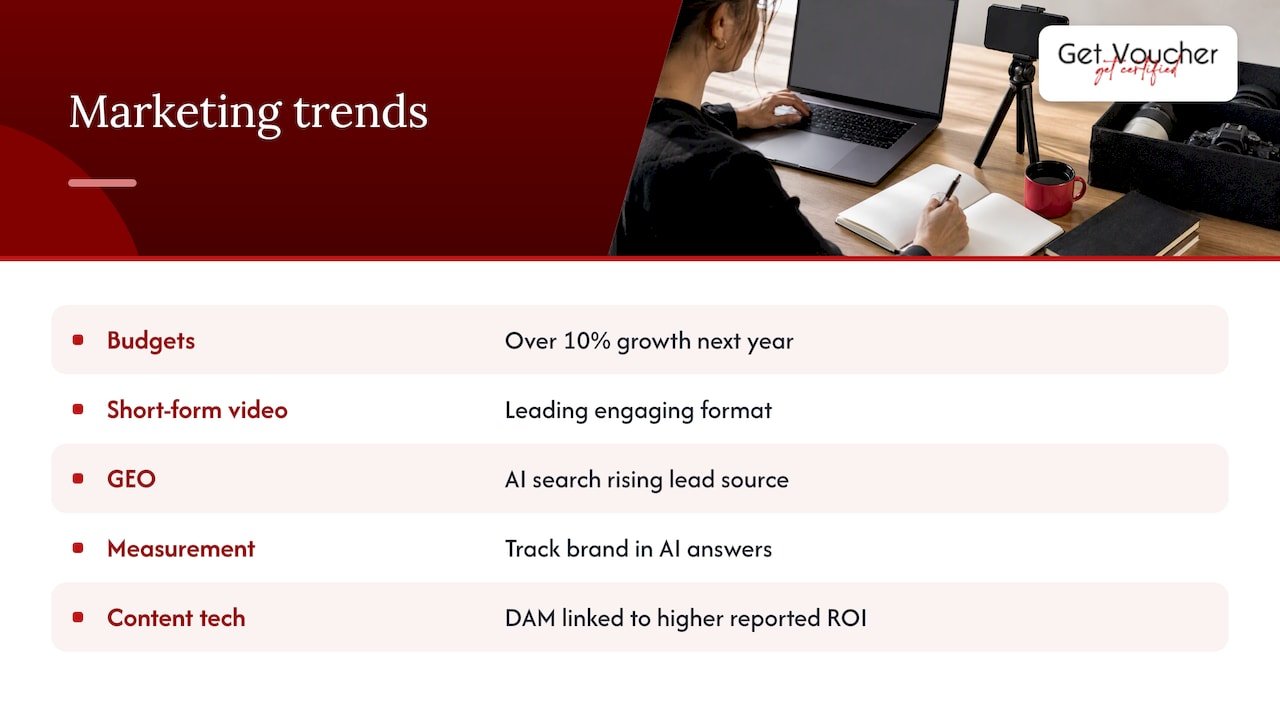
Branded-content budgets are expected to grow by over 10% in the following year, with short-form video named the leading engaging format in IAA London’s 2025 study summary.
GEO, or Generative Engine Optimisation, is emerging as a priority for discoverability. A 2025 B2B content survey reports AI-search platforms as a rising source of qualified leads, and marketers are balancing GEO investment with traditional SEO and paid distribution. The same survey work notes persistent challenges in proving ROI and maintaining brand voice.
For measurement, combine traditional Google metrics with GEO-aware indicators, such as whether your brand appears in AI-generated answers for your core topics. Keep role-specific KPIs and avoid demanding that every asset show immediate sales, a point both CIM and Marketing Week support through their emphasis on balancing short and long horizons.
On operations, the content-tech picture is practical rather than glamorous. The digital content survey links the use of DAM (digital asset management) and integrated content technology with higher reported ROI and better measurement capability. Streamlining your stack, including DAM and PIM (product information management) where relevant, helps teams collaborate and reuse assets instead of recreating them.
One caution on skills: we do not claim that any particular certification teaches GEO. Check the official syllabus of any course before you assume it covers AI-search topics.
My practical view: balance quick tests with a long content plan
I would not choose between the two. Run short, paid tests to learn quickly what your audience responds to, and build a steady content plan so that the learning compounds. The mistake I see most often in this debate is treating content as a slow channel that must justify itself like an advert. It cannot, and it should not be asked to.
Start with three steps:
- Pick one campaign to test, with a single objective and KPI.
- Commit a small paid budget to amplify its best asset.
- Schedule a six-month content cadence so the work does not stop after the test.
Keep editorial governance tight, with clear ownership, a defined brand voice and a review step, and measure each asset against the job you gave it. AI can speed up production, but human judgement is what keeps the output worth reading.
— Rayan
FAQ
What falls under digital marketing?
Digital marketing covers the digital channels used to build visibility, generate traffic and prompt actions. These include SEO, PPC, paid social, display, email, influencer and affiliate marketing, plus your website. Content marketing is one discipline within that mix, as CIM describes it.
How does content marketing differ from advertising?
Content marketing aims to educate, build trust and attract a defined audience with useful material. Advertising, such as PPC or display, pays for reach and prompts a quicker action. They work best together: content supplies the message and paid channels supply distribution.
What are some effective marketing techniques?
Effective techniques include publishing audience-focused guides and videos, optimising for search, nurturing leads by email and amplifying strong content through paid social or search. Which works best depends on your objective and timeline. Test small first, then scale what shows results.
What’s the difference between e-commerce and digital marketing?
E-commerce is selling products or services online, while digital marketing is the set of channels that drive people to buy or act. A shop can run e-commerce without much marketing, but it usually relies on digital marketing and content to be found. At GetVoucher, for example, we sell certification vouchers online and rely on content to help learners choose a path.
Sources
- The CIM Digital Marketing Programme | CIM
- The key differences between Digital Marketing and Content Marketing for UK businesses | b4b Marketing
- READ: How branded content is evolving- and what it means for marketers – IAA London