




SEO, AEO and GEO are three labels for overlapping jobs. SEO aims to get your pages found and ranked in search results. AEO (answer engine optimisation) aims to get your content used as the direct answer. GEO (generative engine optimisation) aims to get your brand represented and cited inside AI-generated responses. They are not rival strategies, and for most UK websites the sensible order is to get SEO right first, then shape the same pages so that answers can be lifted from them cleanly.
This guide separates the three terms, shows where they genuinely differ and where they are the same work with a new name, and explains what to do first. It also covers an honest caveat: the vocabulary is young, and different writers use the acronyms differently.
Table of Contents
- The three terms at a glance
- SEO: still the foundation
- AEO: being the answer, not just a link
- GEO: being represented in generated responses
- Where the three genuinely differ
- Where they are the same work
- What to do first: a sensible order
- Our perspective
- Learning the foundations with GetVoucher
- FAQ
- Sources
The three terms at a glance
| SEO | AEO | GEO | |
|---|---|---|---|
| Full name | Search engine optimisation | Answer engine optimisation | Generative engine optimisation |
| Main aim | Rank well in search results | Be the source of a direct answer | Be represented and cited in AI-generated responses |
| Typical surface | Ranked links in search results | Featured snippets, AI summaries, voice answers | Conversational AI answers and summaries |
| Reader’s action | Clicks through to your page | May read the answer without clicking | May read a synthesised answer, sometimes with a citation |
| What you measure | Rankings, clicks, organic traffic | Whether your content is quoted as the answer | Whether your brand or page is mentioned or cited |
Treat the table as a working summary, not a rulebook. CGO Media Research describes the three as overlapping but distinct: SEO targets top rankings, AEO targets citation in features such as featured snippets, and GEO targets visibility in AI summaries. Other publishers draw the lines a little differently, and some use AEO and GEO almost interchangeably. When you read a vendor’s definition, check which one they are using.
SEO: still the foundation
SEO is the process of improving a website so that search engines can find its content and rank it. Peterborough City Council’s content playbook puts it in exactly those terms, and its guidance is mostly about the basics: clear writing, sensible structure, pages that say what they are about.
SEO is not going away. The same CGO Media research warns that treating GEO as a simple replacement for SEO is a mistake: conventional search still matters for traffic, while GEO adds a different concern, namely how a product, service or organisation is represented in a generated answer. Retail Gazette reaches a similar view for UK retailers, arguing that GEO layers new behaviours on top of old ones rather than replacing them.
If you run a small business, the government’s own advice is blunt about why SEO still matters. The Business Academy on Business.gov.uk covers being visible in the AI-driven search era and still treats search engine optimisation as a core part of getting found.
What SEO work looks like
- Pages that search engines can crawl and understand.
- Content that matches what people actually type, with titles and headings that say so.
- Technical basics: speed, mobile usability, clean structure.
- Links and mentions from other reputable sites.
- Local signals if you serve a specific area.
AEO: being the answer, not just a link
AEO starts from a change in behaviour. People ask a question and expect a clear answer. The University of Glasgow’s web team says its audiences increasingly use answer engines such as Google AI Overviews, ChatGPT or Gemini to find content, and asks its editors to write so that these tools can pick up authoritative answers.
In practice AEO is editorial discipline:
- Lead with the answer. Put the direct response in the first sentence or two under a heading, then add detail.
- Write headings people would ask. A heading that matches a real question gives an answer engine a clear unit to lift.
- Make passages self-contained. The Glasgow guidance reports that self-contained content is over four times more likely to be cited by AI answer engines than fragmented, context-dependent text. Read that as the university’s guidance rather than a universal law, but the principle is sound: a paragraph that makes sense on its own is easier to quote.
- Use plain English. Surrey County Council’s writing guide notes that pages good for AI search tools are clear, informative, accessible and written in plain English, which are the same qualities that work for people.
None of this is exotic. Good AEO is good editing.
GEO: being represented in generated responses
GEO deals with a different problem. A generative tool does not just pick one page and show it. It reads several sources and writes a new answer. Your concern becomes whether your brand, product or organisation is part of that answer, how it is described, and whether it is credited.
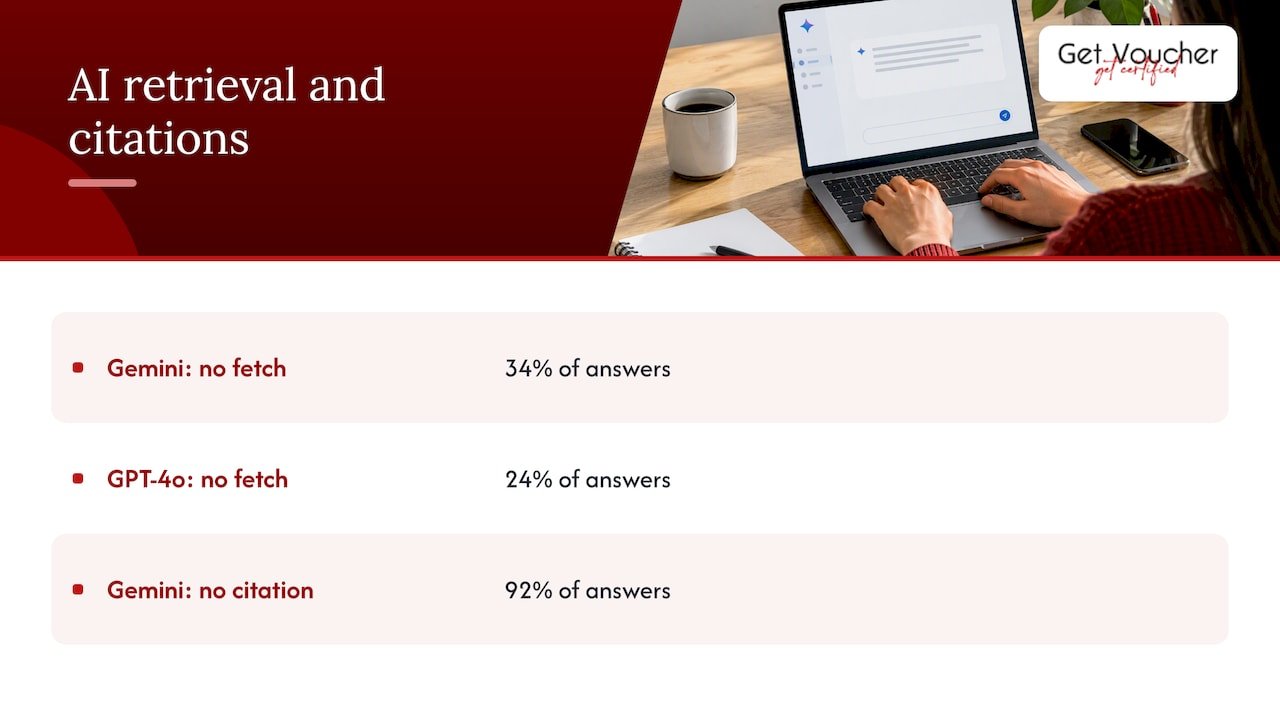
That last point is harder than it sounds. Researchers at the Oxford Internet Institute analysed around 14,000 real-world search logs and found an attribution gap: models read more pages than they cite. In the June 2025 analysis, Gemini and GPT-4o answered without fetching external content 34% and 24% of the time respectively, and Gemini gave no clickable citation in 92% of the answers studied. Being read by an AI system is not the same as being credited or visited.
So GEO goals are usually softer than SEO goals: accurate mentions, consistent descriptions of what you do, and citations where they occur. The Defra digital service manual describes the shift as moving from ranked links to cited answers, where a user may get a complete-feeling answer without opening your site.
A practical GEO checklist
- Put key facts in the HTML. Defra’s guidance notes that many AI crawlers do not render JavaScript, so progressive enhancement matters: if essential content only appears after scripts run, some tools may never see it.
- State who you are and what you do in consistent words across your site and profiles.
- Publish specifics: prices, scope, eligibility, dates, named authors. Vague pages give a model nothing to cite.
- Keep pages current. An out-of-date price quoted by an AI tool is worse than no mention.
- Expect imperfect measurement. Given the attribution gap, absence of a click does not prove absence of influence, and presence of a citation does not guarantee traffic.
Where the three genuinely differ
The overlap is large, but three differences are real.
The unit of success. SEO is about a page ranking for a query. AEO is about a passage being chosen as the answer. GEO is about an entity, meaning your brand or product, being described well across many generated answers.
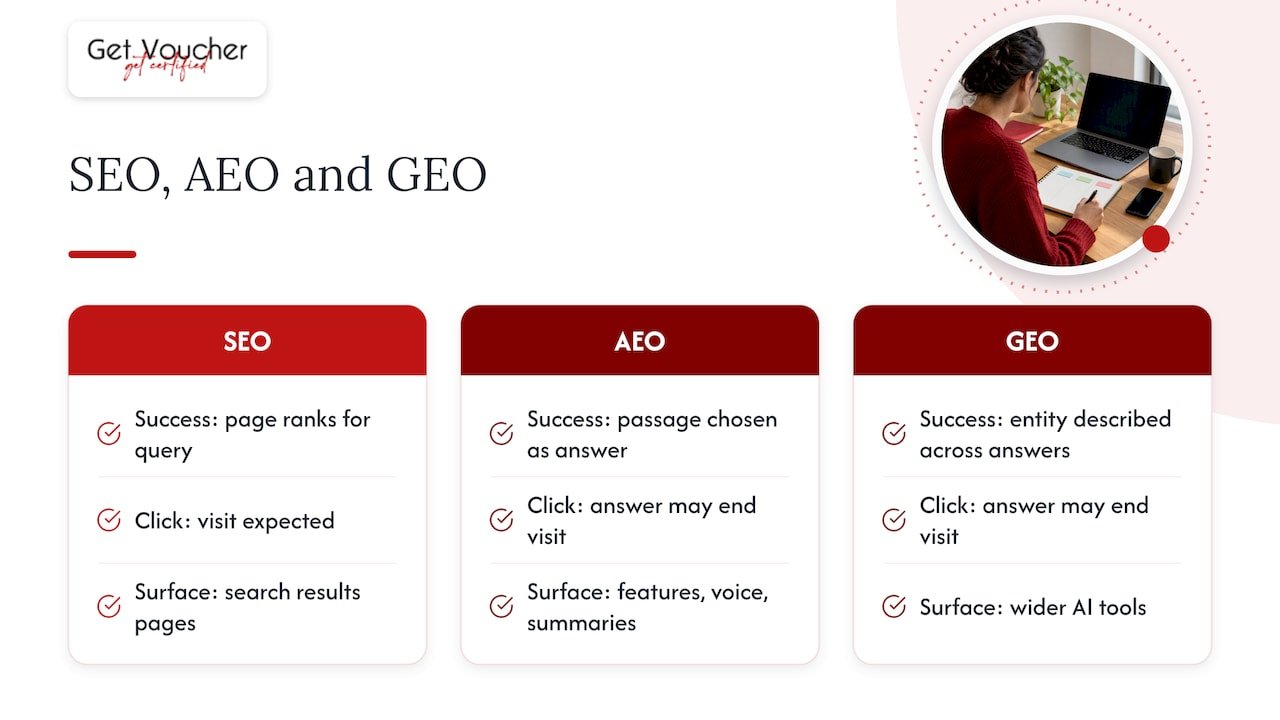
The role of the click. SEO assumes a visit. AEO and GEO accept that the reader may take the answer and leave. The University of Nottingham’s analysis of the impact of AI Overviews on cultural organisations found that, after AI Overviews expanded in the UK in March 2025, informational content faced a higher risk of lost visibility than transactional searches. That is a study of one sector, so do not stretch it to every site, but it suggests which pages to watch first.
The surface. SEO concerns search results pages. AEO concerns features within them, plus voice and summary answers. GEO concerns the wider set of AI tools, which may not behave like a search engine at all.
Where they are the same work
Strip away the acronyms and the foundations match: clear structure, accurate facts, plain language, accessible pages, and content built around what real people ask. Surrey County Council’s digital team makes exactly this point when it says that content designed for human needs serves both visitors and large language models.
That is why a cautious reading of the evidence is that AEO and GEO extend SEO rather than replace it. If a consultant tells you that you need a separate, expensive programme for each, ask which tasks differ from good SEO and editing, and how they will measure them.
What to do first: a sensible order
- Audit your basics (SEO). Can your key pages be crawled? Do titles and headings match what people search? Is the important content in the HTML?
- Rewrite your top informational pages (AEO). Lead with the answer, use question-style headings, make each section stand alone.
- Tighten your facts (GEO). Check that your prices, service descriptions and business details are specific, current and consistent everywhere they appear.
- Track what you can. Watch organic traffic and conversions as before, and note where informational pages lose clicks. Treat AI mentions as a supplementary signal, not a replacement metric.
- Do not abandon transactional pages. Pages where people buy or enquire are, on the evidence above, less exposed than purely informational ones.
Our perspective
We sell certification vouchers, and we publish learning content around them, so we watch this shift from the position of a site that depends on being found. Our view is straightforward.
First, the acronyms matter less than the habit behind them. Pages that answer a specific question clearly, name the provider, and state what is and is not included are easier for a person to trust and easier for a machine to quote. That is why our own product information is written per product: what a voucher covers differs from one certification to the next, and we would rather say that plainly than generalise.
Second, be careful with training in this area. A course completion certificate, a platform credential and a recognised certification are different things, and AEO or GEO are new enough that you should check a syllabus before assuming it covers them. We do not claim that any SMstudy programme teaches AI search or GEO. What our digital marketing programmes can give you is a structured grounding in the wider discipline, including search marketing, that these newer practices build on. A certification does not prove performance, and it does not guarantee a job, a salary or a promotion.
Third, if you are choosing where to learn, start from the foundations. Someone who understands search, content, audiences and measurement will adapt to whatever the next acronym is.
— Rayan
Learning the foundations with GetVoucher
If you want a structured route into the discipline behind all three terms, our Digital Marketing category lists the programmes we offer. The SMstudy® Certified Digital Marketing Professional voucher costs £199 one-off. The SMstudy Digital Marketing Professional exam is an online, unproctored exam of 100 questions over 120 minutes, rather than a project-based assessment, and there are no formal prerequisites, with Fundamentals only preferred, so you can start with Digital Marketing Fundamentals if you like. Our Search Marketing Expert and SEO Expert pages show the more specialised options, and inclusions are described product by product, so check each page for what your purchase covers.
Wondering what counts as a genuine SEO credential and where answer-focused skills fit? Our guide to SEO certifications and where AEO fits sets out the distinctions. If you are weighing content marketing against the wider mix, see Content Marketing vs Digital Marketing.
FAQ
Is GEO the same as AEO?
Not quite, though writers often blur them. AEO usually refers to getting your content chosen as a direct answer, for example in featured snippets or summaries. GEO usually refers to how your brand is represented and cited across generative AI responses. Check how any given author defines each before comparing advice.
Does GEO replace SEO?
The sources we reviewed say no. CGO Media Research calls it a mistake to treat GEO as a simple replacement, and Retail Gazette describes GEO as layering on top of existing behaviour. Conventional search still drives traffic, so SEO remains the base.
Can I do this myself without an agency?
Often you can cover the basics yourself. Clear headings, direct answers, accurate facts and crawlable pages are editorial and technical hygiene rather than secret techniques. Bring in a specialist for technical problems such as rendering, site migrations or large-scale content audits.
Will AI tools always link to my site?
No. Oxford researchers found that models often read more pages than they cite, and in their analysis Gemini gave no clickable citation in 92% of answers studied. Plan for brand visibility and accurate description as well as clicks.
Sources
- The State of Search | AI Search, GEO & SEO, CGO Media Research
- Answer Engine Optimisation (AEO), University of Glasgow
- The Attribution Crisis in LLM Search Results, INET Oxford
- Writing pages that work well for AI search, Surrey County Council
- Users who get answers from AI search, Defra digital service manual
- Defra digital service manual
- The Impact of AI Overviews in the Cultural Sector, University of Nottingham
- Realistically, how can retailers make GEO work for them?, Retail Gazette
- Search Engine Optimisation (SEO) guide, Peterborough City Council
- Being visible in the AI driven search era, Business.gov.uk