




Meta ads are paid adverts you buy through Meta’s own system and show across Facebook, Instagram, Messenger, the Audience Network and Threads. You build them in Ads Manager, choose an objective, audience, budget and placements, and Meta’s auction decides who sees what. Anyone can launch a campaign in an afternoon. Running one that pays for itself, and stays on the right side of UK advertising and data rules, takes more care. This guide covers both.
Table of Contents
- What Meta ads are and where they appear
- How a Meta campaign is structured
- How much do Meta ads cost?
- Are Meta ads worth it?
- Metrics worth watching, and those that mislead
- UK rules every Meta advertiser should know
- Setting up your first campaign, step by step
- Our perspective: ads are a skill, not a setting
- Building the skills behind the campaigns
- Common mistakes to avoid
- FAQ
- Sources
What Meta ads are and where they appear
Meta describes Ads Manager as the starting point for running ads on Facebook, Instagram, Messenger or the Audience Network. In practice, one campaign can reach people in several places:
- Feeds on Facebook and Instagram, where the ad sits among ordinary posts.
- Stories and Reels, full-screen vertical formats where video does most of the work.
- Messenger, for ads that open a conversation.
- Audience Network, which extends ads into third-party apps and sites.
- Threads, which some placement guides now list among Meta’s surfaces.
The terminology trips people up. “Facebook ads”, “Instagram ads” and “Meta ads” are not three products. They are one buying system with different places to show the result. If you manage a Facebook page and an Instagram account for the same business, you will normally run both from one ad account.
Placement availability changes as Meta updates its products, so check what Ads Manager offers for your chosen objective rather than relying on a guide, including this one.
How a Meta campaign is structured
Ads Manager organises everything in three layers. Getting the logic of these layers right matters more than any single trick.
| Layer | What you set | Typical decisions |
|---|---|---|
| Campaign | Objective | Sales, leads, traffic, awareness, engagement |
| Ad set | Audience, budget, schedule, placements | Who sees the ad, where, and how much you spend |
| Ad | Creative and copy | Image or video, headline, text, call to action, destination |
The objective tells Meta what outcome to optimise for. Choose “traffic” and the system looks for people likely to click. Choose “leads” or “sales” and it looks for people likely to complete that action. A mismatch between your real goal and the objective you pick is one of the most common reasons a campaign disappoints.
Audiences: three broad routes
- Core audiences: you pick location, age, interests and behaviours.
- Custom audiences: you build from your own data, such as a customer list or website visitors.
- Lookalike or broad audiences: you let Meta find people who resemble your best customers, or give it wide targeting and let the algorithm work.
Custom audiences built from website activity depend on tracking technology, which brings in UK consent rules. We cover those below.
How much do Meta ads cost?
There is no fixed price. You set a daily or lifetime budget and pay according to the auction, which depends on your audience, your creative, your competition and the season. Anyone quoting a single cost per click for “Meta ads” is guessing.
What you can say with confidence is how the money behaves:
- Your budget is a ceiling, not a fee. Meta spends towards it as the system finds opportunities.
- Audience size and competition drive cost. Narrow, popular audiences are usually more expensive to reach.
- Creative quality affects delivery. Weak ads can end up costing more for the same result.
- Management is a separate cost if you hire someone. Agencies and freelancers set their own fees, so ask for a written scope.
The UK government’s own research is a useful reality check. A qualitative study prepared by Jigsaw Research for the CMA found that most respondents were micro and smaller businesses with relatively low budgets, little time and no specialist knowledge. Many struggled to work out their actual return on investment, and some suspected that the platforms’ own metrics might overstate their effectiveness.
The same research describes how small advertisers often learn by trial and error and can overspend by leaning on default settings or misunderstanding bidding. That is a skills problem, not a budget problem, and it is fixable.
Are Meta ads worth it?
Sometimes, and the honest answer depends on four things you can check before you spend a pound.
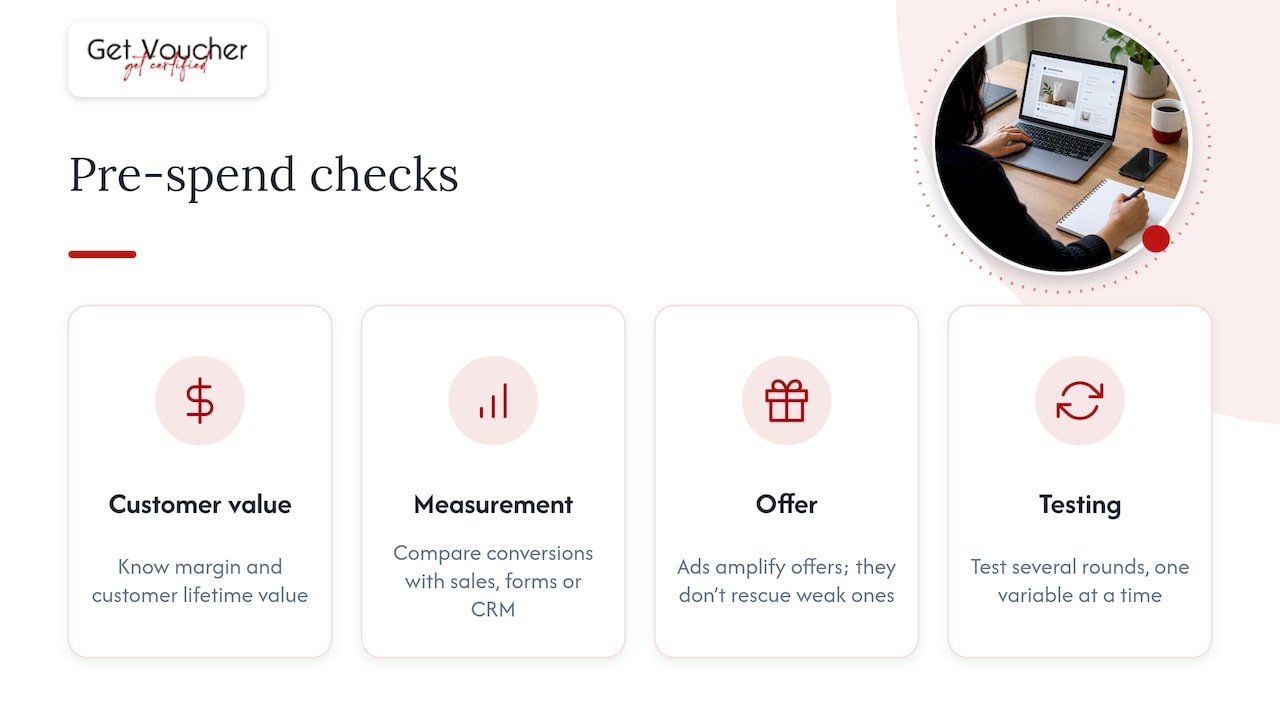
Do you know what a customer is worth? If you do not know your margin and the lifetime value of a customer, you cannot say what an acceptable cost per lead or sale looks like.
Can you measure the result outside Meta? Compare Meta’s reported conversions with your own sales records, enquiry forms or a CRM. The CMA-commissioned research above is a reminder that platform dashboards and your bank balance do not always agree.
Is there an offer worth clicking? Ads amplify an offer. They do not rescue a weak one.
Can you commit to testing? Early results from a small budget are noisy. Plan for several rounds of changes, one variable at a time.
Testing creative properly
Video is now central to Stories and Reels, and it is easy to change five things at once and learn nothing. If you are testing variations of a video ad, this practical guide to video A/B testing explains how to isolate what you change so you can read the result honestly.
A simple testing routine:
- Pick one question, for example “does a customer quote in the first three seconds hold attention longer?”
- Change only that element between two versions.
- Give both versions the same audience and budget.
- Wait until each has enough results to compare, rather than stopping after a day.
- Keep the winner, then test the next question.
Metrics worth watching, and those that mislead
Meta’s dashboard shows a great deal. Focus on the numbers tied to your goal.
| Metric | What it tells you | Caution |
|---|---|---|
| Cost per result | What each lead or sale costs on Meta’s count | Check against your own records |
| Click-through rate | Whether the ad earns attention | A high rate with no sales points to a landing-page or offer issue |
| Frequency | How often the same person sees the ad | Rising frequency with falling results can signal fatigue |
| Conversion rate on your site | Whether visitors act | Measured in your analytics, not just in Meta |
| Return on ad spend | Revenue relative to spend | Only meaningful if revenue is tracked consistently |
Avoid rigid benchmarks. A good click-through rate for a low-price impulse product is not a good one for a high-value service. Compare a campaign with its own history first.
UK rules every Meta advertiser should know
This is the part many guides skip, and it is where UK businesses can get into trouble. Most of the risk sits in three areas.
Ads must be recognisable as ads
The CAP Code requires marketing communications to be obviously identifiable. The ASA’s guidance on brand-owned and paid social media says that when someone sees an ad, it should be immediately obvious that it is one. Paid-for ads on Meta that carry a platform label are one thing, but if you boost a post or work with creators, the ASA’s wider guidance on recognising ads in social media is clear that disclosure placement matters. A label that only appears after someone clicks “See more” is not acceptable. Put it at the start of the text, or prominently on the image itself.
A personalised discount code, a brand tag or a “brand ambassador” label on its own is not enough to make an ad identifiable as such.
Tracking needs consent
The Meta Pixel and similar tools store or access information on a person’s device. The ICO states that using storage and access technologies for online advertising requires consent under PECR, and that this applies both to ad delivery and to associated tracking. Consent has to meet the UK GDPR standard: freely given, specific and easy to withdraw. You cannot rely on implied consent or buried terms of service. The ICO’s page on managing consent in practice is the place to check your cookie banner setup. If you are unsure whether your site complies, speak to a data protection adviser.
The practical effect: if your visitors decline marketing cookies, your pixel audiences and conversion counts will be smaller than your real traffic. Build that into how you read your numbers.
Claims must be defensible
The ASA’s rulings show how quickly an ad can fall foul of the Code. In its ruling on two paid Facebook ads for a sinus-clearing device, the issue was medical-style claims. Advertising a product as treating or restoring a bodily function can be treated as a medical claim, and published scientific literature alone does not justify making one. If you sell health, wellness or anything that touches a medical condition, take specialist advice before you write the copy.
Two more points to remember:
- Age-restricted products such as alcohol, gambling and foods high in fat, salt or sugar need careful targeting. The ASA expects advertisers to take reasonable steps to keep these ads away from children, including using the platform’s targeting tools.
- Environmental claims need to be clear and substantiated. Words like “sustainable” or “eco-friendly” invite scrutiny.
A competition point worth knowing
Following action by the CMA, Meta advertising customers in the UK can opt out of certain ad data being used to operate or improve Facebook Marketplace. It affects few small advertisers day to day, but it is a good illustration of how closely UK regulators watch this market.
Setting up your first campaign, step by step
- Create a Meta Business account and connect your Facebook page and Instagram profile.
- Define one goal in a sentence, with a number attached: for example, 20 qualified enquiries a month.
- Set up measurement first. Install tracking only with a compliant consent banner, and agree how you will count results in your own systems.
- Choose the objective that matches the goal, then the audience and placements. Automatic placements are a reasonable starting point if you are unsure.
- Set a modest budget you can afford to learn with, and a schedule long enough to gather data.
- Build two or three creative variants with a clear call to action and a landing page that matches the ad.
- Check the ad against the CAP Code before it goes live: labelling, claims, audience.
- Review weekly, change one thing at a time, and compare Meta’s numbers with your own.
Our perspective: ads are a skill, not a setting
We sell professional certification vouchers, so we see the same pattern from learners across marketing, Agile and quality management. Tools get easier every year, yet the people who get results are the ones who understand the discipline underneath the tool.
Meta ads are a good example. Ads Manager will happily suggest a budget, an audience and a bid strategy. But deciding whether a campaign is worth running depends on marketing fundamentals: market research, positioning, strategy, measurement and a clear view of the customer. Those transfer across platforms when Meta changes its interface, as it regularly does.
That is why we think of Meta ads as one channel within a wider digital marketing mix, alongside search, email and content, not as a standalone qualification. No certificate proves you will run profitable campaigns, and we would be wary of anyone who claimed otherwise. What structured study can do is give you a shared vocabulary, a framework for planning and evidence of commitment to your own development, which many learners find useful when moving into or between marketing roles.
If you manage budgets for a small business, the single most valuable habit is the one the CMA-commissioned research points to: measure outcomes in your own records, not only in the platform’s dashboard.
— Rayan
Building the skills behind the campaigns
If you want a structured route into digital marketing, we offer SMstudy® voucher options that sit alongside hands-on practice. Details differ by product, so check each page for what is included.
- SMstudy® Certified Digital Marketing Professional: £199. It has no formal prerequisites, with the Fundamentals level only preferred, and it uses a 100-question, 120-minute online unproctored exam rather than a project-based assessment.
- Marketing Strategy Pro and Marketing Research Pro: focused options if you want to plan campaigns and understand customers before spending on ads.
- Search Marketing Expert: for the search side of the mix.
SMstudy certifications are distinct from platform-specific training offered by advertising networks, and from general course-completion certificates. Our materials should not be read as teaching Meta’s interface step by step, so keep practising in Ads Manager itself.
If you are comparing routes, our guides to digital marketing certifications for career switchers and social media certifications set out the options, and you can browse the whole digital marketing category when you are ready to buy.
Common mistakes to avoid
- Boosting posts without a plan. The boost button is quick, but it gives you less control than building a campaign in Ads Manager.
- Judging results after two days. Early data is thin.
- Changing everything at once. You will not know what worked.
- Sending traffic to the homepage. Match the landing page to the ad.
- Ignoring consent. Pixel data collected without valid consent is a compliance risk and an unreliable number.
- Copying a competitor’s claims. What they say may already be a breach of the Code.
FAQ
What are Meta ads?
Meta ads are paid adverts bought through Meta’s Ads Manager that appear on Facebook, Instagram, Messenger, the Audience Network and other Meta surfaces. You choose an objective, an audience, a budget and creative, and Meta’s auction decides delivery. One account can run campaigns across all of these placements.
Are Meta ads really worth it?
They can be, if you know what a customer is worth and can measure results in your own records. Small businesses often find ROI hard to calculate, so set a clear goal and a test budget first. Treat the platform’s reported results as one input rather than the final word.
Can I earn money from Meta ads?
As an advertiser, you spend money to try to win customers, so the earning comes from sales, not from the ads themselves. If you mean earning by running ads for others, that is a freelance or agency service, and your income depends on the fees you agree and the results you can show. Nothing is guaranteed.
How do I stop seeing Meta ads?
You can limit certain ads through the ad preferences and feedback options inside the apps, but that changes which ads you see rather than removing them. Meta has also introduced a paid ad-free option in the UK, so check Meta’s own account settings for current availability and price before you decide.
Sources
- Ads Manager, Meta for Business
- Qualitative research report prepared by Jigsaw Research
- ASA: Recognising ads, brand-owned and paid social media
- ASA: Recognising ads, social media and influencer marketing
- ICO: How do the rules apply to online advertising?
- ICO: How do we manage consent in practice?
- ASA ruling on Cleriva t/a NovaFlow
- ASA: Put a smile on your Face(book) with responsible advertising
- GOV.UK: CMA protects competition by curbing Meta’s use of ad customers’ data