




A good Green Belt study plan does three things. It starts from the Body of Knowledge (BoK) of the specific certification you are sitting, it follows DMAIC in order so each phase feeds the next, and it makes you practise with real data rather than only reading definitions. The plan below uses eight weeks as a working template. Treat that figure as a starting point: your statistics background, your hours per week and your chosen provider will move it.
One warning first. There is no single universal Green Belt standard. ASQ, IASSC/PeopleCert, BSI and 6sigmastudy each set their own prerequisites, exam formats and rules, so the first week of any plan is about choosing the target, not opening a textbook.
Table of Contents
- Step 1: Decide which Green Belt you are studying for
- Step 2: Use the Body of Knowledge as your map
- Step 3: An 8-week plan built around DMAIC
- What makes a study plan work
- How much will it cost?
- Our perspective: plan around the exam you are actually sitting
- Studying with GetVoucher
- Common mistakes to avoid
- FAQ
- Sources
Step 1: Decide which Green Belt you are studying for
Everything else in your plan depends on this choice, so settle it before you buy a single book. The providers differ in ways that change how you study:
| Provider | Entry requirement | Exam format | Notes |
|---|---|---|---|
| ASQ CSSGB | Three years of full-time, paid work experience in Six Sigma project roles, per the research we reviewed | Computer-delivered: 110 questions (100 scored, 10 unscored), exam time of 4 hours 18 minutes, open book | Exam fee listed at $483 at the time of our research |
| IASSC Lean Six Sigma Green Belt | No formal entry or training requirement, though accredited training is recommended | 100 questions, closed book, proctored, 3 hours | Roughly 20 questions from each major section of the BoK |
| BSI | Training course | Course-based; BSI may require exam success and a documented, company-vouched project for its qualification | UK-based training, with Minitab modules in some courses |
| 6sigmastudy (via GetVoucher) | Check the product page for the specific certification | Provider-specific, see the product page | Online learning format |
Two things stand out. First, “open book” and “closed book” call for different preparation: with ASQ you need to navigate references quickly, with IASSC you need to hold formulas and definitions in your head. Second, a project requirement belongs to some providers only. Never assume that every Green Belt needs an assessed project, and never assume that none does.
Also separate a certificate of attendance from a certification. Many courses issue the first on completion. A certification involves an independent examination, and in some cases more. Check which one you are paying for.
Step 2: Use the Body of Knowledge as your map
Both ASQ’s exam guidance and IASSC point candidates to the BoK. It lists every topic and subtopic that can be examined. Print it and treat it as a checklist.
Pay attention to the cognitive levels attached to each subtopic in the ASQ BoK, such as recall, apply or evaluate. They tell you how deep to go:
- Recall: you can define the term and recognise it. A flashcard is enough.
- Apply: you can use the tool on a data set or scenario. You need worked problems.
- Evaluate: you can judge which tool suits a situation and defend the choice. You need case-style practice.
This stops the most common planning mistake: reading every Six Sigma book you can find. ASQ also publishes a reference list that supports the CSSGB BoK, which is a better shopping list than a search for “best Six Sigma book”.
Because the BoKs differ, a study guide written for one body may stress different nuances from another. Match your materials to your exam, not to the Green Belt label.
Step 3: An 8-week plan built around DMAIC
Assume roughly six to eight hours a week, and be cautious with the timeline. If statistics is new to you, add weeks rather than compressing the Measure and Analyze material. If you are sitting an ASQ exam, you already have project experience, so you may move faster on Define and Control.
DMAIC is the structure of the standard methodology, described in BS ISO 13053-1, which sets out how to carry out each phase. Study the phases as a chain. The data you gather in Measure is what makes hypothesis testing in Analyze possible, so a weak Measure week undermines the next one.
Week 1: Foundations and the BoK
- Choose your certification body and download its BoK.
- Read the exam rules: time, question count, open or closed book, pass mark.
- Cover the basics: what Six Sigma is, where Lean fits, roles and responsibilities, voice of the customer, and project selection.
- Take a short diagnostic quiz to see where you are weakest. Mark those BoK lines in a different colour.
Week 2: Define
- Project charters, problem and goal statements, scope, stakeholders.
- SIPOC diagrams, process maps and critical-to-quality requirements.
- Practical task: write a one-page charter for a process you know, such as invoice approval, onboarding or order picking.
Week 3: Measure, part one
- Data types, sampling methods, and data collection plans.
- Descriptive statistics: mean, median, standard deviation, distributions.
- Practical task: collect or download a small data set and summarise it in Excel or Minitab.
Week 4: Measure, part two
- Measurement system analysis, including repeatability and reproducibility.
- Process capability and sigma level calculations.
- Control charts at a first-pass level.
Most candidates underestimate the statistics here. You need to be comfortable with distributions and confidence intervals, not just the arithmetic. If this week feels hard, spend an extra week on it.
Week 5: Analyze
- Root cause tools: fishbone diagrams, 5 Whys, Pareto analysis.
- Hypothesis testing, p-values, confidence intervals, correlation and regression basics.
- Practical task: run a t-test and a simple regression on your data set, and write two sentences on what the result means for the process.
Week 6: Improve and Control
- Solution generation, design of experiments at the level your BoK requires, and pilot testing.
- Control plans, statistical process control, standard work and sustaining the gain.
- Lean tools: waste, 5S, value stream mapping, flow and pull. Check whether your exam body weights these heavily.
Week 7: Practice under exam conditions
- Sit a full timed practice paper in the format of your exam. For ASQ, practise navigating your own reference material. For IASSC, practise with only the permitted aids.
- Review every wrong answer and trace it back to a BoK line.
- Revisit the weakest areas from your Week 1 diagnostic.
Week 8: Consolidate and sit the exam
- Do one more timed practice test early in the week.
- Rework formulas and tool-selection decisions rather than learning new topics.
- Prepare logistics: ID, testing centre or online proctoring set-up, and an early night.
What makes a study plan work
Apply the tools, do not just read them
Many candidates fail to prepare properly because they study theory alone. The exams test whether you can apply and evaluate a tool in context, so build applied practice into every week. Excel is enough for most basic work, and Minitab suits those who want statistical software. Some UK courses, including BSI’s Six Sigma Green Belt training, cover Minitab as part of the content.
Use a weekly rhythm
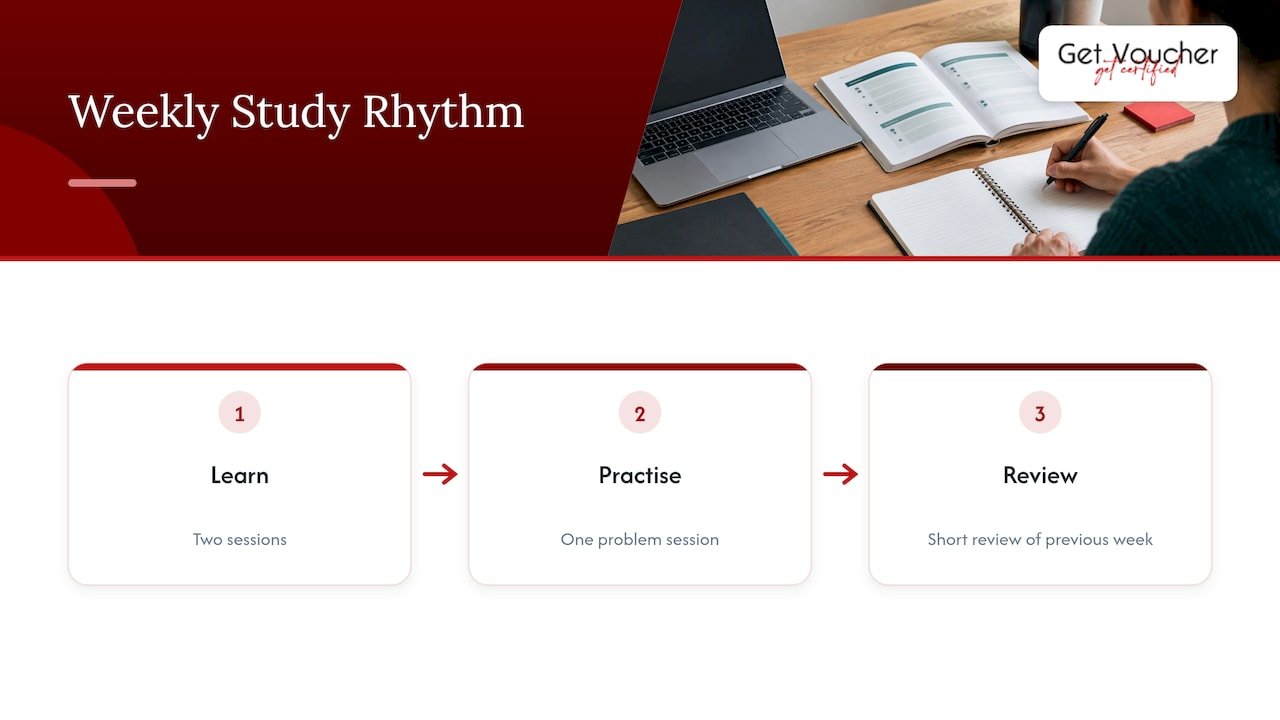
A simple pattern keeps momentum: two sessions to learn, one to practise problems, one short review of the previous week. Spaced review beats a final cram.
Keep an error log
Write down each practice question you get wrong, the BoK line it belongs to, and why you chose the wrong answer. Patterns appear quickly: misreading the question, forgetting a formula, or choosing the wrong test.
Do not treat optional project work as a requirement
A practical project strengthens your understanding. It is useful for your CV and interviews. But it is optional preparation unless your chosen provider explicitly requires it. Check the provider’s own rules.
How much will it cost?
Budget by looking at the exam fee, any mandatory training, optional preparation, retakes and renewal separately, because each provider structures these differently.
- ASQ lists a CSSGB exam fee of $483, per the ASQ certification page. That is the exam only.
- BSI’s Lean Six Sigma Foundation Green Belt is a three-day course, listed as live online training at £1595 + VAT. The research we reviewed shows BSI courses ranging from £1595 to £2585 plus VAT, depending on depth and duration.
- Our own vouchers are listed below.
Exam-only routes are not automatically the cheapest overall. If you need to buy training or a question bank on top, add those costs before comparing.
Our perspective: plan around the exam you are actually sitting
We see the same pattern in people choosing a Green Belt. They start with the topic (“I need to learn Six Sigma”) and later discover that the certification they picked asks different things of them from the one a colleague took. The fix is simple but easy to skip: pick the provider, read its rules, then build the plan.
Three convictions shape how we advise learners:
- Progress from lighter to heavier. Starting with a free introduction such as Six Sigma Yellow Belt lets you test whether the vocabulary and mindset suit you before you commit to statistics-heavy study.
- Keep Six Sigma and Lean distinct. Lean is about flow and waste, Six Sigma about variation and data. A Lean Six Sigma Green Belt combines them, but each provider defines its own syllabus. Our guide to the Six Sigma path explains how belt rules differ.
- A certification is not proof of performance. It shows you studied a body of knowledge and passed an assessment. It does not by itself prove you can deliver results, and it does not guarantee a job, salary or promotion. Pairing study with a real improvement task is what builds confidence.
We do not sell ASQ or IASSC credentials. If those are your target, use their official materials. Our offering is the 6sigmastudy route, described next.
— Rayan
Studying with GetVoucher
If you want an online route that does not need classroom attendance, these are the Green Belt options we sell, with the prices published on our site:
| Voucher | Price |
|---|---|
| Six Sigma Green Belt (SSGB™) | £149 |
| Lean Six Sigma Green Belt (LSSGB™) | £290 |
| Dual 6Sigma Pack: SSGB and LSSGB | £418 |
| Six Sigma Yellow Belt (SSYB™) | £0 |
Inclusions differ by product, so read each product page for exactly what is provided, including learning materials and exam arrangements, before you buy. To compare your options side by side, see Best Six Sigma Certifications: Exam Only or Project Proof?. If you have no project history, our page on process improvement certifications for IT professionals may help.
The plan above still applies. Download the BoK for the 6sigmastudy certification you choose, adapt the weekly structure, and check its exam rules on the product page.
Common mistakes to avoid
- Studying for the wrong syllabus. An ASQ guide may not match an IASSC or 6sigmastudy syllabus.
- Skipping statistics. Hypothesis tests and confidence intervals recur across Measure and Analyze.
- Memorising DMAIC steps without the logic. Know why each phase exists and what output passes to the next. DMAIC is not a slow or complicated method in itself, and its effort depends on the problem.
- Practising only untimed. Time pressure is part of the exam.
- Assuming the exam type. Open book, closed book, proctored or unproctored: confirm for your own provider.
FAQ
How long should a Green Belt study plan be?
Eight weeks at around six to eight hours a week is a reasonable template, but treat it as an estimate. If you have limited statistics experience, allow longer for the Measure and Analyze material. Your provider’s format and your own schedule matter more than any universal figure.
Do I need Minitab or can I use Excel?
It depends on the course and exam. Excel handles many basic calculations and charts, while Minitab is common in UK training such as BSI’s Green Belt course. Check what your chosen provider expects.
Is the Green Belt exam open book?
It varies. The ASQ CSSGB exam is open book, while the IASSC Green Belt exam is closed book and proctored. For any other provider, read its published exam rules.
Do I have to complete a project to become a Green Belt?
Not always. ASQ requires relevant work experience, and BSI may require a documented, company-vouched project for its qualification, while IASSC lists no formal entry requirement. Check the rules of your specific provider.
Sources
- ASQ Six Sigma Green Belt certification
- ASQ Green Belt references
- ASQ certification FAQs: taking the exam
- IASSC Green Belt certification
- BSI Six Sigma Green Belt training course
- BSI Lean Six Sigma Foundation Green Belt training course
- BS ISO 13053-1 on DMAIC methodology