




Six Sigma certification validates knowledge of data-driven process improvement methods, and most professionals begin with a Green Belt. Exact pathways, prerequisites and exam formats differ by certifying body, so the “right” starting point depends on your role, your employer’s expectations and which provider’s syllabus you’re following.
Table of Contents
- What Six Sigma certification actually validates
- The belt system: what each level means, and why providers disagree
- Six Sigma versus Lean Six Sigma: not the same credential
- Choosing a belt and a training format that fits your life
- What to check before you sit the exam
- Core syllabus: DMAIC, statistics and where the exam weight sits
- Where Green Belt sits, and what comes after it
- What counts as a suitable certification project
- Does Six Sigma certification mean the same thing everywhere?
- Benefits and career impact: what the evidence actually supports
- Comparing certification providers: what actually differs
- Common challenges candidates face, and how to work around them
- Author perspective: when certification helps most and common pitfalls
- Get started with GetVoucher
- Sources
- FAQ
What Six Sigma certification actually validates
Six Sigma is a process improvement approach built around DMAIC: Define, Measure, Analyse, Improve, Control. It aims to reduce variation and defects in a process by using statistical tools to find the root cause of a problem rather than guessing at it. Organisations deploy Six Sigma as a management practice, often across manufacturing, healthcare or service operations, running projects that track metrics before and after a change.
A certification is a credential that certifies understanding of DMAIC methodology and validates competency in the statistical tools that sit underneath it, things like control charts, hypothesis testing and process capability analysis. It does not, on its own, prove someone can run a factory floor improvement programme. Real-world project experience is what turns theoretical knowledge into applied skill, which is why several certifying bodies build a project requirement into higher belt levels.
There’s a useful distinction worth holding onto here: an organisational Six Sigma deployment (the company-wide programme, with a governance structure and a portfolio of projects) is a different thing from an individual’s belt. You can work inside a mature Six Sigma deployment without holding any certification, and you can hold a Green Belt without ever having led a full deployment. The credential is personal; the deployment is organisational.
The belt system: what each level means, and why providers disagree
The belt metaphor borrows from martial arts to signal depth of knowledge, but it isn’t a single agreed ladder. Different certifying bodies define entry points, project mandates and exam formats differently, so treat the list below as a description of common practice, not a fixed universal sequence.
- White Belt. An introductory level covering basic Six Sigma vocabulary and concepts, usually with no exam or a very light one. Some providers don’t offer it at all, treating Yellow Belt as the true entry point.
- Yellow Belt. Covers foundational DMAIC awareness and basic tools, aimed at team members who support projects rather than lead them. Requirements vary: some bodies require no prerequisite training hours, others recommend a short self-paced course first. Always check the specific provider’s candidate handbook before assuming your Yellow Belt will be recognised the same way elsewhere.
- Green Belt. Validates working knowledge of DMAIC and core statistical tools, and typically expects candidates to apply that knowledge to a workplace project. PeopleCert’s published Lean Six Sigma Green Belt syllabus recommends around 80 training hours and sets out exam weightings across the DMAIC phases, a good benchmark, but not universal across every certifying body.
- Black Belt. Aimed at candidates who lead improvement projects and mentor Green Belts, with deeper statistical content including regression and design of experiments. Project mandates and retake policies differ significantly by provider, so verify these details directly with whichever body issues the credential you’re considering.
- Master Black Belt. A senior, less standardised tier focused on training others and shaping organisational Six Sigma strategy. Few bodies publish a fixed syllabus for this level, and entry routes vary the most here.
Because requirements diverge this much, don’t assume a White to Yellow to Green to Black to Master progression is mandatory everywhere. Some providers let experienced professionals enter directly at Green Belt; others insist on Yellow Belt first. IASSC’s official syllabus documentation is a sensible place to check exam structure, duration and pass marks before you commit to any single body’s version.
Six Sigma versus Lean Six Sigma: not the same credential
Six Sigma and Lean Six Sigma are separate credential families, even when the same provider offers both under similar-sounding names. Six Sigma keeps its emphasis on statistical variation reduction, using DMAIC and control tools to stabilise a process. Lean Six Sigma folds in Lean principles, waste elimination, flow, value-stream thinking, alongside the same statistical core. BSI’s guidance on Lean Six Sigma qualifications draws this distinction clearly: they cover different skill combinations, not variations on one course.
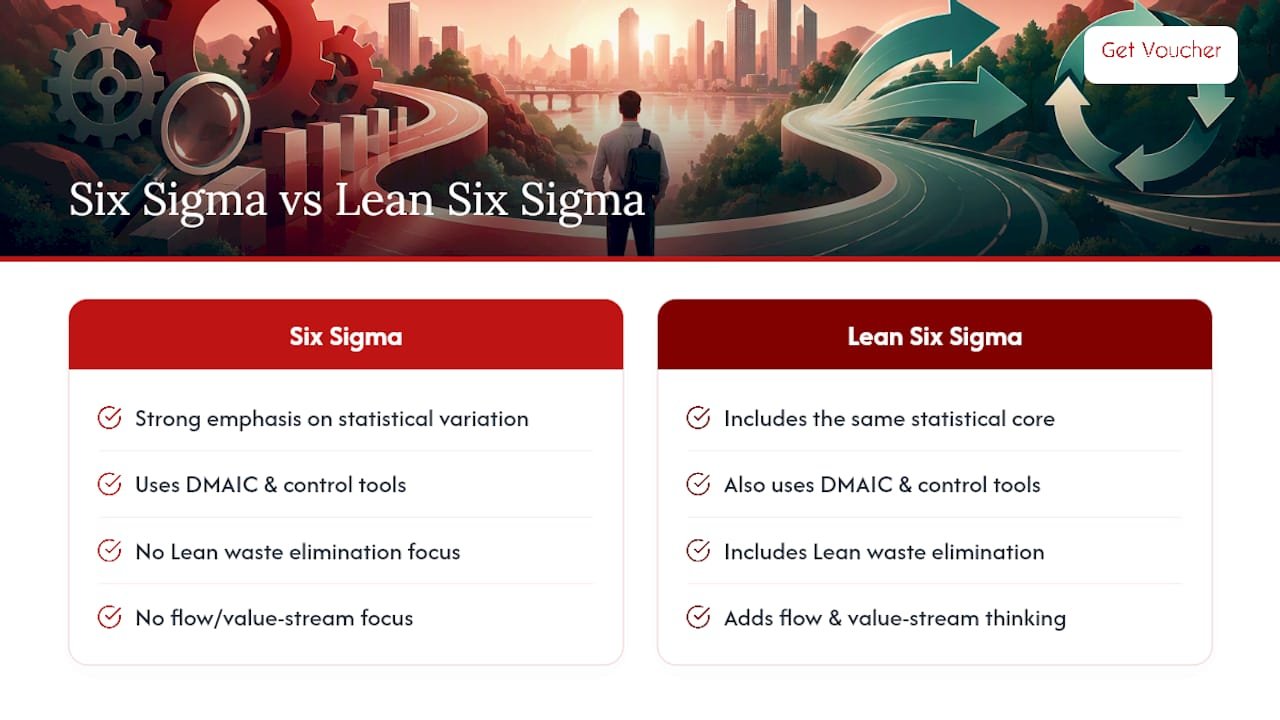
Which fits you depends on your role. Someone in a high-volume manufacturing environment focused on defect rates might lean towards Six Sigma’s tighter statistical focus. Someone in a service or administrative setting, where the problem is often as much about wasted steps and handoffs as measurement variation, may find Lean Six Sigma’s broader toolkit more directly useful. Neither is inherently “better”, and the labelling alone won’t tell you which you’re getting. Always read the syllabus, not just the credential name.
Choosing a belt and a training format that fits your life
Before enrolling anywhere, work through a short checklist rather than picking on brand recognition alone.
- Match the belt to your role. If you’ll be supporting projects occasionally, Yellow Belt content may be enough. If you’re expected to run or co-lead improvement work, Green Belt is the level most professionals treat as the working credential.
- Check your access to a real project. Because Green Belt and above commonly expect applied project work, confirm you have (or can get) a live process to study before you start, not after you’ve paid.
- Be honest about your statistics comfort. Green Belt syllabuses include hypothesis testing and process capability; if that’s unfamiliar territory, budget extra time for a refresher before the exam.
- Ask what your employer actually wants. Some employers specify a provider or a belt level for internal reasons; check before assuming any credential will be treated interchangeably.
On format: self-paced online study suits people juggling full-time work, virtual instructor-led sessions add structure and live Q&A, classroom training gives the most direct coaching but costs more in time and money, and blended formats split the difference. Editorial industry guidance places typical Green Belt training in the region of several dozen hours of study and course fees that commonly run from the low hundreds to over a thousand pounds depending on provider and format, treat that as a rough planning range, not a quote, and always verify current pricing and duration on the provider’s own page.
What to check before you sit the exam
Exam format, entry requirements and recertification rules are exactly the details that vary most between certifying bodies, so verify each one directly rather than assuming consistency.
- Exam format. Common options include computer-based multiple-choice tests, online proctored exams sat remotely under supervision, and in-person tests at a physical testing centre. PeopleCert and IASSC both publish format specifications for their own Lean Six Sigma exams, and the two are not identical.
- Recertification. Validity periods and renewal requirements differ by body, some require periodic renewal, others issue a credential without an expiry. The RSS sector scheme built around ISO 18404 offers one competence framework worth comparing your chosen provider against.
Always read the current candidate handbook rather than a summary article, formats and fees change.
Core syllabus: DMAIC, statistics and where the exam weight sits
Most Green Belt syllabuses build around the five DMAIC phases, alongside statistical process control (SPC), hypothesis testing, and, at more advanced levels, regression analysis. Expect measurement system analysis and root cause tools like fishbone diagrams and Pareto charts to sit inside the Analyse phase specifically.
PeopleCert’s published Lean Six Sigma Green Belt syllabus gives one concrete illustration of how exam weight typically distributes across phases:
| DMAIC phase | Approximate exam weighting |
|---|---|
| Define | Lower weighting |
| Measure | Moderate weighting |
| Analyse | Higher weighting |
| Improve | Moderate weighting |
| Control | Lower to moderate weighting |
This distribution comes from PeopleCert’s own syllabus documentation and reflects one provider’s exam. Others weight phases differently, so treat this as a study-planning reference rather than a universal exam blueprint.
Pro Tip: Pair your online syllabus study with a small, low-stakes process problem at work, even something as modest as reducing a recurring approval delay. You’ll retain the statistical tools far better when you’ve applied them once, and you’ll have early material for a project portfolio.
Where Green Belt sits, and what comes after it
Green Belt has become the level most professionals treat as their working credential because it sits at the point where statistical knowledge meets practical project leadership, without demanding the full-time specialist commitment that Black Belt implies. It’s also the level most frequently referenced in job postings for process improvement or continuous improvement roles, which is part of why so many candidates start there rather than at Yellow Belt.
After certifying, the sensible next step isn’t automatically “go and get Black Belt”. Build a portfolio instead: document the projects you run, quantify results where you genuinely can (cycle time reduced, defect rate lowered, rework hours cut), and keep evidence an employer or client can review. Heriot-Watt’s Executive Education notes on Lean Six Sigma Green Belt point out that applied project work is commonly expected or recommended at Green Belt and above precisely because it demonstrates competence that a multiple-choice exam alone cannot. If you later want to move towards Black Belt, check the specific provider’s project mandate first, several require documented project evidence before they’ll issue the higher credential, and availability of Black Belt training itself varies by provider and by month.
What counts as a suitable certification project
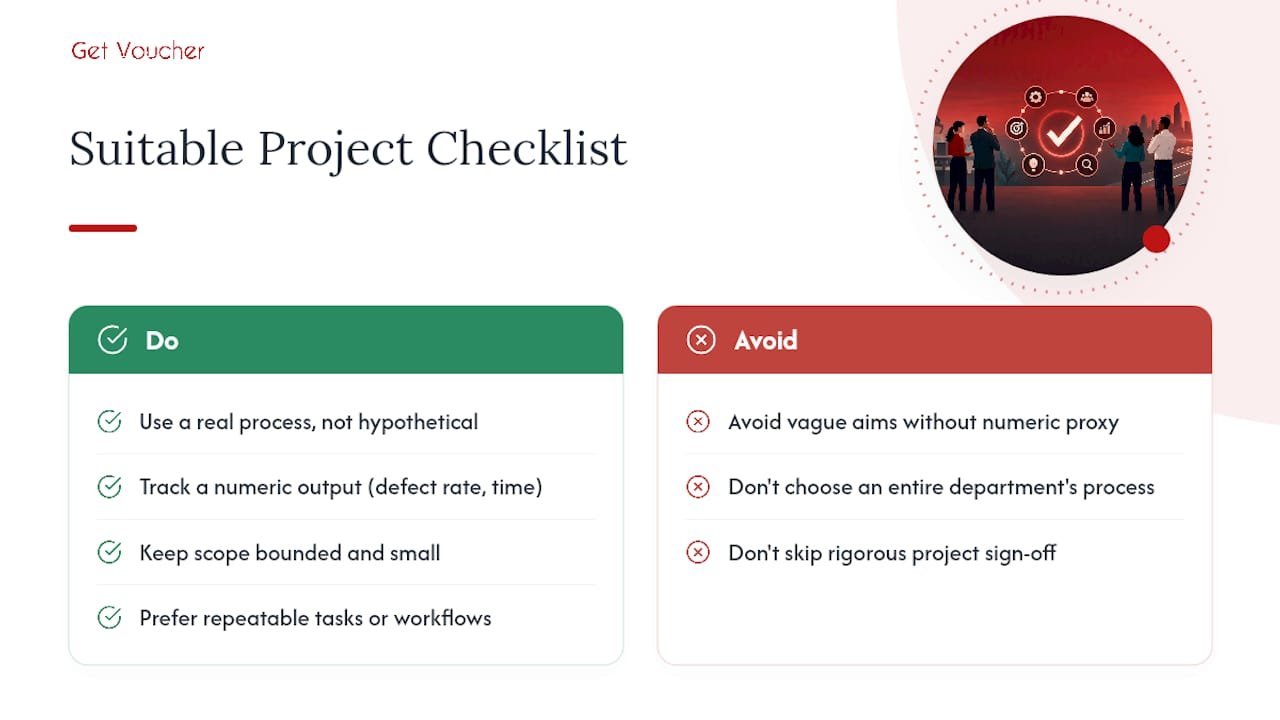
Most Green Belt and Black Belt syllabuses expect candidates to apply DMAIC to a real process rather than a hypothetical one, though the exact project rules again depend on the certifying body. Suitable projects share a few practical features regardless of provider.
The process should have a measurable output you can track before and after a change, a defect rate, a cycle time, a cost per unit, an error count. Vague aims like “improve customer satisfaction” without a numeric proxy are hard to run through DMAIC cleanly. The process should also be bounded, small enough that you can realistically measure, analyse and adjust it within the timeframe your certification allows, rather than an entire department’s operating model.
Common project types candidates use include: reducing defect or error rates in a repeatable task (order processing, data entry, quality inspection), cutting cycle time in an administrative or approval workflow, reducing waste or rework in a production or service handoff, and improving consistency in a customer-facing process like response times or complaint resolution. None of these require a manufacturing floor. Service, healthcare, financial and administrative processes all generate suitable candidates, provided the output is measurable.
Where providers differ is in how formally they require project sign-off. Some ask for a written project report reviewed against a rubric; others accept a self-declared summary with no external verification. If your goal is to build genuinely convincing project evidence for future employers, aim for the more rigorous option even if your certifying body doesn’t strictly require it; the underlying skill, not the paperwork, is what will matter later.
Does Six Sigma certification mean the same thing everywhere?
Not quite. Six Sigma’s roots sit heavily in manufacturing, and adoption remains strongest in sectors with high-volume, repeatable processes: automotive, electronics, pharmaceuticals and logistics. In these industries, employers are more likely to recognise belt terminology and expect specific statistical fluency because the shop-floor problems (defect rates, tolerances, throughput) map directly onto what DMAIC was built to solve.
In healthcare, financial services and the public sector, Six Sigma and Lean Six Sigma have spread more unevenly. Some hospital trusts and financial institutions run structured improvement programmes and value the credential; others have never adopted the framework formally and prefer other quality systems entirely. That inconsistency means the same Green Belt carries different weight depending on which industry, and even which specific employer, is reading your CV.
Geography adds another layer. Uptake and provider preference differ across regions: some sectors and public bodies favour credentials aligned with recognised frameworks such as ISO 18404, which the Royal Statistical Society’s sector scheme interprets as a competence benchmark for Six Sigma and Lean roles. Elsewhere, employers may simply ask “do you hold a Green Belt?” without specifying whose. Rather than assuming your certification will carry uniform weight, check what’s actually valued in your target industry and region, job postings and professional networks in your specific field are a more reliable guide than general assumptions about the credential’s prestige.
Benefits and career impact: what the evidence actually supports
The clearest, best-supported benefit of Six Sigma certification is what it does for your own capability: it certifies understanding of DMAIC methodology and validates competency in statistical tools you can then apply to real problems at work. That’s a concrete, checkable outcome, independent of any job market claim.
On organisational impact, case-study research on quality management practices in UK small and medium enterprises found that Six Sigma implementation outcomes depend heavily on leadership commitment and training quality, businesses that implemented it with genuine management backing saw improvements in operational metrics, while weaker implementations saw far less benefit. That’s a useful caution: the certification is one input into a result, not a guarantee of one. A Green Belt on your CV reflects what you know; whether it improves outcomes at your specific employer depends on whether you’re given a real project, management support and the authority to act on findings.
On career impact specifically, be wary of any source promising a fixed salary uplift or guaranteed promotion tied to a single credential; that kind of claim rarely survives scrutiny of the underlying data, which tends to be self-reported and heavily context-dependent. What’s more defensible is the qualitative pattern: certification can strengthen a CV for process improvement, operations or quality roles by giving a recruiter a recognisable shorthand for a specific skill set, particularly when paired with documented project results. The credential opens a conversation; your project evidence is what tends to close it.
Comparing certification providers: what actually differs
Several bodies issue Six Sigma and Lean Six Sigma credentials, and the differences that matter most are syllabus depth, exam format and whether a project is mandated, not brand recognition alone. PeopleCert publishes detailed syllabuses with specific training-hour recommendations and exam weightings, useful if you want a transparent study roadmap before you commit. IASSC maintains its own syllabus and exam specification, independently verifiable through its official site, and is often referenced alongside PeopleCert as a comparison point for format and structure.
Beyond the big two, other certifying bodies and training organisations issue Six Sigma credentials under their own syllabuses, sometimes with lighter project requirements, sometimes with heavier ones. This is precisely why the RSS sector scheme, built on ISO 18404, exists: it gives employers and candidates a framework to check whether a given provider’s syllabus and assessment meet a recognised competence standard, rather than relying on the provider’s own marketing.
Credibility, in practical terms, comes down to three checkable things: does the provider publish its syllabus openly, does its exam specification match what candidates report actually sitting, and does it align with (or get referenced against) an external framework like ISO 18404. A provider that makes all three easy to verify is a safer bet than one that asks you to trust the name alone.
Common challenges candidates face, and how to work around them
Statistics anxiety is the most common stumbling block, particularly for candidates coming from non-technical backgrounds. Hypothesis testing and process capability calculations can feel abstract without a real dataset to anchor them. The fix isn’t more theory; it’s running the calculations against a genuinely small, real dataset early, even a handful of data points from your own team’s work, before you meet them in an exam context.
Finding a suitable project trips up candidates whose employers don’t run formal improvement programmes. If your workplace has no obvious “Six Sigma project” sitting ready, look for a smaller recurring inefficiency, an approval queue, a repeated data entry error, a scheduling bottleneck, and scope it down to something measurable rather than waiting for a bigger initiative to appear.
Provider confusion is common given how many bodies use similar belt terminology with different requirements underneath. The only reliable fix is reading the specific candidate handbook for the body you’re considering rather than comparing summaries across providers, which tend to blur real distinctions.
Time pressure hits working professionals hardest, since most are studying alongside a full-time job. Self-paced online formats help here precisely because they let you spread the recommended training hours across weeks rather than committing to fixed classroom dates.
Author perspective: when certification helps most and common pitfalls
Certification pays off most clearly when it’s paired with a real project, the credential without evidence is a thinner signal than most candidates assume. The most common pitfall is buying training on brand alone without checking the provider’s actual exam format or project mandate first, followed closely by expecting a belt to trigger an automatic promotion. It rarely does. For career changers, the practical priority is simple: prioritise demonstrable project outcomes over the certificate itself, the paper opens a conversation, the project evidence closes it.
— Rayan
Get started with GetVoucher
GetVoucher is the voucher platform for accessing certification pathways from established providers, and for Six Sigma specifically, that means courses developed through VMEdu and issued by 6sigmastudy as the certification body. If you’ve read this far and you’re now weighing up whether Six Sigma or Lean Six Sigma Green Belt fits your role better, that comparison is exactly what GetVoucher’s course pages are built to help you make, side by side, before you spend anything.

The Six Sigma Green Belt (SSGB™) course suits professionals whose work is closer to structured, statistically-driven process control, while the Lean Six Sigma Green Belt (LSSGB™), priced at £290 one-off, fits those also dealing with waste and workflow inefficiency alongside variation. If you’d rather not choose upfront, the Dual 6Sigma Pack covering both Green Belt credentials lets you study both syllabuses through one voucher. Black Belt certification through 6sigmastudy is planned for the GetVoucher catalogue in the coming months, so if you’re aiming beyond Green Belt, contact GetVoucher directly for current pricing, details and availability. For broader context on how Six Sigma fits alongside other process improvement approaches, the Quality Management category is worth a browse before you decide. Check the full certifications catalogue to compare your options and pick a voucher that matches where you actually are in your career.
Sources
- RSS 18404 sector scheme (ISO 18404 reference)
- BSI guide: Lean Six Sigma courses and qualifications
- Heriot-Watt Executive Education: Lean Six Sigma Green Belt notes
FAQ
What is Six Sigma certification?
Six Sigma certification is a credential that certifies understanding of the DMAIC methodology and validates competency in statistical tools used to reduce process variation and defects. It’s issued by a certifying body rather than a single global authority, so requirements and exam formats differ depending on which organisation, such as PeopleCert or IASSC, issues the credential.
Is Six Sigma certification worth it?
It’s worth it primarily as a way to build and demonstrate specific, checkable process improvement skills, particularly when paired with a real workplace project as evidence. Case-study research on UK SME quality management found that benefits depend heavily on leadership commitment and how the training is applied, so treat the certificate as one input rather than a guaranteed outcome.
How much does Six Sigma certification cost?
Costs vary by provider, belt level and training format, so always check the specific course page for current pricing rather than relying on general estimates. Through GetVoucher, Lean Six Sigma Green Belt (LSSGB™) is priced at £290 one-off, while pricing for Six Sigma Green Belt (SSGB™) is available directly on the course page.
Can I learn Six Sigma for free?
Some certifying bodies and platforms offer free introductory or Yellow Belt level content, which is useful for orientation but typically doesn’t carry the same exam rigour or project requirements as a paid Green Belt or Black Belt credential. Free materials are a sensible starting point for testing your interest before committing to a paid course, but they rarely substitute for the structured training hours most Green Belt syllabuses recommend.