




Yes, practice exams help, and the evidence is among the strongest in learning research. Answering questions from memory strengthens what you know, shows you what you don’t, and lets you rehearse exam conditions before the real thing. They are not a magic score predictor, though, and the way you use them matters as much as whether you use them. This guide covers what the research found, where the limits are, and a simple routine for adults preparing for professional certification.
Table of Contents
- What the research says about practice tests
- Benefit 1: better memory and retention
- Benefit 2: they show you what you don’t know yet
- Benefit 3: pacing, stamina and a calmer exam day
- The limits of practice exams
- How to use practice exams well: a six-step routine
- Practice exams for certification study: check the provider’s rules
- Our perspective
- Where GetVoucher fits
- FAQ
- Sources
What the research says about practice tests
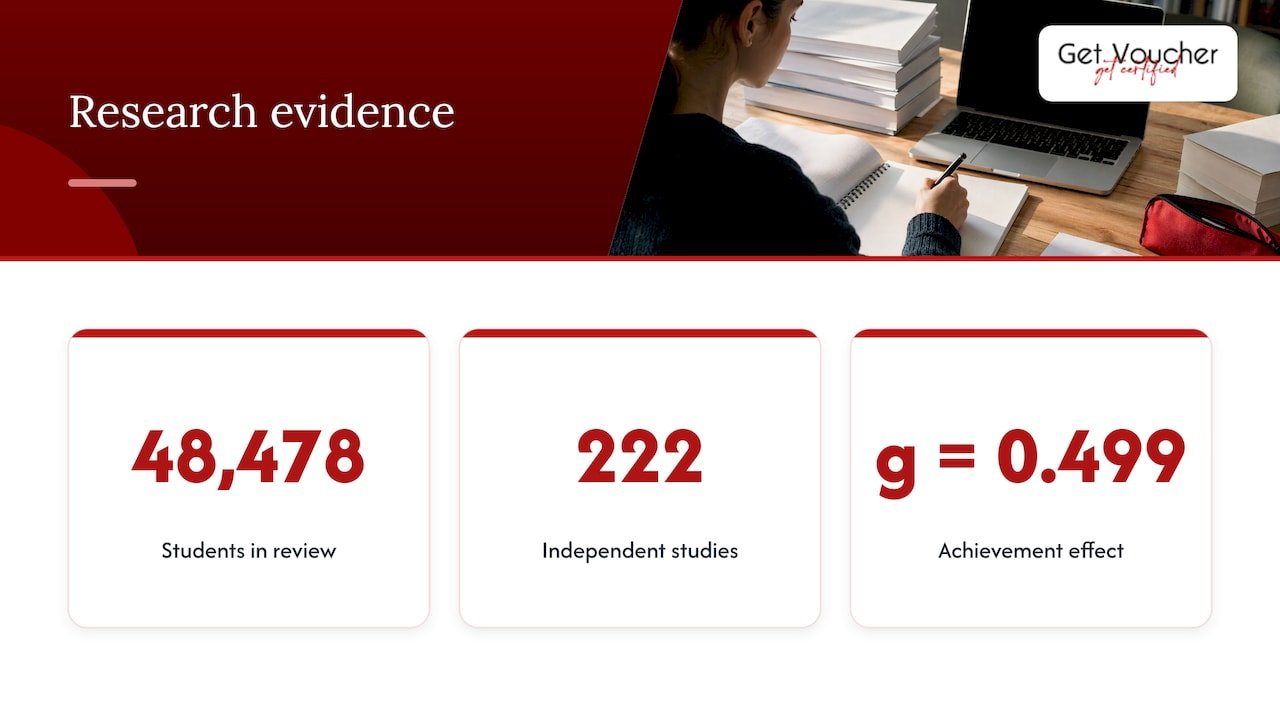
The question “is taking practice tests a good way to study?” has been tested many times. A 2021 review in Psychological Bulletin pooled data from 48,478 students across 222 independent studies and found that quizzing raises academic achievement to a medium extent (g = 0.499). The size of the effect depended on factors such as corrective feedback, the number of test repetitions and how closely the test matched the material.
A 2017 meta-analysis in Educational Researcher reached a similar conclusion: practice tests were more beneficial for learning than restudying and every other comparison condition the authors examined. Earlier, a widely cited 2013 review rated practice testing and distributed practice as high-utility techniques because they help learners of different ages and abilities across many tasks.
The American Psychological Association’s science body summarised the same body of work in plain terms: quizzing yourself and spacing out study can improve performance across many kinds of tests, for students of all ages.
This is not only a classroom finding. A 2025 review notes that the health professions have widely embraced retrieval practice, including for high-stakes licensing exams. Adults sitting professional exams are in good company.
Benefit 1: better memory and retention
The main mechanism is called the testing effect. Pulling information out of your memory strengthens your ability to pull it out again. Rereading feels productive because the material looks familiar, but familiarity is not the same as recall.
The numbers are worth knowing. A 2023 review of the evidence reports that one meta-analysis estimated the testing effect at Hedges’ g = 0.50, and another at 0.70. In plain terms, people assigned to testing scored roughly half a standard deviation or more above people assigned to restudy. The same review reports that testing’s advantage over restudy was larger after more than a day (g = 0.69) than after less than a day (g = 0.41).
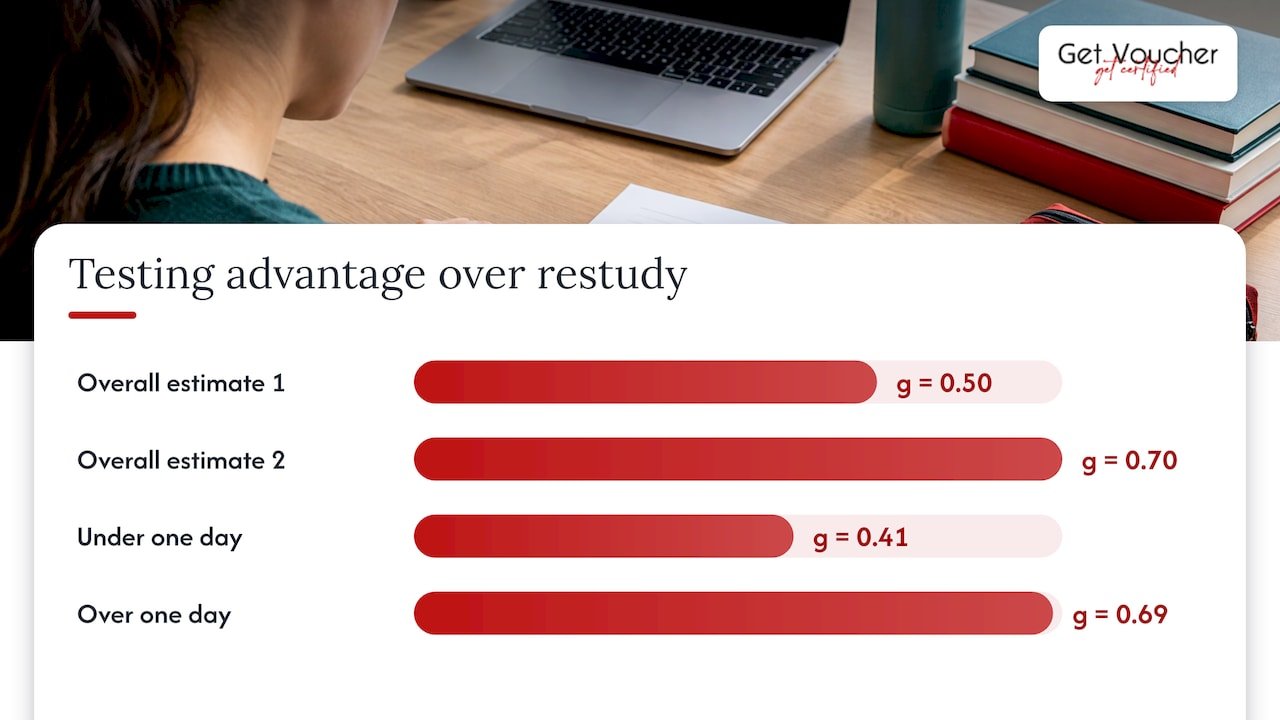
That matters for certification study. Most of us don’t sit an exam the evening after revising. The benefit grows with the gap, which is exactly the situation of a working professional who studies across several weeks.
A 2017 review from Dublin City University adds a second route. Practice tests help through the direct effect of recall, and through test-potentiated learning: once you see what you can and can’t answer, your next restudy session is more focused.
Benefit 2: they show you what you don’t know yet
Passive revision creates a comfortable illusion. A 2025 paper describes how passive approaches can create a false sense of understanding and overconfidence, whereas testing exposes gaps and lets learners judge what they have mastered and what needs more work.
The health-professions review makes the same point: retrieval practice builds metacognitive awareness, so learners can spot gaps and adjust. A 2023 study of exam practice adds that practice exams work as formative assessment, giving feedback on current proficiency. The benefit applied to questions answered correctly and incorrectly, provided students got personalised feedback and could restudy the material.
The practical lesson: the score matters less than the wrong answers. Each miss is a pointer to a chapter or topic. DANB, a dental assisting certification body, says the same in its advice to candidates: getting answers wrong helps identify which topics to review, and understanding why an answer is correct builds confidence before exam day.
A useful side effect of an early attempt is a baseline. Take one practice test near the start of your preparation and you know how far you have to go, which makes the rest of your plan realistic rather than hopeful.
Benefit 3: pacing, stamina and a calmer exam day
Timed, closed-book practice does something reading cannot: it rehearses the experience. You find out whether 120 minutes feels tight, whether you linger on hard questions, and how your concentration holds towards the end.
The Dublin City University review notes that practice tests help most when the test and its conditions closely mirror the real exam, for instance in quiet surroundings and under time limits. It adds that practice taken this way can help test-takers develop strategies for dealing with test anxiety.
If nerves are your main worry, there is more on the subject in managing test anxiety with research-based methods. We also cover the topic in our guide to evidence-backed exam anxiety strategies. Familiarity with the format is one of the simplest ways to remove surprise from the day.
The limits of practice exams
Practice tests are learning aids, not crystal balls. The Dublin City University review says it remains unclear whether practice tests help candidates predict their future results, and the research is mixed: some studies found predictive accuracy did not improve or even fell, while more recent work found the opposite.
Certification bodies are cautious too. The Association of Medical Certified Assistants states that practice performance is not a direct predictor of performance on the operational exam, and that memorising practice questions is not a recommended strategy. Its material is meant to reinforce what candidates have already learned.
Two habits keep you on the right side of these limits:
- Don’t memorise the bank. If you recognise a question because you’ve seen it, you are testing recognition, not understanding. Explain the answer in your own words instead.
- Treat the score as a signal, not a promise. DANB suggests aiming for at least 80% on practice tests, but that is that body’s guidance for its own exam. Other providers set their own pass marks and formats, so check the official rules for the exam you are taking.
Practice scores also vary in reliability by test type. An ETS study of TOEFL practice material found correlations with the real test of .72 for reading but .47 for speaking, partly because practice speaking was scored by software rather than human raters. A practice test is only as informative as its resemblance to the real one.
How to use practice exams well: a six-step routine
The research points to a handful of moves that raise the payoff.
- Learn the material first, then test. Practice tests reinforce learning. Do a first pass through the official syllabus or Body of Knowledge so that the test is retrieval, not guesswork.
- Take a baseline early. One untimed attempt tells you where the gaps are.
- Read the explanations for every wrong answer. A 2023 review notes that an unsuccessful retrieval attempt followed by feedback is more beneficial than simply reading the correct answer without trying first.
- Space your attempts. A 2020 article on testing as a learning tool reports that multiple spaced tests beat a single block, and suggests a spacing interval of 10% to 20% of the time you want to remember the material. If the exam is ten weeks away, that means a test roughly every one to two weeks, not ten in the final weekend.
- Mix topics. The same 2023 review recommends interleaving, switching topics from question to question, which is especially useful for easily confused concepts. Scrum events and accountabilities are a good example.
- Simulate the real thing for the last attempts. Time yourself, close your notes, remove distractions and sit the full length once or twice.
A worked example: you are preparing for a 120-minute, 100-question exam over eight weeks. Week 1, read the syllabus and take a baseline. Weeks 2 to 6, study one domain at a time and finish each with a short quiz on that domain plus a few questions from earlier domains. Week 7, take a full timed paper and sort every miss by topic. Week 8, revisit only those topics, then one final timed run a few days before the exam.
Practice exams for certification study: check the provider’s rules
Certification exams differ in length, question count, delivery and pass mark, so the practice you do should match the specific exam. A few provider-specific facts for the credentials we work with:
- SCRUMstudy Scrum Fundamentals Certified (SFC) uses a 40-question, 60-minute online unproctored exam.
- SCRUMstudy Scrum Master Certified (SMC®) uses a 100-question, 120-minute online unproctored exam.
- SMstudy Digital Marketing Professional uses a 100-question, 120-minute online unproctored exam, and has no formal prerequisites, with Fundamentals only preferred.
These details are provider-specific and should not be assumed for other certification bodies. For side-by-side formats see our guides to Scrum exam format by provider and Six Sigma exam format. An unproctored online exam is not automatically open-book or easier, so read the candidate rules before you plan your preparation. Our article on how professionals verify unproctored certifications explains the distinction, and how to schedule a Scrum exam covers booking provider by provider.
What a practice exam can’t do is stand in for the syllabus. Align your study plan with the certification’s official Body of Knowledge, and use practice questions to test and sharpen it. If you are using study resources, note that the study material that comes with a purchase varies by product, so check what each certification page lists.
People who find reading-heavy revision difficult may also like these retrieval-based study strategies, which turn the same testing idea into short, repeatable tasks.
Our perspective
Most people who come to us are working full time. They have a few hours a week, a syllabus that looks long and a nagging doubt about whether they are ready. Practice questions answer that doubt better than another read-through does, because they turn “I think I know this” into a result you can act on.
That is why we like certification routes that start small. A free introductory credential such as Scrum Fundamentals Certified lets you see the exam style, the pace and the way questions are framed before you commit to a paid certification. Moving from there to a role-level credential is then a step you can judge with real information.
We would also say plainly what a practice score is: a study signal. It doesn’t prove you will pass, and a certificate does not prove real-world performance. What it can do is make your preparation efficient, so the hours you have go to the topics that need them.
Rayan
Where GetVoucher fits
GetVoucher sells vouchers for professional certification courses and exams in Scrum, Agile, digital marketing, quality management and related areas. We work commercially with providers such as VMEdu and certification bodies including SCRUMstudy, SMstudy and 6sigmastudy, and we sell only those providers’ certifications, not credentials from other bodies such as Scrum Alliance or Scrum.org.
If you want a low-risk way to put the practice-first approach to work, Scrum Fundamentals Certified is listed at £0. For a role-level credential, Scrum Master Certified (SMC®) is £249 as a one-off price. Inclusions differ by product, so check each page for what comes with it. You can browse every pathway on our certifications page.
FAQ
Do practice tests really help?
Yes. A 2021 meta-analysis of 222 studies found that quizzing raises achievement to a medium extent, and several other reviews agree that practice testing beats restudying. The gains are largest when you get feedback, space your attempts and use tests that resemble the real exam.
How many practice exams should I take?
There is no universal number. Research favours several spaced attempts over one block, and one source suggests spacing of 10% to 20% of the time you want to retain the material. Quality counts more than quantity: review every wrong answer before taking the next test.
Can a practice exam predict my real score?
Not reliably. Research on prediction is mixed, and at least one certification body states that practice performance does not directly predict performance on the operational exam. Use your result to decide what to revise, not as a forecast.
Will practice exams reduce my nerves?
They can help. Practising under timed, quiet conditions that mirror the real exam gives you familiarity with the format and a chance to build strategies for handling anxiety. If anxiety is severe, speak to your GP or a qualified professional.
Sources
- Testing (quizzing) boosts classroom learning: a systematic and meta-analytic review (2021)
- Rethinking the Use of Tests: A Meta-Analysis of Practice Testing (2017)
- Improving Students’ Learning With Effective Learning Techniques (2013)
- Don’t waste your time: The best and worst study techniques
- The Use of Retrieval Practice in the Health Professions (2025)
- Cognitive perspectives on maintaining physicians’ medical expertise (2023)
- Practice Tests: Do They Work? Can They Work Better? (2017)
- The promise of mastery-based testing (2025)
- Impact of more realistic and earlier practice exams
- How to study for your DANB exam
- Exam Prep Material, AMCA
- Examining Performance Differences on Tests of Academic English (ETS, 2015)
- Using Testing as a Learning Tool
- IQ Test Anxiety: What the Research Shows and How to Manage It
- 6 Evidence Backed Study Strategies Dyslexic Students Can Try This Week