




Yes, you can become a Scrum Master without prior Scrum experience, and you do not need an IT background to begin. What you need is a working grasp of the Scrum Guide, a beginner-level certification that suits your budget, and a small amount of real practice you can describe in an interview. Certification opens the conversation. Evidence that you have applied Scrum, even in a modest setting, is what carries it. If you want a starting point, our free Scrum Fundamentals Certified voucher costs £0.
This guide is for career changers, project managers, graduates and professionals who want to move into a Scrum Master role. It sets out what the role is, which certifications accept beginners, how to build experience before your first job, and how to present it.
Table of Contents
- What a Scrum Master actually does
- Do you need a degree or an IT background?
- Which Scrum certification suits a beginner
- A sensible order for a complete beginner
- How to gain Scrum experience before your first job
- How to present your experience when you have little
- What to expect at interview
- Our view: start small, then build proof
- Where GetVoucher fits
- FAQ
- Sources
What a Scrum Master actually does
Scrum is a framework, and Agile is the wider set of values and approaches it belongs to. Keep the two apart. Many job adverts say “Agile” when they mean Scrum specifically, so know which one a role is asking about.
The Scrum Guide, the free document that defines Scrum, says the Scrum Master is accountable for establishing Scrum as defined in the Guide. They do this by helping the Scrum Team and the wider organisation understand Scrum theory and practice. A Scrum Team has one Scrum Master, one Product Owner and Developers, and it is typically ten people or fewer. Sprints, the fixed-length periods in which the team works, last one month or less.
The Scrum Master is not the team’s manager, and not a project manager under a new name. They are a teacher, a facilitator and someone who removes obstacles to the team’s work. If you are weighing the two careers, our guide on Scrum Master or Project Manager compares them and explains which certification suits each.
Two accountabilities are often muddled, and interviewers like to test them:
- The Product Owner is accountable for maximising the value of the product and for managing the Product Backlog, the ordered list of what the product needs.
- The whole Scrum Team commits to the Sprint Goal, the single objective of the Sprint. It does not commit to a fixed batch of tasks, and the goal does not belong to the Product Owner alone.
If you can explain those two points plainly, you are already ahead of many applicants.
Do you need a degree or an IT background?
The Scrum Guide lists no degree for the Scrum Master role, and the entry credentials from the major bodies do not set a degree requirement either, as this overview of the role notes. Scrum is used in software, but also in marketing, operations, product and service teams. A background in any of those can be an asset, because a Scrum Master spends most of their time on communication, facilitation and coaching rather than technical work.
Be realistic about the job market, though. Some advertised roles ask for several years of Agile experience, as the table below shows, and the entry point is often an internal move: a developer, analyst, coordinator or project manager who starts running Scrum events for their own team. That is why the practical section further down matters as much as the certificate.
Which Scrum certification suits a beginner
Certification is not a legal requirement for the role. Scrum Alliance itself says it is not required to get a Scrum Master job, although some employers ask for a Certified ScrumMaster. A certificate shows you have studied a particular body of knowledge, and nothing more. It does not prove you can facilitate a difficult team, and it does not guarantee a job, a salary or promotion.
Each provider sets its own prerequisites, exam format, cost and renewal rules, so compare them one by one rather than assuming they work alike.
| Credential | Provider | Prerequisites | Exam format | Notes |
|---|---|---|---|---|
| Scrum Fundamentals Certified (SFC) | SCRUMstudy | None stated for beginners | 40 questions, 60 minutes, online, unproctored | Free introductory option |
| Scrum Master Certified (SMC®) | SCRUMstudy | None required to start | 100 questions, 120 minutes, online, unproctored | Based on the SCRUMstudy SBOK® Guide |
| SCRUM Agile Master Certified (SAMC™) | SCRUMstudy | Check the provider’s current requirements | Online, unproctored | Further step after SMC® |
| Professional Scrum Master I (PSM I) | Scrum.org | None: no course, no work experience required | 80 questions, 60 minutes, 85% to pass | $200 per attempt, held for life with no renewal fee |
| Certified ScrumMaster (CSM®) | Scrum Alliance | Required 16-hour course | 50 questions, 60 minutes, 74% to pass | Course price set by the trainer |
A few clarifications keep this table honest:
- The SCRUMstudy material is built on the SBOK® Guide, which is not the Scrum Guide. They are separate documents from separate bodies. Read the Scrum Guide too, since it is free and short, and since interviewers tend to quote it.
- Unproctored does not mean easier or open-book. It describes how the exam is delivered. Check each provider’s own rules on reference material.
- A pass mark is not a pass rate. The 85% for PSM I is the score you need, not the share of candidates who succeed.
- Scrum.org and Scrum Alliance do not assess in the same way. One tests through an exam alone, the other pairs a required course with an exam.
We sell the SCRUMstudy credentials above through our commercial relationship with providers such as VMEdu and SCRUMstudy. We do not sell Scrum.org or Scrum Alliance credentials, and the table lists them so you can see the full field.
A sensible order for a complete beginner
- Read the Scrum Guide. It takes less than an hour and is the common reference for every Scrum credential.
- Start with an introductory credential. The free SFC voucher lets you test your interest and learn the vocabulary at no cost, and the exam is 40 questions in 60 minutes.
- Move to a Scrum Master credential. For SCRUMstudy, that is Scrum Master Certified (SMC®) at £249.
- Add depth where your job points. If you work close to product decisions, the Product Owner path is a natural second step. If you work in operations, the Scrum for Operations and DevOps Expert Certified voucher at £239 may fit better.
Before you commit, Forbes Advisor suggests asking whether the credential is valuable to your company and career path, whether you use Scrum now or will, and whether your schedule allows the study time. Those are good questions to answer on paper first. Keep any timeline cautious: how long you need depends on your starting point, not on a fixed number of weeks.
For a full breakdown of what each route costs, including exam fees, mandatory training, optional preparation, retakes and renewals, see our guides on Scrum Master certification cost and SCRUMstudy exam fees. Being the cheapest route on paper does not make an exam-only voucher the right one for every learner.
How to gain Scrum experience before your first job
This is the part that separates applicants. Practical work is optional and not an official requirement of the certifications above, but it gives you the stories that interviewers ask for. You do not need the title “Scrum Master” to do any of it.
Use Scrum on a small, real piece of work
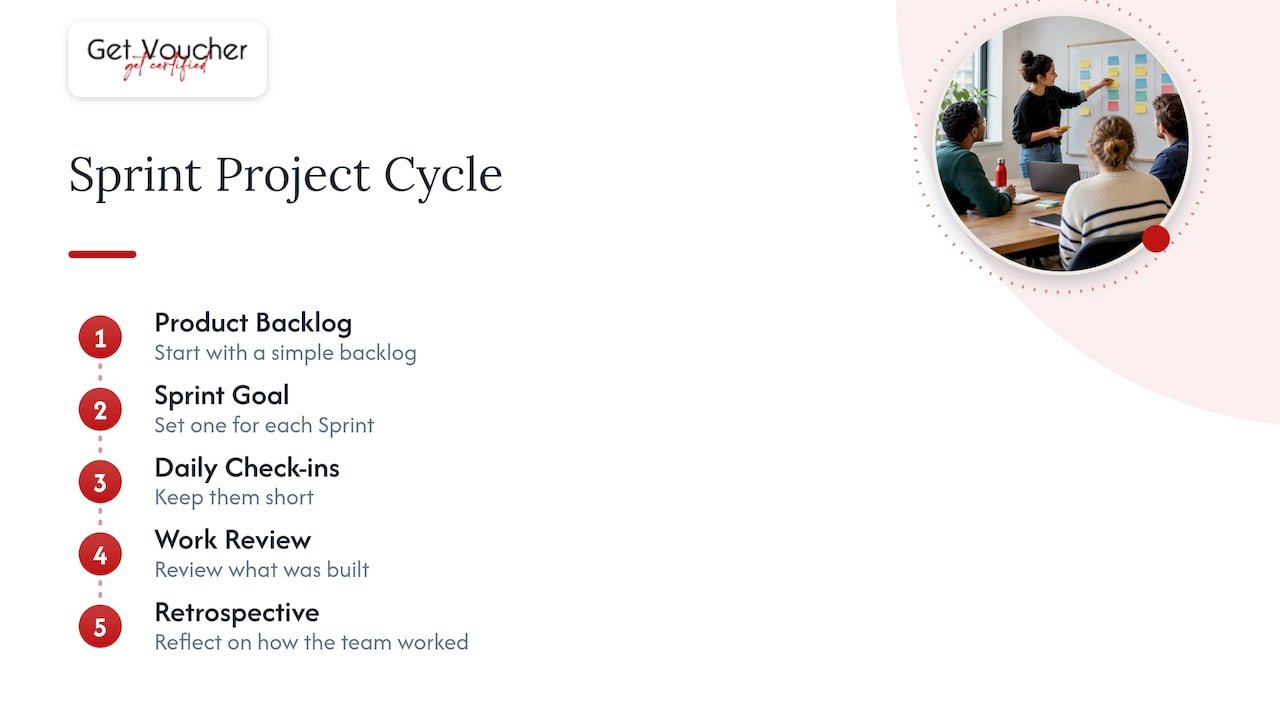
Pick something with a clear outcome and a few people involved: a community event, a volunteer project, a product launch at your current employer, a study group or a side project. Run it for three or four short Sprints with a simple Product Backlog, a Sprint Goal for each Sprint, a short daily check-in, a review of what was built and a retrospective on how the team worked. Keep brief notes on what you tried, what happened and what you changed.
Volunteer inside your current job
If your team already works in an Agile way, offer to facilitate the retrospective or help refine the backlog. If it does not, suggest a four-week trial with one team. Many first Scrum Master roles come from this kind of internal move, because the employer already trusts you.
Learn the surrounding tools
Jira turned up in 65% of US Scrum Master adverts on Adzuna in October 2026, according to one analysis of the role. Tooling varies by employer and country, so treat it as useful rather than essential, and learn enough to set up a board, a backlog and a basic report. Scrum itself does not require any particular tool.
Practise the facilitation skills
Scrum Master work is mostly conversation: asking good questions, handling disagreement, helping a team notice its own patterns. Our guide to becoming an effective Scrum Master lists the skills worth practising, and what a Scrum Master does day to day shows where they apply.
How to present your experience when you have little
Hiring managers tend to look for evidence of what you did with your knowledge. One writer on Scrum hiring argues that a genuine case study of helping a team improve outweighs a stack of certificates. Treat that as one perspective rather than a rule, but it is a useful way to plan your CV.
A defensible claim names what you measured, the starting point, the period and your own part in the change. A resume specialist describes this as being able to answer “walk me through how you measured that”. Compare:
- Weak: “Improved team productivity using Scrum.”
- Stronger: “Ran fortnightly Sprints for a five-person events team. Missed deadlines fell from four in the quarter before to one in the quarter after, tracked on our shared board.”
Only write numbers you can back up. If you have no figures, describe the change plainly: what the team did differently and what you facilitated.
Transferable skills carry weight here. Facilitating meetings, coordinating stakeholders, mentoring colleagues, resolving conflict and managing delivery all count if you tie them to Scrum language. If you want a structured way to show leadership evidence when your formal experience is short, this team leader competencies plan offers a staged approach.
What to expect at interview
Adverts often list a CSM or PSM, Jira or Confluence, and several years of Agile experience, and interviews are commonly scenario-based. Typical questions ask you to walk through running a sprint retrospective or to explain how you would handle a team that keeps missing sprint commitments. The same source recommends preparing three or four stories in the STAR format: Situation, Task, Action, Result.
For the second question, remember what the Scrum Guide says. The team commits to the Sprint Goal, not to a fixed list of tasks, so a strong answer talks about why the goal is slipping, what the team can learn in the retrospective and how the work can be adjusted, rather than about blame or pushing harder.
If the advert asks for several years of experience and you have none, apply anyway when the rest fits, and lead with your practice projects and transferable skills. Some adverts are wish lists. Do not assume a specific employer will treat a certificate as proof of competence or will prefer one provider over another: practice varies widely.
Our view: start small, then build proof
We built GetVoucher for people in exactly your position: capable, motivated, and unsure where to begin. Our view is that a beginner should not have to pay classroom prices to find out whether Scrum suits them.
That is why the free Scrum Fundamentals Certified voucher exists. It lets you meet the vocabulary and the logic of Scrum before you spend anything. When you are ready for a Scrum Master credential, the SCRUMstudy route we offer pairs the exam voucher with online learning, and the inclusions differ by product, so we describe each one on its own page.
Whatever credential you choose, we would push you towards the same habit: apply what you learn to something real within weeks. A certificate and a short, honest case study together tell an employer far more than either does alone. Our aim is to make the certificate part affordable and straightforward, so your time goes into the practice.
Rayan
Where GetVoucher fits
Our Scrum range starts with the free Scrum Fundamentals Certified voucher at £0. From there, Scrum Developer Certified (SDC®) is £99, Scrum Master Certified (SMC®) is £249, Scrum Product Owner Certified (SPOC®) is £299 and SCRUM Agile Master Certified (SAMC™) is £349. The Dual Agile Pack, covering the Scrum Master and Product Owner certifications at Associate level, is £519. The SMC® exam is 100 questions in 120 minutes, online and unproctored.
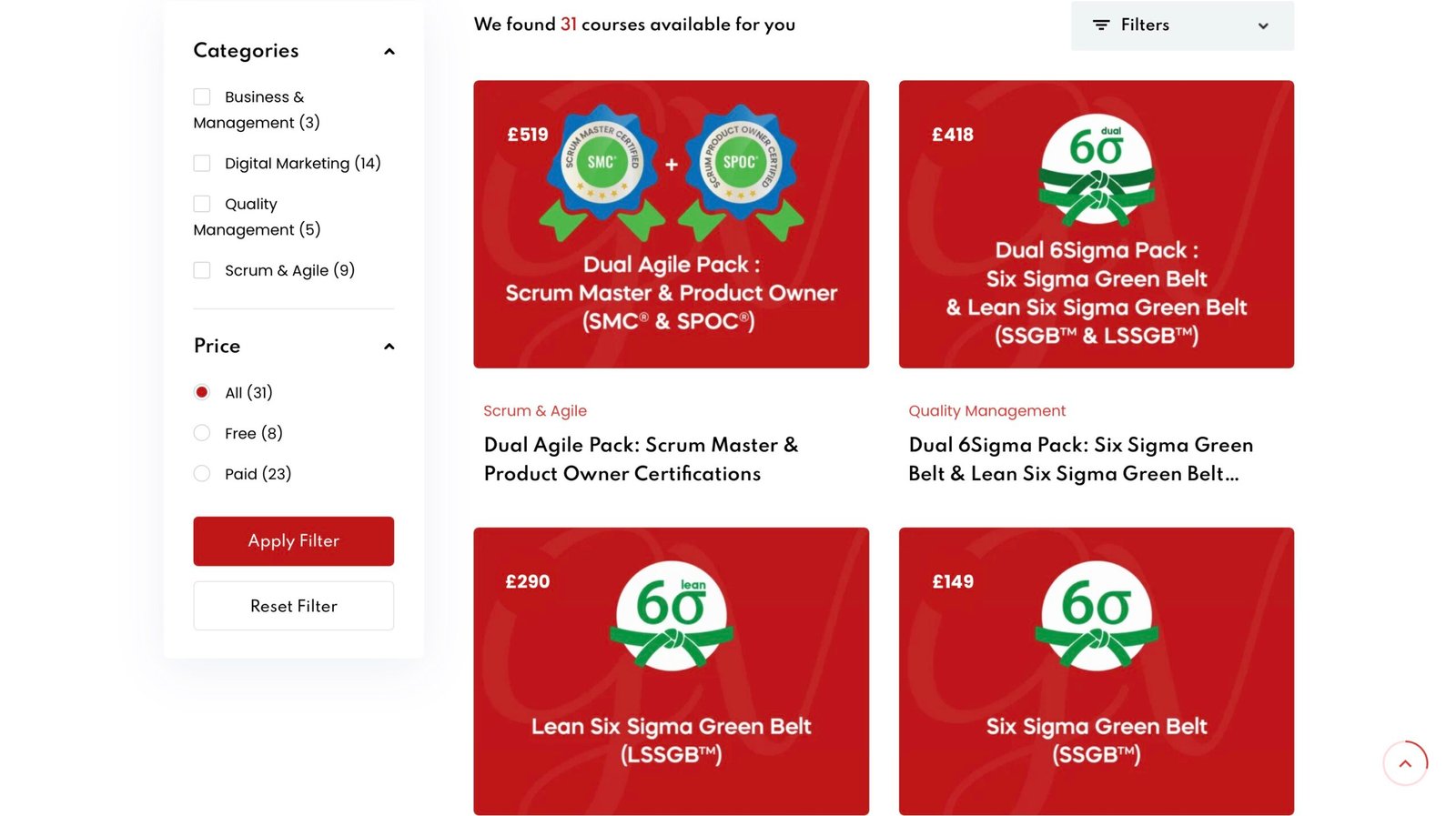
What each purchase includes depends on the product, so check the product page for training, materials and exam scheduling support before you order. You can browse the full range on the GetVoucher homepage, and our guides on how to pass the Scrum Master exam and how to schedule a Scrum exam cover the steps after purchase. The wider Scrum and Agile guide maps how the credentials connect.
FAQ
Can I be a Scrum Master with no experience at all?
Yes, you can start. The Scrum Guide sets no degree or prior-experience requirement for the role. Many adverts do ask for experience, so build a small practice project and use transferable skills from your current job to fill the gap.
Which Scrum certification is best for a complete beginner?
It depends on your budget and learning style. Our free Scrum Fundamentals Certified voucher is a no-cost way in, and SMC® is the Scrum Master credential we offer. Scrum.org’s PSM I has no prerequisites either, while Scrum Alliance’s CSM requires a 16-hour course first.
Do I need a certification to get a Scrum Master job?
Not legally, and Scrum Alliance says it is not required. Some employers do list one in the advert, so having a credential removes a hurdle. It does not prove competence, so pair it with practical examples.
How long does it take to get certified?
It varies by provider and by how much time you can study. Read the exam format for your chosen credential, such as 100 questions in 120 minutes for SMC®, and plan study around your own schedule instead of a generic timeline.
Sources
- The Scrum Guide (2020)
- How to become a Scrum master with no experience in 2026
- PSM I Certification Guide
- Scrum Master Certifications: 6 Options To Consider, Forbes Advisor
- Scrum Master Jobs in 2026: Where to Find Them and How to Stand Out
- Scrum Master Resume Examples: Defensible Metrics That Pass
- Team leader competencies: a 3/6/12 plan