




There is no single Six Sigma pass rate, because each certifying body runs its own exams. The clearest published figures come from ASQ, which reports pass rates by exam and year. For 2022 to 2024 these were 80% to 83% for Yellow Belt, 69% to 77% for Green Belt and 73% to 76% for Black Belt. Those numbers describe ASQ candidates only. They say nothing about other providers, and they do not predict whether you will pass.
This guide explains what the figures measure, how a passing mark is set, why some candidates fall short and how to prepare. It also covers what to check before you buy a voucher from any provider.
Table of Contents
- ASQ Six Sigma pass rates by belt, 2022 to 2024
- What a pass rate does and does not tell you
- How ASQ sets the passing score
- Is the Six Sigma exam hard to pass?
- Retakes, passing scores and what happens if you fall short
- Preparing for a Six Sigma exam
- Choosing a voucher with the pass rate in mind
- Our perspective
- Six Sigma vouchers from GetVoucher
- FAQ
- Sources
ASQ Six Sigma pass rates by belt, 2022 to 2024
ASQ lists a pass rate for each belt exam and year. Here they are side by side:
| ASQ exam | 2022 | 2023 | 2024 |
|---|---|---|---|
| Certified Six Sigma Yellow Belt (CSSYB) | 80% | 81% | 83% |
| Certified Six Sigma Green Belt (CSSGB) | 69% | 76% | 77% |
| Certified Six Sigma Black Belt (CSSBB) | 76% | 75% | 73% |
Source: ASQ Exam Grading & Certification Pass Rates FAQ.
Three readings are fair:
- Most candidates who sit these exams pass. In every year shown, roughly seven in ten or more succeeded.
- The Green Belt rate rose over the period, from 69% to 77%. The Black Belt rate drifted down slightly. Three years is a short window, so avoid reading a trend into it.
- The Yellow Belt rate is the highest, which fits the exam’s introductory scope.
Older ASQ data points the same way. An IQPS article reported that across all ASQ certification exams, 9,394 of 14,906 test-takers passed in 2008 (63%). In 2007 it was 9,431 of 14,422 (65%). Those figures cover every ASQ certification, not only Six Sigma, so treat them as background.
What a pass rate does and does not tell you
A pass rate is the share of people who sat an exam and passed it. It is not a fixed percentage-correct threshold, and it is not a measure of how hard the exam feels to you.
Two cautions help you read it:
- It reflects who takes the exam. Candidates arrive with different experience and different preparation, and the rate blends all of them. A figure of 77% does not mean you have a 77% chance.
- It is specific to a provider and exam. An ASQ Green Belt rate cannot be carried over to another provider’s Green Belt. Prerequisites, question counts, timing, proctoring and passing scores differ by provider, so keep each one separate.
Pass rate and passing score are also different things. The rate says how many candidates passed. The score is the line a single candidate must cross.
You may also meet claims online such as “90 percent pass” or “above 80% gives an excellent chance”. Those come from anecdotes or unsourced pages. Rely on a certifying body’s own published data.

One more source of confusion is the “60% of Six Sigma projects fail” claim that circulates. It concerns business improvement projects, not certification exams. It has nothing to do with whether a candidate passes a belt exam.
How ASQ sets the passing score
ASQ does not use a flat percentage. It sets each exam’s cut point through a Modified Angoff study. According to ASQ’s grading process FAQ, a panel of 12 to 15 subject matter experts judges every question. For each one they estimate what proportion of 100 borderline, minimally qualified candidates would answer correctly. The raw cut score that results is then converted to a scaled score.
The practical consequences:
- The pass mark is 550 on a scale of 750. ASQ’s exam results FAQ states this. Do not read 550 out of 750 as a percentage of questions answered correctly, because scaled scores do not work that way.
- Different exam forms stay comparable. The scaled score keeps the standard consistent, so drawing a harder form should not count against you.
- ASQ designs its exams to separate competent from not-yet-competent candidates, not to rank successful ones. For that reason it does not report scaled scores to those who pass. If you want a parallel from another field, CCRN scoring explained shows how a published pass mark relates to the number of questions on a different professional exam.
- ASQ does not deduct points for wrong answers, so answering every question is sensible.
The cut point is set when a Body of Knowledge is created or revised. ASQ says it follows the Standards for Educational and Psychological Testing.
ASQ’s rules are specific to ASQ. Scrum.org, Scrum Alliance and other bodies use different assessment models, and so do other Six Sigma providers. Always read the passing score on the provider’s own exam page.
Is the Six Sigma exam hard to pass?
For most candidates who prepare against the official syllabus, the published ASQ figures suggest a pass is realistic. Difficulty is personal, though, and shouldn’t be generalised across providers or belts.
ASQ’s own explanation points to what separates borderline candidates from comfortable ones. Borderline candidates tend to do well on definitions but less reliably when they must apply a formula. If your preparation is mostly flashcards of terms, that is the gap to close.
Other factors that shape your odds:
- Your experience. ASQ asks for relevant on-the-job experience for some levels. It requires three years of experience for the Black Belt, for example. Experience helps with applied questions.
- The exam format. ASQ describes the Green Belt computer exam as open-book but timed. Open-book does not mean easy. Time spent hunting through a reference is time not spent answering.
- Statistics comfort. Candidates who expect a heavy maths exam are often surprised. One ASQ Green Belt candidate’s account put numerical questions at roughly 15% to 20% of the paper, but treat that as one person’s experience, not a rule.
- Familiarity with question style. Practice under timed conditions helps with pacing.
These points apply to ASQ. Other providers publish their own question counts and time limits. Our guide to Six Sigma exam format by provider lays them side by side.
Retakes, passing scores and what happens if you fall short
Failing a Six Sigma exam is not the end of the road, but the rules depend on the body.
For ASQ:
- There is no limit on retakes.
- A retake fee is charged each time.
- The retake must happen within two years of your last attempt.
- Candidates who do not pass can review a detailed analysis of their results by logging into their ASQ account, as stated on the ASQ results FAQ. That breakdown by topic tells you where to focus.
For any other provider, check the retake count, retake fee, waiting period and voucher validity before you buy. These can differ even between two exams from the same body. Our page on what to do after failing a certification exam walks through the questions to ask.
Preparing for a Six Sigma exam
Good preparation starts with the official Body of Knowledge for your exam, because that is what the questions are drawn from. Then build around it:
- Map the syllabus to your gaps. The ASQ Black Belt Body of Knowledge, for example, has nine sections. Measure carries 25 questions and Analyze 22, according to the OpenExamPrep breakdown of the 150 scored items. Heavier sections deserve more of your time.
- Practise applying formulas, not only naming them. Work through control charts, capability indices and hypothesis tests by hand until you can choose the right tool for a scenario.
- Use timed question banks. ASQ’s preparation guidance lists handbooks, courses, question banks and study guides. It also makes clear that using a course or resource does not guarantee a pass.
- Review by topic. Whether you use practice results or a diagnostic report, spend time on your weakest area first.
- Rehearse the format. If your exam is open-book, practise with only the references you are allowed to bring, so you aren’t discovering the layout on exam day.
Keep timeline estimates cautious. How long you need depends on your experience with statistics and process improvement, and on how many hours a week you can protect.
Choosing a voucher with the pass rate in mind
A pass rate is only one input when you choose a certification. Prerequisites, assessment style, price and what the voucher includes matter as much.
We sell vouchers for 6sigmastudy certifications, and we have commercial relationships with certification providers such as VMEdu. 6sigmastudy is a separate body from ASQ and from IASSC/PeopleCert, each with its own prerequisites, exams, project requirements and renewal rules. Our vouchers do not give you ASQ credentials. If you want to compare approaches before you decide, read our guide to the best Six Sigma certifications and our overview of the Six Sigma certification path.
A few points worth holding onto:
- Certification shows you met a provider’s assessment. It is not proof of real-world performance, and it does not guarantee employment, salary or promotion.
- Not every certification requires a project or a proctored exam. Check each one individually.
- Belt progression is common guidance, not a universal law. Providers set their own order and eligibility.
Our perspective
Pass rates are useful, but readers often ask them to carry too much weight. A published percentage describes a population of candidates sitting one provider’s exam in one period. It cannot tell you how you will do, and it says nothing about another provider.
What we see as more useful is a clear path. Start with a free introduction, see whether the subject suits you, then move to a belt that fits your experience. That is why we offer Six Sigma Yellow Belt (SSYB™) at £0 and build upward from there. A low-risk first step lets you judge the material before you commit to a larger one.
We also believe in matching the certification to your situation instead of chasing the one with the highest quoted pass rate. Some people want an exam-based credential with online study resources. Others need a recognised route that fits a full-time job. Because our catalogue covers several Six Sigma options, you can compare them on prerequisites, assessment style and price before you pay.
Preparation is what you control. Study the official Body of Knowledge for your exam, practise applying methods to realistic scenarios and time yourself. A pass rate becomes a side note once you have done that.
Rayan
Six Sigma vouchers from GetVoucher
If you are ready to start, these are our current Six Sigma prices, each a one-off payment:
| Certification | Price |
|---|---|
| Six Sigma Yellow Belt (SSYB™) | £0 |
| Six Sigma Green Belt (SSGB™) | £149 |
| Lean Six Sigma Green Belt (LSSGB™) | £290 |
| Six Sigma Black Belt (SSBB™) | £299 |
| Dual 6Sigma Pack: Green Belt and Lean Six Sigma Green Belt | £418 |
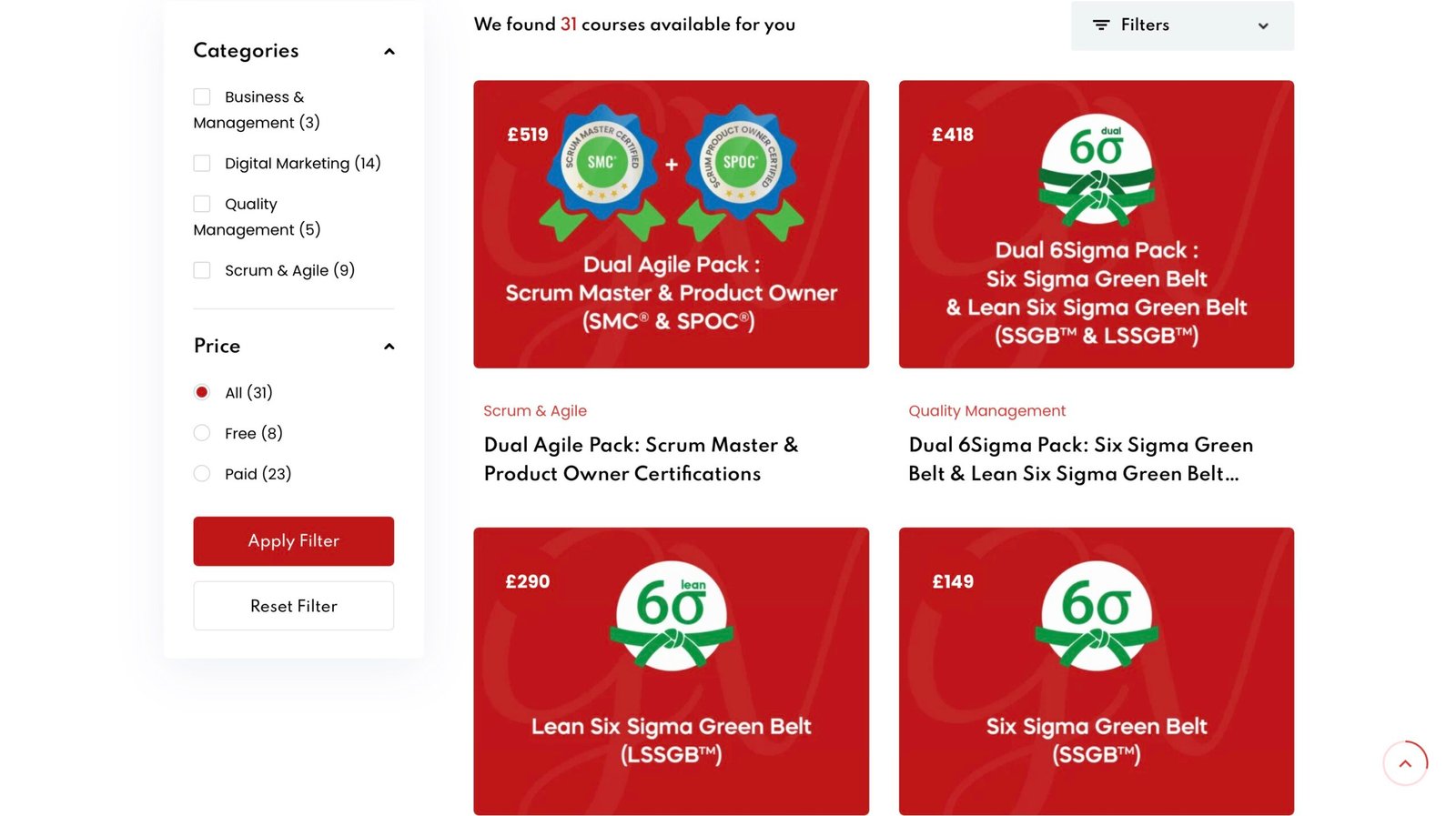
What is included differs by product, so check each course page for the study materials, access and exam arrangements that apply. Our Green Belt guide shows how one route is structured.
FAQ
What is the pass rate for the ASQ Six Sigma Green Belt exam?
ASQ reported 69% for 2022, 76% for 2023 and 77% for 2024. These figures apply to ASQ’s CSSGB exam only. They are not a pass rate for other providers’ Green Belt certifications.
What score do you need to pass an ASQ Six Sigma exam?
ASQ requires a scaled score of 550 out of 750. This is not the same as a percentage of questions answered correctly, because ASQ converts the raw cut score to a scaled score. Other providers set different passing marks, so check each exam page.
Can you retake a Six Sigma exam if you fail?
With ASQ, yes. There is no limit on attempts, a fee is charged for each retake and you must retake within two years of your last attempt. Other providers have their own rules on retakes, fees and voucher validity, so confirm them before purchase.
Is the Six Sigma pass rate the same as the Six Sigma project failure rate?
No. The pass rate describes how many candidates pass a certification exam. Project failure statistics refer to improvement projects in organisations and are unrelated to exam results.
Sources
- ASQ: Exam Grading & Certification Pass Rates FAQ
- ASQ: Exam Results, Pass Rates & Score FAQs
- ASQ: Six Sigma Green Belt Certification
- ASQ: Six Sigma Black Belt Certification
- ASQ: Six Sigma Certification Preparation
- IQPS: Test Run, ASQ exam pass data
- OpenExamPrep: CSSBB exam format and scoring
- CCRN Scoring Explained