



Yes, you can earn a Six Sigma Green Belt without work experience, but not with every provider. IASSC and the Council for Six Sigma Certification (CSSC) set no work-experience or project prerequisites for their Green Belt exams, while ASQ asks for three years of paid, on-the-job experience before you can sit its exam. So the real question is not whether you are allowed, but which provider’s rules fit your starting point.
This guide sets out how the main bodies differ, how hard the exams are, how a beginner can prepare, and what a Green Belt does and does not prove. Everything about provider rules here is provider-specific on purpose: there is no single international standard that all Green Belts follow.
Table of Contents
- Who asks for experience and who does not
- What ASQ’s experience rule actually means
- Starting with no experience: a realistic first step
- How hard is the Green Belt exam?
- A cautious preparation timeline
- What a Green Belt does and does not show
- Perspective
- Our Green Belt options and what they cost
- Choosing between Green Belt routes
- FAQ
- Sources
Who asks for experience and who does not
A Green Belt is not one credential. Several independent bodies issue their own, each with its own entry rules, exam and cost. The table below covers the three bodies most beginners meet, plus our own provider.
| Provider | Work experience | Project required | Exam format |
|---|---|---|---|
| ASQ (CSSGB) | 3 years full-time, paid, in one or more areas of the Body of Knowledge | Not stated as a requirement in the research we used | 110 questions, open-book, computer-delivered |
| IASSC (Lean Six Sigma Green Belt) | None | None | 100 questions, closed-book, proctored, 70% minimum score |
| CSSC (standard Green Belt) | None | None | 100 questions, open-book, online or at a test centre |
| 6sigmastudy (via GetVoucher) | Check the product page for current prerequisites | Check the product page | Provider-specific, see the SSGB page |
Two things stand out. First, “no prerequisites” does not mean “no exam”: every route above ends in an assessment you have to pass. Second, the formats differ in ways that matter to a beginner. ASQ and CSSC allow reference materials, IASSC does not. Do not assume one provider’s rules carry over to another.
If you want the wider map of belts and how providers order them, our Six Sigma certification path guide lays it out.
What ASQ’s experience rule actually means
ASQ is the one that trips beginners up. Its Certified Six Sigma Green Belt (CSSGB) page states that candidates need three years of full-time, paid, on-the-job work in one or more areas of the CSSGB Body of Knowledge before taking the exam (ASQ, 2026). That is a work-experience requirement, not a documented-project requirement. If you are a student, graduate or career changer with no relevant paid role yet, ASQ is a later goal rather than a first step.
That does not close the door. Many beginners start with a provider that has no entry barrier, learn the tools, and apply them at work. If you later accumulate the years ASQ asks for, you can look at the ASQ route with a stronger background. Treat that as one possible sequence, not the only one.
Starting with no experience: a realistic first step
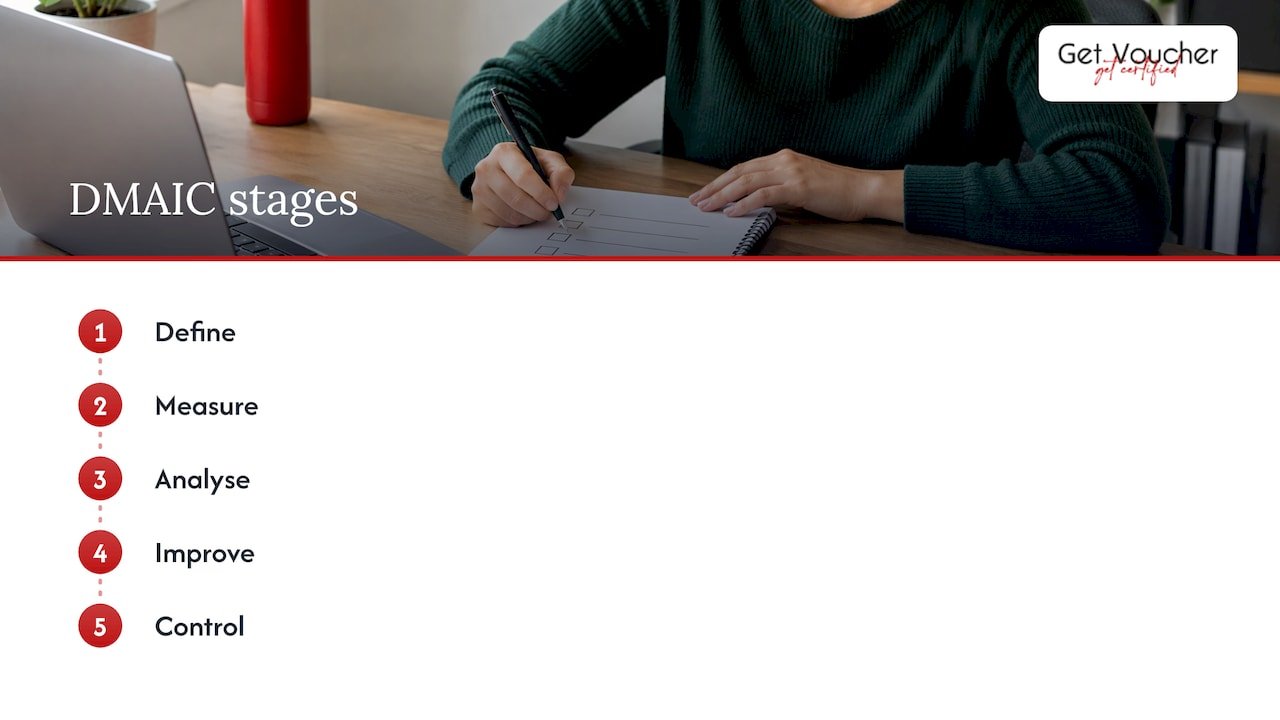
If you have never touched Six Sigma, the vocabulary alone can feel heavy. DMAIC (Define, Measure, Analyse, Improve, Control), process variation, control charts and root-cause analysis all arrive quickly. A gentler on-ramp helps.
Begin with the Yellow Belt
A Yellow Belt introduces the language and the basic logic of process improvement. Through GetVoucher, the Six Sigma Yellow Belt (SSYB™) voucher is £0. It is a low-risk way to see whether the subject suits you before you pay for anything. Note that a Yellow Belt is optional with some providers: the research shows Green Belt programmes that do not demand one, so you can skip it if you are confident.
Use free study material
CSSC publishes free self-study guides and its Body of Knowledge, and recommends either training or studying its guide to prepare for the exam (CSSC). Reading a Body of Knowledge before you commit is sensible with any provider: it tells you exactly what the exam will cover and lets you spot topics you have never met, such as hypothesis testing or process capability.
Practise on something small
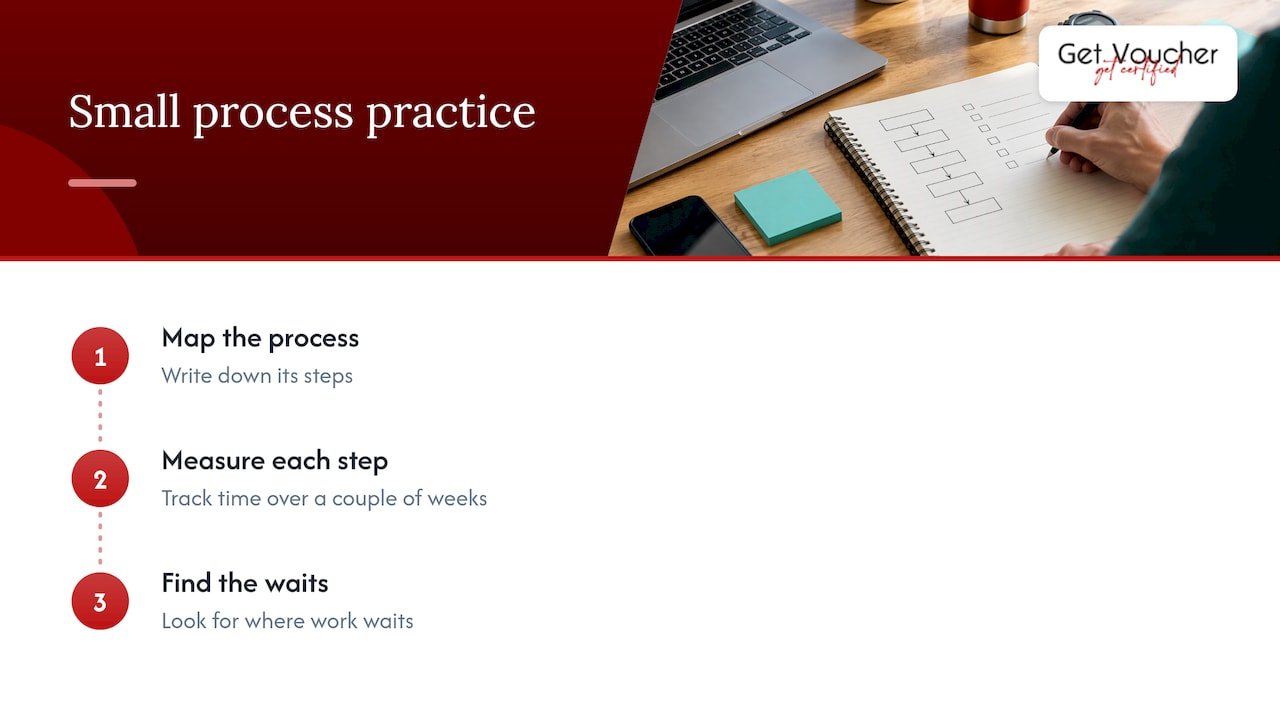
You do not need a factory. A beginner can map a process they already know: how invoices get approved, how a returns request moves through a shop, how long a hospital discharge letter takes. Write down the steps, measure how long each takes over a couple of weeks, and look for where work waits. This kind of practice is optional portfolio work. It is not an official certification requirement, and it will not be required by providers that have no project rule, but it makes the theory stick and gives you something concrete to say in an interview.
If you are moving into a new field and wondering how to talk about skills without a long track record, advice on starting a career with no experience covers the job-hunting side that certification alone does not.
How hard is the Green Belt exam?
Difficulty depends on the provider, the exam format and how much statistics you have met before. There is no single answer, so use the facts that are published.
- Pass rates are not passing scores. A passing score is the mark you need. A pass rate is the share of candidates who succeed. ASQ reports a CSSGB pass rate of 69% in 2022, 76% in 2023 and 77% in 2024 (ASQ). That applies to ASQ candidates, who must already have three years of experience, so it says little about how a beginner would fare elsewhere.
- Length. The ASQ exam has 110 multiple-choice questions, of which 100 are scored and 10 are unscored, with 4 hours 18 minutes of exam time and a total appointment of about four and a half hours (ASQ). IASSC and CSSC both use 100 questions.
- Reference rules. ASQ’s exam is open-book. CSSC’s is open-book. IASSC’s is closed-book and proctored, with a 70% minimum score (IASSC). Open-book does not mean easy: you still need to find and apply the right method under time pressure.
- Your maths. The hardest part for most beginners is statistics, not the vocabulary. If you are comfortable with averages, standard deviation and reading a chart, you have a head start. If not, give that section extra weeks.
A proctored exam is not automatically more credible than an unproctored one, and an unproctored one is not automatically easier. Judge each exam by what it assesses and how well the Body of Knowledge matches your goals.
A note on Scrum Master exam difficulty
Readers comparing Green Belts with Scrum often ask about Scrum Master exams too. Difficulty again varies by provider, and costs split into exam fees, mandatory training, optional preparation, retakes and renewal. Our own SCRUMstudy Scrum Master Certified (SMC®) uses a 100-question, 120-minute online unproctored exam. Check the SMC page for what that purchase includes. Do not compare it with other bodies’ exams on question count alone, because each provider tests differently.
A cautious preparation timeline
How long you need depends on your background, so treat any figure as a planning guess. As a rough shape for someone starting from zero:
- Weeks 1 to 2: read the Body of Knowledge for your chosen provider and note what is unfamiliar.
- Weeks 3 to 5: work through the training material, focusing on DMAIC and the basic statistics.
- Weeks 6 to 7: practise on a small real process and revisit weak topics.
- Week 8: take practice questions and plan exam day.
We have laid this out in more detail in our 8-week Green Belt study plan. Adjust it to the provider’s official syllabus, and allow longer if statistics is new to you.
What a Green Belt does and does not show
A Green Belt shows you have studied a body of knowledge and passed an assessment. It does not prove you can deliver results in a real workplace, and it does not guarantee a job, a salary or a promotion. Employer attitudes vary by company and sector.
Some data exists, with limits. ASQ’s 2020 Quality Progress Salary Survey found that US respondents who completed any level of Six Sigma training earned $16,411 more on average than those with none, and CSSGB holders earned $10,736 more on average (ASQ, 2020). That is a US survey of respondents from one year and shows association, not cause. It should not be read as a UK pay forecast.
Perspective
We built our Six Sigma range around the fact that beginners rarely arrive with three years of process-improvement work behind them. That is why we start the path at a £0 Yellow Belt, and why we offer Green Belt options that let you move forward while you build real-world practice alongside your study.
Our view is that a Green Belt voucher is most useful when you match it to your own goal. If you want a structured, self-paced route into process improvement and you are not yet eligible for experience-based bodies, a 6sigmastudy Green Belt gives you a practical entry point. If you later want to add Lean tools, the Lean Six Sigma Green Belt sits alongside it, and the Black Belt route is there when you are ready.
We would also say plainly: certification is one input. Pair it with a small improvement exercise at work or in a volunteer setting, and you will be able to explain what you learned in your own words.
Rayan
Our Green Belt options and what they cost
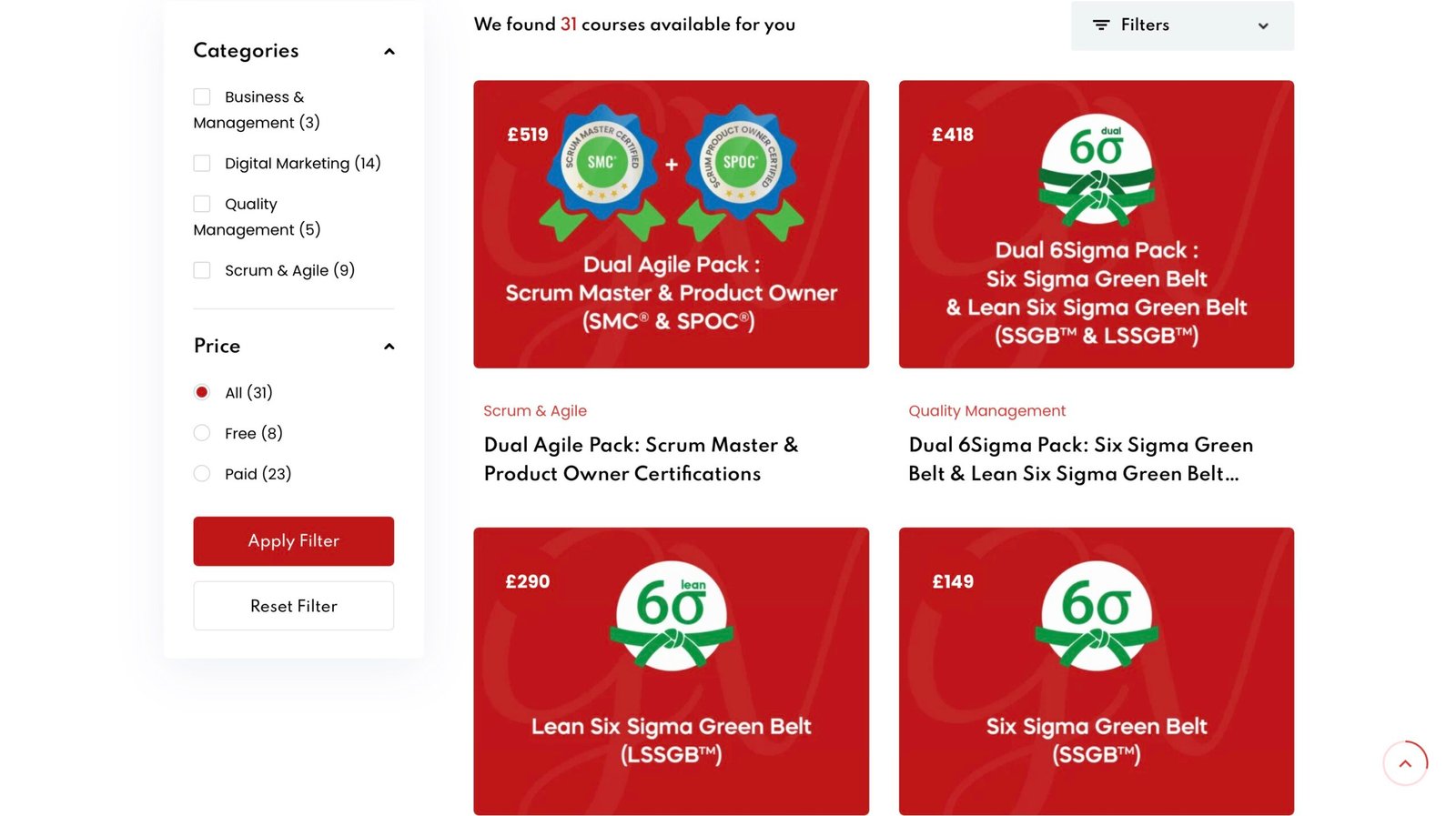
GetVoucher sells vouchers for certifications from providers such as VMEdu and the 6sigmastudy brand, so we have a commercial relationship with them. These are the Six Sigma prices published in our catalogue, which we read on 14 October 2026:
| Voucher | Price |
|---|---|
| Six Sigma Yellow Belt (SSYB™) | £0 |
| Six Sigma Green Belt (SSGB™) | £149 |
| Lean Six Sigma Green Belt (LSSGB™) | £290 |
| Dual 6Sigma Pack (SSGB and LSSGB) | £418 |
| Six Sigma Black Belt Certified (SSBB™) | £299 |
These are one-off prices. What each purchase includes, such as training resources, materials or exam scheduling support, differs per product, so read the product page before you buy. Lean, Six Sigma and Lean Six Sigma are distinct: Six Sigma centres on reducing variation, Lean on removing waste, and the combined Green Belt blends both, with its own provider-specific rules.
The Green Belt vouchers are external to ASQ, IASSC and CSSC: we do not sell those bodies’ credentials, and a 6sigmastudy certificate is a different credential from theirs.
If you are ready to start, the Six Sigma Green Belt (SSGB™) page lists the current details. For a side-by-side view of exam-only versus project-based routes, see our guide to the best Six Sigma certifications.
Choosing between Green Belt routes
Use these criteria rather than a single “best” answer:
- Your experience today. No paid, relevant experience? Providers with no work-experience prerequisite, such as IASSC and CSSC, or a provider whose product page confirms open entry, fit best now.
- Exam style. Prefer reference materials in the exam? ASQ and CSSC are open-book. Prefer a closed-book, proctored sitting? IASSC is. Neither is superior in itself.
- Project requirements. Some credentials involve project proof at higher belts. ASQ’s Black Belt, for example, has separate project requirements. Do not assume a Green Belt needs one: the three bodies above do not list a project for Green Belt.
- Where you want to go. If you expect to move toward Black Belt, our Six Sigma certification path article shows how belt rules differ by provider.
- Budget. Compare the full cost: exam fee, any mandatory training, optional preparation, retakes and renewal. An exam-only route is not automatically the cheapest overall.
For a longer read on timing and content, our Green Belt in 80 hours article covers how the study hours break down.
FAQ
Can I get a Green Belt with no experience at all?
Yes, with providers that set no work-experience prerequisite. IASSC and CSSC list none for their Green Belts. ASQ requires three years of paid experience, so it is not an option until you have it.
Do I need a Yellow Belt first?
Not necessarily. Some Green Belt programmes do not require a Yellow Belt. It can still be a useful introduction, and our Six Sigma Yellow Belt voucher costs £0.
Is the Green Belt exam hard for beginners?
It depends on the provider and your comfort with statistics. ASQ’s reported pass rate was 77% in 2024, though ASQ candidates all have prior experience. Allow extra time for statistics and practise with the official Body of Knowledge.
Is a Green Belt worth it without a project?
It shows you have learned and been assessed on the methods, which can support a conversation with an employer. It does not prove real-world performance or guarantee career progression, so pair it with a small practical improvement example where you can.
Sources
- ASQ: Six Sigma Green Belt Certification
- ASQ: Exam grading and certification pass rates
- ASQ: Six Sigma belts, levels and roles
- IASSC: Green Belt Certification
- CSSC: Six Sigma Green Belt Certification