




The most reliable route into agile coaching starts with a practitioner-level certification such as Scrum Fundamentals or Scrum Master Certified, then adds a coaching knowledge credential as your remit broadens, and only later moves to competency-based assessment if your role specifically requires demonstrated coaching practice. Several valid pathways exist depending on your background. Vouchers for practitioner stages, including Scrum Master Certified and Scrum Fundamentals Certified, are available.
Table of Contents
- Building your certification roadmap: from practitioner to coach
- Knowledge-based, competency-based and microcredential routes compared
- Preparing for the exam: formats, timelines and real costs
- How to choose the right certification for your situation
- How GetVoucher supports this roadmap
- Why a certificate is not the same as coaching ability
- Get moving: vouchers, formats and your next study block
- FAQ
- Sources
- Sources to verify before you commit
Building your certification roadmap: from practitioner to coach
Most people who end up coaching teams did not start out planning to. They started as a Scrum Master, a Product Owner, or a business analyst, picked up facilitation skills on the job, and only later formalised that into a coaching-focused credential. Thinking in stages helps you avoid buying certifications you do not need yet.
Entry stage. A practitioner certification such as Scrum Fundamentals Certified or Scrum Master Certified (SMC®) covers the vocabulary and mechanics you will coach others on: sprints, backlogs, retrospectives, the Scrum Master’s facilitation role. These are knowledge-based credentials, assessed through structured learning and a knowledge check rather than observed practice.
Mid stage. This is where backgrounds diverge. Some professionals add Product Ownership to understand how backlogs get prioritised. Others move towards Kanban for flow-based delivery, or business analysis to sharpen requirements and stakeholder work. None of these is a prerequisite for the next stage. They simply widen the context you can coach into.
Coaching knowledge credentials. At this point, some professionals pursue a dedicated coaching credential that assesses facilitation, mentoring and teaching skills rather than delivery mechanics. ICAgile’s ICP‑ACC is one widely referenced example of a knowledge-based coaching certification, open to people from varied starting points rather than reserved for former Product Owners or Scrum Masters specifically.
Advanced or competency stage. When an employer or client needs evidence that you can coach, not just explain coaching, that is when competency-based assessment, supervised practice or portfolio review comes into play, as covered in the next section.
A quick way to decide where to start:
- If you are new to agile delivery, begin with a practitioner certification before anything coaching-specific.
- If you already run ceremonies and want broader context, add Product Ownership, Kanban or business analysis based on your team’s gaps.
- If you are being asked to coach formally, look at a knowledge-based coaching credential next.
- If a client or employer wants proof of coaching competence, expect a competency-based route with assessed practice.
Knowledge-based, competency-based and microcredential routes compared
Not every certification measures the same thing, and conflating them leads to disappointment on both sides of the hiring table.
Knowledge-based credentials assess whether you understand a syllabus: concepts, frameworks, terminology, typically through a workshop and a written or online exam. Scrum Fundamentals, Scrum Master Certified and ICAgile’s ICP‑ACC fall into this category. They demonstrate that you know what good coaching looks like.
Competency-based credentials go further and require evidence that you have applied the skill. ICAgile’s ICE‑AC is the clearest example: it requires ICP‑ATF and ICP‑ACC as prerequisites, plus demonstrated real-world coaching practice validated through a portfolio and peer feedback. This is the stage where supervised practice genuinely belongs, not earlier.
Microcredentials are narrower still: a focused module on one skill, such as facilitation or mentoring, rather than a full coaching syllabus. They suit people who want to close a specific gap quickly rather than complete a lengthy programme.
- Knowledge-based: syllabus plus exam, no observed practice required.
- Competency-based: prerequisites plus portfolio and peer-assessed practice.
- Microcredential: one targeted skill, faster to complete.
Pro Tip: Ask any certifying body exactly what “assessed” means for their credential before you enrol, since the word covers everything from a multiple-choice quiz to months of mentored coaching.
Employers increasingly look past the certificate title to what was actually assessed, so keeping a short written record of real coaching situations you have handled strengthens your case regardless of which credential you hold.
Preparing for the exam: formats, timelines and real costs
Preparation routes vary by provider and budget. The most common are self-paced video courses, instructor-led workshops, cohort-based practice groups and mentored coaching practice for advanced credentials. Assessment formats differ too: some certifications use an online proctored exam, others a workshop-based assessment, and competency-based credentials rely on portfolio review.
- Confirm whether the exam is delivered as an online proctored test, an in-person session or a workshop assessment before you buy anything.
- Check retake policy and renewal requirements, since these vary significantly between certifying bodies.
- Compare what is included in the price: the exam itself, study materials, or both, since this is the main reason the same subject can cost very differently across providers.
- Budget study time realistically. Knowledge-based practitioner certifications typically involve fewer study hours than competency-based coaching credentials, which require accumulated coaching practice over months, not days.
Costs vary because providers bundle different things into the same headline price, and format changes the workload: a self-paced course asks more discipline of you than an instructor-led workshop, but usually costs less.
How to choose the right certification for your situation
Start with the job you actually want to do, not the certificate that sounds most impressive. A team-level coach, a delivery coach working across several teams, and an enterprise coach advising leadership all need different depth, and no single credential covers all three equally well.
- Match the credential to your target role: team coaching, delivery coaching or enterprise-level advisory work each imply different scope.
- Filter by your current experience level and whether your next role genuinely requires assessed practice or simply a knowledge foundation.
- Decide between self-paced and instructor-led formats based on your available time and budget, not just price.
- Ask any provider directly how the exam is assessed, what renewal involves, and where their accreditation claims can be independently verified.
- Treat an unclear assessment method, a missing syllabus, or unverifiable accreditation claims as reasons to look elsewhere.
How GetVoucher supports this roadmap
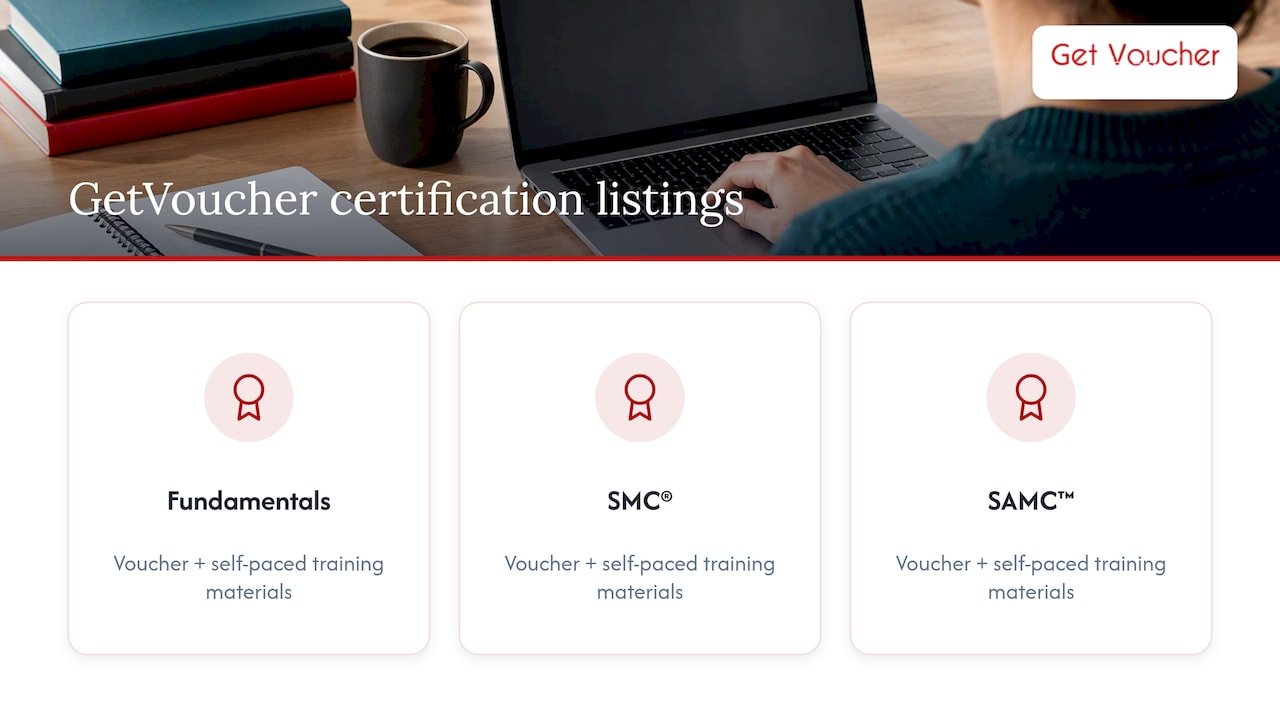
GetVoucher works as a voucher platform for certifications from established providers including VMEdu brands such as SCRUMstudy. For the practitioner stages of this roadmap, GetVoucher lists Scrum Fundamentals Certified, Scrum Master Certified (SMC®) and SCRUM Agile Master Certified (SAMC™), each paired with self-paced training materials that reduce time spent hunting for separate study resources. Confirm current pricing and exam delivery details on the live course pages before purchasing, since these can change.
Why a certificate is not the same as coaching ability
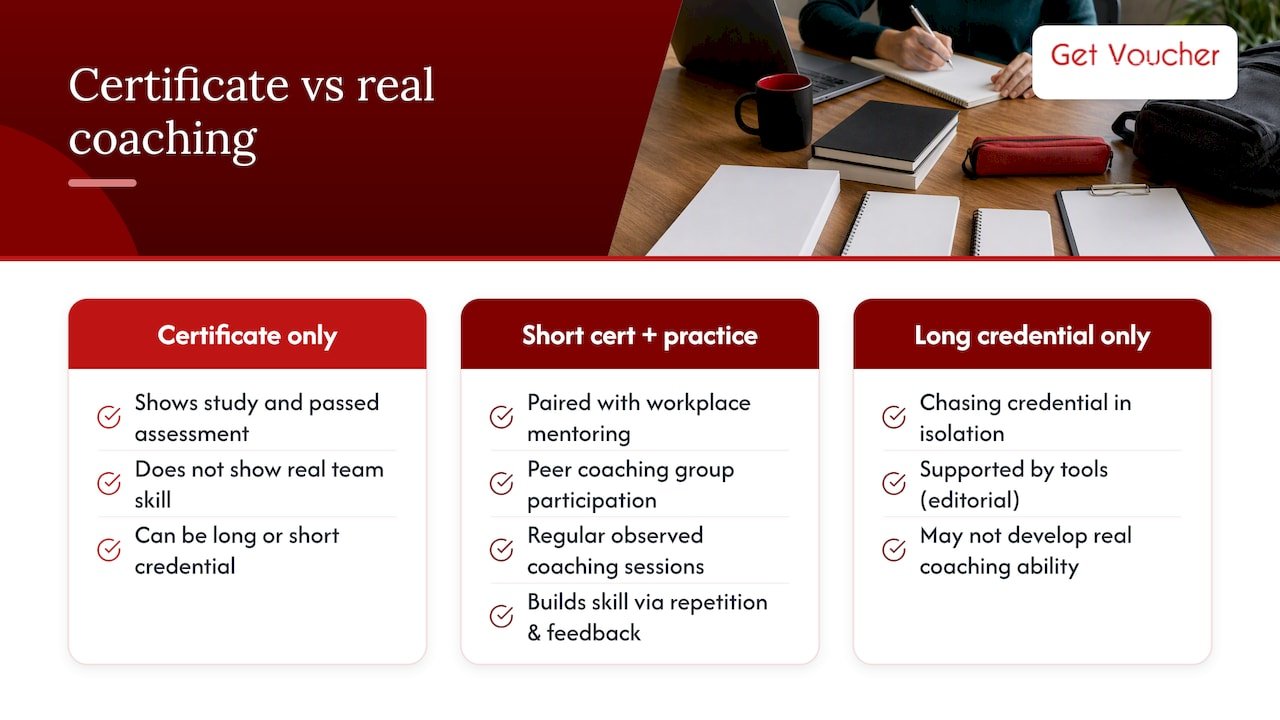
A certificate tells you someone studied the material and passed an assessment. It does not tell you whether they can sit with a struggling team and actually shift how that team works, which is a different skill built through repetition, feedback and the occasional uncomfortable conversation.
My own view, for what it is worth, is that pairing a shorter knowledge-based certificate with real workplace mentoring, a peer coaching group or regular observed sessions does more for your coaching ability than chasing a longer credential in isolation, supported by tools like Omniprism for professionals. That is an editorial opinion, not a factual claim about any certifying body’s standards.
— Rayan
Get moving: vouchers, formats and your next study block
Once you know which stage of the roadmap you are on, the practical blocker is usually logistics, not motivation. Voucher platforms can help remove that friction: you pick the certification, buy the voucher, and get access to structured self-paced material instead of piecing together free videos from multiple sources.
For professionals building towards coaching, a sensible starting point is the Dual Agile Pack covering Scrum Master and Product Owner certification, which gives you both delivery and product context in one purchase. If you only need the entry step, Scrum Fundamentals Certified is free. From there:
- Browse the full list of certifications on GetVoucher to see what maps to your stage.
- Verify exam delivery format and renewal terms on the specific course page before buying.
- Schedule your study block around the format you choose, self-paced or workshop-based.
- Consider joining a practice group or finding a mentor alongside your certification to build the practical side the exam will not test.
FAQ
How can I become an agile coach?
Most professionals build towards agile coaching by starting with a practitioner-level certification, broadening into related areas such as Product Ownership or Kanban, and then adding a coaching-focused knowledge credential before pursuing competency-based assessment if a role demands it. The Scrum Alliance notes that certification is not strictly required to work as an agile coach, though it can help signal competence to employers.
How much do agile coaches earn?
Compensation for agile coaches varies by region, employer, sector and experience, and no single figure applies universally. Rather than quoting one number, check current local salary surveys and job postings for your market and seniority level.
Will AI replace agile coaches?
Agile coaching centres on human facilitation, mentoring and navigating team dynamics, which are not tasks current automation tools replicate directly. AI tools may support coaches with data or logistics, but they do not substitute for observed, human-led coaching practice.
Are agile coach and Scrum Master the same?
No. A Scrum Master typically facilitates one team’s use of the Scrum framework, while an agile coach often works across multiple teams or at an organisational level and may draw on broader coaching, mentoring and facilitation skills beyond a single framework.
Sources to verify before you commit
Confirm credential rules and recent programme changes directly with the issuing bodies rather than relying on secondary summaries. The Scrum Alliance explains what agile coaching involves and how certification fits in, while its help centre update describes recent changes to coaching pathways including new microcredentials. For voucher availability and pricing, check the GetVoucher landing page and the relevant course pages directly.