




Agile often suits work where requirements shift and feedback drives direction, while Waterfall commonly fits projects with well-defined, stable requirements and a clear sequence of stages. Most organisations, though, blend the two rather than picking one outright, a point that both the APM and Gov guidance make clear. Certification platforms such as GetVoucher can help you validate whichever skill set your context demands.
Table of Contents
- What is Agile? A framework-neutral explanation
- What is Waterfall? The sequential planning model
- Agile vs waterfall: a side-by-side comparison
- Benefits and challenges of each approach
- A fit-for-purpose framework for choosing your approach
- Governance, planning and contracting implications
- Hybrid and blended life cycles in practice
- Why the binary framing misses the point
- Build your Agile and Scrum skills with GetVoucher
- FAQ
- Sources
What is Agile? A framework-neutral explanation
Agile describes an approach built around short cycles of planning, building and reviewing work, with frequent opportunities to adjust direction based on feedback. Rather than one methodology, it covers a family of practices that share a preference for iteration over a single upfront plan, as the Agile Manifesto sets out in its founding principles. It is worth separating this general approach from specific frameworks like Scrum, which adds its own named roles and ceremonies on top of the underlying Agile mindset.
A team working in an Agile way typically organises delivery around:
- Short review periods, often a few weeks long, where a working increment is produced and assessed.
- A prioritised backlog of work items that gets reordered as priorities change.
- Regular demonstrations of progress to stakeholders, used to gather feedback early.
- Ongoing retrospection and adjustment of how the team works, not just what it builds.
A common misconception is that Agile means no planning at all. GOV.UK guidance notes that Agile teams commonly maintain a roadmap looking 6 to 12 months ahead, while planning the detail of each cycle more closely as it approaches.
What is Waterfall? The sequential planning model
Waterfall, more formally a predictive or sequential life cycle, organises delivery into distinct phases that run in order: requirements, design, build, test and release. Each phase is generally expected to be completed and signed off before the next begins, which GOV.UK’s own guidance uses as the contrasting case when explaining Agile delivery.
In a predictive setup, scope, time and cost are often fixed early and tracked against that baseline, though the degree of rigidity in practice depends heavily on the contract type and how much change the client is prepared to approve mid-project. Typical features include:
- A detailed upfront requirements specification, agreed before design work starts.
- Formal sign-off gates between phases, often tied to budget release.
- Limited built-in mechanisms for incorporating feedback once a phase is closed.
- Documentation-heavy handover points, useful where multiple teams or contractors are involved.
Sequential planning is often adopted in construction, integrated hardware builds and other contexts where physical dependencies or regulatory sign-off make late-stage changes expensive, though Waterfall is used across many other sectors too.
Agile vs waterfall: a side-by-side comparison
The clearest way to compare the two is across the dimensions that actually affect delivery decisions, rather than treating them as a binary choice. The table below reflects typical patterns described in APM’s comparison of the two approaches.
| Dimension | Agile | Waterfall |
|---|---|---|
| Planning cadence | Short cycles, replanned regularly | Upfront plan, fixed before delivery starts |
| Scope handling | Backlog reprioritised as learning occurs | Scope generally agreed and baselined early |
| Stakeholder feedback | Built in through regular reviews | Concentrated at phase gates or project end |
| Best for | Uncertain or evolving requirements | Clearly specified, stable requirements |
| Main risks | Scope creep without strong backlog discipline | Late discovery of issues, costly rework |
APM research associates greater use of Agile techniques with improved project outcomes, though it frames this as a correlation rather than proof that Agile guarantees success. Read these rows as typical contrasts: many real projects combine predictive governance with iterative delivery rather than sitting purely on one side.
Benefits and challenges of each approach
Neither approach is free of trade-offs, and the evidence behind each benefit is best read as an association with good outcomes rather than a guarantee.
- Agile’s frequent feedback loops can surface misunderstandings early, which may reduce the cost of late-stage rework on projects where requirements are still settling.
- Agile’s incremental delivery can let stakeholders see working output sooner, which APM’s research associates with stronger sponsor and customer outcomes, while cautioning that more investigation is still needed.
- Agile asks for sustained stakeholder availability. When that commitment is not maintained, the review cycle can become superficial, undermining the approach’s core advantage.
- Waterfall’s upfront specification can give finance and procurement teams a clear baseline for budgeting, which may suit fixed-price contracts and multi-supplier handovers.
- Waterfall’s phase gates can provide clear audit points, useful where formal sign-off is a regulatory or contractual requirement.
- Waterfall can struggle when requirements are genuinely unstable, since change requests late in the sequence tend to be more expensive to absorb than in an iterative setup.
- Both approaches can fail for the same underlying reason: a mismatch between the organisation’s governance culture and the delivery method chosen, rather than any inherent flaw in the method itself.
A fit-for-purpose framework for choosing your approach
Rather than asking “Agile or Waterfall”, it helps to work through a short set of context questions, since most organisations end up blending elements of both.
- How well defined are your requirements? Stable, detailed specifications point towards a more sequential plan; evolving or exploratory requirements often suit iterative cycles.
- Can stakeholders commit to regular feedback? Agile’s value depends on that availability; where it cannot be guaranteed, phase-gated reviews may be more realistic.
- Are there regulatory or physical constraints? Hardware dependencies or formal compliance sign-off can make sequential milestones useful, without ruling out iterative work within them.
- How is commercial risk allocated? Fixed-price contracts often assume a predictive structure; time-and-materials or outcome-based contracts can support iterative delivery more naturally.
- What is your team’s working maturity and toolchain readiness? A team new to iterative delivery, or without supporting tools, may need a hybrid transition rather than a full switch.
Pro Tip: Treat these as trade-off questions, not a scorecard: most answers point towards a hybrid structure rather than a pure method.
Governance, planning and contracting implications
How you present progress for approval looks different depending on the life cycle you choose, and procurement teams often need to adjust accordingly. The 2024 HM Treasury and Central Digital and Data Office clarification confirms that Agile delivery can sit within formal business-case processes when the evidence used for approval is adapted to iterative artefacts.
Practical steps for aligning governance include:
- Replace single milestone sign-offs with recurring review points tied to working demonstrations and backlog status.
- Brief finance and procurement early on how risk allocation shifts under iterative contracts, since fixed-scope assumptions may no longer apply.
- Agree in advance what evidence (demos, burn charts, backlog health) will satisfy internal approval stages.
- Revisit contract terms where commercial risk needs to sit differently between client and supplier.
Hybrid and blended life cycles in practice
Many delivery teams run a predictive outer structure with iterative work inside it: a sequential business case and phase gates at the programme level, with short review cycles used for the detailed build. Academic and industry research into hybrid project management practices describes this pattern as common, often summarised as a ‘golf-bag’ approach where the technique is chosen per situation rather than fixed in advance.
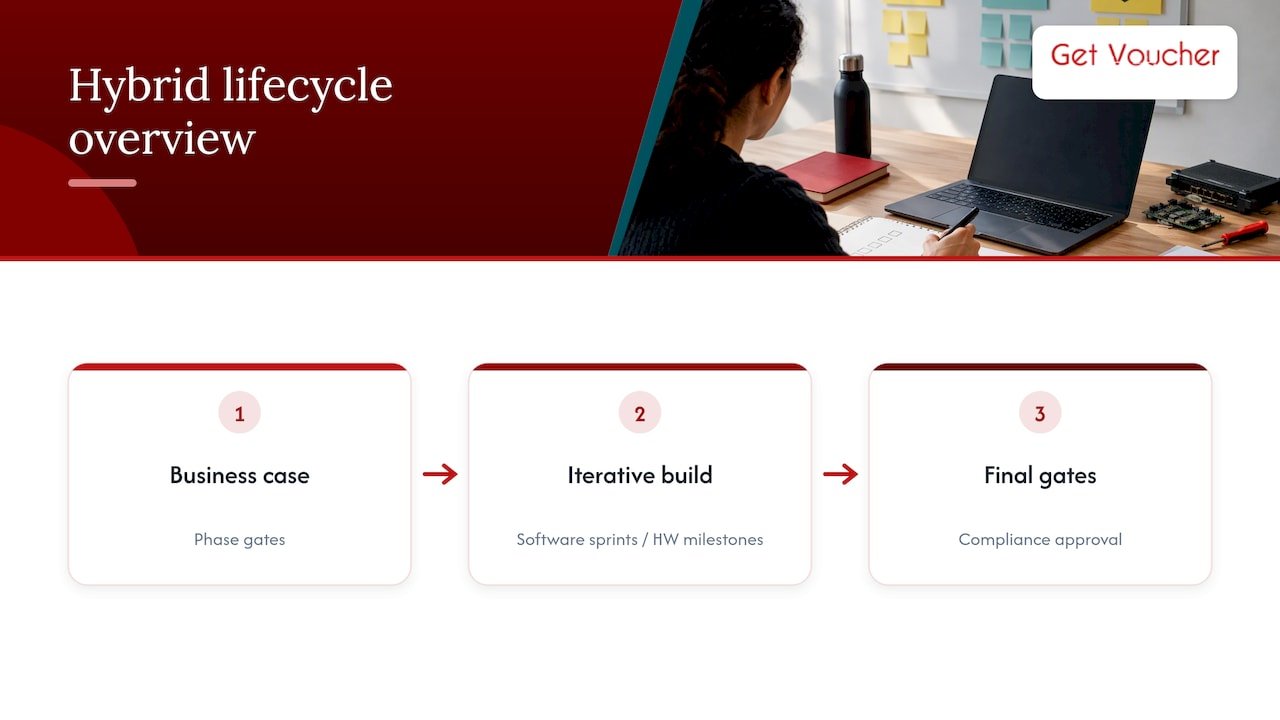
A software project with embedded hardware components might run iterative cycles for the application layer while keeping sequential milestones for the physical build. A regulated service might keep a fixed approval gate for compliance sign-off while running iterative design work on the user-facing parts in between gates.
Why the binary framing misses the point
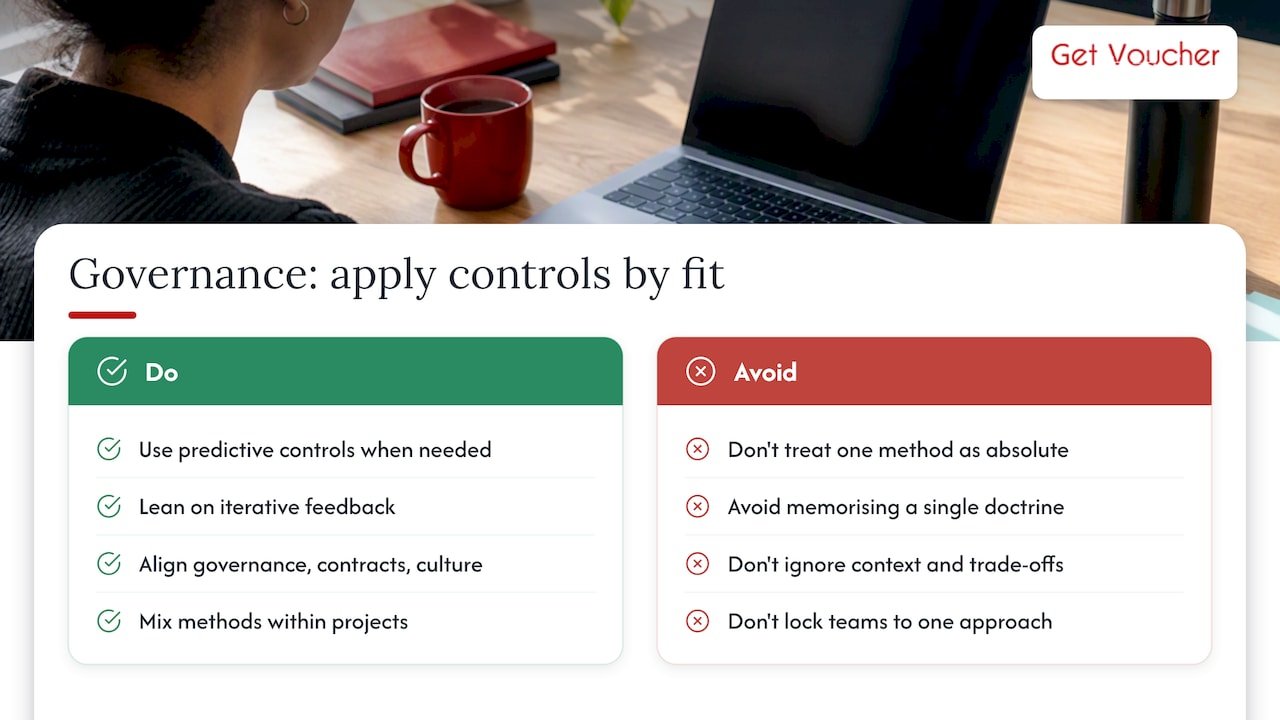
Most of the debate around Agile versus Waterfall assumes you are picking a side once and living with it. In practice, the more useful skill is knowing when to apply predictive controls and when to lean on iterative feedback, often within the same project. APM has made this point directly, cautioning against treating either method as the only correct answer regardless of context.
What tends to separate successful projects from struggling ones is not the branded method on the cover page, but whether governance, contracting and team culture are genuinely set up to support the chosen mix. Readers validating their own delivery skills, whether through Scrum-specific training or broader project management study, are better served by understanding this trade-off than by memorising a single doctrine.
— Rayan
Build your Agile and Scrum skills with GetVoucher
Whichever mix of Agile and Waterfall your organisation settles on, having a recognised certification behind you makes it easier to argue for the right approach in the room. GetVoucher is an online certification voucher platform offering flexible, self-paced pathways across Scrum and Agile, including the Scrum Fundamentals Certified course as a starting point and the Dual Agile Pack covering Scrum Master and Product Owner certification for those ready to go further.
If you want a fuller map of certification options and how they fit a career path, the complete Scrum and Agile guide walks through the main routes. Browse the full certifications catalogue to find the pathway that matches where you want to take your delivery career.
FAQ
Is Waterfall still relevant today?
Yes, Waterfall remains in active use, particularly where requirements are stable and sign-off gates matter for contractual or regulatory reasons. APM’s guidance treats it as one end of a continuum rather than an outdated method, with choice depending on project context.
Is Scrum Agile or Waterfall?
Scrum is a specific framework built on Agile principles, using short review periods, a backlog and defined roles such as a Scrum Master and Product Owner. It is not a form of Waterfall: its structure is iterative, aligning with the general Agile approach described in the Agile Manifesto.
Is Agile still relevant in 2026?
Agile continues to be widely applied, with APM research associating greater use of Agile techniques with improved project outcomes, though not guaranteeing success on every project. Its relevance depends on whether requirements are likely to change and whether stakeholders can commit to regular feedback.
Is Jira Agile or Waterfall?
Jira is a project tracking tool that supports both Agile boards, such as Scrum and Kanban style workflows, and more sequential, phase-based tracking depending on how a team configures it. The tool itself does not determine the methodology; that choice sits with the team and the project’s governance needs.
Which approach suits regulated industries?
Regulated and safety-critical industries often adopt sequential sign-off gates to satisfy compliance requirements, but Agile is also used in regulated contexts where iterative development is paired with formal review points. The right fit depends on the specific regulatory driver, not the industry label alone.