




The best negotiation management certification for professionals ready to prove advanced skill is the Negotiation Management Professional (NCN-P), available through GetVoucher with VMEdu as the delivering provider and NGstudy as the certification body. If you want a free, no-risk starting point first, NGstudy’s Certified Negotiation Associate (NCN-A) builds the groundwork before you commit to NCN-P’s practical, career-focused curriculum.
TL;DR:
- The entry-level NGstudy Certified Negotiation Associate (NCN-A) offers a free, self-paced introduction to negotiation fundamentals, ideal for beginners testing interest.
- The professional NCN-P credential builds on NCN-A, requiring deeper study, structured exams, and is suited for experienced negotiators handling high-value deals.
- The NCN-A exam is unproctored with 40 questions completed online, while NCN-P involves a more rigorous, professional-style assessment delivered via GetVoucher and VMEdu.
- Certification alignment to the NBOK guide ensures syllabus consistency, with transparent exam details and a clear progression pathway from NCN-A to NCN-P.
- Many other negotiation courses rely on workshops and simulations without formal exams, making NCN-A and NCN-P the most transparent options for skill validation and career advancement.
Table of Contents
- Top picks for negotiation management certification
- How do these negotiation certifications compare?
- How do you choose the right negotiation certification for your role?
- What do these negotiation courses actually teach you?
- How do you progress from NCN-A to NCN-P?
- Why are GetVoucher, VMEdu and NGstudy trustworthy for this credential?
- Should you start with NCN-A or commit straight to NCN-P?
- Where can you get these negotiation certification vouchers?
- Sources
Top picks for negotiation management certification
Most professionals researching a negotiation management certification are really choosing between two decisions: whether to test the water for free, or commit straight to a credential that signals advanced capability to employers. GetVoucher’s catalogue, built on NGstudy’s certification framework and delivered through VMEdu, covers both.
Negotiation Management Professional (NCN-P) sits at the professional tier. It follows the associate level in NGstudy’s certification progression and is aimed at people who already handle negotiation in some form at work, whether that’s procurement, commercial contracts, or senior client-facing roles, and want a credential that reflects applied, practice-led learning rather than a general overview. You can review the syllabus and access details on the Negotiation Management Professional (NCN-P) page.
NGstudy Certified Negotiation Associate (NCN-A) is the free entry point. It’s self-paced, requires no prior negotiation training, and gives you a structured introduction to the NBOK framework that underpins NGstudy’s entire certification family. The NGstudy Certified Negotiation Associate (NCN-A) exam runs to 40 questions across 60 minutes, delivered online and unproctored, with a pass mark of 30 out of 40. Clear it and your name goes onto the NGstudy certification registry.
Here’s how the two compare at a glance:
- Level: NCN-A is entry-level; NCN-P is professional-level, building on associate foundations.
- Cost: NCN-A is free; NCN-P is a paid credential accessed via a GetVoucher voucher.
- Exam delivery: NCN-A uses an unproctored online exam; NCN-P follows a more rigorous format suited to a professional-tier credential.
- Best for: NCN-A suits anyone testing whether negotiation training fits their career plans; NCN-P suits people already negotiating high-value deals who need a credential that reflects that.
- Time commitment: NCN-A is designed to be completed quickly and flexibly; NCN-P asks for a deeper, more sustained study period given its applied focus.
If your goal is simply to understand negotiation theory before deciding whether to invest further, start with NCN-A. If you’re already negotiating contracts, vendor terms, or client agreements and need a credential that reflects that reality, NCN-P is the stronger fit. Many professionals use NCN-A as a genuine first step and progress into NCN-P once they’ve confirmed the subject is worth the deeper investment, which is exactly how NGstudy’s own certification pathway is designed to work.
You’ll also see other names mentioned across negotiation training discussions, including Negotiation Experts’ Competent Negotiator programme, Northwestern Kellogg’s High-Performance Negotiation Skills course, Yale University’s Negotiation Strategies, The Gap’s Complete Skilled Negotiator, Scotwork’s Advancing Negotiation Skills, Karrass’s Effective Negotiating, Rotterdam School of Management’s Effective Negotiating Skills, and Shapiro Negotiations Institute’s Negotiation Training. These programmes each have their own positioning, and we’ll place them alongside NCN-A and NCN-P in the comparison below so you can see where the real differences lie.
How do these negotiation certifications compare?
The table below sets out the two GetVoucher certifications against the wider field of well-known negotiation training providers, using the criteria professionals actually weigh up: level, skills taught, who it suits, time and format, exam type, and cost.
| Certification | Level | Core skills taught | Suitable profiles | Time commitment / format | Exam format & delivery | Cost / availability |
|---|---|---|---|---|---|---|
| Negotiation Management Professional (NCN-P) | Professional | Applied, practice-led negotiation management building on associate-level foundations | Procurement, commercial contracts, legal, senior commercial roles | Self-paced online study, professional-tier depth | Structured exam via VMEdu/NGstudy delivery | Paid, via GetVoucher voucher |
| NGstudy Certified Negotiation Associate (NCN-A) | Entry-level | Foundational negotiation concepts aligned to the NBOK guide | Learners exploring negotiation fundamentals, first-time credential seekers | Self-paced online course | 40 questions, 60 minutes, unproctored, online | Free |
| Negotiation Experts – Competent Negotiator | Professional/executive | Broad negotiation frameworks and tactics | Executives and managers seeking general negotiation grounding | Instructor-led, cohort-based | Varies by provider | Paid, contact provider |
| Northwestern Kellogg — High-Performance Negotiation Skills | Executive education | Advanced tactics for high-stakes business negotiation | Senior leaders and executives | Intensive short-course format | No formal certification exam | Paid, university tuition |
| Yale University – Negotiation Strategies | Academic/professional | Strategic negotiation theory and application | Professionals wanting an academic credential | Online course, several weeks | Coursework-based assessment | Paid, university tuition |
| The Gap – The Complete Skilled Negotiator | Professional | Practical negotiation skill-building | Sales, procurement, and commercial teams | Multi-day workshop format | No standardised exam | Paid, contact provider |
| Scotwork – Advancing Negotiation Skills | Professional | Behavioural negotiation skills, live simulations | Experienced negotiators wanting skill refinement | Workshop-based, several days | No formal exam | Paid, contact provider |
| Karrass – Effective Negotiating | Professional | Classic negotiation tactics and strategy | General business professionals | Seminar format, one to two days | No formal exam | Paid, contact provider |
| Rotterdam School of Management (RSM) – Effective Negotiating Skills | Executive education | Negotiation strategy grounded in academic research | Managers and executives | Short executive programme | Coursework-based assessment | Paid, university tuition |
| Shapiro Negotiations Institute (SNI) – Negotiation Training | Professional | Customised negotiation training for teams | Corporate teams and sales organisations | Varies, often workshop-based | No standardised exam | Paid, contact provider |
The most decisive trade-off in this table isn’t price. It’s exam structure. NCN-A’s unproctored, 40-question format makes it genuinely low-friction, which is why it works so well as an introduction. NCN-P, by contrast, sits within a professional-tier credentialing structure that reflects the applied nature of the material, closer in spirit to how executive programmes from Kellogg, Yale, or RSM position themselves, minus the university tuition fees.
Several of the workshop-based providers, Scotwork, Karrass, The Gap, and SNI, lean heavily on live simulations and role play rather than formal exams. That’s a legitimate teaching method, and one NGstudy also uses within its own curriculum design. NGstudy’s own materials describe a progression of credentials running from NCN-A through NCN-P to more senior tiers, all aligned to the same NBOK guide, so the syllabus consistency carries through as you advance, which isn’t guaranteed when you switch between unrelated providers.
Pro Tip: If a negotiation programme doesn’t publish its syllabus alignment or exam structure anywhere public, treat that as a gap to investigate before you pay, not a detail to assume in the provider’s favour.
If any single row above feels thin on detail for a competing provider, that’s usually because pricing, exam structure, or duration for university-run and workshop-based programmes tends to be confirmed directly with the provider rather than published as a fixed rate.
How do you choose the right negotiation certification for your role?
Choosing between negotiation certifications gets easier once you stop comparing brand names and start comparing five concrete factors.
- Certification body and provider clarity. Know exactly who sets the syllabus and who delivers the course. For GetVoucher’s negotiation credentials, NGstudy is the certification body defining the curriculum, and VMEdu is the provider delivering it. That separation matters because it tells you who to check for syllabus updates and who to contact for access issues.
- Syllabus alignment. Ask whether the course maps to a named framework. NGstudy’s negotiation credentials align to the NBOK guide, which gives you a documented reference point rather than a vague “our own methodology” claim.
- Practical exercises versus pure theory. A programme heavy on case studies, simulations, and role play will build transferable skill faster than one built entirely around reading and multiple-choice testing. Check the course description for how much of the time is spent applying concepts versus absorbing them.
- Exam delivery format. Some certifications use unproctored online exams (like NCN-A), others use proctored delivery, and some workshop-based programmes skip formal exams altogether. Know which you’re signing up for before you register.
- Employer recognition in your specific field. A credential that’s well known in procurement may carry less weight in sales, and vice versa. Ask your manager or industry peers what they recognise before assuming any single certification carries universal weight.
Before committing, ask any provider these questions directly: Is the exam proctored or unproctored, and how long do I have to complete it? Will my name appear on a public certification registry after passing? What study materials come with the course, and are they self-paced or scheduled? Does the credential carry continuing education or recertification requirements, or is it a one-time qualification?
Three red flags should make you pause. First, a provider that won’t specify its exam format or pass mark in writing. Second, a syllabus that doesn’t reference any named framework or guide, which usually signals inconsistent content quality. Third, vague claims about “guaranteed” career outcomes, since no legitimate certification body can promise promotion or salary results.
Pro Tip: A fast credibility check: search for the certification body’s name alongside “registry” or “syllabus”. If a provider makes it easy to find its certification registry and its curriculum reference, that transparency is usually a decent proxy for how seriously it takes the credential overall.
What do these negotiation courses actually teach you?
Negotiation certifications live or die on whether the skills transfer to a Monday-morning meeting, not whether they look good on a certificate. Here’s what the curriculum underlying NGstudy’s NCN-A and NCN-P actually covers, and where it shows up at work.
BATNA analysis. Your Best Alternative to a Negotiated Agreement is the anchor concept in almost every serious negotiation curriculum, including NGstudy’s NBOK-aligned framework. Knowing your BATNA before you walk into a negotiation gives you clarity on when to push and when to walk away, rather than negotiating from anxiety about losing the deal entirely. In practice, this means a procurement manager entering supplier renewal talks with a clear number for “the point where switching suppliers beats staying,” rather than accepting whatever terms feel least uncomfortable in the room.
Interest-based bargaining. Rather than starting from fixed positions, interest-based approaches ask what each side actually needs and why. This is where active listening becomes a trained skill rather than a personality trait. Practitioner guidance from Harvard’s Program on Negotiation is blunt about the common failure mode here: most people spend their counterpart’s talking time preparing a rebuttal instead of listening for the interests hidden inside what’s being said. Structured negotiation training drills this deliberately, often through exercises that require summarising the other party’s position before responding to it.
Multi-issue trade-offs. Real negotiations rarely involve a single variable. A sales contract negotiation might involve price, payment terms, delivery schedule, and contract length simultaneously. Courses that teach multi-issue bargaining train you to identify which issues matter most to each side, so you can trade concessions on lower-priority points to win on higher-priority ones, rather than negotiating each issue in isolation.
Simulation-led practice. Many established negotiation programmes, from Scotwork’s live simulations to Karrass’s seminar exercises, build learning around role play rather than passive instruction, and NGstudy’s curriculum design follows the same logic within its own certification tiers. Simulations force you to apply BATNA thinking and interest-based questioning under mild time pressure, which is a far closer approximation of a real negotiation than reading a case study.
Dispute resolution. Not every negotiation proceeds smoothly. Courses covering dispute resolution teach de-escalation techniques and structured approaches for negotiations that have stalled or turned adversarial, a skill set that matters as much in internal stakeholder disputes as it does in external vendor conflicts.
Where does this show up at work?
- A procurement lead uses BATNA analysis to negotiate a supplier contract renewal without overpaying out of fear of disruption.
- A sales account manager applies multi-issue trade-offs to close a deal on favourable payment terms while conceding on delivery timeline, a concession that costs less than it appears to.
- A project manager applies interest-based bargaining to align two internal stakeholders who each believe their department’s priority should come first.
- A commercial lawyer uses dispute resolution techniques to bring a stalled contract renegotiation back to productive terms rather than escalating to formal proceedings.
The learning activities behind these outcomes typically split into three categories. Role plays develop real-time decision-making under mild pressure. Case studies develop pattern recognition, the ability to spot which negotiation tactic is being used against you before it lands. Exam-style assessment, whether NCN-A’s 40-question unproctored test or NCN-P’s more applied professional-tier format, checks that the underlying concepts have actually stuck, rather than just having been read once and forgotten.
How do you progress from NCN-A to NCN-P?
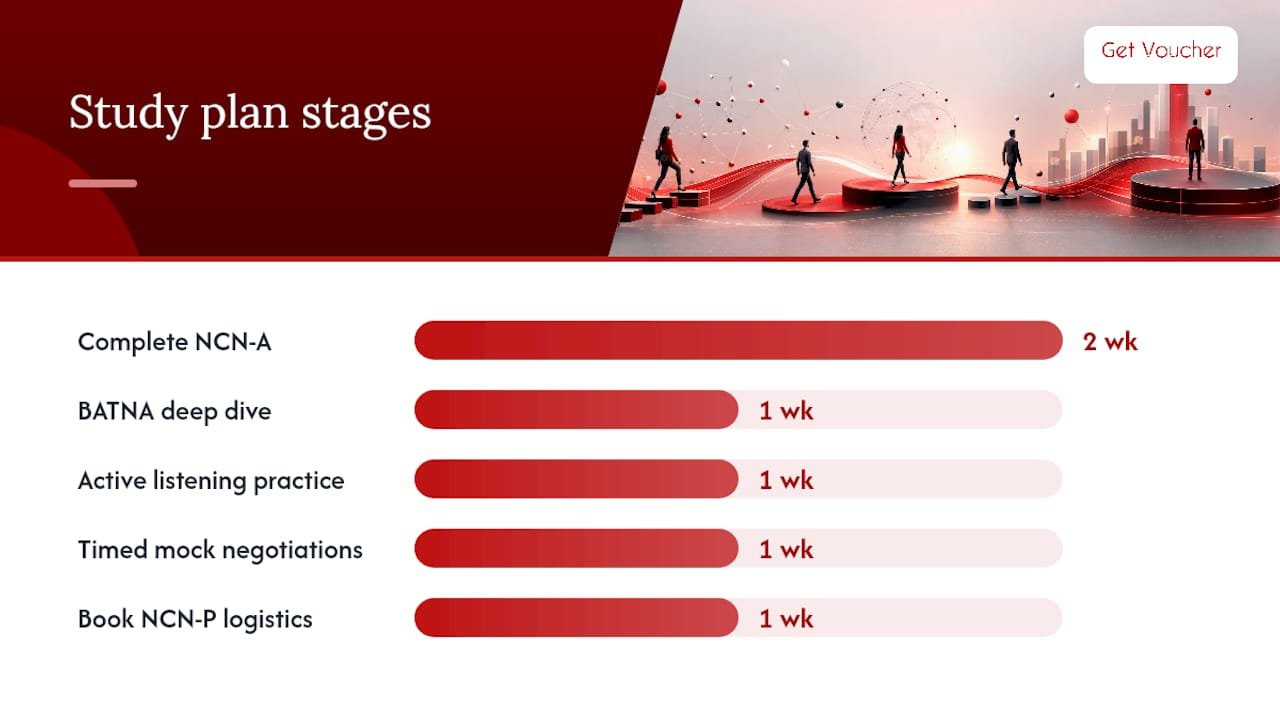
Moving from NGstudy’s free associate credential to the paid professional one doesn’t need to be a leap. A structured six to eight week study plan makes the transition manageable alongside a full-time job.
- Weeks 1 and 2: Complete NCN-A if you haven’t already. Work through the self-paced material, focusing on the NBOK framework’s core vocabulary. Treat the unproctored exam as a genuine checkpoint, not a formality, since it confirms whether the foundational concepts have actually landed.
- Week 3: Revisit BATNA and interest-based bargaining in depth. Draft a written BATNA for a real negotiation you’re facing at work, even a minor one. Writing it down forces the kind of specificity that reading about the concept doesn’t.
- Week 4: Practise active listening deliberately. Record yourself (or a colleague) in a mock negotiation and review it afterwards for moments where you were mentally rehearsing a response instead of listening for the other party’s underlying interest.
- Week 5: Run timed mock negotiations on multi-issue scenarios. Set a clock, give yourself three variables to trade (price, timeline, scope, for example), and force a resolution within 20 minutes. This builds the pressure-tolerance that a real negotiation demands.
- Week 6: Book your NCN-P access via GetVoucher and confirm the exam logistics. Check whether the sitting is proctored or unproctored, how long you have to complete it, and what materials you’re permitted to reference during the exam.
- Weeks 7 and 8: Consolidate with simulation practice and a final review pass. Revisit weaker areas identified during your mock sessions, and use any remaining study time on the topics that felt least intuitive during weeks 3 to 5.
On logistics: a GetVoucher voucher gives you access to the course materials and exam registration for the certification it corresponds to, purchased once and used to unlock the relevant NGstudy or VMEdu-delivered course. If you’re unsure which exam format applies to a specific sitting, or want confirmation of current scope and access details, GetVoucher’s certifications page is the place to check before you buy.
Pro Tip: You don’t need a real deal on the line to practise negotiation. Low-stakes settings, negotiating a return policy exception, agreeing meeting times with a colleague, even haggling at a market stall while travelling, all train the same listening and trade-off instincts. The research on decision practice is consistent on this point: repeated, low-pressure practice builds transferable capability faster than passive study alone.
Why are GetVoucher, VMEdu and NGstudy trustworthy for this credential?
GetVoucher’s role in this pathway is specific: it’s the voucher platform, not the certification body and not the training provider. When you buy access to NCN-P or register for the free NCN-A through GetVoucher, VMEdu is the provider delivering the course structure, and NGstudy is the certification body that owns the syllabus, sets the exam, and maintains the credential.
That separation of roles is itself a trust signal, because it means the curriculum content doesn’t change depending on which platform you access it through. NGstudy’s negotiation credentials align to its own NBOK guide, and the certification progression, associate through to more senior tiers, follows a documented pathway rather than an ad hoc course list.
The strongest trust signal in any certification isn’t the badge you get at the end. It’s whether the certification body publishes exactly what the exam covers, how it’s delivered, and what happens to your result once you pass. NGstudy does this openly for NCN-A: a 40-question, unproctored exam, a defined pass mark, and a place on the certification registry once you clear it.
That level of published detail is worth checking for any certification you’re weighing up, not only NGstudy’s. If a provider can’t tell you how the exam is structured or what happens after you pass, that’s a gap worth asking about directly.
Should you start with NCN-A or commit straight to NCN-P?
If you’re weighing this decision right now, here’s the honest read. NCN-A makes sense if you’re exploring negotiation as a discipline for the first time, or if your current role touches negotiation only occasionally and you want to confirm the subject is worth deeper investment before spending anything. It’s free, it’s self-paced, and the unproctored exam removes the pressure that might otherwise stop someone from starting at all.
NCN-P earns its place when negotiation is already a meaningful part of your role, procurement, contract management, senior sales, or commercial law, and you need a credential that reflects applied capability rather than introductory awareness. The return on that investment tends to show up fastest for people who are already negotiating regularly and want a structured way to sharpen technique they’re already using under real pressure.
On how employers view it: a professional-tier negotiation credential can support a promotion case or a lateral move into a more negotiation-heavy role, particularly when paired with demonstrable results in your current position. It’s reasonable to expect it to add weight to a CV or internal case, though how much weight varies by industry and by how well-known NGstudy’s credentials are within your specific field, so it’s worth checking with hiring managers or industry peers in your sector rather than assuming universal recognition.
My honest recommendation: if you’re unsure which tier fits you, don’t agonise over it. Start with NCN-A this month. It costs nothing, and finishing it will tell you more about whether NCN-P is the right next step than any amount of comparing course descriptions will.
— Rayan
Where can you get these negotiation certification vouchers?
GetVoucher is where you access both credentials covered in this comparison. The NGstudy Certified Negotiation Associate (NCN-A) page has full details on the free entry-level course, including how to start the self-paced material and register for the exam.

For the professional tier, the Negotiation Management Professional (NCN-P) page sets out how to access the paid course through a GetVoucher voucher. A voucher typically gives you access to the course materials and exam registration for the certification it’s tied to, purchased once through GetVoucher and then used with VMEdu, the delivering provider, to complete the course and sit the exam set by NGstudy.
If you’re weighing up other professional credentials alongside negotiation, from Agile and Scrum through to Six Sigma and digital marketing, GetVoucher’s certifications page lists what’s currently available. Some VMEdu brands, including SCRUMstudy, 6sigmastudy, SMstudy, KANBANstudy, RMstudy, and BAlearning, cover disciplines beyond negotiation and are being added to the GetVoucher catalogue over the coming months. If a certification you’re after isn’t listed yet, contact GetVoucher directly for current pricing and availability rather than assuming it’s unavailable long-term.
To check availability or current access details for either negotiation certification, visit your GetVoucher account or browse the full course list before purchasing.
Sources
- Why Get Certified — NGstudy
- Listening skills for maximum success — Program on Negotiation (Harvard)
- Business negotiation strategies to get better deals | Xero