




The best quality management certification is the one that matches your role, your experience and the way your employer or clients already talk about quality. For most people that means choosing between three families: broad professional credentials such as those from ASQ, auditor qualifications linked to the ISO 9001 standard, and process improvement belts such as Six Sigma. This guide explains what each family covers, who it suits and what to check before you pay, so you can build a shortlist of two or three options rather than a list of twenty.
One point first: no certification proves real-world performance, a job offer or a salary rise. A credential is a structured, third-party statement that you have studied a body of knowledge and passed an assessment. How much it matters depends on the employer, the sector and the provider, so check each provider’s current official pages for prerequisites, exam format, fees and renewal rules before you commit.
Table of Contents
- What a quality management certification actually is
- The main families of quality certification
- Comparing the options side by side
- Matching a certification to your role
- What to check before you pay
- Perspective: why we think accessible Six Sigma routes belong on your shortlist
- Quality certifications you can get through GetVoucher
- Ready to start?
- A sensible way to build your shortlist
- FAQ
- Sources
What a quality management certification actually is
The phrase covers two quite different things, and mixing them up is the most common mistake in this search.
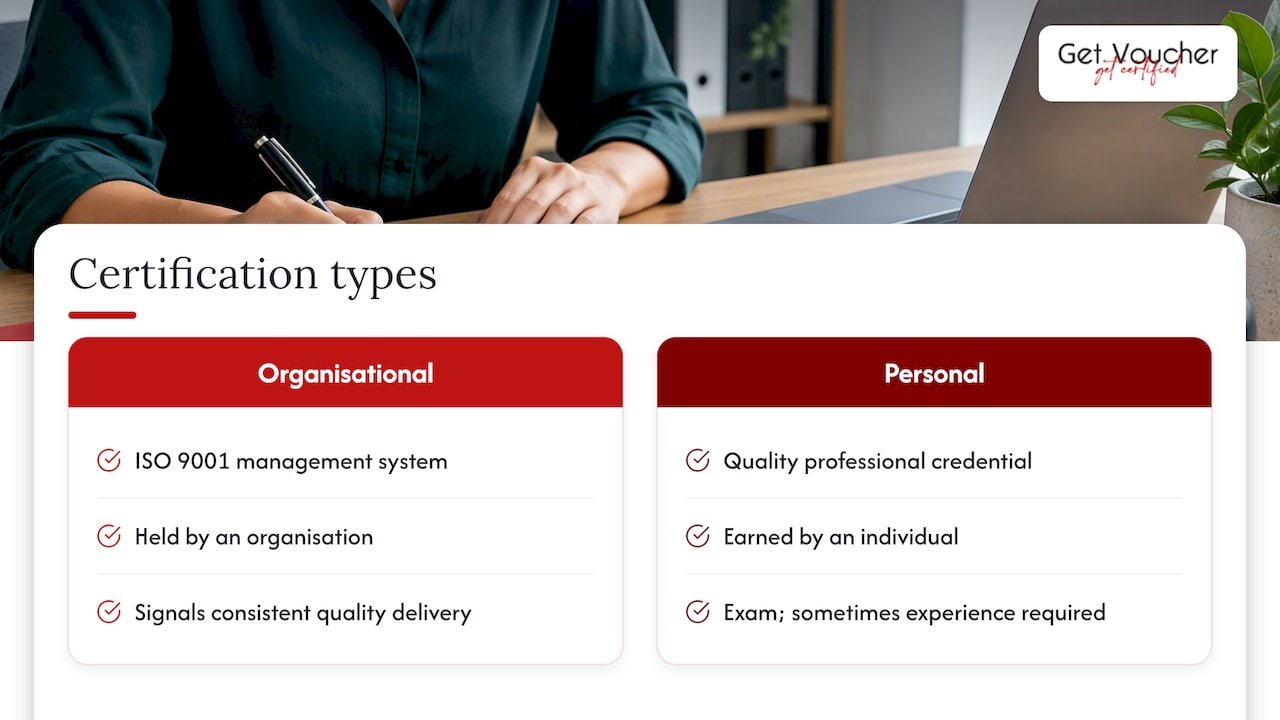
Organisational certification. ISO 9001 is the international standard for quality management systems. ISO explains that ISO 9001 certification commonly applies to an organisation’s management system rather than to an individual, although professionals can pursue related auditor qualifications. The standard itself notes that organisations can choose whether or not to seek certification, and that it signals a commitment to consistently delivering quality products and services. The current edition is ISO 9001:2026, the sixth edition, published by ISO in September 2026. If you work in a company that holds ISO 9001 certification, you will not hold the certificate personally, but you may be asked to understand or audit against it.
Personal professional certification. This is what you earn as an individual: a credential in quality engineering, auditing, management or process improvement, awarded after you pass an exam and sometimes meet experience requirements. This is the type the rest of this article compares.
On the value of personal credentials, Quality Magazine reports that they act as independent, third-party acknowledgments of expertise and can help to separate candidates in hiring, including as a tie-breaker between similar applicants. That is a media report from 2022 and a general observation, not a guarantee. Treat a certification as one piece of evidence next to your experience.
The main families of quality certification
ASQ professional certifications
ASQ is the best-known professional body in this field. According to Quality Magazine, ASQ offers 18 industry-impartial certifications across quality engineering, auditing, management, technical and inspection, Six Sigma and quality fundamentals, each with its own Body of Knowledge. The same article reports that ASQ certification is accredited by ANSI against ISO 17024, the international standard for bodies that certify people, and that exam questions are fact-based and validated by subject matter experts.
Credentials you will see named most often in job adverts and in the pages that rank for this topic include:
- Certified Quality Improvement Associate (CQIA): an entry-level credential on fundamental quality principles, team involvement and process improvement.
- Certified Manager of Quality/Organizational Excellence (CMQ/OE): aimed at people who lead quality functions or manage quality across a business.
- Certified Quality Auditor (CQA): for people who plan and carry out audits.
- Certified Quality Engineer (CQE): for technical roles in product and process quality.
- Certified Reliability Engineer (CRE): for reliability-focused engineering roles.
- ASQ Six Sigma belts: Green Belt and Black Belt credentials.
Prerequisites differ by credential and can change, so read ASQ’s current certification page for each one. Two points are worth knowing for Six Sigma specifically: the ASQ Green Belt requires relevant work experience but not a documented project, while the ASQ Black Belt has separate project requirements. Fees, recertification cycles and exam formats are set by ASQ, not by us, so confirm the current figures on their site.
ISO 9001 auditor and lead auditor qualifications
If you want to audit quality management systems, the route is an auditor qualification tied to the ISO 9001 standard rather than the standard’s organisational certificate. Training providers and certification bodies run these courses, and they usually involve a taught course plus an assessment. Requirements, course length and registration rules vary by body and by the level of auditor (internal auditor, auditor, lead auditor), so compare the official syllabus and any prior-experience rules before you book. If you are in a UK organisation that is audited by an external certification body, ask your quality manager which auditor qualifications that body accepts.
Six Sigma and Lean Six Sigma belts
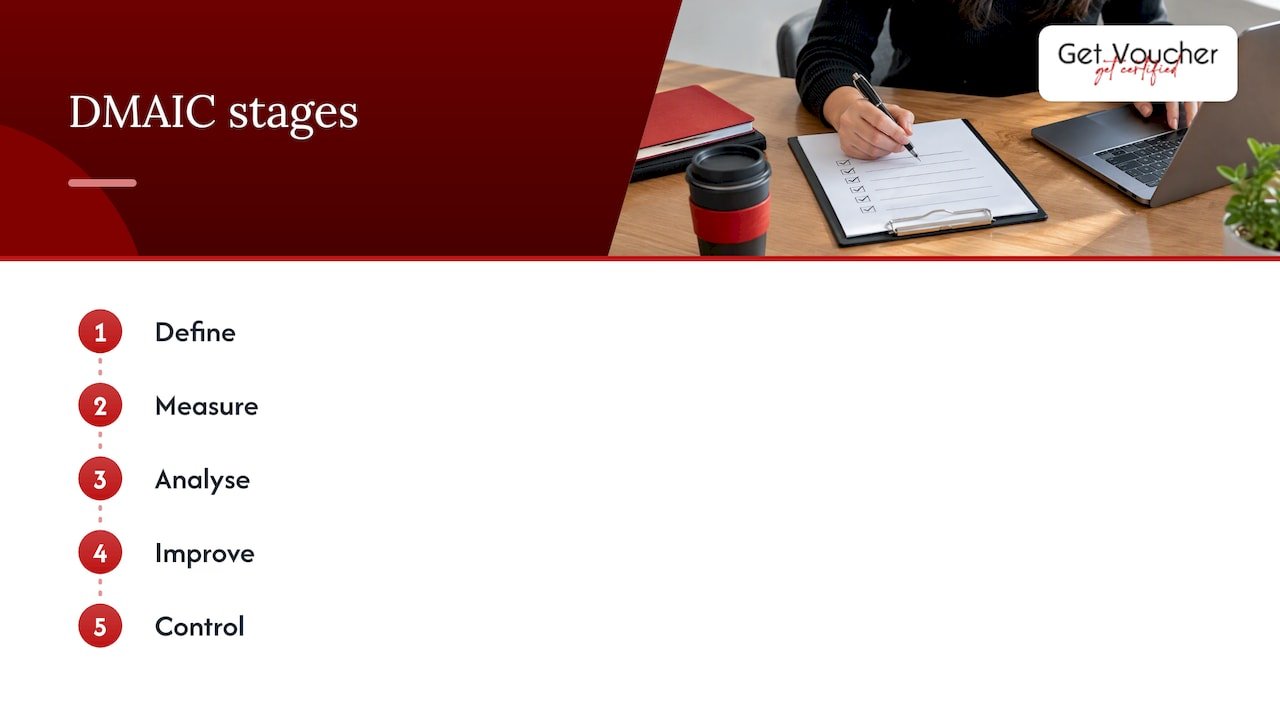
Six Sigma belts focus on reducing variation and defects through structured problem solving, usually using the DMAIC cycle (define, measure, analyse, improve, control). DMAIC is used in Six Sigma, Lean and broader process improvement work. Belts are not interchangeable between providers: ASQ, IASSC/PeopleCert, CSSC and 6sigmastudy each set their own prerequisites, exams, project requirements and renewal rules. Role responsibilities for each belt also vary between organisations, so treat any belt description as common guidance, not a universal rule.
Lean, Six Sigma and Lean Six Sigma are distinct. Lean focuses on flow and waste, Six Sigma on variation and defects, and Lean Six Sigma combines the two. If you want to see how belt pathways differ, our guide to the Six Sigma certification path lays out the differences, and Best Six Sigma certifications: exam only or project proof? covers the assessment question in more depth.
Comparing the options side by side
The table sets out what each family is for. It deliberately avoids fees and renewal terms for external bodies, because those change and belong on the provider’s own page.
| Option | Best for | What it covers | Check before you buy |
|---|---|---|---|
| ASQ CQIA | Newcomers to quality work | Fundamental quality principles, teamwork, improvement | Current eligibility, exam fee, recertification |
| ASQ CMQ/OE | Quality leads and managers | Managing quality and organisational excellence | Experience requirement, renewal cycle |
| ASQ CQA | Auditors | Audit planning, execution, reporting | Experience requirement, renewal cycle |
| ASQ CQE | Quality engineers | Technical quality methods | Experience requirement, exam format |
| ISO 9001 auditor / lead auditor courses | People auditing management systems | Auditing against ISO 9001 | Course accreditation, assessment, registration rules |
| ASQ Six Sigma Green and Black Belt | Process improvement practitioners | Data-driven improvement, DMAIC | Green Belt: work experience; Black Belt: project requirements |
| 6sigmastudy belts (sold by GetVoucher) | Self-paced learners and career switchers | Six Sigma and Lean Six Sigma pathways | Provider-specific exam format and renewal terms |
Matching a certification to your role
Start from the job you want, not the credential with the most impressive name.
- You are new to quality and want a first credential. An entry-level option such as the ASQ CQIA, or a free introductory belt, lets you learn the vocabulary without a big outlay. Our Six Sigma Yellow Belt (SSYB™) voucher costs £0, which makes it a low-risk way to test whether process improvement suits you.
- You want to audit. Look at ISO 9001 auditor and lead auditor qualifications, and ASQ’s auditor credential. These are separate routes with different requirements.
- You manage a quality team. A management-level credential such as the ASQ CMQ/OE speaks to leadership and organisational excellence. A Green Belt can complement it by giving you improvement tools.
- You work in operations, manufacturing or services and want to fix processes. A Six Sigma or Lean Six Sigma Green Belt is the usual starting point, with a Black Belt as a later step if your work involves leading complex improvement efforts.
- You come from IT or another field with no project history. Several providers can be approached without a documented project. Our guide to process improvement certifications for IT professionals explains the options, though you should still check each provider’s own requirements.
Not every certification requires a practical portfolio, an assessed project or a proctored exam, and none of these formats is automatically more credible than another. Proctored and unproctored exams simply test in different ways, and project-based assessment is one model among several. What matters is whether the format suits you and whether the employers you are targeting know the credential.
What to check before you pay
Use the same checklist on every option, including ours.
- Who awards the credential? A professional body, a standards-linked certification body or a training provider each carries different weight in different sectors. Quality Magazine points to independent oversight such as ISO 17024 accreditation as one thing candidates can look for.
- What are the prerequisites? Some credentials need years of work experience, some need approved training, some need nothing. Never assume.
- What does the exam look like? Question count, time limit, delivery and pass mark are set by each provider. Do not infer open-book status or difficulty from how an exam is delivered.
- What does it really cost? Separate the exam fee, any mandatory training, optional preparation materials, retakes and renewal. An exam-only voucher is not automatically the cheapest route overall.
- How long does it last? Some credentials expire and need continuing education or a renewal fee, others do not. Check the specific rules.
- Will your target employers know it? Look at ten job adverts for the role you want and note which credentials they name. That tells you more than any ranking.
If you want a deeper look at what an exam voucher is and what it does and does not include, read our explainer on what an exam voucher means.
Perspective: why we think accessible Six Sigma routes belong on your shortlist
We built GetVoucher because many professionals who would benefit from a quality credential are put off by cost, classroom schedules or the effort of piecing together study material from many places. In quality management, the entry point matters. A learner who can start with a free Yellow Belt, see whether the discipline suits them, and then move to a Green Belt or Lean Six Sigma Green Belt at a clear price is in a much better position than one who commits to an expensive course before knowing.
That is why our quality pathway runs from introductory to advanced: Six Sigma Yellow Belt at £0, Six Sigma Green Belt at £149, Lean Six Sigma Green Belt at £290 and Six Sigma Black Belt at £299, with a dual pack for people who want both Green Belts. Each is delivered through 6sigmastudy, and what each purchase includes, from training resources to exam arrangements, is described on its own product page. We do not suggest these replace ASQ, ISO auditor routes or any other body’s credentials. They are a complementary, flexible option, especially for working professionals and career switchers who need to build or validate skills without classroom training.
Our advice is to treat a certification as a structured way to learn and a recognisable statement of what you have studied. Pair it with real improvement work wherever you can, and choose the pathway whose rules you understand.
Rayan
Quality certifications you can get through GetVoucher
We sell vouchers for 6sigmastudy credentials, which are separate from ASQ, IASSC/PeopleCert and CSSC certifications. Prices below are as published on our site, one-off.
| Certification | Price | Who it suits |
|---|---|---|
| Six Sigma Yellow Belt (SSYB™) | £0 | Beginners testing the field |
| Six Sigma Green Belt (SSGB™) | £149 | Practitioners who support improvement work |
| Lean Six Sigma Green Belt (LSSGB™) | £290 | Those who want Lean and Six Sigma combined |
| Dual 6Sigma Pack | £418 | Those who want both Green Belts together |
| Six Sigma Black Belt (SSBB™) | £299 | Experienced practitioners moving to advanced level |
| Risk Management | £99 | Quality and operations staff adding risk skills |
Exam formats, prerequisites and renewal terms are specific to each 6sigmastudy credential, so read the product page for the one you want. Our exam format guide by provider compares them, and our overview of quality management and Six Sigma is a good starting read if the terminology is new.
Ready to start?
If you want a flexible, online route into quality and process improvement, begin with the free Yellow Belt and move up when you are ready. Browse the full Quality Management category to see every voucher and what each includes.
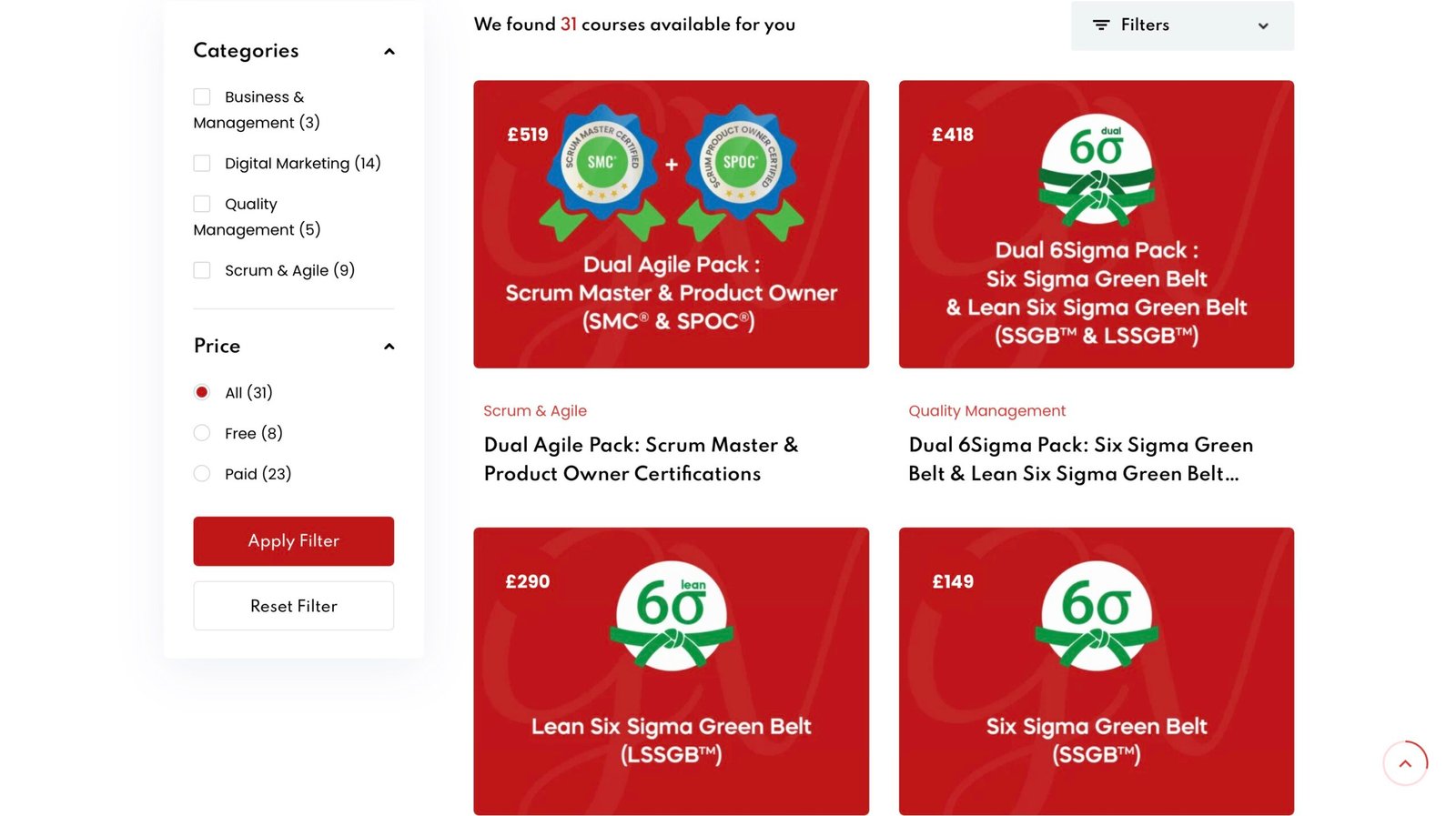
If you are comparing pathways first, the certifications overview shows everything we offer across quality, Scrum, digital marketing and more.
A sensible way to build your shortlist
Here is a practical sequence that works for most readers.
- Write down the role you want in the next two years.
- Collect job adverts for it and list the credentials they mention.
- Decide which family fits: management and engineering credentials, auditing, or process improvement.
- Pick an entry point that costs little in money and time, such as a free introductory belt.
- Check prerequisites, exam format, total cost and renewal on each provider’s official page.
- Plan your preparation time cautiously. Study time varies a great deal with your background, so avoid committing to a fixed number of weeks.
A combination is often better than a single credential. A management-level qualification shows you can run a quality function, and a belt shows you can improve a process. Neither replaces experience, and the strongest candidates can describe a real problem they helped to solve.
FAQ
What is a quality management certification?
It is a credential awarded to an individual who passes an assessment in a defined area of quality, such as auditing, quality management or Six Sigma. It is different from ISO 9001 certification, which commonly applies to an organisation’s management system rather than to a person. Professionals can, however, pursue related auditor qualifications.
Which quality certification is best for a beginner?
There is no single best option, but entry-level credentials such as the ASQ CQIA or an introductory Six Sigma Yellow Belt are common starting points. Our Yellow Belt voucher costs £0, so you can explore the subject before spending money. Check each provider’s prerequisites first.
Do quality certifications guarantee a job or a pay rise?
No. Certifications can help to differentiate candidates, and Quality Magazine describes them as tie-breakers in hiring, but they do not prove competence or guarantee employment, salary or promotion. Experience and results still carry the most weight.
Is a Six Sigma belt a quality management certification?
Yes, in the broad sense that it sits within quality and process improvement, but it focuses on reducing variation and defects rather than on managing a whole quality function. Belts from ASQ, IASSC/PeopleCert, CSSC and 6sigmastudy each have their own rules, so compare them provider by provider.
Sources
- ISO: ISO 9001 explained
- ISO 9001:2026 Quality management systems: Requirements
- Quality Magazine: Why Quality Certifications Matter