




Digital marketing certification cost ranges widely, depending on the credential, the awarding body and how much support you need to pass. Free fundamentals courses cost nothing, short specialist courses typically cost under a few hundred pounds, professional certificates from bodies such as the IPA and CIM often cost several hundred pounds, and bootcamps or postgraduate diplomas can cost from around one thousand pounds to several thousand pounds. Whatever headline price you see, budget extra: assessment, membership and exam fees regularly add several hundred pounds on top. The platform lists both free Fundamentals vouchers and paid professional options, so you can compare tiers before committing.
TL;DR:
- Recognized industry certificates from bodies like CIM and IPA typically cost between £275 and £600, excluding assessment and membership fees that can add several hundred pounds.
- Certification prices are influenced by format, with self-paced courses costing up to around £300, while cohort programs and bootcamps can range from £1,000 to over £7,500.
- The total cost often exceeds the headline fee due to additional expenses such as membership, assessment, and resit fees, which are usually charged separately.
- The value of a certificate depends on your experience level, career goals, and whether industry recognition or portfolio work is necessary for your target roles.
- Currency and regional differences greatly affect final costs, especially for internationally priced courses, so always compare prices in local currency and consider your income level.
Table of Contents
- Typical price ranges by certification level
- What do certification fees actually include?
- How does training format change the price?
- When is a free certificate enough, and when should you pay more?
- Does location affect what you pay for certification?
- Can your employer pay for your certification?
- Is a paid certification actually worth the money?
- Publisher perspective: GetVoucher’s practical view on cost and access
- How GetVoucher helps you spend less on certification
- Sources
- FAQ
Typical price ranges by certification level
Certification pricing splits into four rough tiers, and each one suits a different kind of learner. Knowing which tier you actually need saves you from either overpaying for credentials you don’t need yet, or underinvesting when a job change is genuinely on the table.
- Free tier: introductory certificates covering tools, platforms or fundamentals. Ideal for the curious explorer testing whether digital marketing interests them at all.
- Low-cost short courses (roughly £20–£300): single-topic training, often self-printed CPD-style certificates rather than awarding-body credentials. A Virtual College listing shows a digital marketing training course priced as low as around £25 plus VAT, a useful benchmark for this bracket.
- Mid-tier professional certificates (roughly £275–£600+): recognised industry credentials with assessment and membership requirements attached. The IPA’s Digital Performance Essentials certificate costs several hundred pounds, with a member discount option, a clear illustration of how membership status changes the final bill.
- Bootcamps, university extension and postgraduate courses (£1,000–£7,500+): intensive, often accredited, programmes aimed at career switchers who need a fast, structured path with heavier assessment and sometimes placement support.
Google’s Digital Marketing & e-commerce Certificate sits somewhat outside this ladder because it’s sold as a subscription rather than a one-off fee. The Grow with Google platform lists an example price of US$49 per month after a free trial, so a learner who finishes in three months pays a very different total to one who takes a year.
Duration and credential type both push price up or down independently of provider reputation. A three-week self-paced course costs less to run than a twelve-week cohort with live tutoring, and a credential that requires proctored exams and portfolio review costs more to administer than one that issues a certificate on course completion alone. These figures are illustrative examples from named providers, not fixed industry rates, so treat them as reference points rather than guarantees of what you’ll pay.
On GetVoucher’s own catalogue, Digital Marketing Fundamentals sits at the free end of that spectrum, while Digital Marketing Professional and specialist options such as Search Marketing Expert occupy the paid, professional tier.
What do certification fees actually include?
A quoted tuition price rarely tells the whole story. Most providers separate the headline course fee from the fees you need to actually sit the assessment and hold the credential, and that gap is where budgets go wrong.
What’s usually included in the headline fee:
- Access to the learning platform or video content for a set period.
- Course materials, whether that’s slides, workbooks or recorded lectures.
- A completion certificate, in cases where no formal assessment is required.
What’s commonly excluded, and needs adding separately:
- Awarding-body membership, which some professional bodies require before you can sit an assessment.
- Per-module or final assessment fees, charged on top of tuition.
- Resit fees if you don’t pass first time.
- Proctored exam booking fees for remotely invigilated tests.
- Optional mentoring, coaching or job-placement services.
A Loughborough College listing for the Level 4 CIM Certificate in Professional Marketing shows tuition over a thousand pounds, with additional membership and assessment fees charged separately. That’s roughly £195 of add-on cost on top of the headline figure, before you factor in a possible resit.
CIM’s own qualification page confirms this pattern at a larger scale: published assessment fees for the Certificate in Professional & Digital Marketing run to several hundred pounds separated from tuition fees, entirely separate from any tuition paid to a training provider. When comparing two courses, always ask what the quoted price covers and what it doesn’t, because the cheaper-looking option on paper can end up costing more once assessment and membership fees are added.
How does training format change the price?
Format drives price almost as much as credential level does, because it changes how much human time the provider has to put in. Self-paced video training is cheap to deliver at scale; live mentoring, feedback and placement support are not.
- Self-paced courses typically cost from free up to around £300. You get flexibility and tool familiarity, but little in the way of accountability, feedback on your work or bridge support into a new job.
- Cohort or mentored programmes sit in the mid-tier, usually somewhere between the low-cost and premium bands. You pay more for structured deadlines, peer accountability and often a portfolio review, which matters if you’re trying to prove competence to an employer rather than just learn a tool.
- Bootcamps and university extension or postgraduate courses command premium pricing, frequently running into the thousands. In return you usually get formal accreditation, structured assessment and, in some programmes, career or placement support.
Pro Tip: If you’re weighing a self-paced certificate against a cohort programme purely on price, factor in the cost of your own time. A self-paced course that takes twice as long to finish because there’s no deadline pressure isn’t automatically the cheaper option once you account for that.
SMstudy certifications, delivered through VMEdu and available via GetVoucher, are a good example of where self-paced format actively reduces total cost. These certifications include self-paced online video training as part of the voucher, which cuts down on the need to pay separately for coaching or to hunt across multiple external sites for preparation material. For someone comparing a £300 self-paced professional voucher against a £1,500 mentored bootcamp, the right answer depends on whether you need the accountability and portfolio support that the higher price buys, or whether structured video training alone gets you where you need to go.
University extension and postgraduate diplomas justify their premium mainly through accreditation and depth of assessment, worth considering only if a specific employer or industry expects that level of formal qualification.
When is a free certificate enough, and when should you pay more?
Run through a short checklist before spending anything. Your answers to these five questions do more to determine the right budget than any price comparison table:
- What’s your current experience level? Complete beginners often get more value from a free fundamentals course than from jumping straight into a paid specialisation they’re not ready for.
- What’s the actual goal, exploration or a job change? Exploring a new field justifies free or low-cost options; switching careers usually justifies paying for a recognised credential that signals commitment to a hiring manager.
- Do you need a portfolio, not just a certificate? If you’re applying for roles that ask to see work, a paid programme with project-based assessment often serves you better than a certificate alone.
- Does your employer or target industry expect a specific qualification? Some sectors and some managers recognise particular bodies (CIM, IPA) by name; check before you commit.
- What are your real time and money constraints? A £7,000 postgraduate diploma is meaningless if you can’t afford it or complete it in the timeframe you have.
Four typical scenarios show how this plays out. The curious explorer testing the waters should start with a free certificate like Digital Marketing Fundamentals and stop there until a clearer goal forms. The job switcher targeting a marketing role generally needs at least one paid, recognised credential to be taken seriously by recruiters. The manager upskilling in a specific area (SEO, analytics, email) is usually better served by a focused specialist course than a broad generalist one. The small-business owner managing their own marketing might get more practical value from a mid-tier practical certificate than an expensive postgraduate qualification aimed at agency careers.
The strongest signalling combination, according to industry commentary on certificate value and ROI, is stacking: pair free platform badges that show tool breadth with one recognised professional qualification that shows depth. Price alone tells you very little about how employable a certificate makes you.
Does location affect what you pay for certification?
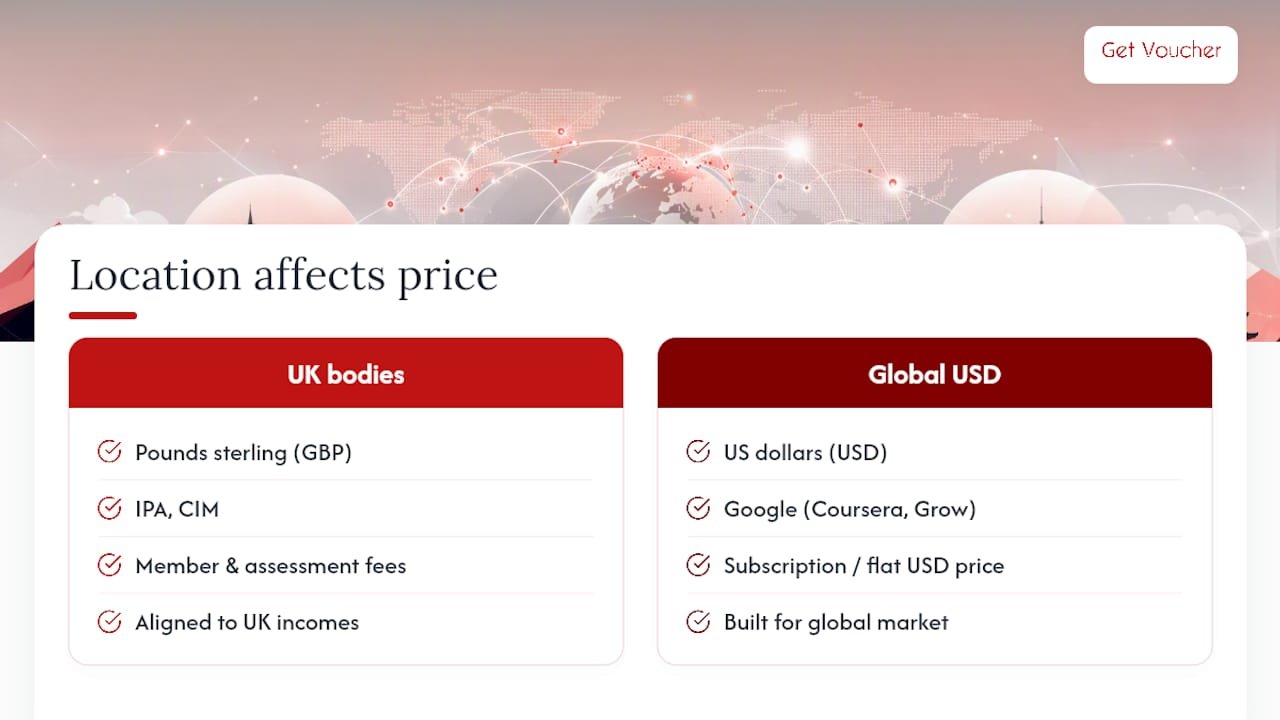
Where you’re based, and which currency your provider prices in, changes your final cost more than most people expect. A course priced in US dollars through an American platform costs a different amount in real terms to a UK learner than a course priced in pounds by a British awarding body, purely because of exchange rates and local purchasing power.
Awarding bodies based in the UK, such as the IPA and CIM, price in pounds sterling and structure fees around UK membership and assessment norms. Providers built around a global subscription model, such as Google’s certificate delivered through Grow and Coursera, price in US dollars regardless of where the learner is based, so the effective cost in local currency shifts with currency movements.
Beyond the currency itself, regional differences in average income and cost of living mean the same headline price represents a very different proportion of a learner’s budget depending on where they live. A £550 non-member fee for the IPA’s Digital Performance Essentials certificate is a meaningfully different investment for someone earning a UK median salary than for someone in a lower-income market taking the same qualification remotely. There’s no single global rate for digital marketing certification, only a patchwork of provider pricing that reflects the market each awarding body was built to serve. If you’re comparing options across borders, always check the provider’s own pricing page in its native currency rather than relying on a rough conversion, since exchange rates shift and providers occasionally reprice.
Can your employer pay for your certification?
Many employers will fund all or part of a relevant marketing certification, particularly when the credential maps directly onto a current role or a planned internal move. It’s worth asking before you pay out of pocket, because sponsorship policies are often underused simply because staff don’t know they exist.
Approaches vary by company size and structure. Larger organisations frequently run a formal learning and development budget with a defined process for requesting course funding, sometimes capped at a set amount per employee per year. Smaller businesses are less likely to have a formal policy, but many will still cover a course cost informally if you can show a clear link between the certification and your day-to-day responsibilities.
The strongest pitch to a manager isn’t “I want to learn digital marketing,” it’s a specific certification tied to a specific outcome: “This SEO certification will let me manage our organic search strategy in-house rather than outsourcing it.” Bringing a clear price, expected time investment and stated benefit to the conversation makes approval far more likely than a vague request.
Where full sponsorship isn’t available, partial reimbursement, tied to completion or a pass mark, is common. Some employers will only pay out once you’ve passed the final assessment, which is another reason to check exactly what a course’s assessment and resit fees look like before you start, since a failed first attempt can mean paying for a resit out of your own pocket even when the original course was sponsored.
Is a paid certification actually worth the money?
Return on investment depends heavily on which tier you’re evaluating, and treating all certifications as equivalent investments is the most common mistake learners make when comparing prices.
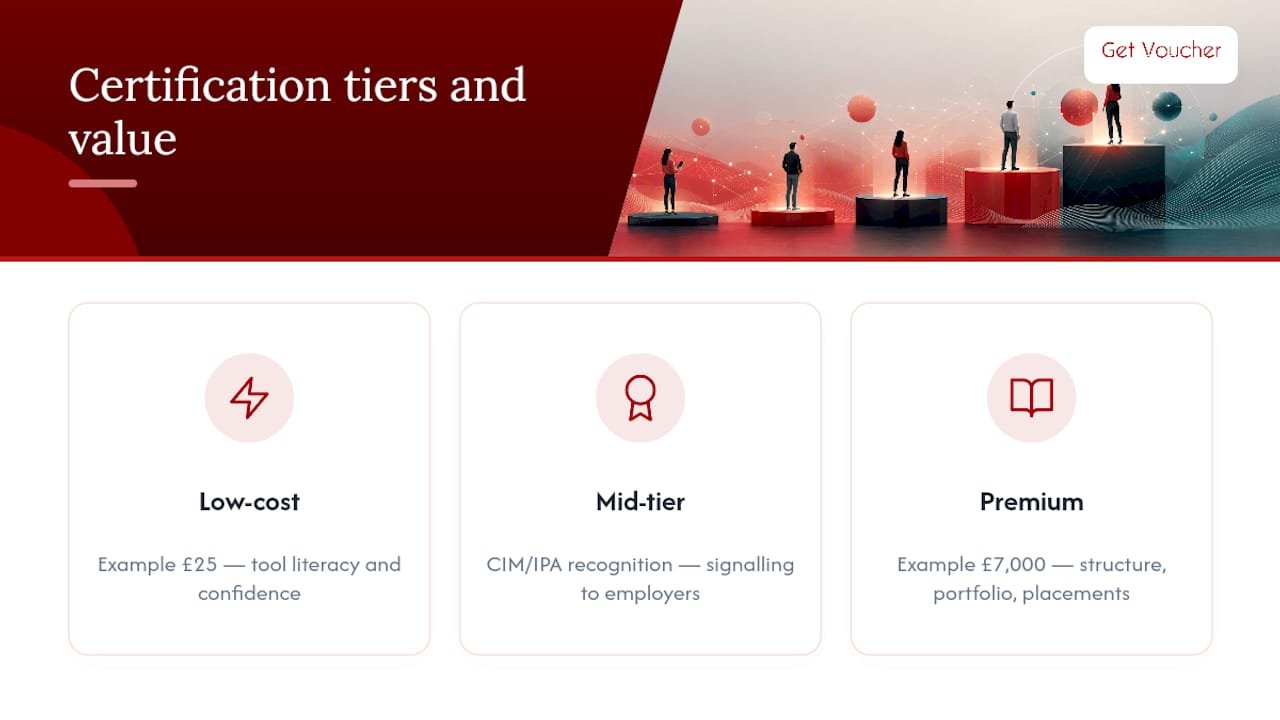
Free and low-cost tiers deliver their ROI almost immediately, in the form of tool literacy and confidence, but they don’t carry much weight on a CV by themselves. Their value is in removing uncertainty cheaply. If a free certificate confirms you enjoy the subject before you spend anything further, that’s a good return even though it produced no qualification an employer will recognise on its own.
Mid-tier professional certificates from bodies such as the IPA or CIM earn their ROI differently: through recognition. A hiring manager who knows the CIM name reads a candidate’s certificate as a signal of a baseline standard, which can be the difference between an interview and a rejection when a CV is otherwise unremarkable. That signalling value is genuinely hard to put a number on, and depends heavily on whether your target industry or employer recognises the specific body.
Premium bootcamps and postgraduate diplomas justify their cost mainly through structure and depth rather than name recognition alone, particularly when they include a portfolio, work placement, or direct employer connections. For a career switcher with no existing marketing experience, that structure can be worth far more than the certificate itself, because it compresses months of self-directed learning into a defined, assessed programme.
The honest takeaway across all three tiers is that price correlates weakly with career outcome. A £25 course and a £7,000 diploma can both be the right choice, depending entirely on what you already know and what you’re trying to prove to whom.
Publisher perspective: GetVoucher’s practical view on cost and access
Most guides to certification cost treat price as the only variable that matters. It isn’t. What actually determines value is whether the certificate matches where you are: a free Fundamentals voucher for someone testing the water, a paid Professional or Search Marketing Expert voucher for someone building a case to an employer. GetVoucher exists to make that ladder visible in one place, alongside self-paced SMstudy video training that cuts the need for separate coaching.
— Rayan
How GetVoucher helps you spend less on certification
GetVoucher is the practical route to comparing free and paid digital marketing credentials side by side, without paying agency-style mark-ups on top of the certification itself. Rather than piecing together separate coaching, prep material and exam bookings from different sources, you access the voucher, the self-paced training and the assessment path through one catalogue.

Browse the full Digital Marketing certifications hub to see where free Fundamentals vouchers and paid Professional pathways sit relative to your budget, or go straight to the Digital Marketing Professional voucher if you already know a recognised credential is the next step. For certifications not yet listed on the platform, GetVoucher plans to add further options in the coming months. Get in touch to check current pricing and availability availability before you commit elsewhere.
Sources
- IPA | Digital Performance Essentials Certificate
- Google Digital Marketing & e-commerce Certificate
- CIM | Certificate in Professional & Digital Marketing
- Loughborough College | Level 4 Chartered Institute of Marketing (CIM) certificate
FAQ
Is a certificate in digital marketing worth it?
It depends on the tier: free certificates build tool literacy cheaply, while recognised professional credentials from bodies like CIM or the IPA carry more weight with employers who know those names.
Can I learn digital marketing in three months?
You can complete a self-paced fundamentals course or a subscription-based certificate like Google’s in around three months, though deeper professional qualifications with assessments and membership requirements often take longer.
Is digital marketing certification still worth pursuing?
Certification remains a valid way to demonstrate skill, particularly when stacked, combining free platform badges with one recognised professional qualification tends to signal both breadth and depth to employers.
Which certification is best for digital marketing?
There’s no single best option; it depends on your goal, with free Fundamentals suiting explorers, mid-tier professional certificates suiting job switchers, and specialist vouchers such as Search Marketing Expert suiting those focused on one discipline.
How much do additional exam and membership fees typically add?
Membership and assessment fees commonly add several hundred pounds on top of headline tuition, as shown by CIM’s published assessment fees of around £460 to £520 separate from any training provider’s course cost.
Best SEO Certifications in 2026: Start Free, Earn One Credential
[…] separate course sites, PDFs and video libraries. For readers weighing up budget against depth, our guide to digital marketing certification costs breaks down what each tier typically involves. If search marketing specifically is your focus […]
Best Content Marketing Courses: Free Skills or Formal Credit?
[…] a paid pathway, our 90-day starter plan sets out a practical study sequence, and our guide to certification cost by goal helps you total the full budget before you buy a […]
Digital Marketing Courses for Career Switchers: Exam Plus Practice
[…] £0–£7,500+: Digital Marketing Certification Cost by Your Goal […]