




The smartest route through digital marketing certification starts small: a fundamentals certificate to prove you understand the basics, one or two specialist credentials in a channel you enjoy, then a professional diploma once you’re ready to lead campaigns rather than run them. GetVoucher gives you a single place to buy the vouchers for that whole journey, book your exams, and move up without hunting across a dozen providers. Each step adds a validated skill employers can check, and each one makes the next easier to justify to a manager or a hiring panel.
TL;DR:
- Completing a fundamentals certificate usually takes 5 to 30 hours, establishing core marketing vocabulary and platform knowledge for beginners.
- Specialist certificates focus on one channel and include practical labs, often completed within a few months to deepen hands-on skills.
- Professional diplomas combine several channels into strategic planning, typically requiring 6 to 9 months for assessment through coursework and case studies.
- Certification choices should align with career stage, with new marketers starting small and managers pursuing comprehensive diplomas or advanced leadership programs.
- Validating skills through recognized providers often involves clear assessment formats, practical labs, and CPD policies, avoiding vague or poorly documented courses.
Table of Contents
- What is a digital marketing certification, and how does the roadmap work?
- What do the different certification levels actually teach?
- Which certification suits your job title and career stage?
- Which skills and specialisms should you combine?
- How do you choose the right certification provider?
- How GetVoucher supports your certification pathway
- A note on how this roadmap was built
- Sources
What is a digital marketing certification, and how does the roadmap work?
A digital marketing certification is a structured, assessed qualification that proves you can plan, run, and measure marketing campaigns across channels such as search, social, and email, rather than just claiming familiarity with them on a CV. Providers typically organise these credentials into three broad tiers, and understanding the tiers matters more than chasing any single badge.
Foundation-level certificates are short, often running from around 5 hours up to roughly 30, and they cover core vocabulary and platform basics. Professional diplomas sit above that, typically spanning 30 to 160-plus hours of structured study, and they integrate strategy with practical execution. Advanced programmes, aimed at senior marketers and heads of function, run for months and lean heavily into leadership, budget ownership, and cross-channel strategy.
A typical progression looks like this:
- Month 1 to 2: Complete a fundamentals certificate to lock in terminology and platform basics.
- Month 2 to 4: Add one or two specialist certificates in a channel that matches your role, such as search or social.
- Month 4 to 9: Work through a professional diploma that ties those channel skills into a coherent strategy.
- Beyond that: Consider an advanced or leadership-track programme once you’re managing budgets or teams.
Recertification patterns vary by provider, but many professional bodies now expect ongoing continuing professional development rather than a one-off exam, because digital channels change fast enough that a five-year-old certificate can undersell what you actually know today. GetVoucher’s Digital Marketing Fundamentals course is a sensible first stop for exactly this reason: it’s short enough to finish in weeks, not months.
What do the different certification levels actually teach?
Each tier has a distinct job to do, and knowing what happens inside each one helps you avoid paying for depth you don’t need yet, or worse, skipping depth you do need.
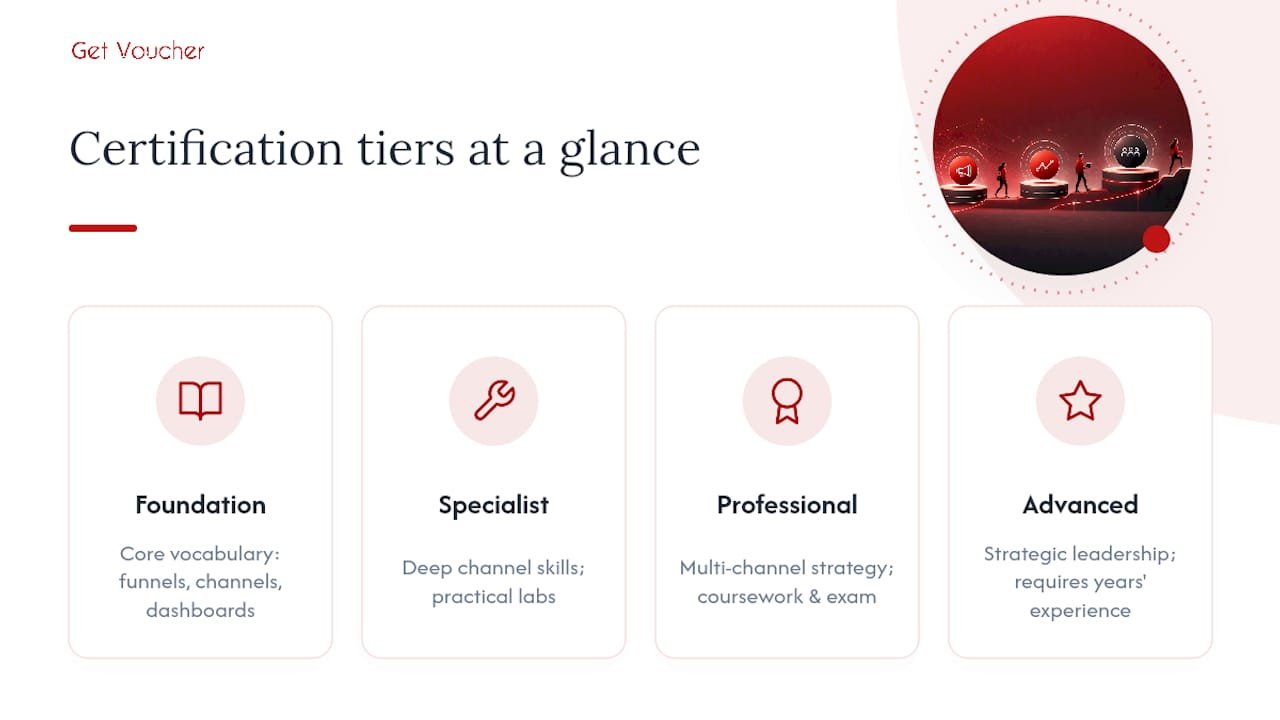
Foundation courses teach core vocabulary: what a conversion funnel is, how paid and organic channels differ, and how to read a basic dashboard. They suit total beginners, career switchers testing the waters, and anyone whose current role touches marketing without owning it. Completion is quick, which is precisely the point.
Specialist certificates go deep on one channel. A search marketing module covers keyword research, on-page optimisation, and paid search auction mechanics. A social media module covers platform-specific ad formats, audience targeting, and organic content planning. These typically include practical labs where you build a mock campaign inside real ad platform interfaces rather than just answering multiple-choice questions.
Professional diplomas integrate several channels into a single strategic view. Industry-body programmes such as CIM’s Level 4 qualification map their modules to campaign planning, analytics, content, SEO, and marketing technology, and one provider’s own course page suggests a 6 to 9 month completion window for that pathway. Assessment usually mixes coursework, case studies, and a final exam rather than a single test.
Advanced programmes assume you already have professional-level knowledge and add strategic leadership, budget allocation, and stakeholder management. Most expect several years of hands-on experience before you enrol.
Which certification suits your job title and career stage?
Matching the credential to where you actually sit in your career avoids two common mistakes: over-investing in a diploma before you’ve proven the basics, or under-investing in a certificate that won’t move the needle for a management role.
- Junior marketers and career starters should begin with a fundamentals certificate plus one short specialist course. This combination proves both breadth and one area of depth without a huge time commitment.
- Channel specialists (SEO executives, paid media buyers, social media managers) benefit most from a focused certificate in their channel paired with hands-on practical labs, since employers in these roles want proof you can run the tools, not just describe them.
- Marketing managers and team leads are better served by a professional diploma or advanced programme, because these roles demand cross-channel strategy and budget reasoning that single-channel certificates don’t cover.
- Career switchers gain the most from structured professional qualifications specifically because they formalise a route that signals credibility to employers in a way informal, self-taught learning struggles to match. A recognised syllabus and assessment record does work that a portfolio alone can’t always do on its own.
Pro Tip: If you’re switching careers, pair your certification with two or three small campaign case studies you build yourself, even on a personal project. The certificate proves you know the theory; the case study proves you can apply it.
Which skills and specialisms should you combine?
Digital marketing splits into several practical tracks, and each one teaches specific tools and outcomes rather than abstract theory. Platform-style courses such as those from Google or HubSpot explicitly list the tools you’ll learn, from Google Ads and GA4 through to Shopify and Mailchimp, which makes it easier to judge whether a course matches the software your target employer actually uses.
- Search marketing covers keyword strategy, on-page SEO, and paid search bidding, and it remains one of the most transferable skills across industries.
- Social media marketing teaches platform-specific ad formats, audience segmentation, and organic content strategy across the major networks.
- Email marketing focuses on segmentation, automation workflows, and deliverability, skills that stay relevant even as other channels shift.
- Affiliate marketing and marketing research round out a commercial view of how campaigns get measured and monetised beyond a single channel.
- Web analytics ties everything together by teaching you to read performance data and prove what’s actually working.
Combining tracks strengthens a candidate profile more than stacking multiple certificates in the same channel. Analytics paired with content, for instance, lets you both create campaigns and prove their return, which is a rarer and more hireable combination than content skills alone. If you’re weighing analytics-adjacent skills further, frameworks used to evaluate AI and measurement systems are increasingly relevant as marketing tools add generative-AI features. As a rule, pick one specialist certificate to go deep and stack two or three shorter courses around it, rather than spreading study time evenly across everything at once.
How do you choose the right certification provider?
Not every certification carries the same weight, and a few checks up front save you from paying for a credential that employers won’t recognise or a course that turns out thinner than it looked.
Run through this checklist before you commit:
- Does the provider name a recognised awarding body or accreditation, rather than just describing itself as “industry standard”?
- Are study hours and assessment format stated clearly, rather than left vague?
- Is there a published syllabus you can read before paying, module by module?
- Does the course include practical labs or only multiple-choice testing?
- Is there a clear recertification or CPD policy if the credential has an expiry?
| Question to ask the provider | Why it matters |
|---|---|
| What does the assessment actually involve? | Coursework, exams, and case studies each prove different things to employers. |
| How is the exam booked and proctored? | Confirms whether you can sit it remotely and on your own schedule. |
| What study resources are included? | Video training, downloadable materials, or bare slides make a real difference to outcomes. |
Red flags include vague or absent syllabuses, opaque pricing that only appears at checkout, and providers unwilling to describe how assessment works. Coursera’s own overview of industry-recognised certificates notes that job-ready skills and employer recognition vary meaningfully between programmes, which is exactly why this checklist matters more than brand name alone.
How GetVoucher supports your certification pathway
GetVoucher works as the voucher platform for this entire roadmap, with VMEdu as the main provider and SMstudy as the certification body behind the Digital Marketing catalogue. That means one account, one checkout, and one place to track progress rather than juggling logins across separate course providers.
Start with Digital Marketing Fundamentals if you’re new to the field, then add a channel specialism through Search Marketing Expert, Social Media Marketing Expert, or Email Marketing Expert depending on where your interest sits. Once you’ve built that base, the Digital Marketing Professional diploma pulls those channel skills into a single strategic credential. Each voucher gives you access to self-paced video training and downloadable study materials, which cuts down the time you’d otherwise spend hunting for separate resources, and GetVoucher supports scheduling your proctored exam once you’re ready to sit it. If a certification you’re after isn’t listed in the catalogue yet, it may be planned for the coming months, so contact GetVoucher directly for pricing and availability. Visit the certifications hub to compare the full Digital Marketing lineup and buy the voucher that matches your next step.
A note on how this roadmap was built
This roadmap draws on published syllabus structures, provider study-hour data, and employer-recognition research from professional marketing bodies, rather than opinion alone. GetVoucher’s own catalogue, built with VMEdu as provider and SMstudy as certification body, was used as the practical reference point throughout. The aim was to give you a route you can actually follow, not just a list of course names.
— Rayan
Sources
For readers who want to go deeper on any claim in this roadmap: CIM’s Level 4 qualification page covers professional diploma module structures and timelines. Loucoll’s CIM course overview breaks down study-hour tiers. The IPA’s Digital Performance Essentials page illustrates cost variation across provider types. Coursera’s certificate overview compares recognised programmes and their outcomes.
- Certificate in Professional & Digital Marketing — Loucoll (CIM Level 4 information)
- 8 industry-recognised digital marketing certificates — Coursera
- Certificate in Professional & Digital Marketing — CIM
Digital Marketing Courses for Career Switchers: Exam Plus Practice
[…] 6 to 12: add a second or third certification from a multi-week pathway, build measurable campaign results into a portfolio, and prepare for interviews with that evidence […]