




An exam fee normally pays for the right to sit the exam and receive a result, and little else. Whether it also covers a retake, training, a certificate, identity checks or a first year of maintenance is set by each provider, so the only reliable answer sits in that provider’s own handbook or policy page. This guide shows what fees typically include, what tends to be billed separately, and how to compare two prices that look the same but are not.
Table of Contents
- What an exam fee usually means
- What a fee can pay for behind the scenes
- Fee, attempts and time limits
- Costs often charged on top
- Why the same exam costs different amounts
- A checklist before you pay
- Worked example: comparing two quotes
- What this means for the certifications we offer
- Where to start at GetVoucher
- FAQ
- Sources
What an exam fee usually means
The exam fee is the amount a certification body charges to authorise and deliver one assessment. Some bodies quote a single figure. Others split it into an application or registration fee plus an exam fee, and then add costs for retakes, rescheduling or maintenance.
A clear example is the ATD APTD Certification Handbook (January 2026). Its registration fee of US$525 for ATD members and US$800 for non-members includes 18 months of eligibility, one testing attempt in a pre-selected two-month window, the exam score report, and the certificate and lapel pin once you pass. It does not include classes, study materials, study group support, travel to testing centres, retests, transfers or test administration fees.
That list is a good template for your own reading. For any exam, ask five questions:
- How many attempts does the fee buy?
- How long do you have to use it?
- Is the certificate or digital credential included?
- Is any learning material included?
- What happens if you need to move the date or retake?
What a fee can pay for behind the scenes
Some providers itemise where the money goes, which makes the price easier to judge. The Philippine NMAT Bulletin of Information splits its Php1,900 total into a Php500 registration fee for the online registration system, downloadable test forms and practice sets, and a Php1,400 test fee covering test development, application processing, administration, scoring and delivery of results.
The American physical therapy specialist body explains in its specialization FAQ that its fees cover reviewing applications, developing the exam and setting the passing score. It also notes the certification is valid for 10 years, so the cost can be spread over that period.
Most professional certifications in business, Agile or quality management are priced far lower than these, but the logic is the same: the fee is for assessment, not for teaching you the content.
Fee, attempts and time limits
Two exams with the same price can differ in what you actually get. Compare these terms side by side.
| Provider | What the fee is stated to cover | Time limit | Retake |
|---|---|---|---|
| ATD (APTD) | One attempt in a pre-selected window, score report, certificate | 18 months of eligibility | US$275 retest fee |
| CSCMP (SCPro Level One) | One attempt, on-demand online exam | One year from payment or the fee is forfeited | US$50 per later attempt, no sooner than 30 days after a fail |
| CertiProf | Two exam attempts per authorisation | Six months from purchase, no extension | Retake fees depend on regional pricing |
| NASFAA (CFAA) | US$375 exam, application fee waived | Set by the eligibility period | US$275, one retake allowed |
The figures were taken from each provider’s page as published for its stated period, and they change, so confirm them on the provider’s site before you pay.
The pattern is useful: the same headline price can hide a one-year deadline, a six-month deadline or no stated deadline at all. A fee that buys two attempts is not directly comparable with one that buys one.
Costs often charged on top
The fee you see first is not always the total. Here are the common extras, with real examples.
Application and registration
Some bodies charge an application fee before the exam fee. Exam Atlas’s 2026 report lists application fees of about US$100 for SPHR and aPHR and about US$50 for CISA. The same report found that 20 of 73 professional exams (27%) carry mandatory costs beyond the exam itself, such as applications, enrolments, memberships or annual maintenance.
Online delivery and administration
The TIC Council petroleum inspector programme charges €165 for a member-company candidate plus €25 for online delivery, so an online candidate from a member company pays €190 in total. Small supplements like this are easy to miss when you only read the headline.
Rescheduling and cancellation
The ATD handbook applies a US$125 administrative fee to in-person cancellations under 72 hours’ notice and to no-shows, while remote-proctored candidates can cancel up to appointment time without penalty. Moving to a different testing window costs US$275. CSCMP says changing a scheduled exam date may incur an additional fee. If your diary is unpredictable, rescheduling terms matter as much as the base price. Our partners’ guide on the missed exam policy and makeups covers what you may have to pay when an exam date goes wrong.
Membership and renewal
Membership is often a separate purchase. The SCCE compliance certification FAQ states that membership dues do not cover the cost of becoming certified or renewing, and that event fees do not count towards certification costs. Its CCEP exam is US$350 for members and US$450 for non-members, with renewal every two years.
Preparation materials
Study resources are frequently optional and priced separately. NASFAA lists its exam preparation guide at US$175 and its online prep workshop at US$325 on top of the US$375 exam.
Why the same exam costs different amounts
Price differences come from the provider’s rules, not only from the exam.
- Country. CBIC prices on a tiered scale by World Bank income classification. In its 2026 fee schedule, the CIC exam is US$445 in high-income countries and US$110 in low-income countries.
- Membership. CSCMP charges US$650 to members and US$975 to non-members for its Level One exam.
- How you book. UXQB says its CPUX costs range from €300 to €360 for foundation and certain other levels, depending on the administering body, first attempt or retest, student or member status, and whether the exam is booked directly or through a training provider.
- Bundling. PECB says that for candidates completing a PECB Partner training course, the training fee includes the first exam attempt, one free retake, the certification application fee and the first year of the annual maintenance fee.
The last example shows why a low exam-only price is not automatically the cheapest total. Compare what each route includes.
A checklist before you pay
Read the provider’s handbook or policy page, not a summary elsewhere, and find these points:
- Attempts included. One, two, or one plus a free retake.
- Validity of the purchase. The period in which you must book or finish. Redemption deadlines and exam completion deadlines can be different things, so look for both.
- Refunds and extensions. Many providers state fees are non-refundable once issued, as CertiProf, CSCMP and NASFAA do. If you buy from a UK retailer, check the retailer’s own terms as well.
- Retake price and waiting period. CSCMP, for instance, requires at least 30 days after a failed attempt.
- Identity checks and delivery format. CertiProf requires ID only where the scheme demands it. Unproctored and proctored formats are both used; neither is inherently more credible.
- Rescheduling charges. Look at the notice period and who is paid.
- Credential costs after passing. Certificate, renewal, annual maintenance or continuing education.
- Booking steps. Account activation, voucher redemption and exam booking are separate steps with some providers. Check which one starts your clock.
Our guide to the exam voucher meaning explains how vouchers fit into this, and our certification retake policy guide shows how to read voucher terms for retakes.
Worked example: comparing two quotes
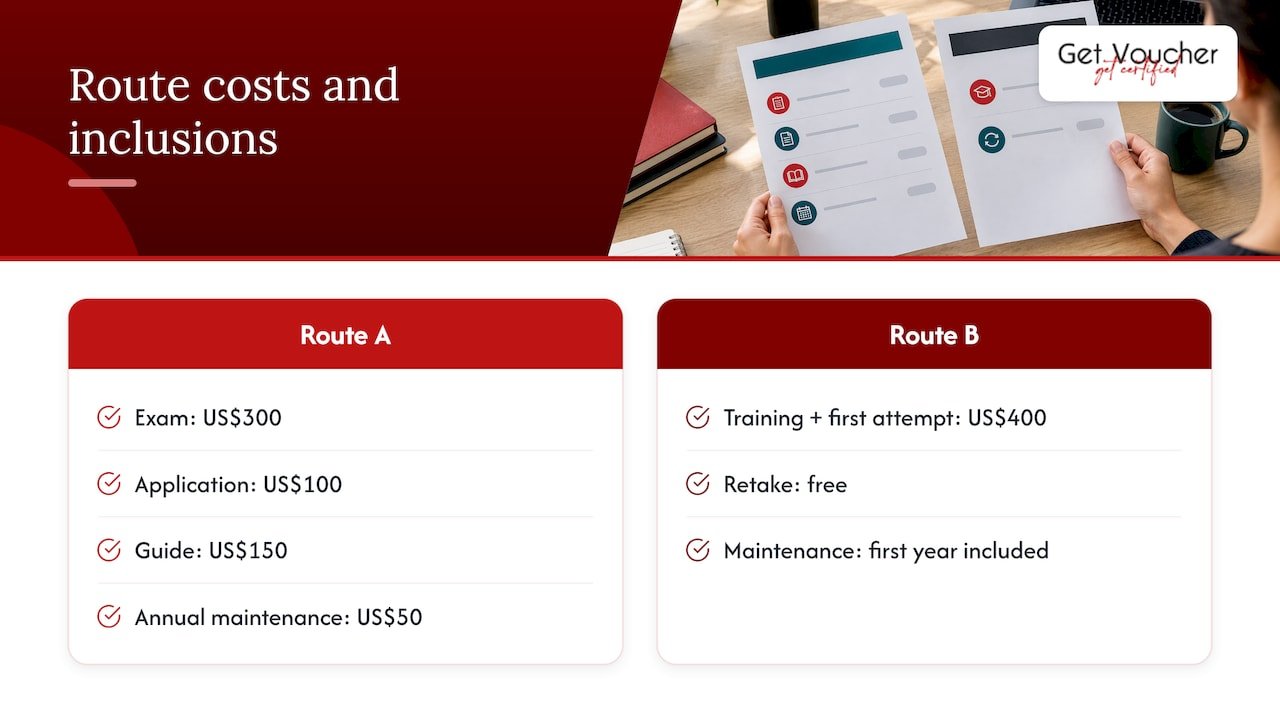
Suppose you are weighing two routes to a credential. Route A is US$300 for the exam only. Route B is US$400 for training plus the first attempt, a free retake and the first year of maintenance.
Route A looks US$100 cheaper. Add a US$100 application fee, a US$150 preparation guide and a US$50 annual maintenance charge, and it is US$600 before any retake. The numbers are invented to show the method, not any real provider, but the method holds: add everything you will have to pay to get from today to a valid credential, then compare. Your own total depends on how you prepare and whether you pass first time.
What this means for the certifications we offer
Our certifications come from providers including SCRUMstudy, SMstudy, 6sigmastudy and NGstudy, and each has its own exam format and terms. Inclusions are described product by product, so read the page of the certification you are considering.
For reference, here are exam formats we state for specific SCRUMstudy and SMstudy credentials:
| Certification | Exam format | Price at GetVoucher |
|---|---|---|
| Scrum Fundamentals Certified (SFC) | 40 questions, 60 minutes, online, unproctored | £0 |
| Scrum Master Certified (SMC®) | 100 questions, 120 minutes, online, unproctored | £249 |
| SCRUM Agile Master Certified (SAMC™) | Online, unproctored | £349 |
| SMstudy® Certified Digital Marketing Professional | 100 questions, 120 minutes, online, unproctored, no formal prerequisites (Fundamentals only preferred) | £199 |
These formats are specific to those SCRUMstudy and SMstudy credentials and are not a rule for other providers. Our SCRUMstudy exam cost guide separates fees by certification, and our Six Sigma exam cost guide does the same for 6sigmastudy. Scrum Alliance and Scrum.org credentials are separate from what we sell, and they use different assessment models and pricing.
A note on transparency: we have a commercial relationship with certification providers such as VMEdu, whose brands we sell vouchers for.
Our view on reading exam fees
We think the most useful question is not how much the exam costs but what you will have paid when you hold the credential. A fee that looks small can leave the training, the retake and the renewal as separate bills, while a higher one can bundle them.
That is why we publish a price for each voucher in pounds and describe what each product includes on its own page, rather than assuming every purchase is the same. For some certifications, structured online learning, including self-paced video training, is available, which can reduce the time spent searching across separate courses, documents and videos.
We also like free entry points. Scrum Fundamentals Certified and Six Sigma Yellow Belt are £0, so you can start with an introductory credential and move on to a paid one when you are sure of the direction.
Rayan
Where to start at GetVoucher
If you are choosing between Agile credentials, the SCRUMstudy range runs from the free Scrum Fundamentals Certified up to the £349 SCRUM Agile Master Certified. For the middle of the range, Scrum Master Certified (SMC®) is £249 one-off, and the Dual Agile Pack combining Scrum Master and Product Owner is £519. Six Sigma vouchers run from £0 for the Yellow Belt to £149 for Green Belt and £290 for Lean Six Sigma Green Belt, with a Dual 6Sigma Pack at £418 and a Black Belt voucher at £299.
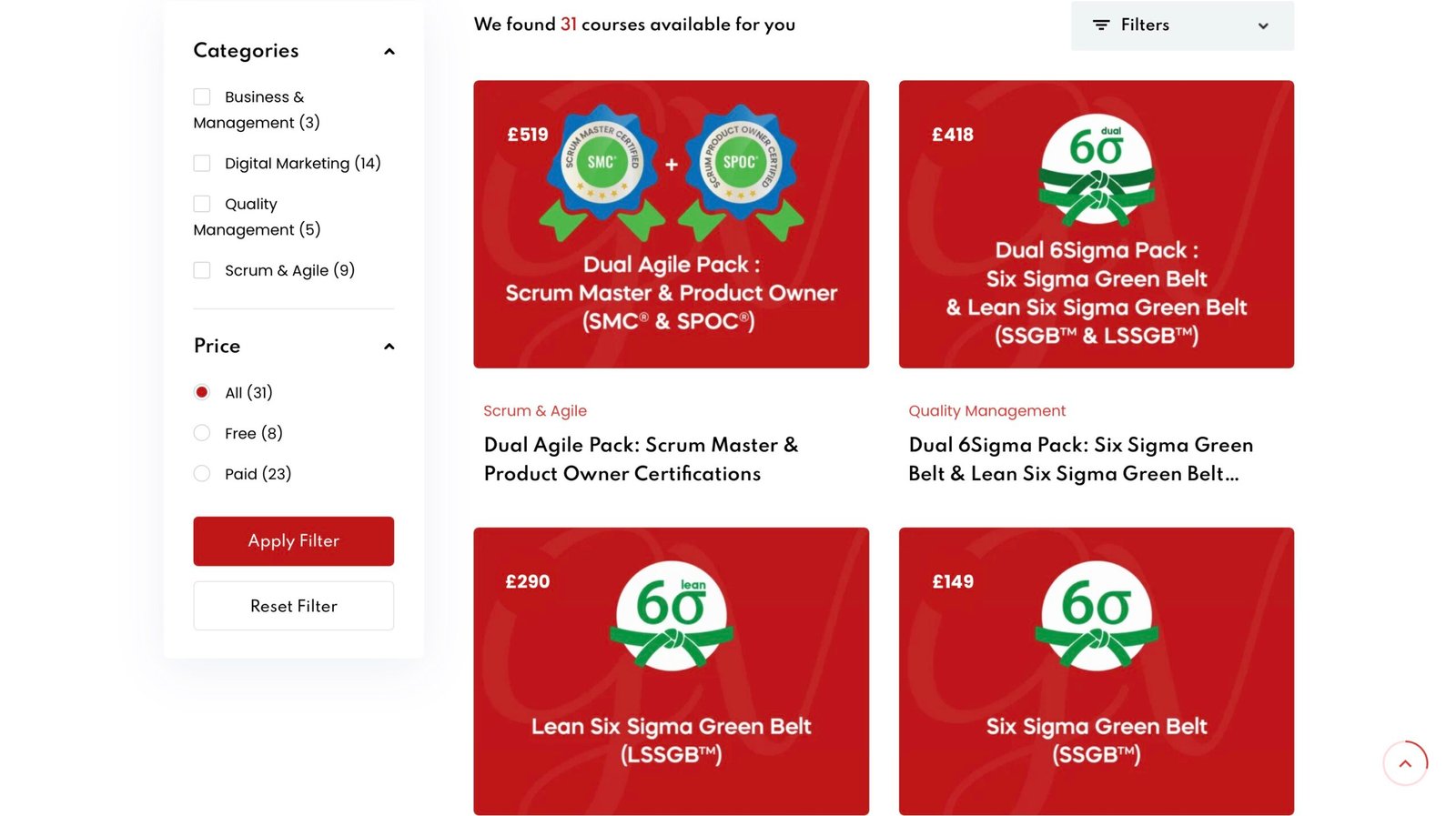
You can see the full list on our certifications page, and each product page states what that voucher includes.
FAQ
What does an exam fee usually include?
Usually the right to sit the exam and receive a result. Some providers add a score report, a certificate or a second attempt. For example, ATD’s APTD fee includes one attempt and the certificate but not study materials or retests. Always check the provider’s handbook.
Is the retake included in the exam fee?
It depends on the provider. CertiProf’s initial purchase includes two attempts, while CSCMP and ATD charge separately for retakes. PECB’s training fee includes one free retake. Read the retake clause before you pay.
Are study materials part of the fee?
Often not. ATD’s fee excludes study materials, and NASFAA sells preparation materials separately. Some voucher products come with learning resources, so check the product page for what is included.
Can I get a refund if I cannot sit the exam?
Many providers state that fees are non-refundable once issued, and some forfeit them if you do not sit within a set period. CSCMP gives one year. Check the provider’s terms, and the seller’s terms if you bought through a retailer.
Sources
- ATD APTD Certification Handbook, January 2026
- CEM NMAT Bulletin of Information
- APTA specialization FAQs
- CSCMP Purchase Exams
- CertiProf Certification Examination Policy
- NASFAA Certification Candidate Handbook
- Exam Atlas, certification costs 2026
- TIC Council petroleum inspector certification
- SCCE Compliance Certification FAQs
- CBIC examination fees 2026
- UXQB exam process
- PECB Exam Rules and Policies
- Missed Exam Policy guide