



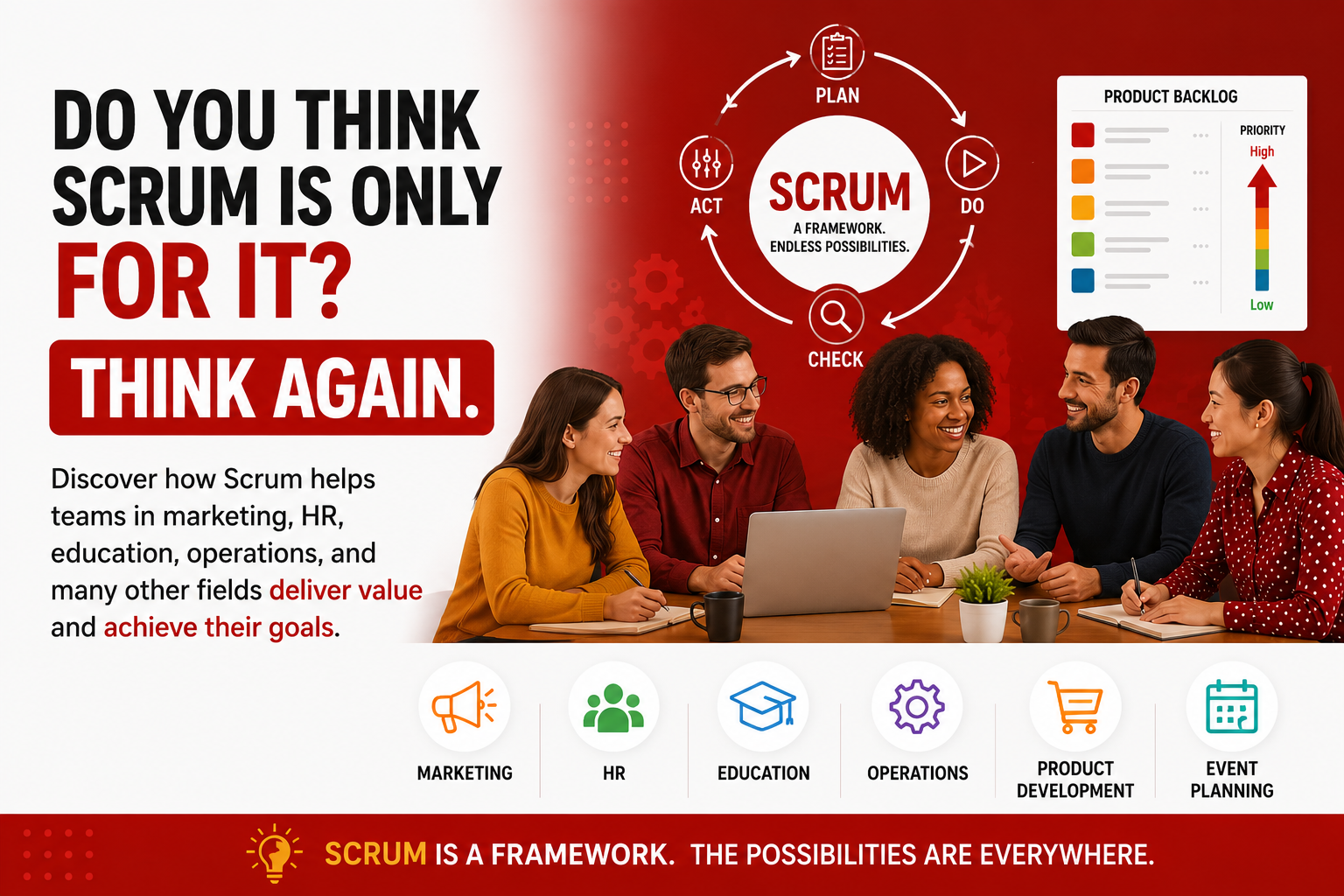
When people hear the word Scrum, they often immediately think about software development, developers, sprints, user stories, and technical teams.
This is understandable.
Scrum became popular in the world of IT because software teams needed a better way to manage complexity, adapt to changing requirements, and deliver value more frequently.
But Scrum is not only for IT.
Scrum is a lightweight framework designed to help teams solve complex problems, collaborate better, and deliver valuable outcomes in an iterative way. That makes it useful far beyond software development.
Today, Scrum is used in marketing, education, human resources, healthcare, finance, operations, consulting, product development, event planning, and even personal productivity.
So, if you think Scrum is only for developers, think again.
What Is Scrum Really About?
Scrum is not a coding method.
Scrum is a way of organizing work around transparency, inspection, and adaptation.
It helps teams answer three important questions:
- What is the most valuable thing to work on next?
- How can we deliver progress in small, useful increments?
- How can we inspect results and improve continuously?
At its core, Scrum helps people work together more effectively in uncertain environments.
That uncertainty exists in many industries, not only in IT.
A marketing team may not know which campaign will perform best.
A training team may not know which learning format will create the strongest results.
A business team may not know which process improvement will save the most time.
A startup may not know which offer customers will respond to first.
In all these situations, Scrum can help.
Why People Think Scrum Is Only for IT
Scrum is often associated with IT because software development was one of the first fields where Scrum became widely adopted.
Software teams usually deal with:
- Changing requirements
- Complex technical work
- Frequent customer feedback
- Fast delivery cycles
- Cross-functional collaboration
- Continuous improvement
Scrum fits this environment very well.
However, these challenges are not exclusive to IT.
Many modern teams face the same type of complexity.
Marketing teams deal with changing customer behavior.
HR teams deal with evolving employee needs.
Education teams adapt learning programs based on student feedback.
Operations teams continuously improve processes.
Product teams test ideas before investing too much time and money.
The environment may be different, but the need is the same: deliver value, learn fast, and improve continuously.
Scrum Can Be Used Anywhere There Is Complexity
Scrum is especially useful when work is complex, uncertain, or collaborative.
This means Scrum can help when:
- The final solution is not fully known from the beginning
- Requirements may change over time
- Feedback is important
- Different people need to collaborate
- The team needs to deliver value step by step
- Priorities need to be reviewed regularly
- Continuous improvement matters
That is why Scrum can be applied outside IT.
The key question is not:
“Are we building software?”
The real question is:
“Are we working in a complex environment where collaboration, feedback, and adaptation are important?”
If the answer is yes, Scrum may be useful.
Examples of Scrum Outside IT
1. Scrum in Marketing
Marketing teams can use Scrum to plan and deliver campaigns more effectively.
Instead of creating a huge annual plan and waiting months to measure results, a marketing team can work in short Sprints.
During each Sprint, the team may focus on:
- Creating social media campaigns
- Testing ad creatives
- Writing blog posts
- Improving landing pages
- Launching email sequences
- Analyzing campaign performance
At the end of the Sprint, the team reviews results, learns what worked, and adapts the next campaign.
This allows marketing teams to move faster and make better decisions based on real data.
2. Scrum in Education and Training
Scrum can also be useful in education and professional training.
A training team can use Scrum to develop a new course, certification program, or learning experience.
The Product Backlog may include:
- Course modules
- Video lessons
- Quizzes
- Case studies
- Student exercises
- Feedback improvements
- Learning platform updates
Instead of building the entire course before testing it, the team can deliver small learning increments and improve them based on learner feedback.
This helps create better educational products.
3. Scrum in Human Resources
HR teams often manage complex initiatives involving people, communication, and organizational change.
Scrum can help HR teams work on projects such as:
- Employee onboarding
- Internal training programs
- Recruitment campaigns
- Performance review improvements
- Employee engagement initiatives
- HR process automation
Using Scrum, HR teams can prioritize work, deliver improvements gradually, and collect feedback from employees and managers.
This creates a more adaptive and people-centered HR approach.
4. Scrum in Operations
Operations teams constantly look for ways to improve efficiency, reduce waste, and solve recurring problems.
Scrum can support operational improvement projects such as:
- Reducing process delays
- Improving customer support workflows
- Automating repetitive tasks
- Enhancing internal communication
- Optimizing reporting processes
- Improving service quality
By working in Sprints, operations teams can test improvements quickly and measure their impact.
5. Scrum in Product Development
Scrum is highly relevant for product development, even when the product is not software.
Teams developing physical products, services, online programs, or business offers can use Scrum to validate ideas and reduce risk.
For example, a team launching a new service can use Scrum to:
- Define customer needs
- Build a first version of the offer
- Test messaging
- Collect feedback
- Improve the service
- Prepare launch materials
Scrum helps teams avoid spending months building something without knowing whether customers actually need it.
6. Scrum in Event Planning
Event planning involves deadlines, stakeholders, changing priorities, and many moving parts.
Scrum can help teams organize events such as:
- Conferences
- Workshops
- Webinars
- Corporate events
- Training sessions
- Product launches
The team can manage the event backlog, prioritize tasks, inspect progress regularly, and adapt when constraints change.
This improves coordination and reduces last-minute chaos.
What Changes When Scrum Is Used Outside IT?
When Scrum is used outside IT, the language may need to be adapted.
For example:
|
Scrum Concept |
IT Example |
Non-IT Example |
|---|---|---|
|
Product Backlog |
Software features |
Campaign tasks, course modules, HR initiatives |
|
Increment |
Working software |
Published content, completed training module, improved process |
|
Sprint Review |
Demo of functionality |
Review of campaign results, process improvement, or deliverable |
|
Product Owner |
Product decision-maker |
Business owner, campaign owner, training owner |
|
Developers |
Software developers |
People doing the work: marketers, trainers, HR specialists, analysts |
The Scrum principles remain the same.
What changes is the type of work being delivered.
The Benefits of Scrum Beyond IT
Using Scrum outside IT can bring several benefits.
Better Prioritization
Scrum helps teams focus on the most valuable work first.
Instead of trying to do everything at once, teams prioritize based on impact, urgency, and value.
More Transparency
Scrum makes work visible.
Everyone can see what is planned, what is in progress, what is completed, and what is blocking progress.
Faster Feedback
By working in short cycles, teams can collect feedback earlier and avoid investing too much time in the wrong direction.
Improved Collaboration
Scrum encourages regular communication between team members, stakeholders, and decision-makers.
Continuous Improvement
Through inspection and adaptation, teams continuously improve both their work and the way they work.
Reduced Waste
Scrum helps teams avoid unnecessary work by validating ideas earlier and focusing on real value.
Common Misconceptions About Scrum Outside IT
“Scrum Is Only for Developers”
This is one of the most common misconceptions.
Scrum started gaining popularity in software development, but the framework itself is not limited to technical work.
Any team dealing with complex work can benefit from Scrum principles.
“Non-IT Teams Do Not Need Sprints”
Sprints are useful whenever a team needs focus, rhythm, and regular delivery.
A Sprint can help a marketing team launch a campaign, an HR team improve onboarding, or a training team publish a course module.
“Scrum Is Too Technical for Business Teams”
Scrum does not require technical knowledge.
It requires collaboration, transparency, prioritization, and continuous improvement.
These are business skills, not only technical skills.
“Scrum Means More Meetings”
Scrum does include events, but they are designed to reduce confusion, improve alignment, and support better decisions.
When Scrum is applied correctly, meetings become more focused and useful.
When Scrum May Not Be the Best Fit
Scrum is powerful, but it is not the answer to every situation.
Scrum may not be necessary when:
- Work is simple and predictable
- Tasks are repetitive with little uncertainty
- Feedback is not needed
- Priorities rarely change
- A simple checklist or process is enough
For example, a routine administrative process may not require Scrum.
But when the work is complex, uncertain, collaborative, and value-driven, Scrum can be a strong option.
How to Start Using Scrum Outside IT
If your team is not technical but wants to try Scrum, start simple.
1. Define the Goal
Clarify what the team wants to achieve.
This could be launching a campaign, improving a process, creating a training program, or delivering a business initiative.
2. Create a Backlog
List the work that could help achieve the goal.
Then prioritize the most valuable items.
3. Work in Short Sprints
Choose a short time period, such as one or two weeks.
Focus on a small set of priorities during that Sprint.
4. Review the Results
At the end of the Sprint, inspect what was delivered and collect feedback.
5. Improve the Way You Work
Discuss what went well, what did not, and what can be improved in the next Sprint.
Start small, learn quickly, and adapt.
That is the spirit of Scrum.
Scrum Is a Mindset, Not Just a Method
Scrum is not only about events, roles, or artifacts.
It is also about mindset.
A Scrum mindset means:
- Deliver value early
- Learn through feedback
- Collaborate openly
- Adapt to change
- Make work transparent
- Improve continuously
- Focus on outcomes, not just tasks
This mindset is valuable in almost every industry.
That is why Scrum is no longer only an IT topic.
It is a modern way of working.
Final Thoughts
Scrum may have become famous through software development, but it is not limited to IT.
Scrum can help any team that needs to manage complexity, improve collaboration, deliver value incrementally, and adapt based on feedback.
Marketing teams, HR departments, educators, consultants, operations teams, product teams, and business leaders can all benefit from Scrum when it is applied thoughtfully.
The question is not whether Scrum belongs outside IT.
The question is whether your team needs more focus, transparency, collaboration, and adaptability.
If the answer is yes, Scrum may be exactly what you need.
Explore More Agile & Scrum Learning Resources
Want to understand Scrum beyond theory and apply it in real professional contexts?
Explore more Agile and Scrum guides on GetVoucher and discover how Scrum certifications can help you build practical skills for IT and non-IT environments.
Start learning today and take the next step in your Agile career.
5 Questions That Decide PRINCE2 vs Agile and When to Hybridize
[…] Do You Think Scrum Is Only for IT? Think Again […]
Authority or Influence: Scrum Master vs Project Manager in the AI Era
[…] Do You Think Scrum Is Only for IT? Think Again […]