



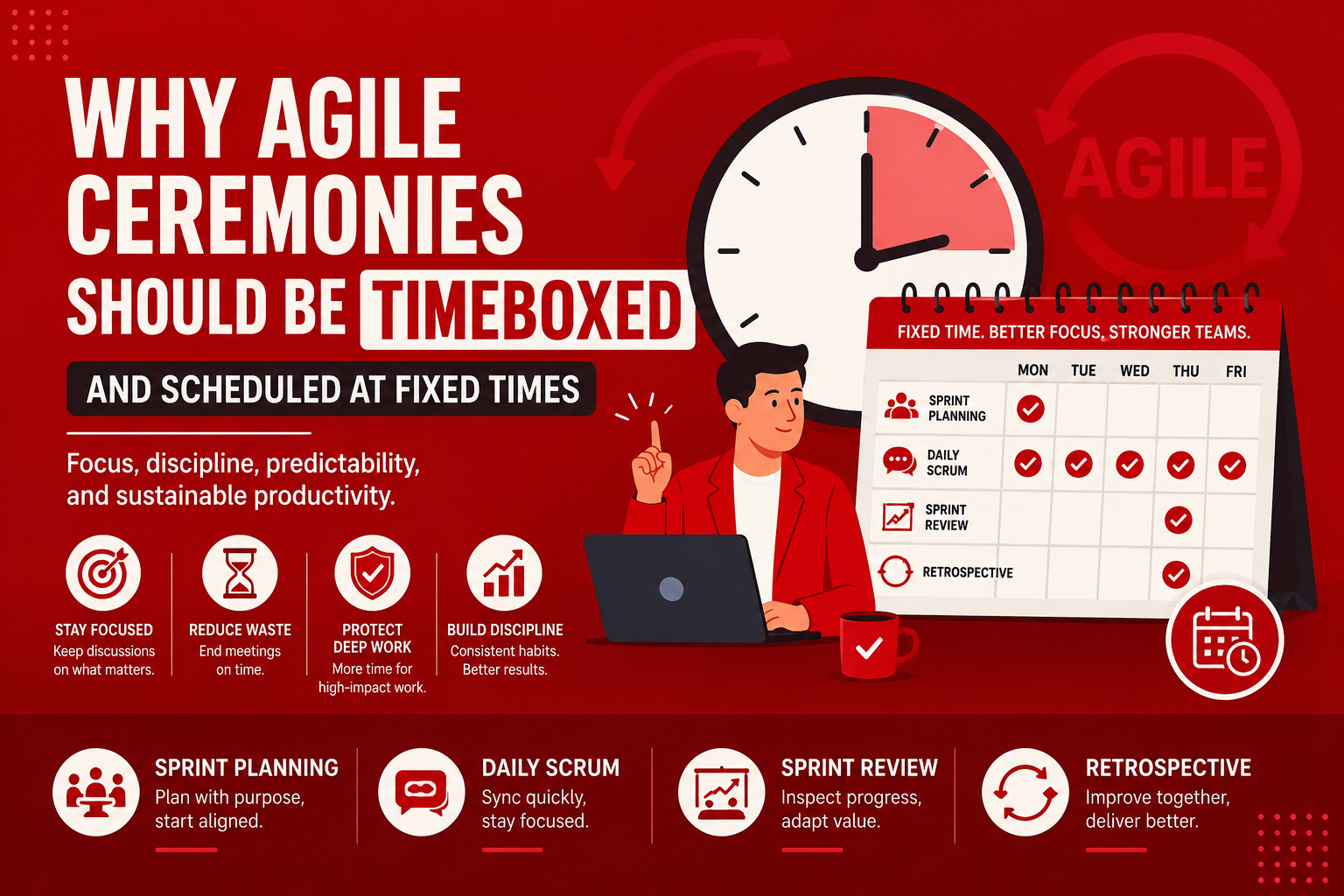
Agile teams are designed to move fast, collaborate frequently, and adapt to change. But speed without structure can quickly become chaos.
That is why Scrum and Agile teams rely on two essential practices: timeboxing and fixed meeting schedules.
Timeboxing does not limit collaboration. It protects it.
By setting clear boundaries around meetings, teams create more focus, discipline, predictability, and sustainable productivity. In a modern Agile environment, ceremonies should not become endless discussions. They should help the team inspect, adapt, align, and move forward with clarity.
What Does “Timeboxed” Mean in Agile?
In Agile, a timebox is a predefined maximum duration for a meeting, event, or activity.
The goal is not to rush people. The goal is to keep the conversation focused on its purpose.
For example, Scrum events are timeboxed to help teams maintain rhythm and efficiency:
|
Agile Event |
Typical Timebox |
|---|---|
|
Daily Scrum |
15 minutes |
|
Sprint Planning |
Up to 8 hours for a one-month Sprint |
|
Sprint Review |
Up to 4 hours for a one-month Sprint |
|
Sprint Retrospective |
Up to 3 hours for a one-month Sprint |
Shorter Sprints usually require shorter events.
The purpose of timeboxing is simple:
- Keep discussions focused.
- Avoid unnecessary delays.
- Protect productive work time.
- Encourage faster decision-making.
- Maintain a sustainable team rhythm.
Without timeboxes, meetings often expand beyond their real value. A discussion that could take 15 minutes can easily become a full hour when there is no clear limit.
Why Agile Ceremonies Should Be Timeboxed
1. Timeboxing Prevents Endless Meetings
One of the biggest productivity killers in modern organizations is the never-ending meeting.
Without a clear time limit:
- Discussions drift away from the original topic.
- New topics appear without structure.
- Decisions are postponed.
- Participants lose focus.
- The team leaves without clear outcomes.
Timeboxing helps prevent this. It encourages the team to stay aligned with the purpose of the ceremony and focus only on what needs to be discussed at that moment.
For example, the Daily Scrum is designed for synchronization and planning the next 24 hours of work. It is not meant to solve every technical issue in real time.
When deeper discussions are needed, the best approach is to schedule a separate follow-up conversation with only the relevant people involved. This keeps the Daily Scrum short while still allowing important problems to be solved properly.
2. Timeboxing Encourages Clear Communication
When time is limited, communication becomes more intentional.
Team members learn to focus on what matters most:
- Current progress
- Blockers
- Priorities
- Risks
- Immediate next steps
This improves the quality of communication and reduces unnecessary details.
In Agile environments, clarity is often more valuable than long discussions. A short, focused conversation can create more alignment than a long meeting with no structure.
Timeboxing helps teams communicate with purpose.
3. Timeboxing Protects Deep Work
Agile teams collaborate often, but they also need time to execute.
Developers, designers, analysts, marketers, product owners, and delivery teams all need uninterrupted focus time to produce high-quality work.
Too many long meetings create:
- Context switching
- Reduced concentration
- Slower delivery
- Lower quality
- Increased frustration
- Meeting fatigue
Timeboxed ceremonies create a better balance between collaboration and execution.
The team still aligns regularly, but meetings do not consume the entire workday. This balance is essential for sustainable Agile delivery.
4. Timeboxing Creates Operational Discipline
Agile is not about improvising everything. It is built around rhythm, transparency, inspection, and adaptation.
Timeboxed ceremonies help teams build operational discipline because everyone understands:
- Why the meeting exists
- How long it should last
- What outcome is expected
- What topics belong there
- What topics should be handled separately
Over time, this creates stronger habits and more predictable delivery.
Teams become more mature because they learn to use ceremonies as structured tools, not as open-ended conversations.
5. Timeboxing Forces Prioritization
Limited time forces teams to focus on what truly matters.
Instead of discussing everything, the team learns to ask better questions:
- What is the most important issue right now?
- What decision is required today?
- What information is missing?
- What can be handled after the ceremony?
- What does not need to be discussed at all?
This aligns directly with Agile and Lean principles: maximize value, reduce waste, and keep the process simple.
Not every topic deserves equal meeting time. Timeboxing helps teams protect attention for the conversations that create the most value.
Why Fixed Meeting Times Matter
Timeboxing is powerful, but it becomes even more effective when combined with fixed and recurring meeting times.
A ceremony that changes time every week creates friction. A ceremony that happens at a predictable time becomes part of the team’s rhythm.
1. Fixed Times Create Routine
When Agile ceremonies happen at the same time every day or every Sprint, the team builds habits.
Fixed times help improve:
- Attendance
- Preparation
- Scheduling
- Team rhythm
- Calendar visibility
- Mental clarity
For example, a Daily Scrum every morning at 9:00 AM quickly becomes part of the team’s operational routine.
Nobody has to renegotiate the schedule every day. Everyone knows when alignment happens.
This reduces friction and helps the team start the day with clarity.
2. Fixed Schedules Improve Team Synchronization
Agile teams depend on fast communication and frequent alignment.
Fixed meeting times ensure that everyone knows:
- When priorities are reviewed
- When blockers are discussed
- When Sprint progress is inspected
- When stakeholder feedback is collected
- When improvement actions are defined
This creates a shared rhythm across the team and reduces delays.
When the schedule is predictable, people prepare better. They know when decisions are expected and when information needs to be ready.
3. Predictability Reduces Organizational Chaos
Constantly moving ceremonies creates unnecessary confusion.
It can lead to:
- Fragmented calendars
- Missed meetings
- Scheduling conflicts
- Delayed decisions
- Communication gaps
- Reduced accountability
Consistency simplifies collaboration.
In fast-moving Agile environments, predictability often increases efficiency. A stable calendar gives the team more space to focus on real delivery rather than coordination problems.
4. Fixed Ceremonies Strengthen Accountability
Recurring ceremonies create shared expectations.
Team members know when they will:
- Share progress
- Discuss blockers
- Review deliverables
- Inspect results
- Reflect on improvements
- Commit to next steps
This reinforces ownership and transparency.
Fixed ceremonies also make progress visible. The team regularly inspects what is happening, adapts when needed, and keeps everyone aligned around the same goals.
The Psychological Benefits of Timeboxing
Timeboxing also has a strong psychological impact.
Clear limits create:
- Focus
- Urgency
- Energy
- Better preparation
- Faster decisions
- Stronger engagement
Unlimited meetings often lead to the opposite:
- Repetition
- Over-analysis
- Decision paralysis
- Lower attention
- Reduced motivation
When people know a meeting has a clear limit, they are more likely to participate actively and stay focused.
A focused 15-minute discussion is often more useful than a vague one-hour conversation.
Common Misconceptions About Timeboxing
Some people think timeboxing means rushing conversations or ignoring important topics.
That is not true.
Timeboxing does not mean:
- Cutting people off unfairly
- Avoiding collaboration
- Ignoring complex problems
- Preventing useful discussion
It means each ceremony should serve its intended purpose efficiently.
For example:
- The Daily Scrum is for synchronization.
- Sprint Planning is for planning the Sprint.
- The Sprint Review is for inspecting the Increment and gathering feedback.
- The Sprint Retrospective is for improving the team’s way of working.
If a topic requires more time, the team can schedule a dedicated follow-up discussion with the right people.
This keeps ceremonies focused while still allowing deeper collaboration when needed.
Best Practices for Timeboxed Agile Ceremonies
To make timeboxing effective, teams should not treat it as a mechanical rule. They should use it as a practical discipline.
Here are a few best practices:
Start on Time and End on Time
Respecting the timebox builds trust and discipline. If meetings often start late or run over, the team quickly stops taking the schedule seriously.
Clarify the Purpose of Each Ceremony
Every ceremony should have a clear objective. If people do not understand why they are meeting, the conversation becomes unfocused.
Separate Alignment from Problem-Solving
Not every problem needs to be solved during the ceremony. Some topics should be captured and handled afterward by the relevant people.
Prepare Before the Meeting
Good preparation reduces meeting time. Product Owners, Scrum Masters, Developers, and stakeholders should arrive with the necessary information.
Inspect and Improve the Meetings Themselves
If a ceremony is not creating value, the team should discuss it during the Retrospective and improve how it is run.
Final Thoughts
Timeboxed ceremonies and fixed meeting schedules are not arbitrary Agile rules.
They exist because they help teams:
- Communicate more effectively
- Reduce wasted meeting time
- Protect deep work
- Improve delivery consistency
- Build sustainable work habits
- Strengthen accountability
- Maintain focus on outcomes
In many organizations, productivity problems are not caused by a lack of talent. They are caused by a lack of structure.
Agile ceremonies work best when they are focused, predictable, disciplined, and outcome-oriented.
That is why timeboxing remains one of the most important practices in modern Agile delivery.
Explore More Agile & Scrum Learning Resources
Want to build stronger Agile habits and improve your understanding of Scrum?
Explore more guides on GetVoucher and learn about Agile, Scrum, Product Ownership, Scrum Master responsibilities, team collaboration, and certification pathways.
Start learning today and take the next step toward becoming a more confident Agile professional.
Balance Governance and Speed: PRINCE2 7 vs Agile
[…] Why Agile Ceremonies Should Be Timeboxed and Scheduled at Fixed Times […]
Agile vs Waterfall: 5 Questions for PMs on Governance & Contracts
[…] Why Agile Ceremonies Should Be Timeboxed and Scheduled at Fixed Times […]