



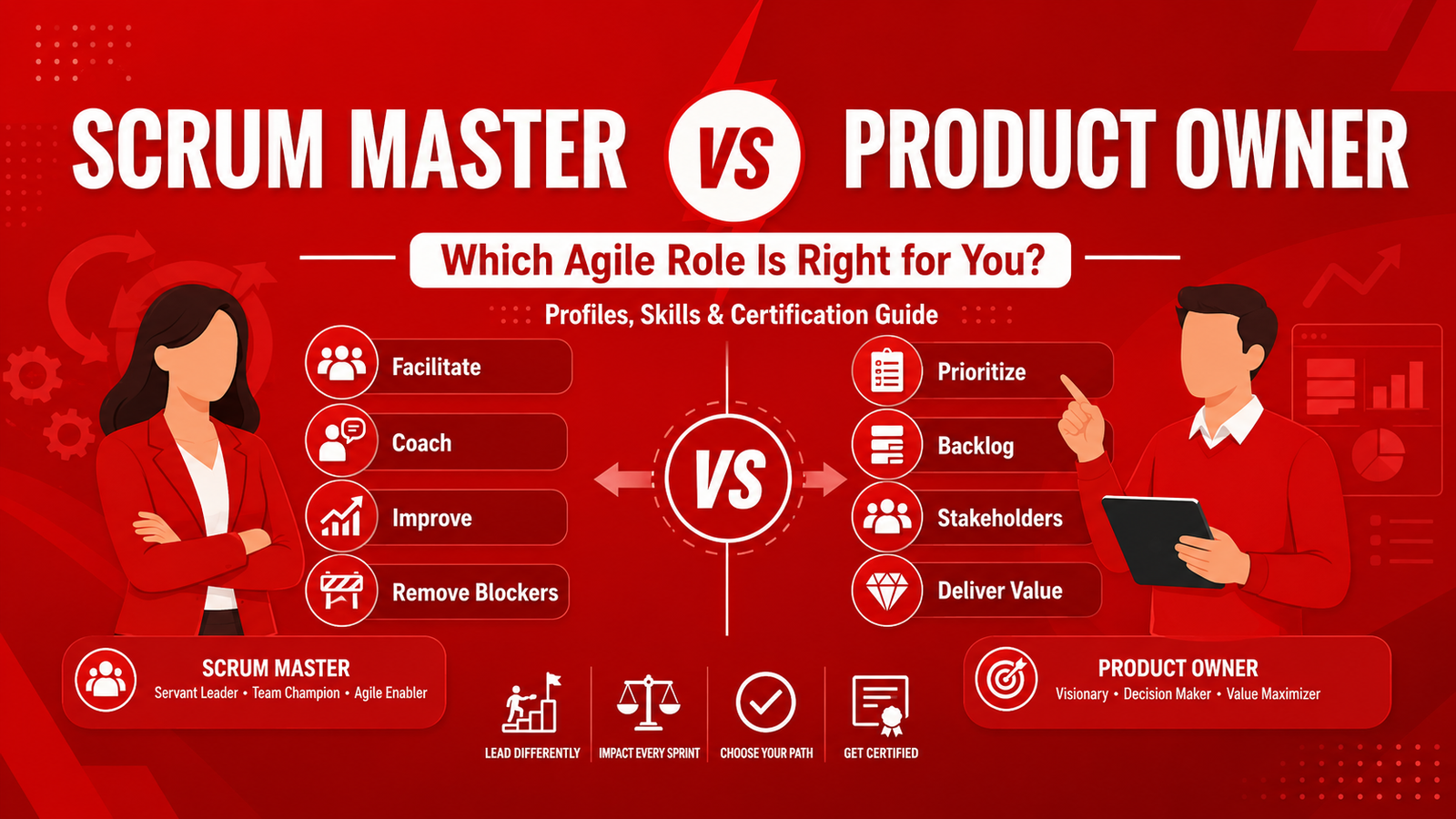
Agile and Scrum careers offer many opportunities, but choosing the right path is not always easy.
Two of the most important profiles in a Scrum Team are the Scrum Master and the Product Owner. Both play essential roles. Both contribute to successful product delivery. Both require strong communication and collaboration skills.
However, they do not have the same focus.
The Scrum Master helps the team work more effectively. The Product Owner helps the team build the most valuable product possible.
Understanding the difference between these two profiles is essential before choosing your next Agile certification.
Should you pursue a Scrum Master certification or a Product Owner certification?
The answer depends on your personality, strengths, career goals, and the type of responsibilities you enjoy most.
Scrum Master and Product Owner: Two Complementary Profiles
The Scrum Master and Product Owner are not competing roles.
One is not more important than the other.
They work together to help the Scrum Team deliver value consistently.
The Scrum Master focuses primarily on:
- Team effectiveness
- Scrum adoption
- Facilitation
- Continuous improvement
- Removing impediments
- Healthy collaboration
The Product Owner focuses primarily on:
- Product value
- Customer needs
- Product vision
- Product Backlog management
- Prioritization
- Stakeholder alignment
The Scrum Master helps the team improve how it works.
The Product Owner helps the team decide what matters most.
The Scrum Master Profile
What Does a Scrum Master Do?
The Scrum Master helps the Scrum Team understand and apply Scrum effectively.
They are not the team’s boss. They do not distribute tasks. They do not micromanage developers.
Instead, the Scrum Master acts as a facilitator, coach, and servant leader.
Their purpose is to create an environment where the team can collaborate, self-manage, and continuously improve.
A Scrum Master helps the team:
- Understand Scrum principles and practices
- Organize productive Scrum events
- Remove or escalate impediments
- Improve collaboration
- Protect focus
- Resolve tensions
- Identify process improvements
- Work toward valuable and high-quality outcomes
Key Responsibilities of a Scrum Master
Facilitating Scrum Events
The Scrum Master helps ensure that Sprint Planning, Daily Scrum, Sprint Review, and Sprint Retrospective remain productive, focused, and timeboxed.
The goal is not to control every discussion. The goal is to help the team use each event effectively.
Removing Impediments
A Scrum Master helps the team identify and overcome obstacles that slow down progress.
These obstacles may include:
- Unclear processes
- Communication gaps
- Team conflicts
- Organizational blockers
- External interruptions
- Missing information
- Dependency issues
Coaching the Team
A good Scrum Master helps team members become more autonomous.
Instead of solving every problem directly, they encourage the team to reflect, collaborate, and find sustainable solutions.
Supporting Continuous Improvement
The Scrum Master helps the team inspect how it works and identify ways to improve quality, collaboration, and efficiency.
They promote a culture of learning rather than blame.
Supporting the Product Owner
The Scrum Master also helps the Product Owner improve Product Goal definition, Product Backlog management, and stakeholder collaboration.
Essential Qualities of an Effective Scrum Master
Empathy
They understand team dynamics and listen carefully to individual perspectives.
Patience
Change does not happen overnight. A Scrum Master must support gradual improvement without forcing solutions too quickly.
Emotional Intelligence
They can identify tension, low morale, or communication issues before they become larger problems.
Facilitation Skills
They guide discussions and help people reach useful outcomes without dominating the conversation.
Conflict Resolution
They help the team address disagreements constructively.
Active Listening
They listen to understand, not simply to respond.
Adaptability
Every team is different. A Scrum Master adjusts their approach depending on the people, context, and maturity of the organization.
Servant Leadership
They lead through support, influence, and example rather than authority.
Want to explore the qualities and skills that make a great Scrum Master? Read our complete guide: Becoming an Effective Scrum Master: Essential Skills and Best Practices.
.
Who Is the Scrum Master Role Best Suited For?
The Scrum Master path may be a strong fit for you if you enjoy:
- Helping people succeed
- Improving team collaboration
- Facilitating meetings
- Resolving conflicts
- Coaching colleagues
- Identifying blockers
- Improving working methods
- Building healthy team habits
- Supporting organizational change
You may also enjoy this role if people often come to you when they need help structuring a discussion, solving a collaboration issue, or improving a process.
Typical Backgrounds for Future Scrum Masters
Professionals from many backgrounds can become effective Scrum Masters, including:
- Team leads
- Project coordinators
- Agile delivery professionals
- Developers interested in team facilitation
- QA professionals
- Business analysts
- Operations professionals
- HR or organizational change professionals
- Managers transitioning toward servant leadership
Technical knowledge can be useful, but it is not the only factor.
The ability to understand people, facilitate collaboration, and encourage continuous improvement is equally important.
Want to learn more about the Scrum Master role? Read our complete guide: Scrum Master: Roles, Responsibilities, and Real-World Impact.
The Product Owner Profile
What Does a Product Owner Do?
The Product Owner is responsible for maximizing the value of the product resulting from the work of the Scrum Team.
They represent product priorities and help the team understand what should be built next and why it matters.
The Product Owner connects:
- Customer needs
- Business goals
- Product vision
- Stakeholder expectations
- Product Backlog priorities
- Team delivery
A Product Owner does not simply write user stories.
They make decisions about value.
Key Responsibilities of a Product Owner
Defining the Product Vision
The Product Owner communicates where the product is going and what problem it aims to solve.
A clear vision helps the team understand the purpose behind its work.
Managing the Product Backlog
The Product Owner ensures that the Product Backlog is visible, clear, ordered, and understood.
They continuously review priorities and adapt the backlog as new information becomes available.
Prioritizing Work
Not every feature can be developed immediately.
The Product Owner decides which backlog items should be addressed first based on factors such as:
- Customer value
- Business impact
- Risk
- Urgency
- Dependencies
- Effort
- Product strategy
Collaborating With Stakeholders
The Product Owner collects input from stakeholders, listens to customer needs, and communicates trade-offs.
They must balance multiple perspectives without turning the Product Backlog into a list of unfiltered requests.
Clarifying Requirements
The Product Owner works closely with developers to clarify expectations, acceptance criteria, and desired outcomes.
Measuring Product Outcomes
A strong Product Owner does not focus only on the number of features delivered.
They focus on results such as:
- User adoption
- Customer satisfaction
- Retention
- Revenue impact
- Conversion rate
- Reduced errors
- Time saved
- Business value
Essential Qualities of an Effective Product Owner
Customer Focus
They understand customer problems and use feedback to guide decisions.
Strategic Thinking
They connect short-term decisions with long-term product goals.
Prioritization Skills
They know how to identify what matters most and say no to low-value requests.
Decision-Making
A Product Owner must be comfortable making decisions, even when information is incomplete.
Communication Skills
They explain priorities clearly to developers, stakeholders, and leadership teams.
Negotiation Skills
They manage competing expectations and communicate trade-offs transparently.
Business Awareness
They understand how product decisions affect business performance.
Analytical Thinking
They use data, feedback, and evidence to make better product decisions.
Curiosity
They ask questions, challenge assumptions, and remain open to learning from users and the market.
Want to explore the qualities, skills, and best practices that make an effective Product Owner? Read our complete guide: Becoming an Effective Product Owner: Essential Skills and Best Practices.
Who Is the Product Owner Role Best Suited For?
The Product Owner path may be a strong fit for you if you enjoy:
- Understanding customer needs
- Defining product priorities
- Making strategic decisions
- Managing stakeholders
- Working with business objectives
- Writing or refining user stories
- Clarifying requirements
- Evaluating opportunities
- Measuring product outcomes
- Creating a product roadmap
You may also enjoy this role if you naturally ask questions such as:
- What problem are we solving?
- Who benefits from this feature?
- Why should we build this now?
- What creates the most value?
- How will we measure success?
Typical Backgrounds for Future Product Owners
Professionals from many backgrounds can transition into Product Ownership, including:
- Product managers
- Business analysts
- Project managers
- Entrepreneurs
- Marketing professionals
- Customer success professionals
- UX professionals
- Sales professionals with product knowledge
- Developers interested in product strategy
- Domain experts
A Product Owner does not need to be a developer.
However, understanding technical constraints can help them make better decisions and collaborate more effectively with developers.
Want to learn more about the Product Owner role? Read our complete guide: Product Owner: Roles, Responsibilities, and Real-World Impact.
Scrum Master vs Product Owner: Key Differences
| Area | Scrum Master | Product Owner |
|---|---|---|
| Primary Focus | Team effectiveness and Scrum adoption | Product value and priorities |
| Main Question | How can the team work more effectively? | What should we build next and why? |
| Leadership Style | Facilitation, coaching, and servant leadership | Product leadership and decision-making |
| Main Artifact | Supports the Scrum Team’s effective use of Scrum | Accountable for effective Product Backlog management |
| Stakeholder Interaction | Facilitates collaboration when needed | Represents and balances stakeholder needs |
| Team Interaction | Coaches the team and removes impediments | Clarifies priorities and expected outcomes |
| Key Strength | Improving collaboration and ways of working | Maximizing value and making trade-offs |
| Ideal Mindset | People-oriented and improvement-driven | Customer-oriented and value-driven |
Which Profile Matches Your Personality?
The following questions can help you identify your preferred path.
Choose the Scrum Master Path If You Mostly Answer “Yes” to These Questions
- Do you enjoy helping people collaborate more effectively?
- Are you comfortable facilitating discussions?
- Do you notice team tensions or blockers quickly?
- Do you like coaching others instead of giving direct orders?
- Are you interested in improving processes and working methods?
- Do you enjoy creating structure without micromanaging people?
- Do you want to help teams become more autonomous?
- Are you motivated by team growth and continuous improvement?
If these questions describe you, the Scrum Master role may be a strong match.
Choose the Product Owner Path If You Mostly Answer “Yes” to These Questions
- Do you enjoy understanding customer needs?
- Do you like deciding what should be prioritized?
- Are you comfortable saying no when a request does not create enough value?
- Do you enjoy working with stakeholders?
- Are you interested in product strategy and business goals?
- Do you like clarifying requirements?
- Do you naturally compare opportunities and trade-offs?
- Are you motivated by product impact and customer outcomes?
If these questions describe you, the Product Owner role may be a strong match.
Which Certification Should You Choose?
Once you understand your preferred profile, choosing your certification becomes easier.
Choose Scrum Master Certified (SMC®) If You Want To:
- Become a Scrum Master
- Facilitate Scrum events
- Support Agile teams
- Remove impediments
- Improve team collaboration
- Coach self-managing teams
- Promote continuous improvement
- Build a career in Agile delivery or Agile coaching
The Scrum Master certification path is particularly relevant for professionals who want to focus on people, collaboration, team effectiveness, and Scrum implementation.
Choose Scrum Product Owner Certified (SPOC®) If You Want To:
- Become a Product Owner
- Manage a Product Backlog
- Define and communicate product priorities
- Work closely with stakeholders
- Connect business strategy with team delivery
- Improve product value
- Understand customer needs
- Build a career in Product Ownership or product management
The Product Owner certification path is particularly relevant for professionals who want to focus on customers, business value, prioritization, and product strategy.
Choose Both Certifications If You Want a Broader Agile Perspective
Some professionals benefit from understanding both roles.
This may be especially useful if you are:
- A team lead
- A project manager
- A business analyst
- A consultant
- An entrepreneur
- An Agile transformation professional
- A manager working with Agile teams
- A professional exploring a career transition
Understanding both perspectives helps you see the complete picture:
- How teams collaborate
- How value is prioritized
- How Scrum events support delivery
- How product decisions influence execution
- How execution constraints influence product planning
The two roles remain distinct, but the knowledge is complementary.
Can One Person Be Both Scrum Master and Product Owner?
In a small organization, one person may sometimes be asked to cover multiple responsibilities.
However, combining the Scrum Master and Product Owner accountabilities is generally difficult.
The Product Owner must make prioritization decisions and represent product value.
The Scrum Master must coach the team, support healthy collaboration, and help identify problems objectively.
These responsibilities can create tension when held by the same person.
For example, a Product Owner may feel pressure to deliver more features, while a Scrum Master may need to protect the team from unrealistic expectations.
Understanding both roles is valuable. Confusing them is not.
Practical Examples
Scenario 1: A Team Struggles With Collaboration
The Daily Scrum frequently turns into a one-hour discussion. Developers hesitate to raise blockers. Retrospectives do not lead to improvement actions.
This situation needs strong Scrum Master skills.
The priority is to improve facilitation, trust, team dynamics, and working practices.
Scenario 2: A Product Backlog Has Too Many Competing Requests
Stakeholders request new features every week. Developers do not understand which items are most important. The team delivers features, but customer adoption remains low.
This situation needs strong Product Owner skills.
The priority is to clarify product goals, improve prioritization, and focus on outcomes.
Scenario 3: A Professional Wants to Lead Agile Projects
A team lead or consultant wants to understand both team dynamics and product prioritization.
This person may benefit from studying both Scrum Master and Product Owner practices.
A dual certification path can provide a broader understanding of Agile delivery.
Common Misconceptions
“The Scrum Master Is the Team Manager”
This is incorrect.
The Scrum Master does not assign tasks or control developers. They help the team improve how it works.
“The Product Owner Is Just a Business Analyst”
This is also incorrect.
A Product Owner may use business analysis skills, but the role includes strategic prioritization, stakeholder alignment, and accountability for product value.
“The Product Owner Writes Every User Story Alone”
Not necessarily.
Product Backlog management is collaborative. The Product Owner remains accountable, but developers and other contributors can help refine backlog items.
“The Scrum Master Organizes Meetings All Day”
Facilitation is only one part of the role.
A strong Scrum Master also coaches the team, helps remove impediments, supports continuous improvement, and promotes effective Scrum adoption across the organization.
Final Thoughts
Choosing between a Scrum Master and Product Owner certification is not simply about selecting a popular course.
It is about identifying the type of impact you want to create.
Choose the Scrum Master path if you want to help teams collaborate, improve, and deliver more effectively.
Choose the Product Owner path if you want to maximize product value, understand customer needs, and define priorities.
Choose both if your career requires a broader understanding of Agile delivery.
The best certification is the one that matches your strengths, ambitions, and professional goals.
Start Your Agile Certification Journey
Ready to choose your path?
Explore our Scrum and Agile certification programs on GetVoucher:
- Scrum Master Certified (SMC®) for aspiring Scrum Masters and Agile team facilitators
- Scrum Product Owner Certified (SPOC®) for professionals focused on product value and stakeholder collaboration
- Dual Agile Pack: Scrum Master & Product Owner Certification for a broader understanding of both Agile roles
Build the right skills, earn your certification, and take the next step in your Agile career.
CAPM vs PMP: Which Certification Fits Your Career Stage? – GetVoucher
[…] Scrum Master vs Product Owner: Which Agile Role and Certification Is Right for You? – GetVoucher […]
Agile certification: what it means and how to get one – GetVoucher
[…] Scrum Master vs Product Owner: Which Agile Role and Certification Is Right for You? – GetVoucher […]
Scrum vs Agile: 4 signs to choose Scrum and the fastest cert path – GetVoucher
[…] Scrum Master vs Product Owner: Which Agile Role and Certification Is Right for You? […]
35 Hours vs No Prereqs: PRINCE2 vs PMP for UK & Global Careers
[…] Scrum Master vs Product Owner: Which Agile Role and Certification Is Right for You? […]
Earn 10–25% More: Best Certifications for Cross Functional Careers
[…] facilitation and removing blockers, Product Owners on backlog priority and stakeholder value. Read Scrum Master vs Product Owner if you’re unsure which role fits your current job. Most candidates prepare in two to four weeks […]
5 Questions for Project Managers to Choose PRINCE2, Agile, or Hybrid
[…] Scrum Master vs Product Owner guide walks through exactly this split, and its SCRUMstudy Master Certified (SMC) and SCRUM Product […]
5 Coaching Stances That Make Agile Coach Certification Count
[…] Scrum Master vs Product Owner: Which Agile Role and Certification Is Right for You? […]
One project management certification plus one skill for PMs
[…] Scrum Master vs Product Owner: Which Agile Role and Certification Is Right for You? […]
Is SMC® the Right Certification for Scrum Master or Project Manager?
[…] Scrum Master vs Product Owner: Which Agile Role and Certification Is Right for You? […]
5 Role Matches: Kanban Certification for Practitioners, GetVoucher Soon
[…] you’re still deciding between Scrum-first and Kanban-first paths, a comparison of Scrum Master versus Product Owner roles is worth reading before you commit budget to […]
Voucher Backed Product Owner Certification for Busy Professionals
[…] Scrum Master vs Product Owner: Which Agile Role and Certification Is Right for You? […]
Pick your role: GetVoucher Scrum certification in 2–6 weeks
[…] and Product Owner tracks diverge in daily responsibility and long-term progression, a dedicated role comparison guide is worth reading before you commit budget to […]